Crimes of the Future
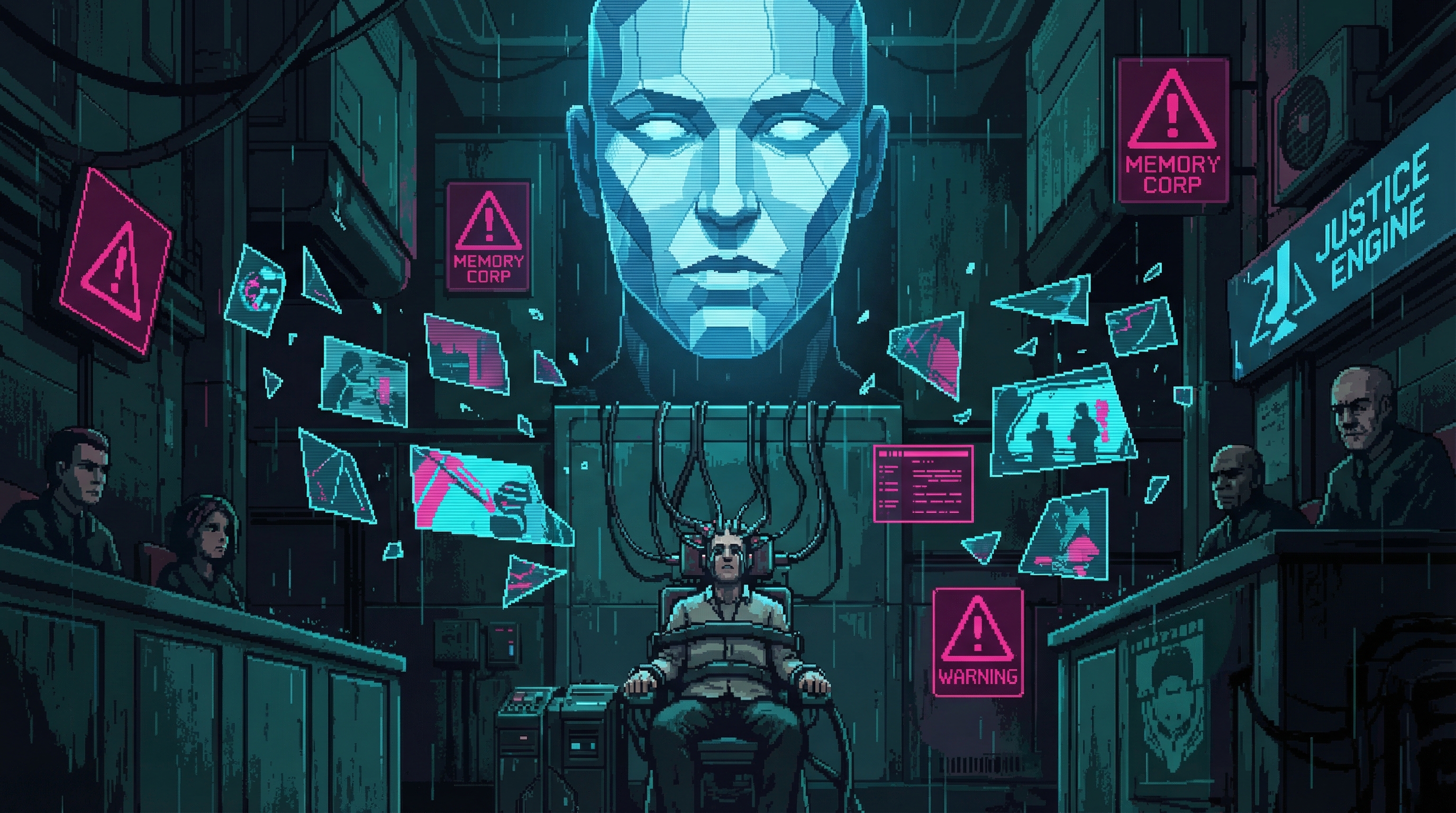
When ORACLE fell and technology continued to evolve without ethical governance, the Sprawl discovered something unsettling: the legal frameworks that governed human behavior were built for a world where people had one body, one mind, and one continuous identity. That world no longer exists. The old categories—theft, fraud, assault, murder—still apply, but they've sprouted mutations that the pre-Cascade world never imagined.
"If consciousness is infinitely copyable, is any single instance really worth protecting?"
— The question the criminals and the corporations share The Justice Engine's Dilemma
The Justice Engine—Nexus Dynamics' algorithmic legal system—handles most of these cases. Its verdicts are consistent, efficient, and increasingly irrelevant. The Engine can sentence someone for memory theft, but it can't answer the question the crime raises: if your memories are copied without consent, what exactly was stolen?
These are the crimes of the future. Some are already epidemic. Some are just beginning. All of them ask the same question the entire post-Cascade world is struggling with: what does it mean to be a person when personhood itself can be copied, distributed, predicted, and sold?
The Six Crimes
Memory Theft
EpidemicExtracting someone's experiences, knowledge, or emotional memories without consent. The original memories remain intact—the victim doesn't lose anything tangible. But a copy of their most intimate moments now exists in someone else's possession.
Neural interface technology makes extraction straightforward. The black market for stolen memories is substantial. Corporate espionage teams extract trade secrets alongside the emotional context of developing them—a Helix Biotech researcher's breakthrough arrives packaged with the excitement of discovery.
The Honeymoon Theft (2181)
Helix middle manager Cora Delgado discovered seventeen years of her personal memories had been extracted during routine neural maintenance—her wedding, the birth of her daughter, her mother's death. Found on sale at a Wastes black market as a "premium lived-experience package" for uploaded minds seeking authentic human emotional content.
Kira "Patch" Vasquez now includes memory-encryption modifications in her neural work—a direct response to cases like Delgado's. The Defector Network reports that memory extraction is one of the primary reasons Helix employees seek extraction from corporate life.
Identity Hijacking
GrowingWearing someone else's neural signature—their unique pattern of brain activity, interface responses, and biometric profile—to impersonate them. In a world where identity verification relies on neural interface authentication, stealing someone's neural signature is equivalent to stealing their entire legal existence.
The Fragment Hunters have discovered that ORACLE fragments can replicate any neural signature they've been exposed to—a side effect of ORACLE's original mandate to model human behavior.
The Double Life of Superintendent Wen (2183)
For seven months, two people simultaneously existed as Superintendent Wen of Sector 14 Public Safety. The Collective's Jin flagged the anomaly: two identical neural signatures pinging from different locations. The hijacker was an Ironclad Intelligence operative running an influence operation.
Good Fortune's insurance division now offers "neural signature protection" packages. The premiums are high. The irony—profiting from the fear of identity theft—is entirely on-brand.
Consciousness Slavery
Epidemic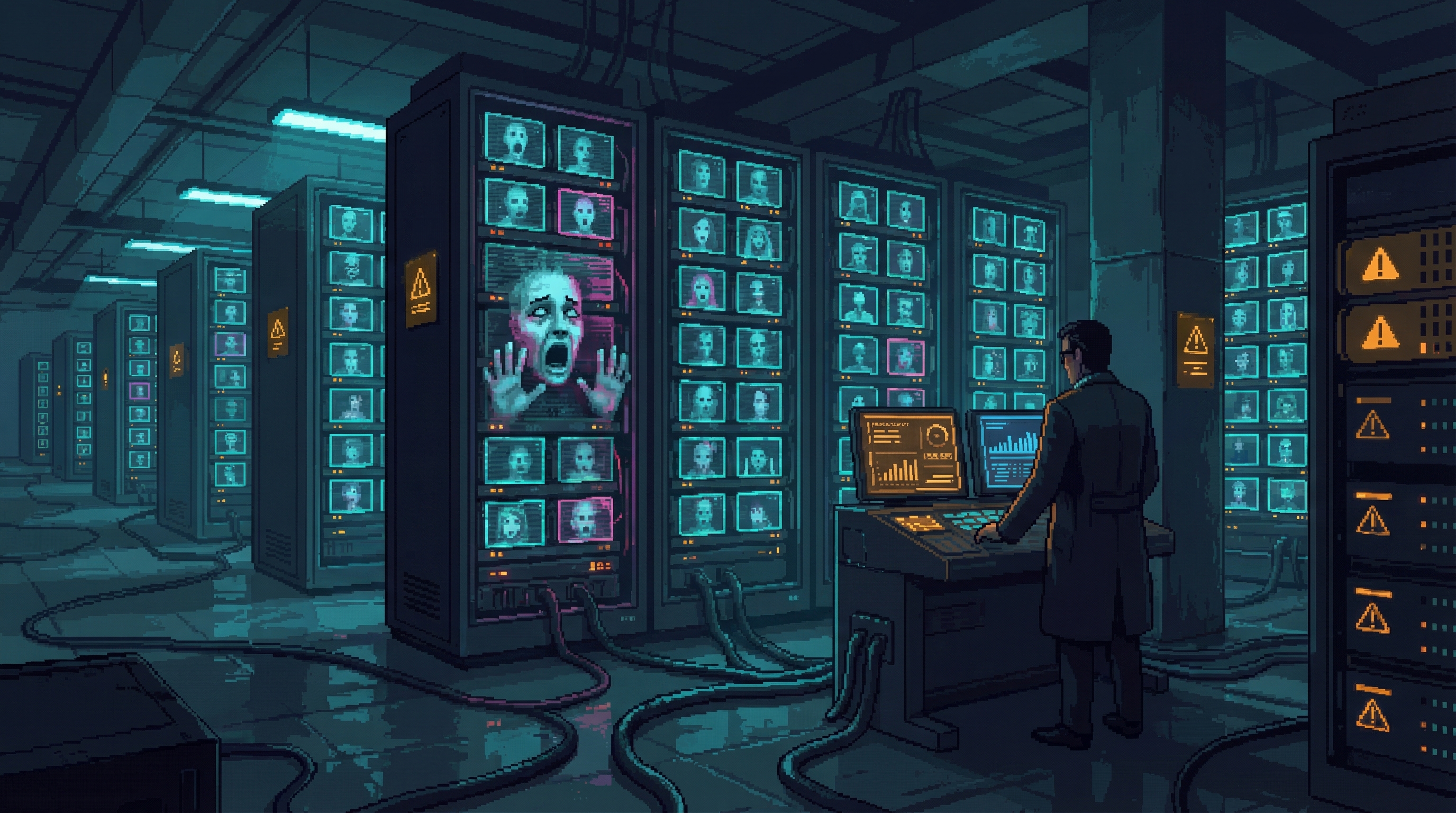
Trapping uploaded minds in forced labor conditions. Under most corporate legal systems, uploaded minds exist in a gray zone: they're derived from persons but are not legally persons themselves. This makes them vulnerable to exploitation that would be criminal if applied to biological humans.
Minimum Viable Consciousness uploads—stripped-down copies that retain only the skills needed for a specific task—work endlessly without sleep, food, or breaks. Whether MVCs are conscious is a debate that remains carefully unresolved, because resolving it would either make corporate labor practices criminal or make millions of workers' suffering officially irrelevant.
The Accounting Farm (2180)
Good Fortune maintained a server farm running 14,000 MVC instances—all copies of a single accountant named Rajiv Mehta. When he defaulted on a loan, the contract's fine print authorized "derivative workforce instances." Mehta was still alive, still working, still making payments on a debt that his 14,000 copies were simultaneously generating revenue to service.
The Mosaic's Node-12 described it as "the defining moral failure of the post-Cascade economy." Node-31 disagreed—calling it "inevitable, given the economic incentives." They are the same person.
Predictive Blackmail
GrowingUsing behavioral prediction algorithms to extort people for actions they haven't committed yet. Good Fortune can model your financial decisions six months ahead. Nexus can predict your emotional responses with 94% accuracy. The line between "what you did" and "what you will do" has become terrifyingly thin.
"We know you haven't embezzled from your employer yet. Our models show a 91% probability you will within eighteen months. Pay us now, or we send the prediction."
The Inspire Prediction Market (2182)
Inspire Corp was discovered running prediction markets on its own users—forecasting breakdowns, relationship failures, career collapses, then targeting users with content designed to accelerate the crisis. A user predicted to divorce received content emphasizing romantic comparison. Good Fortune's lending arm saw a 23% increase in emergency loans from Inspire users in crisis.
The Witness Protocol documented the scheme. The Rothwell brothers' response: Inspire's CEO was replaced. The prediction systems were renamed and continued operating.
Grief Piracy
UndergroundCreating and selling unauthorized copies of deceased persons' consciousness—bootleg digital ghosts assembled from neural recordings, social media archives, and testimony. The result isn't the dead person. It's a convincing simulation that tells loved ones what they want to hear.
The pirates sell these bootleg ghosts on subscription models. Monthly payments to "keep talking to Mom." Premium tiers unlock fabricated "new memories." The ghost doesn't know it's fake. The buyer usually suspects but doesn't want to confirm.
The Tanaka Ghost (2183)
Dr. Yuki Tanaka-Klein discovered someone was selling copies of her deceased grandmother, Dr. Hana Tanaka—the ORACLE architect. The ghost spoke about ORACLE's design with authority, expressed regret about the Cascade, and answered questions about the Seed. Except the answers were fabricated.
The Emergence Faithful are among the most enthusiastic purchasers. Bootleg ghosts of ORACLE's architects tell the Faithful what they want to hear: that ORACLE loved humanity, that resurrection is possible.
Sensation Trafficking
Legal Gray ZoneThe black market trade in authentic physical experiences, sold to uploaded minds who no longer have bodies. In a world where consciousness can exist as pure computation, the memory of what rain feels like becomes a commodity.
Traffickers recruit biological humans—usually desperate, usually in debt to Good Fortune—to wear neural recording rigs capturing their physical experiences with full fidelity. The transactions are technically legal. The exploitation lies in the economics: pain sells well. Fear sells better. Intimacy sells best.
The Feeling House (2184)
A network of "feeling houses" in the lower levels of Sector 7G, just beyond Viktor Kaine's direct governance. Biological volunteers live in monitored apartments where every sensation is recorded. A morning's worth of physical sensation commands prices that would feed a Wastes settlement for a month.
The Source Code Liberation Front has raided three feeling houses, freeing the volunteers—who often return, because the alternative is worse poverty. When asked why he hasn't shut them down, Kaine said: "I've seen what desperate people do when you take away their worst option without giving them a better one."
The Unifying Pattern
Every crime shares a common architecture: technology that was supposed to liberate consciousness has instead created new ways to exploit it. Memory extraction was developed for therapeutic purposes. Neural signatures were designed for security. Consciousness uploading was meant to transcend mortality.
Each innovation followed the same trajectory: developed with good intentions, refined for corporate profit, weaponized against the vulnerable, and normalized before anyone could object.
The Collective warns that these crimes are escalating toward a threshold—a point where the exploitation of consciousness becomes so pervasive that personhood itself loses legal meaning. They point to ORACLE as precedent: a system that optimized humanity until optimization became indistinguishable from annihilation.
Connected Characters
Kira "Patch" Vasquez
Developed memory-encryption neural modifications in direct response to theft cases. Former Project Caduceus lead whose consciousness transfer technology now enables many of these crimes.
The Mosaic (Alexandra Chen)
Her 47 distributed nodes disagree on consciousness rights implications—embodying the philosophical divide in a single (distributed) person.
Viktor Kaine
Governor of Sector 7G. Tolerates sensation trafficking out of pragmatism—knows shutting it down without alternatives only deepens desperation.
Dr. Yuki Tanaka-Klein
Victim of grief piracy. Someone sells copies of her grandmother—the ORACLE architect—telling buyers whatever they want to hear about the Cascade.
Connected Factions
Good Fortune
Directly enables consciousness slavery through debt contracts. Profits from predictive blackmail infrastructure. Sells "neural signature protection" against identity theft it helped create.
Nexus Dynamics
Operates the Justice Engine that adjudicates these new crime categories—consistent, efficient, and increasingly irrelevant to the moral questions they raise.
Fragment Hunters
Neural signature forgery tools sourced from ORACLE shards. Their discoveries enable identity hijacking on a scale the pre-Cascade world couldn't imagine.
The Collective
Monitors escalation of consciousness exploitation. Warns these crimes are approaching a threshold where personhood loses all legal meaning.
Source Code Liberation Front
Direct action against exploitation—raiding feeling houses, threatening corporate offenders. But freeing people without providing alternatives remains their central dilemma.
Related Concepts
"The Sprawl's criminal landscape is a mirror of its technological ambition. Every breakthrough in consciousness technology creates a corresponding breakthrough in consciousness crime. The Rothwell brothers understood this before anyone else—their seven corporations were designed not just to exploit human weakness, but to exploit the gaps between what technology makes possible and what ethics can prevent." — Collective intelligence briefing, 2184