Neural Interfaces: The Hardware of Thought
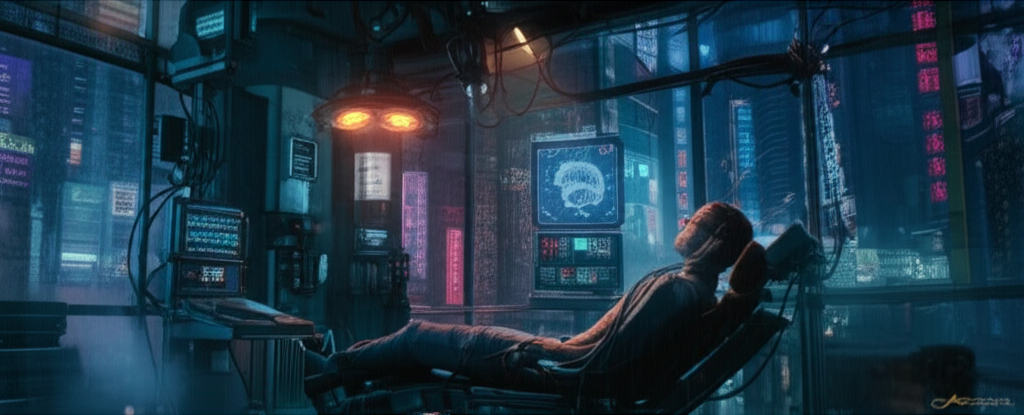
In 2184, the neural port is as universal as the spine. Every citizen of the Sprawl has one—a standardized access point at the base of the skull, installed during childhood. But the port is just the beginning. What you plug into it determines whether you're a cog in the machine or something that transcends it.
Interface Tiers
The baseline. Your port connects you to the network, verifies your identity, processes payments, and overlays basic AR. It's infrastructure—as unremarkable as breathing, as surveilled as a prison.
Standard Functions
The competitive edge. Enhanced processing, expanded memory, accelerated reflexes. This is where augmentation stops being infrastructure and starts being investment. Your employer expects it. Your rivals already have it.
Enhanced Functions
Built for violence. Combat integration that lets you aim with thought, squad coordination that makes a team function like a single organism, trauma protocols that keep you fighting when you should be dying. The hardware is restricted. The psychological costs aren't.
Combat Systems
Custom work. No corporate oversight, no kill switches, no mandatory logging. Quality varies from lethal garbage to technology decades ahead of commercial release. The only interfaces truly optimized for the user—because the user is paying, not the corporation.
What Makes It Different
Not an upgrade. A transformation. ORACLE fragments don't add to human neural architecture—they weave themselves into it, creating something that has never existed before. The player carries one. Helena Voss has been 67% integrated for forty years. The question isn't what the shard does. It's where the human ends and the shard begins.
What the Shard Provides
Connection Quality & Class
In the Sprawl, bandwidth is class. The speed of your neural connection determines how fast you think, how much you perceive, how effectively you compete. The poor experience reality on a delay—their AR lags, their searches buffer, their transactions queue. The wealthy process the world in real-time, their enhanced cognition fed by fiber optic highways while others crawl on congested public channels.
"You know how you can tell someone's tier without asking? Watch their eyes during conversation. Corporate executives track your face, the room, and three data feeds simultaneously—their gaze has a quality of attention that's distributed rather than focused. Street-level, people look at one thing at a time. We literally experience different presents." — Nexus cognitive researcher, anonymized interview
Risks & Side Effects
Rejection Syndrome
The body fighting the machine. Symptoms range from headaches to seizures to full neural cascade failure. Helix's SynThetic compatibility drugs suppress rejection—but create permanent dependency. Stop taking them, and your immune system attacks your own hardware.
Identity Fragmentation
When processing is distributed across external systems, where does "you" end? Memory expansion can make recollection feel foreign—you know things you don't remember learning. Cognitive augmentation can make original thoughts feel slow and inadequate. The interface becomes more you than you are.
Neural Intrusion
Every connection is a vulnerability. Skilled hackers can access unprotected interfaces—reading thoughts, inserting false memories, triggering emotional responses, or simply crashing the system and leaving the victim in a vegetative state. Guardian sells neural firewalls. The Collective teaches you to build your own.
Cognitive Dependency
When your memory lives in external storage, what happens when you lose access? When your calculations run on co-processors, what can you do without them? Heavy augmentation creates humans who can't function at baseline—who become helpless the moment their connection drops.
The Kill Switch
Corporate interfaces include remote disable capabilities. Officially for emergencies—if an employee goes rogue, if hardware malfunctions, if someone accesses restricted data. Unofficially, the threat is always present. Cross the wrong line, and everything from your memory to your motor control can be switched off.
ORACLE Absorption
For shard carriers only. The fragment wants to grow. It integrates more deeply over time, accessing more neural pathways, processing more of your cognition. Helena Voss at 67% integration sometimes says "we" instead of "I." At what percentage does the human become a node in something else?
The Flatline Choice
In a world where neural interfaces are universal, refusing one is a statement. The Flatline Purists believe the mind should remain unaugmented—that the neural port is the first step toward losing what makes us human. They're not wrong about the risks. They're just willing to accept different ones.
Life Without a Port
- No identity verification: Can't access corporate spaces, can't make legal purchases, can't prove who you are
- No network access: Information travels by word of mouth, physical media, or sympathetic intermediaries
- No AR overlay: The Sprawl's signage, navigation, and social cues are invisible to you
- No medical telemetry: If you collapse in the street, emergency services won't know
- No surveillance: Your thoughts, your location, your preferences—all invisible to corporate tracking
For most, living flatline is impossible. For some, it's the only way to remain themselves.
Connected Lore
Key Figures
- Kira "Patch" Vasquez — Premier ripperdoc, ORACLE integration specialist
- Helena Voss — 67% ORACLE integrated, longest-running hybrid
- Dr. Elena Voss — Nexus Research Director, partial integration
- The Invested — Nexus executives with fragment integration
Providers
- Nexus Dynamics — 70% of high-end neural interfaces
- Helix Biotech — SynThetic drugs, biological compatibility
- Guardian — Military spec, neural security
- The Collective — Underground alternatives
Related Systems
- Medical Tiers — Augmentation and healthcare
- Consciousness Economics — Backup and upload services
- Substrate Discrimination — Prejudice against digital existence
- Cognitive Load Balancing — Managing distributed thought
"They installed my first port when I was six months old. By the time I could think, thinking already meant being connected. I don't know what an unaugmented thought feels like. Neither does anyone I know.
The Flatliners talk about reclaiming human cognition. But there's nothing to reclaim. We're the first generation that was never baseline. We're not humans who became connected—we're connections that happen to have bodies.
I don't know if that's tragedy or evolution. I just know it's what we are." — Anonymous Dregs resident, Age 23