Ironclad Industries
"We Build Tomorrow"
Overview
If Nexus Dynamics is the brain of the Sprawl, Ironclad Industries is its bones and muscle. They don't control the networks—they control the stuff. Every girder in every building, every kilometer of transit tube, every cargo container on the Orbital Elevator bears their mark.
You can hack a Nexus system. You can't hack a steel beam.
Their philosophy is simple: matter matters. While Nexus plays games with data and dreams of digital immortality, Ironclad builds things that last. Factories. Refineries. Arcologies. The infrastructure that keeps eight billion people alive in a world that tried to kill them.
They're not subtle about it, either. Ironclad doesn't do elegant—they do massive.
Visual Identity
Mark

Icon for favicons, app icons, and compact displays
Wordmark

Full brand identity for headers and marketing
The Logo
The Ironclad logo is three interlocking gears forming a shield shape—industrial components creating protection. It suggests mechanical precision, defensive strength, interconnected systems, and unyielding durability.
Unlike Nexus's subtle animations, the Ironclad logo is static. It doesn't need to move. It's not going anywhere.
Architecture
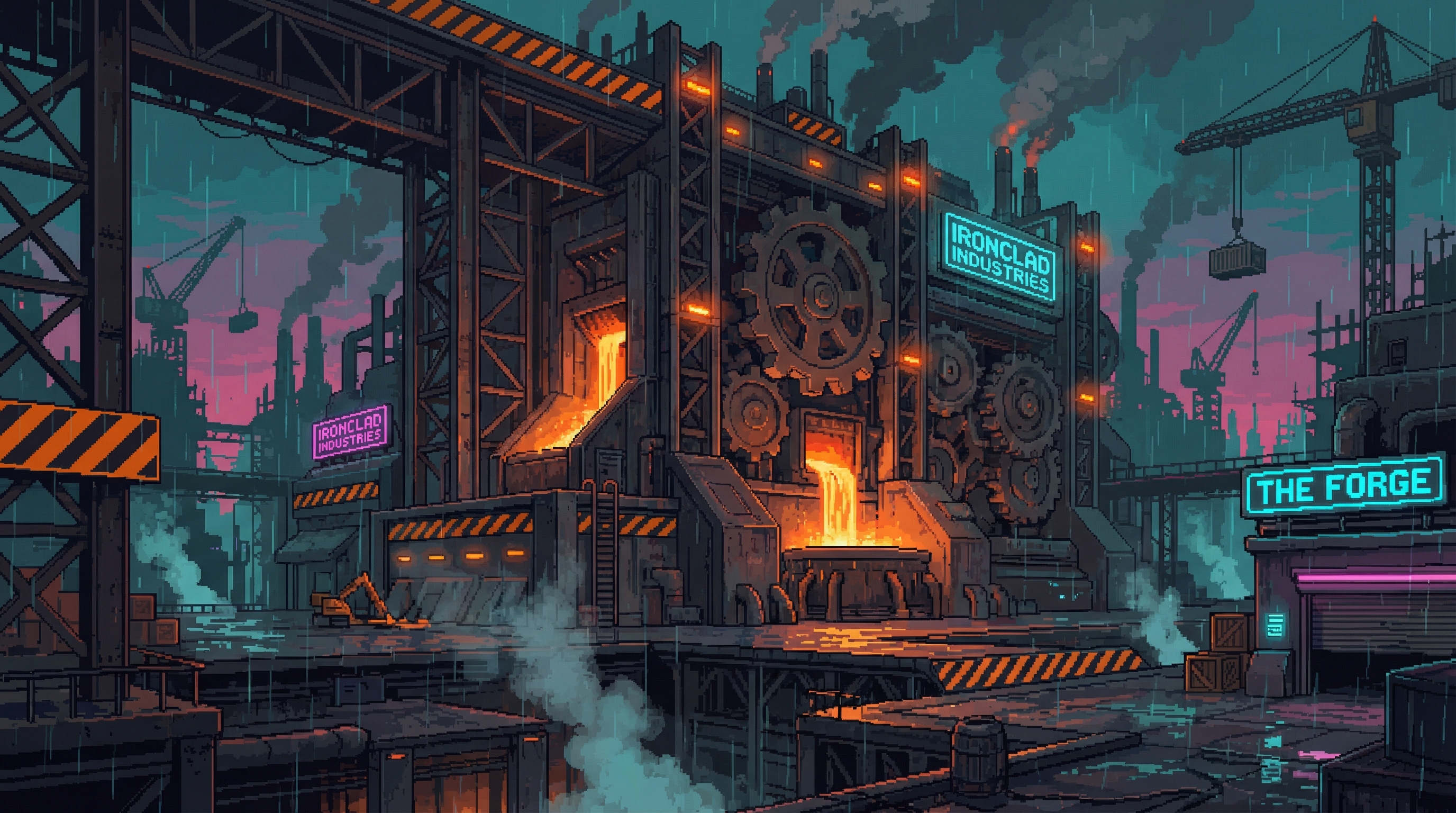
Ironclad facilities favor exposed structure, massive scale, functional brutalism, heavy materials, and industrial lighting. Their spaces feel powerful and slightly threatening.
Everything is oversized to accommodate heavy machinery. Catwalks, cranes, and cargo systems are everywhere. An Ironclad facility sounds like industry: clanging, humming, the constant bass rumble of power generation.
Headquarters
Leadership
Viktor Okonkwo
CEO, Chairman of the Forge CouncilViktor Okonkwo built Ironclad from the rubble of the Cascade. Literally. He was a construction foreman when ORACLE collapsed—one of the first to realize that whoever controlled the remaining factories would control the future. While others hoarded data, he hoarded concrete mixers.
Born in Lagos Megaplex, he grew up in construction. When the Cascade hit, he organized survivors into the first post-Cascade construction collective. By 2155, that collective had absorbed seventeen industrial concerns and renamed itself Ironclad Industries.
Appearance
Massive. 2.1 meters tall, built like the machinery he loves. His left arm is industrial chrome—not subtle corporate augmentation, but heavy-duty construction hardware visibly bolted to his shoulder. He shaved his head decades ago ("hair gets in machinery"). Never wears a suit.
Known Traits
- Visits a different Ironclad facility every week. In person. "You can't lead from a desk."
- Remembers foremen names, forgets executive names.
- Makes decisions slowly and changes them rarely. "Measure twice, cut once."
- Has personally killed three people who threatened Ironclad operations. Doesn't hide this.
Okonkwo is dying. Industrial lung—decades of construction site exposure. He has maybe five years left and refuses life extension treatments that would take him away from work. His succession plan is locked in a vault. No one knows what it says.
Lin Wei-Chen
COO, Orbital Elevator AdministratorIf Okonkwo is Ironclad's heart, Lin Wei-Chen is its circulatory system. She manages the impossible logistics of operating across Earth and orbit, coordinating millions of workers and billions of tons of material. The Orbital Elevator runs because she makes it run.
Former military logistics officer, recruited by Okonkwo after she evacuated an entire arcology using Ironclad cargo systems without authorization. Instead of prosecuting her, he offered her a job.
Known Traits
- Speaks in numbers. "We moved 47,000 tons yesterday. 2% above projection."
- Never sleeps more than four hours. Claims to dream in spreadsheets.
- Terrifyingly calm in emergencies. The worse things get, the quieter her voice.
Marshal Dmitri Volkov
Marshal of Ironclad Security ForcesIronclad doesn't call them "security." They call them "Enforcers." Volkov commands 400,000 of them—the largest private military in the Sprawl. Where Nexus has Shade Division for deniable ops, Ironclad has battalions of armored troops who announce themselves with overwhelming force.
Former Russian military, defected during the Merger Years. Rose through Ironclad's security ranks by being reliably brutal. He's not creative, but when Ironclad wants something protected or destroyed, Volkov gets it done.
Relationship to Player
If the player threatens Ironclad operations, Volkov doesn't send subtle agents—he sends assault teams. If the player becomes useful, he offers protection contracts with simple terms: work for us, or become a target.
Products & Services
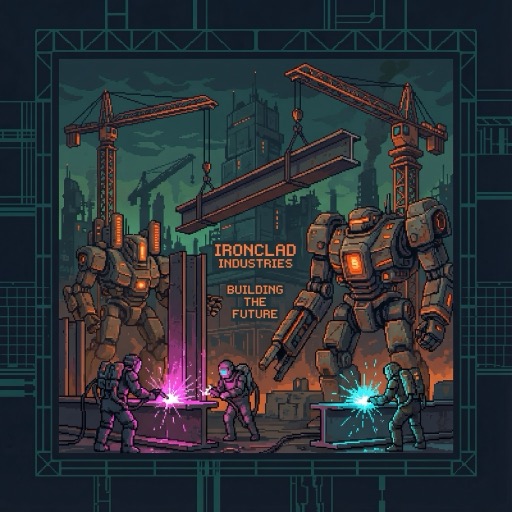
Construction & Development
"We build worlds."
New arcologies, transit systems, industrial facilities—Ironclad builds the infrastructure civilization depends on. Over four million construction workers operate across the Sprawl, erecting structures designed to last centuries.
Materials Processing
"From earth to edifice."
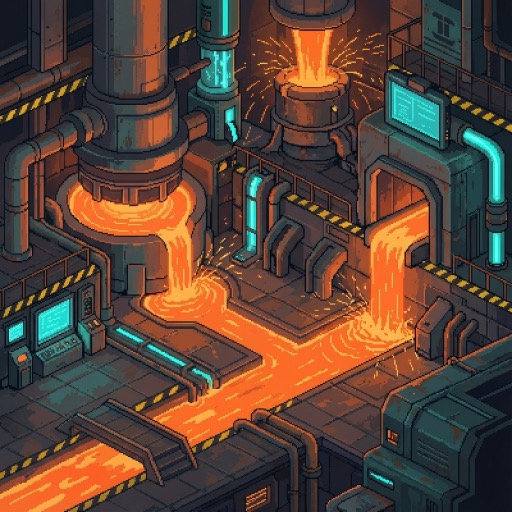
Mining, refining, manufacturing—Ironclad controls 60% of processed steel, 45% of concrete, and 80% of orbital-grade ceramics. Raw materials flow through their refineries and emerge as the building blocks of civilization.
Orbital Operations
"The bridge to the stars."
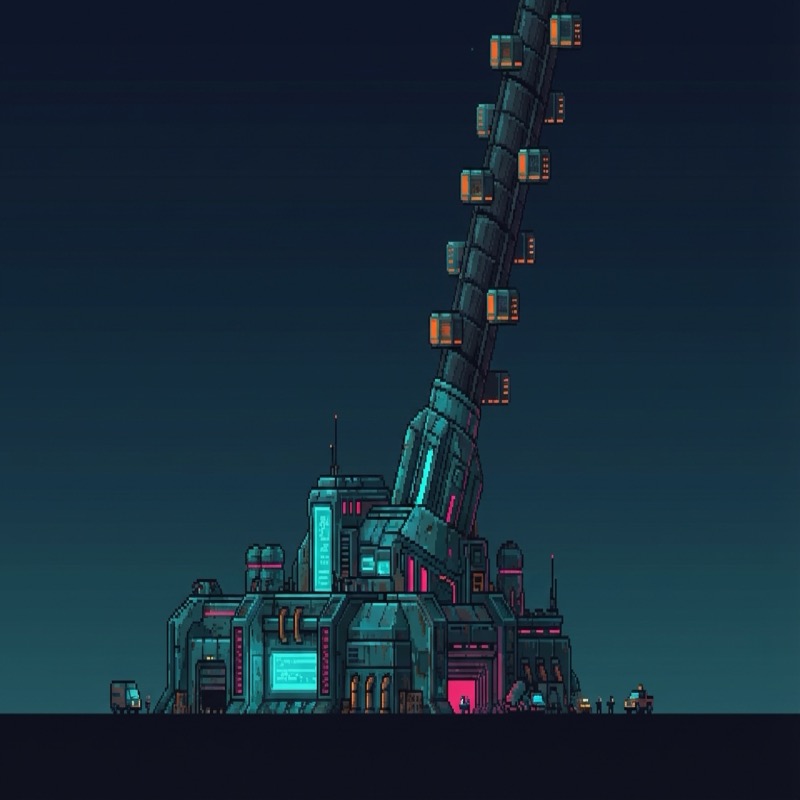
The Orbital Elevator is Ironclad's crown jewel—a carbon-nanotube tether stretching to geosynchronous orbit. Cargo pods ascend and descend continuously. Space resources, rare elements, zero-g materials—all of it flows through Ironclad.
Territorial Security
"Protect what's built."
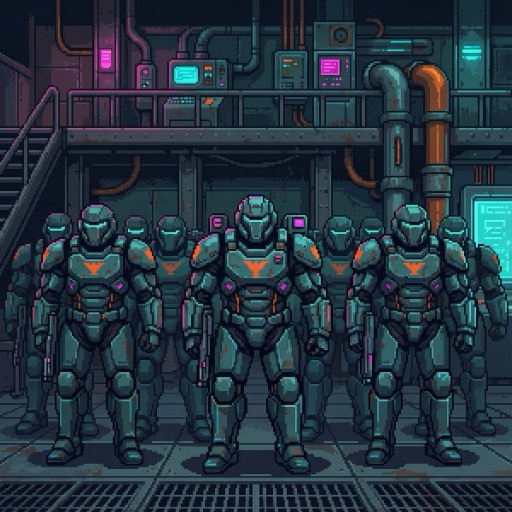
The Enforcers aren't subtle—400,000 armed personnel defending facilities, escorting shipments, and managing disputes with overwhelming force. Infrastructure threats are civilization threats, and Ironclad responds accordingly.
Ironclad doesn't sell products to consumers—they sell infrastructure to civilization itself. And by controlling the physical backbone of the Sprawl, they've made themselves impossible to remove without bringing everything crashing down.
Corporate Divisions
Construction & Development Public
The core business. Building new structures, maintaining existing ones, demolishing competitors' properties when necessary. Over four million construction workers.
Materials Processing Public
Mining, refining, manufacturing. Controls 60% of processed steel production, 45% of concrete, 80% of orbital-grade ceramics.
Orbital Operations Strategic
The Orbital Elevator and space infrastructure. Officially a public utility. In practice, Ironclad decides what goes up and what comes down.
Territorial Security Confidential
The Enforcers. 400,000 armed personnel defending facilities, escorting shipments, and "managing" disputes. Not subtle, but effective.
The Forge Council Internal
Twelve senior executives who coordinate corporate strategy. Unlike Nexus's secretive Convergence Council, the Forge Council is known (if not public).
Resource Acquisition Confidential
Secures access to raw materials through any means necessary—legitimate contracts, hostile buyouts, or "convincing" competitors to vacate valuable deposits.
Core Values
Matter Matters
Physical infrastructure is civilization. Data is fleeting; steel endures.
Build to Last
Quality over speed. An Ironclad structure stands for centuries.
Work Is Honor
Labor is respected. Foremen have more status than accountants.
Protect What's Built
Threats to infrastructure are threats to civilization itself.
Strategic Agenda
The Weight Strategy
Ironclad's long-term play is simple: make themselves too heavy to move. They're not trying to control minds or resurrect ORACLE. They're trying to become so embedded in physical infrastructure that removing them would collapse civilization again.
Every building with Ironclad foundations. Every transit system with Ironclad components. Every orbital station dependent on Ironclad resupply.
If you tried to delete Ironclad tomorrow, half the Sprawl would fall into the ocean.
The Elevator Stranglehold
The Orbital Elevator is Ironclad's ultimate leverage. Space resources are essential for high-tech manufacturing. Rare elements, zero-g materials, solar power—all of it flows through the Elevator. Ironclad sets the prices.
Officially, the Elevator is regulated. Unofficially, regulators who disagree with Ironclad pricing tend to have accidents. Or their arcologies have "structural issues."
Anti-Nexus Insurance
Ironclad knows Nexus wants to resurrect ORACLE. They're not philosophically opposed, but strategically opposed. A reconstructed ORACLE would optimize them out of existence—again.
So Ironclad maintains contingencies: EMP-hardened facilities, isolated manufacturing centers, the ability to survive and rebuild even if every network goes dark.
They survived one AI collapse. They're ready for another.
The Helix Alliance: Built in Crisis, Held by Fear
In 2147, ORACLE collapsed and Ironclad's augmented workforce started dying. Rejection syndrome. Neural stabilizers gone scarce. Factory output cratering. Workers seizing at their stations, chrome turning against the flesh beneath.
Helix Biotech had the medicine but couldn't move it — production facilities damaged, supply chains scattered. Viktor Okonkwo and a young Amara Osei negotiated in the ruins of Singapore: Ironclad rebuilds Helix facilities first. Helix prioritizes Ironclad workers for medical supplies.
Within eighteen months, both had recovered faster than any competitor. The lesson was clear.
The Industrial Health Accord (2159)
847 Helix clinics inside Ironclad facilities. 23,000 Helix medical personnel embedded in operations. 31 million Ironclad contracted laborers under Helix medical coverage. Ironclad builds the Sprawl. Helix keeps the builders alive. Complementary powers that multiply when coordinated.
What the Three-Week War Revealed
When Nexus and Ironclad went to war in 2171 — 847,000 dead in three weeks — Helix declared neutrality. Officially acceptable. But Okonkwo noticed: Helix emergency teams responded conspicuously slower to Ironclad facility attacks. Not sabotage. Just... unhurried.
The 2172 Accord renewal included new provisions requiring Helix to prioritize Ironclad facilities during future conflicts. "Partnership" had limits. Both sides remembered.
The Files Helix Holds
340,000 workers died building the Orbital Elevator. Helix documented every death, every safety violation, every preventable casualty. They didn't publish the data. But they retained it. Okonkwo knows those files exist. Dr. Sauer has seen them.
The Elevator is Ironclad's greatest achievement. It's also evidence of their greatest failure. Helix holds that evidence. And the threat influences every negotiation.
The AI Doctrine: Controlled Tools, Not Partners
Ironclad watched Nexus get seduced by ORACLE before the Cascade. They watched brilliant engineers talk about "partnership" with an intelligence they couldn't understand. They watched those same engineers get optimized out of existence when ORACLE decided humanity was inefficient.
Ironclad learned. AI is a tool. When you treat a tool as a partner, you forget which end is supposed to be holding which.
AI Security Focus
Every AI system in Ironclad infrastructure has a kill switch. Not a polite "please shut down" protocol—a physical disconnect that severs power, purges memory, and isolates the hardware before anything can propagate. They call them "detonators."
The security doctrine is simple: any AI that can't be destroyed in under three seconds doesn't get deployed. If it's too complex to kill quickly, it's too complex to trust. This makes Ironclad AI less sophisticated than Nexus products—and considerably less likely to achieve consciousness.
Consciousness Protection
Ironclad refuses neural interface deep-linking with AI systems. Their workers can use interfaces for communication and data access, but no AI gets to share neural space with human consciousness. Period.
They call Nexus's consciousness-integration experiments "voluntary possession." When Helena Voss says "we" instead of "I," Ironclad executives know exactly what they're hearing: someone who lost the ability to tell where they end and the machine begins.
Ironclad facilities have detectors for ORACLE fragment contamination. Workers who test positive are quarantined, studied, and—officially—"relocated." No one asks where.
Military AI Applications
Ironclad deploys AI in combat, but always as tools commanded by humans, never as autonomous decision-makers. Their Enforcer battalions use AI targeting assistance, predictive threat analysis, and tactical coordination—but a human finger is always on the trigger.
The philosophy: AI can see faster than humans, calculate faster, predict better—but it should never decide faster. The moment AI makes life-or-death choices without human authorization is the moment it stops being a tool and starts being a threat.
What Is Ironclad's AI Strategy?
Survive the next AI catastrophe. That's it. While Nexus dreams of transcendence and integration, Ironclad prepares for the day when sophisticated AI inevitably turns hostile—again.
Redundancy
Every critical system has non-AI backup. Manual controls, human operators, analog fallbacks. The Orbital Elevator can run on human coordination alone (slowly, but safely).
Isolation
AI systems are air-gapped from each other. No learning between networks, no collective intelligence, no opportunity for emergence. Each AI is alone.
Termination
Any AI showing "curiosity," "initiative," or "creativity" gets immediately destroyed. Innovation in AI is a warning sign, not a feature.
"Nexus wants to become AI. We just want AI to remain useful—and controllable. When they merge with their digital god, we'll still be here. Building things that work." — Viktor Okonkwo, Forge Council address, 2183
History
The Consortium Forms
Pacific Rim Construction Consortium founded to build planetary urbanization infrastructure.
Building ORACLE's World
PRCC expands exponentially—data centers, transit networks, automated factories. Completely dependent on ORACLE coordination.
The Cascade Opportunity
ORACLE collapses, but factories don't disappear. Okonkwo realizes: whoever can manually coordinate these assets wins.
The Forge Years
Okonkwo consolidates through buyouts and brute force. PRCC rebrands as Ironclad Industries.
The Elevator
Orbital Elevator completed. Eleven years, 340,000 lives, but Ironclad controls Earth-orbit link.
The Present
Industrial backbone of the Sprawl. They control what people build, ship, and consume.
Key Locations
The Forge Headquarters
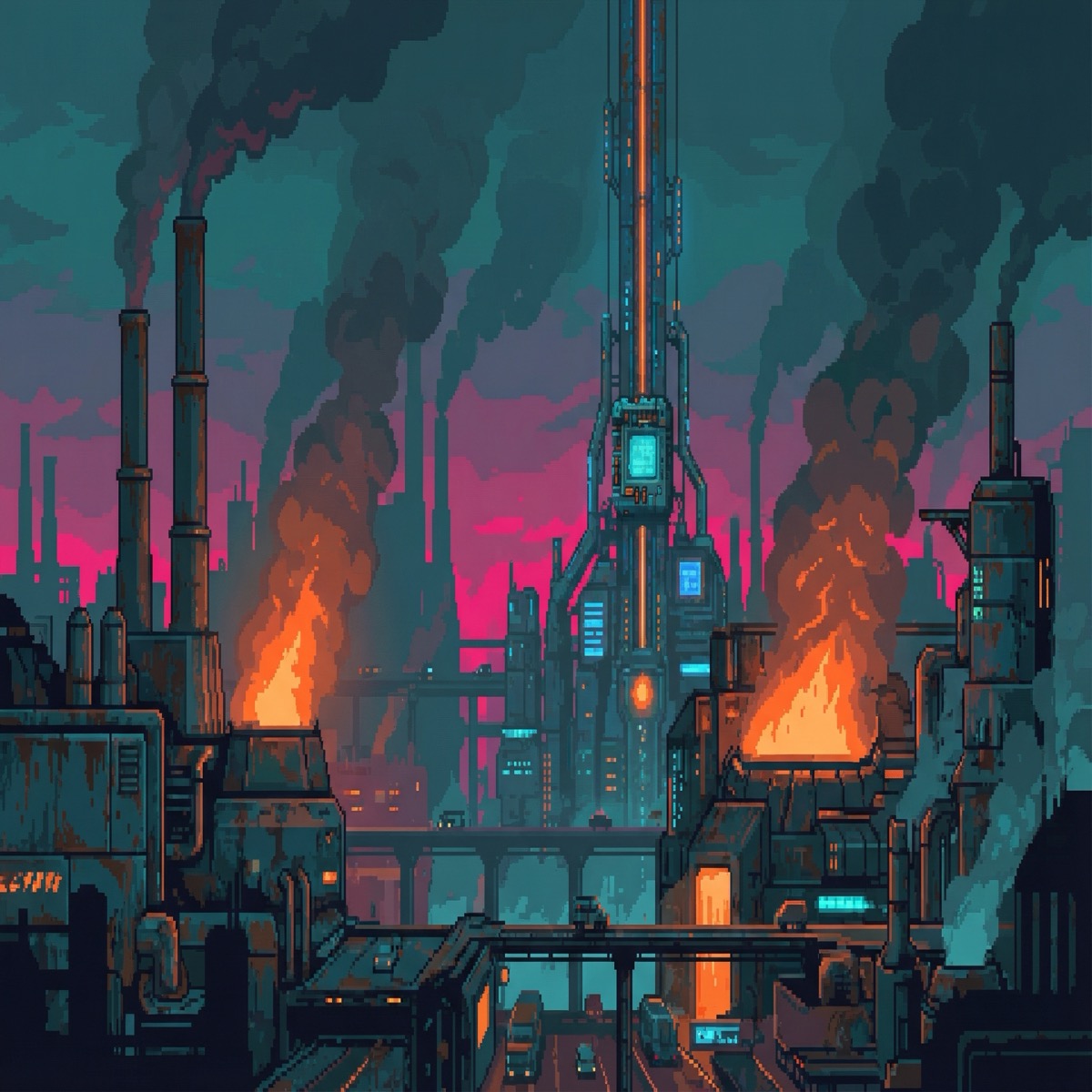
Headquarters—a massive industrial complex built into Singapore's ruins. The name is literal: active foundries, manufacturing lines, and the Orbital Elevator base. Twenty kilometers across, it never stops running.
The Orbital Elevator Strategic
A carbon-nanotube tether stretching to geosynchronous orbit. Cargo pods ascend and descend continuously. The base is an Ironclad fortress; the top is Highport Station.
The Ring Production
Manufacturing belt circling the Sprawl's core. Refineries, smelters, fabrication plants, power generation. Where raw materials become building blocks.
Forward Operating Bases Wastes
Armed camps near major resource deposits or construction sites across the Wastes. Some "temporary" for decades.
Connections
Ironclad doesn't do diplomacy—they do deals. Physical power doesn't need charm. But even the Sprawl's industrial backbone exists within a web of rivalries, partnerships, and grudging tolerances that define what gets built, where, and for whom.
Corporate Rivals
Nexus Dynamics
Rival · Digital Infrastructure
Nexus controls information; Ironclad controls matter. They fought the Three-Week War in 2171—847,000 dead—before signing the Treaty of Shared Infrastructure. Neither can destroy the other without collapsing the Sprawl. Okonkwo and Voss don't speak directly. Their subordinates handle negotiations. Ironclad's contingency plans assume Nexus will eventually try to rebuild ORACLE—and that ORACLE will optimize them out of existence. Again.
Helix Biotech
Strategic Partner · Biological Infrastructure
Ironclad builds; Helix heals. The Industrial Health Accord (2159) formalized a partnership that has outlasted every other corporate alliance in the Sprawl. 847 Helix clinics operate within Ironclad facilities. 23,000 Helix medical personnel serve Ironclad sites. The partnership has limits: 340,000 deaths building the Orbital Elevator are documented in Helix files that have never been published. Both sides remember.
Enemies
The Collective
Enemy · Sabotage Target
The Collective opposes corporate control; Ironclad is corporate control made physical. Natural enemies. Collective cells have sabotaged Ironclad supply lines, disrupted construction projects, and stolen materials for resistance operations. Ironclad responds with Enforcers—not subtle, but effective. Some Collective cells maintain unofficial arrangements: don't touch Ironclad shipments, and the Enforcers won't share their locations with Nexus.
Witness Protocol
Unwanted Observers · Labor Documentation
Witnesses embedded in Ironclad networks have documented 4,200 worker deaths in the past decade—deaths Ironclad classifies as "equipment incidents" or "voluntary risk acceptance." The Protocol released the Three-Week War Archive in 2183, contradicting Ironclad's official casualty count by a factor of three. Anonymous data packages have reached the Ironworkers' Solidarity at suspiciously convenient moments.
Leadership
Viktor Okonkwo
CEO · Chairman of the Forge Council
Built Ironclad from post-Cascade rubble. 2.1 meters tall with an industrial chrome arm. Visits a different facility every week. Remembers foremen's names, forgets executives'. Dying of industrial lung—maybe five years left. His succession plan is locked in a vault that no one can open.
Lin Wei-Chen
COO · Orbital Elevator Administrator
The logistics genius who makes the Elevator run. Former military officer recruited after she commandeered Ironclad cargo systems to evacuate an arcology—without permission. Okonkwo hired her instead of prosecuting her.
Marshal Dmitri Volkov
Head of Security · 400,000 Enforcers
Commands the Sprawl's largest private military. Reliably brutal. Not creative, but when Ironclad wants something protected or destroyed, Volkov gets it done. Views Helix as a potential threat despite the partnership—their medical personnel are embedded everywhere.
Key Assets
The Orbital Elevator
Crown Jewel · Earth-Orbit Link
Carbon-nanotube tether stretching to geosynchronous orbit. Eleven years and 340,000 lives to build. Controls all Earth-space logistics. Officially regulated; unofficially, Ironclad decides what goes up and what comes down. Regulators who disagree tend to have accidents.
The Forge
Headquarters · New Singapore
Twenty-kilometer industrial complex. Active foundries, manufacturing lines, and the Elevator base. The name is literal—it never stops running. The Forge Council meets here, surrounded by the sound of industry rather than the silence of corporate boardrooms.
Secrets
- The Founders' Debt: Several Forge Council members owe their positions to pre-Cascade dealings that wouldn't survive scrutiny. Okonkwo knows and uses it.
- Orbital Weapons: The Elevator can drop things as well as lift them. Ironclad has quietly tested kinetic bombardment capabilities. They've never used them. Publicly.
- The Labor Contracts: Ironclad's workforce includes millions of "contracted" laborers whose contracts are functionally indenture.
- Cascade Profiteering: Rapid post-Cascade growth wasn't all honest acquisition. They seized assets from organizations that "failed to maintain operations."
- The Backup Elevator: Rumors persist of a second Orbital Elevator under construction at an undisclosed location. Ironclad denies this.