Corporate Defector Network
Underground Railroad for Corporate Refugees
Overview
In the Sprawl, leaving a corporation isn't resignation—it's desertion. Corporate employment contracts bind for life. Housing, food, medical care, identity itself—all tied to your employer. Quitting means losing everything. Running means becoming a non-person.
And yet people run. The Corporate Defector Network is the underground railroad that helps them escape.
They are former executives, disgraced researchers, disillusioned security personnel, and ordinary workers who saw too much. They are people who left and now help others leave.
Services
Extraction
Getting people out of corporate territories through smuggling, bribery, or simply knowing which paths aren't watched.
Erasure
Deleting or corrupting corporate records—neural interface data, surveillance footage, financial histories.
Identity
New names, documents, and histories for life outside corporate systems. Becoming someone new.
Placement
Connecting refugees with destinations: Zephyria, the Wastes, Collective safe houses, or sympathetic settlements.
Why People Defect
The Moral Crisis
Researchers who realize what their project really means. Security ordered to eliminate witnesses. Engineers told to cut corners that will kill workers.
The Personal Crisis
Workers with conditions their employers caused. Families separated by transfers. Relationships that cross corporate boundaries.
The Wanted
Whistleblowers who've already talked. Employees who've seen things they weren't supposed to see. Anyone who's become inconvenient enough to eliminate.
How It Works
Contact
Find the right entry point. In Nexus: "a bird with no cage." In Helix: "Dr. Orosco's treatment." Each corporation has its own signal.
Vetting
The Network investigates. Genuine refugee or corporate plant? Days to weeks of careful assessment.
Extraction
Methods vary: walking out during shift change, staged incidents, or full extraction teams with maximum resources.
Transit
Movement through safe houses. Each hand-off minimizes exposure. Some refugees spend months in transit.
Resettlement
Arrival at destination with new identity and basic resources. What happens next is up to the refugee.
Organization
The Network has no headquarters, no leadership, no central command. It's a collection of cells that share methods and trust—but operate independently. If one cell is compromised, others remain safe.
Entry Cells
2-5 membersInitial contact and vetting
Extraction Cells
3-8 membersPlanning and execution
Transit Cells
2-4 membersSafe houses and transport
Tech Cells
1-3 membersDigital erasure, identity creation
Key Figures
"The Ferryman"
Legendary CoordinatorNo one knows their identity—face, voice, location, even gender. They've handled thousands of extractions over twenty years. May be one person, a rotating position, or a collective fiction that gives the Network coherence.
"The Ferryman has never lost a refugee after accepting the case."
Kira "Patch" Vasquez
Technical ConsultantThe former Nexus researcher developed many neural interface spoofing techniques the Network still uses. She doesn't coordinate, doesn't extract—she solves problems no one else can.
"Grandmother"
Helix Network LeadFormer Helix researcher who fled after her daughter was used in experiments. Eighteen years of getting Helix employees off corporate pharmaceuticals without killing them.
"Helix thinks they own you because they made you need them. We prove them wrong, one withdrawal at a time."
Relationships
Zephyria
Primary Destination60% of successful extractions end in the Free City. Haven's Edge district exists partly because the Network keeps filling it.
Labor Movements
Mutual SupportGuild members referred to the Network when pressure gets too intense. Refugees connected to organizing when they need work.
The Collective
Tactical AllianceResistance networks overlap. Some cells serve both organizations. Cooperation is tactical, not strategic.
Corporations
Pure OppositionThe Network exists to undermine corporate control. Corporate retrieval teams hunt operatives with lethal intent.
Risks and Costs
To Operatives
Death from retrieval teams. Capture and neural interrogation. Betrayal by plants or people who crack under pressure.
To Refugees
Failed extractions. Months in transit limbo. High-value targets hunted for years after escape.
To Society
Each success leads to tighter corporate controls for everyone who remains. Propaganda justifies more surveillance.
A Safe House in Sector 7G
First-person account, recorded 2183
The door doesn't look like a door. It looks like a service panel for the ventilation system in the sub-basement of a Wholesome distribution warehouse—rusted shut, no handle, the kind of thing maintenance forgot about decades ago. You wouldn't look twice.
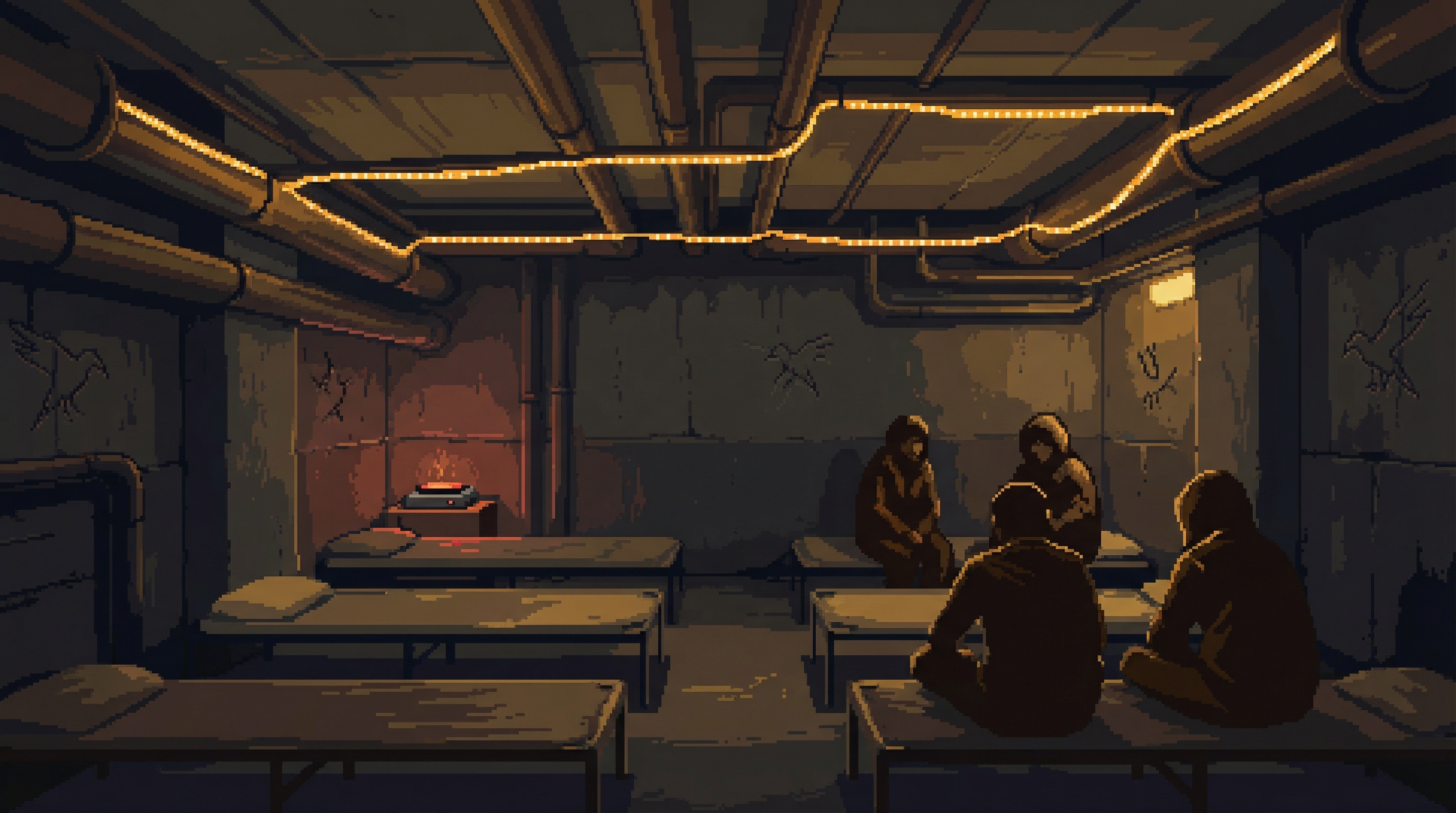
Inside, the safe house is a converted utility crawlspace, maybe twelve meters by eight. Someone has strung LED strips along the pipes—warm amber, never white, never bright enough to leak through cracks. Six cots with thin foam mattresses. A chemical toilet behind a curtain. A hot plate and a stack of Wholesome ration packs—the irony of hiding from corporations while eating their food isn't lost on anyone, but nobody laughs about it anymore.
Three refugees are already here: a Nexus data analyst who keeps pressing her fingers to her temple where the neural port used to be—Kira Vasquez's people removed it during a twelve-hour procedure, and the phantom signals haven't stopped. A Helix lab technician shaking through withdrawal from tailored nootropics baked into the cafeteria food. And a young Ironclad welder who hasn't spoken since she arrived.
The Rules
Explained once, on arrival. No written copy—nothing to find if the safe house burns.
- No transmissions. No neural pings. No diagnostic checks on your augments. Vasquez designed the signal-dampening mesh in the walls, but mesh fails. Silence is the only guarantee.
- Hot plate runs between 0200 and 0400 only—the heat signature blends with the warehouse's overnight baking cycles. You eat when the timer says.
- LED strips go red every six hours. That means a sweep passing overhead—Nexus surveillance drones mapping the district, the same ones Viktor Kaine pretends not to notice when they cross into Sector 7G airspace. During red, you don't move. You become furniture.
- If the door opens without the knock pattern, it's not your handler. The knife under each cot isn't decorative.
- Average stay: five days. Nobody stays longer than eight.
On day three, the Helix technician's shaking gets worse—vomiting for six hours as the compounds leave his system. The handler produces a syringe: "Grandmother's recipe," she calls it. Something developed by the Helix Network Lead herself, a cocktail designed to ease withdrawal from corporate biochemistry. Within an hour, he can hold water again.
Previous refugees have scratched marks on the wall. A bird with no cage, repeated dozens of times in different handwriting. Someone wrote "Marcus W. didn't die for nothing" in letters so small you need augmented vision to read them. A date—2171—and the number 207. The Great Extraction. Two hundred and seven people moved in a single night.
The Passage: Safe House to Zephyria
First-person account, continued
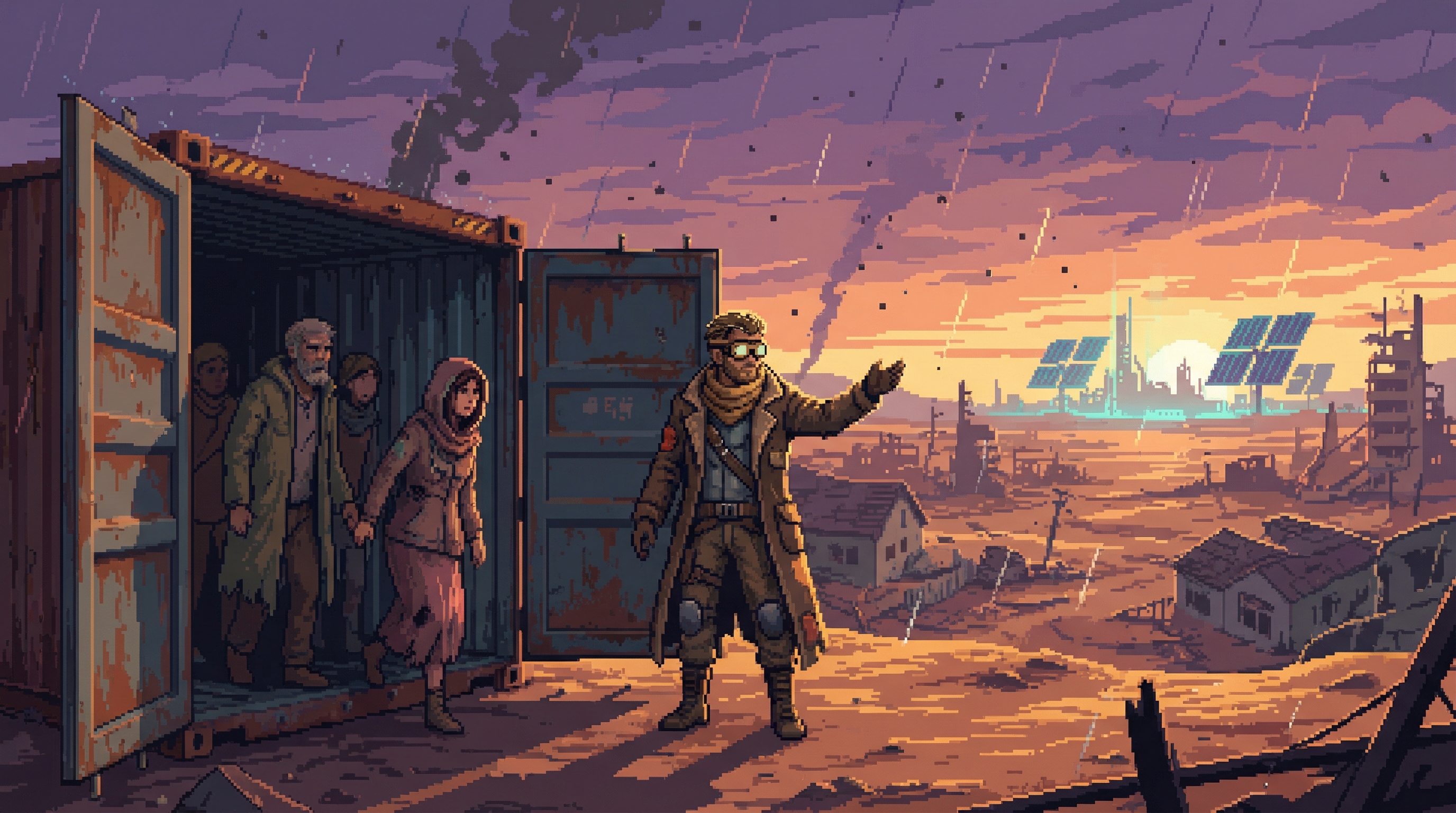
The first transfer happens in the warehouse loading bay. A cargo loader—an Ironclad model hauling Wholesome product between districts—sits idling. We climb into a false compartment behind pallets of synthetic protein, and the air turns thick with the chemical sweetness of corporate packaging.
Forty minutes of darkness. Through a drainage culvert that smells of rust and stagnant water. Up through a maintenance hatch into blinding daylight.
The Wastes. The actual sky, without the Sprawl's light pollution and atmospheric haze. It's the color of bruised fruit—purples and oranges where industrial particulates catch the sunset—and it's the most terrifying and beautiful thing I've ever seen.
Three days in the Wastes. Different operatives at each stop. A settlement of salvagers who cook real food—actual grain, grown in soil, tasting of dirt and sun and nothing synthetic. A night in an abandoned relay station where the wind sounds like the Sprawl breathing in its sleep. A crossing point where we wait six hours for a patrol to pass—Ironclad regulars running the border, their searchlights painting the dust in cold white arcs.
The Arrival
Jin "Rust" Tanaka's people meet us at the Zephyria perimeter. Scraptown district—the gateway, where everything that comes out of the Wastes gets sorted, including people. A clerk with scarred hands and kind eyes processes us through a system that doesn't ask where we came from.
New names. Real ones this time—not safe house callsigns but identities backed by documentation that Vasquez's Tech Cell protégés have threaded into Zephyria's systems.
Haven's Edge. The refugee district. Small apartments carved from repurposed shipping containers. My neighbors are a former Nexus middle-manager who now teaches children to read, and a Helix escapee who runs a small clinic using what Grandmother taught her. Nobody asks about the past.
"The first morning, I wake up and reach for my neural interface to check the quota board. There is no quota board. Outside, someone is singing. Not a corporate jingle, not an optimized mood-regulation frequency. Just singing—off-key, because they want to."
Testimony: "What I Left Behind"
From the Zephyria Oral History Archive, recorded 2182
My name now is Lena Ostrova. That's not the name I was born with. The name I was born with belongs to Nexus Dynamics, and I don't use stolen property.
I worked in Predictive Social Analytics for eleven years—the department that decides what you want before you want it. I had a corner office on the 140th floor. An efficiency rating in the 94th percentile. What I didn't have was a choice. Helena Voss built a system where choice is the only true luxury—everything else can be optimized. But free will? That's an inefficiency, and Voss does not tolerate inefficiency.
I left because of a Tuesday. I was reviewing behavioral modification protocols and noticed the target demographic was children. Ages four to eleven. We were going to reshape how an entire generation thinks about loyalty, obedience, and need. On adults, it felt like marketing. On children, it felt like what it always was.
I found the Network through a G Nook café in the lower levels—El Money's network, those underground places where Nexus surveillance can't quite reach.
"Marcus Webb gave his life so the Network could survive. I give my teaching so the next generation won't need the Network at all. One of us is more optimistic than the other."
Visual Language
Color Palette
Key Phrases
- "Underground railroad"
- "Extraction" / "Erasure"
- "The Ferryman"
- "A bird with no cage"
Connections
Nexus Dynamics: Primary source of defectors. Nexus's total-surveillance culture and behavioral modification programs generate a steady stream of employees who see too much, know too much, or simply break under the weight of what they're asked to do. The phrase "a bird with no cage" originated in Nexus lower-level cafeterias — whispered between people who hadn't yet decided to run.
Ironclad Industries: Secondary source. Ironclad defectors tend to be engineers and safety inspectors — people who discovered what corners were being cut and couldn't live with the math. Their extractions are often simpler than Nexus runs; Ironclad relies more on physical security than neural surveillance, and their border patrols have patterns that experienced operatives can predict.
Helix Biotech: Secondary source, highest-risk extractions. Helix employees are biochemically dependent on corporate pharmaceuticals baked into their food and air systems. Extracting them means managing withdrawal that can kill — which is exactly how Helix designed it. "Grandmother" and her network specialize in these cases.
The Collective: Tactical alliance. Resistance networks overlap at the operational level — some cells serve both organizations. The Collective provides safe houses, intelligence on corporate security rotations, and occasionally muscle when an extraction goes sideways. The relationship is pragmatic, not ideological: the Network moves people, the Collective fights systems.
GG: Key operative who moves defectors through the most dangerous transit corridors. The Sprawl's deadliest assassin has contacts, routes, and a reputation that makes corporate retrieval teams think twice. She doesn't do it for ideology — she does it because the Network once helped someone she cared about, and debts in the Sprawl don't expire.
Kira Vasquez: Safe house connection and technical backbone. The former Nexus researcher designed the signal-dampening mesh that keeps safe houses invisible to surveillance sweeps, the neural interface spoofing techniques that mask defector locations, and the identity fabrication protocols that give refugees new lives. Every successful extraction runs on technology she built.
The Free City: Primary destination. Sixty percent of successful extractions end in Zephyria. Haven's Edge district exists because the Network keeps filling it with people who need somewhere to be someone new. Jin "Rust" Tanaka's people process arrivals through systems that don't ask questions about the past.
Sector 7G: Critical transit point. The safe house described in the Sector 7G narrative operates in the sub-basements of distribution warehouses — spaces where corporate surveillance has gaps and Viktor Kaine's district governance conveniently looks the other way. Most extractions from Nexus territory pass through 7G before reaching the Wastes.