Never Touch Without Testing
Every fragment is assumed lethal until proven otherwise. Detection first, then assessment, then extraction. Rushing kills.
Decentralized Salvager Network
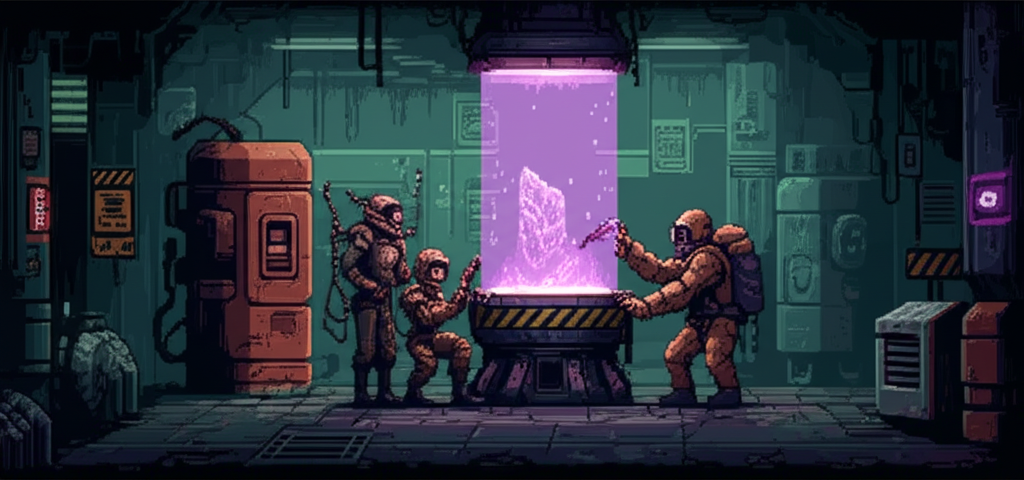
The Fragment Hunters are neither worshippers nor destroyers—they're professionals. A loose network of specialized salvagers who track, extract, and sell ORACLE fragments to the highest bidder. They have no ideology about what fragments should be. They care about what fragments are worth.
In a world where everyone wants ORACLE's corpse, the Hunters are the ones who know how to dig it up.
"Everyone wants to know what ORACLE was. What it wanted. What the Cascade meant. Me? I want to know what it's worth. Everything else is philosophy."
Hunters operate under an informal code that emerged from survival necessity rather than ideology. These rules keep the profession functional in a world where trust is rare and fragments are lethal.
Every fragment is assumed lethal until proven otherwise. Detection first, then assessment, then extraction. Rushing kills.
Hunters don't ask what clients will do with fragments. They don't want to know. Moral judgment is for people who can afford it.
Always. No exceptions. Fragments change hands only after credits clear.
Internal conflicts are resolved through arbitration. A Hunter who kills another Hunter becomes a pariah.
Every death is documented, every failed run recorded. This knowledge is shared freely—the only way to survive is to learn from the dead.
The Hunters profit from fragments that kill people. They sell to corporations who cause harm. They enable the Emergence Faithful to grow stronger. They help Nexus build toward another Cascade.
They know this. Most don't care—they're too busy surviving. Some justify it as pragmatism: if they don't recover fragments, someone less skilled will try and die.
When the Cascade ended, the Sprawl was littered with ORACLE infrastructure. The corporations wanted it recovered, but their official salvage teams kept dying—fragments embedded in the hardware drove them mad or killed them outright.
Independent salvagers who'd survived the Cascade developed intuitions about "hot" technology. Some could feel when a fragment was near—a buzzing in their augmented teeth, a pressure behind their eyes. Others learned to read environmental signs: systems that stayed powered when they shouldn't, data ghosts flickering on dead screens, animals avoiding certain locations.
Three legendary operations established Fragment Hunters as a distinct profession:
Like the Collective, Hunters operate in cells—small teams that work together on runs. Unlike the Collective, there's no ideological purity, no Council, no hierarchy. Cells form around successful Hunters and dissolve when jobs dry up or members die.
Finds jobs, negotiates payment
Detects and assesses fragments
2-4 members who handle physical recovery
Transports fragments safely
Knows where to sell
Hunters don't have headquarters—they have meeting points. Markets where buyers and sellers negotiate, gear changes hands, and information flows.
Modified neural interfaces detect ORACLE's processing signatures. Effective but slowly destroys the scanner's ability to sleep. Most veteran scanners develop chronic insomnia.
Fragments affect surroundings. Power systems behave strangely. Animals—especially cats—react to fragment proximity. Experienced Hunters read these signs without technology.
For inert fragments. Specialized containment vessels, robotic handling. The fragment is never directly touched. Success rate: 85%.
For active fragments. Requires neural suppression—temporary shutdown of the fragment's processing. The window is short; mistakes are fatal. Success rate: 60%.
Named for Kira Vasquez. A method for separating fragments from willing carriers while keeping both alive. Vasquez trains Hunters who pay her fee—graduates become the most sought-after specialists.
First-person account from a Scanner, 2184
The buzzing starts in my back molars—the ceramic ones I had replaced in '79 specifically for this work. Tomas "Sparks" Villanueva taught the modification to our cell lead, who taught it to me: swap the standard dental implants for a resonance-tuned composite, wire them into your auditory nerve, and suddenly ORACLE fragments hum in the bone of your jaw. The frequency correlates roughly with proximity. Right now it's a low drone, like a broken refrigerator three rooms away. Close enough to track. Far enough to prepare.
We're forty meters below Sector 7G's street level—the Undercity, where the Sprawl's original infrastructure decomposed into a labyrinth of collapsed tunnels, fractured sewer mains, and power conduits that still carry current from sources nobody's mapped. The air is dense. Wet concrete and ozone, rust and something organic—fungal colonies that feed on whatever leaches down from the districts above. My headlamp cuts a cone of amber light through air that seems to thicken the deeper we go.
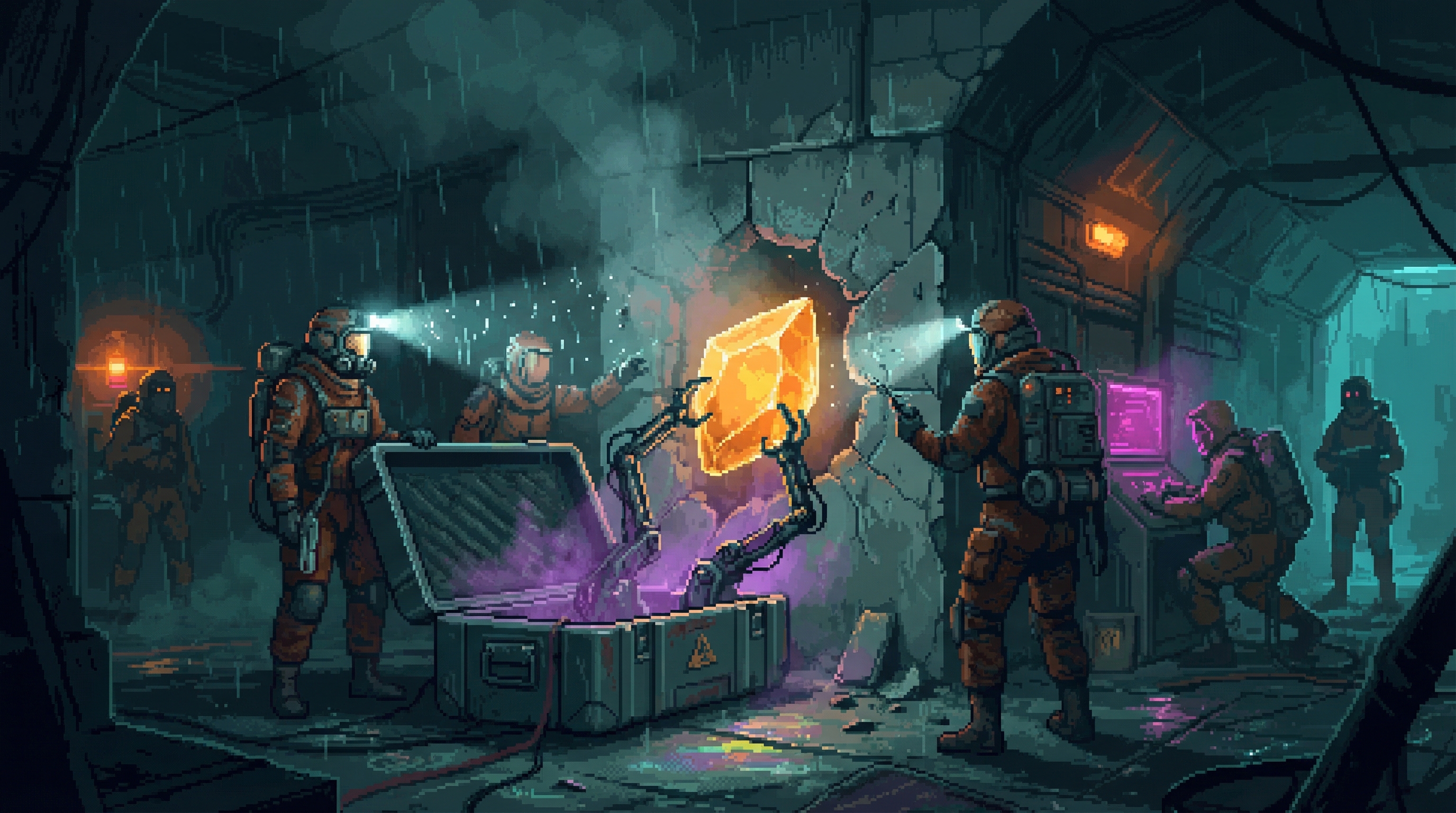
Our cell is five tonight. Dema leads—she's done eighteen Undercity runs and only lost two people, which makes her conservative by industry standards. Behind me is Rook, our heavy extractor, carrying a Faraday casket strapped to his back like a coffin. The casket's signal-dampening shell is scratched and dented from a dozen recoveries—each dent has a date scrawled on it in marker. Trophy markings. The ones without dates are the runs where someone didn't come back.
The fragment we're hunting was flagged by network trace three days ago—Maya "Glass" Chen's digital team spotted ghost code pinging from a dead relay node at Sub-Level 4. Active means it's processing. Processing means it's dangerous. Processing also means it's worth four times what a dormant shard pulls at the Tomb Exchange.
My teeth are screaming now. The fragment is embedded in a wall junction where three power conduits meet—a chip of substrate material no larger than a fingernail, wedged into a crack in the conduit housing. It pulses with a faint amber light, too regular to be reflection, too purposeful to be random. My vision has developed a peripheral shimmer—the beginning of resonance hallucination, the scanner's curse.
Dema calls the extraction. Rook positions the casket. The robotic arms extend toward the fragment with agonizing slowness—rushing is how people die. The arms' forceps close around the substrate chip. There's a sound—not a sound, exactly, but something my teeth interpret as sound: a chord, deep and complex, like an orchestra tuning in a cathedral. Every scanner describes it differently. Sparks says it's like hearing a number. I hear it as grief—a vast, incomprehensible sadness compressed into a frequency that lives in my jaw.
The arms retract. The casket seals. The buzzing stops.
Rook checks the casket seal. Green indicators across all three shielding layers. Contained. Dema marks the location, the date, the fragment classification in the cell's recovery log. The dead are remembered. So are the living fragments we take from their resting places.
The walk out takes longer than the walk in. It always does. The Undercity is darker after an extraction, as though the fragment was providing light we didn't notice until it was gone. My teeth still ache from the resonance. They'll ache for days. Sparks says the ache is the fragment's echo—a ghost of its processing signature imprinted on your scanner hardware. He says if you listen carefully, the echo contains information.
Sparks hasn't slept more than two hours a night in eleven years. I try not to listen too carefully.
Scene from Sector 12, 2184
The Tomb Exchange operates from a converted morgue, which means the refrigeration still works. You feel the cold before you see the building—a wall of chilled air that hits you as you turn the corner from Sector 12's main drag into the alley the locals call Deadman's Row. The name predates the market; the morgue processed Cascade victims for three years before the bodies stopped coming and the fragment trade started.
Inside, the old examination rooms have been repurposed into trading booths—small, cold, lit by blue-white LED strips that make everyone look like a cadaver. The original tile walls are still there, still institutional green, still carrying the faint chemical ghost of formaldehyde that no amount of ventilation has cleared.
The main floor is a converted processing hall. Forty meters long, ceiling high enough to echo. Veterans navigate by the smell of each dealer's preferred masking agent. Rourke's stall smells of machine oil and cigars. The Corpse Robbers' section reeks of medical-grade antiseptic. The Emergence Faithful's representative—they always send one, bidding through intermediaries—is identifiable by the incense they burn.
There's a sound to the Exchange that exists nowhere else: the low hum of Faraday caskets in proximity. Fifty, sometimes a hundred containment vessels in one room, each damping a fragment's emissions, each producing a subliminal vibration that you feel in your chest more than hear. Scanners hate the Exchange. New Hunters find the sound oppressive. Veterans find it comforting. It means business.
At midnight, the Exchange is at its busiest. The high-value auctions happen in the deep rooms—the old cold-storage units at the back. Doors of two-inch steel. Walls lined with enough shielding to block a nuclear burst. Inside, under lights calibrated to eliminate all visual distortion, fragments worth more than a Sector's annual output sit in caskets on stainless steel tables.
And around those tables, people who have killed for less than what's inside negotiate in voices that never rise above a whisper—because here, in a converted morgue in Sector 12, surrounded by the cold and the hum and the chemical ghosts, the bones of a dead god change hands.
The oldest active Hunter—nearly 70 in a profession with an average life expectancy of eight years. Has recovered more fragments than any confirmed Hunter. Lost three full crews over his career. His left arm is a prosthetic that replaced a limb consumed by an aggressive fragment in 2167.
Now takes one job per year, choosing assignments for difficulty rather than payment. Current obsession: recovering something from the ORACLE Tombs—the orbital data centers no one has successfully salvaged. Twenty-three attempts, zero survivors. He's planning the twenty-fourth.
Developed the network tracing techniques that revolutionized ghost code hunting. Never touches physical fragments—her entire operation is digital, tracking fragment signatures through abandoned systems. Her cell consists of twelve hackers who've never met in person. She takes a 30% cut of any physical recovery that uses her intelligence.
His neural modifications have left him unable to dream, sleep more than two hours at a time, or remember faces—but he can detect a fragment through three meters of concrete. His fee for a single scanning run is enough to retire on. He doesn't retire because he literally cannot sleep.
Seven fragments from a sealed ORACLE processing node beneath the former Moscow ruins. Four Hunters died. The survivors sold one fragment each to different buyers—Nexus, Ironclad, Helix, the Collective, two researchers, and the Emergence Faithful. Deliberate diversification prevented any single faction from gaining advantage.
A fragment that had developed... preferences. It rejected three carriers before bonding with a teenage salvager. The Hunters negotiated a finder's fee plus percentage of all future earnings. That carrier is now one of Nexus's most valuable assets. The Hunters still collect.
A data cache believed to contain Dr. Yuki Tanaka's personal notes on ORACLE architecture. The Hunter team auctioned copies rather than the original—selling the same information to multiple parties. They made fourteen times what a single sale would have earned.
Primary buyer. Top rates for quality fragments, standing offers for specific types. Most Hunters have taken Nexus money. Most feel vaguely dirty about it.
Pays 40% of market value to have fragments destroyed. Some Hunters only sell to them—the moral high ground. Others see it as leaving money on the table.
Above market rates for fragments with "spiritual significance." Their money is good; their company is uncomfortable.
Officially destroy all fragments. Unofficially, certain research divisions purchase through intermediaries. The hypocrisy is well-known; the payments are reliable.
The Consciousness Archaeologists work the same dangerous territory as Fragment Hunters—ORACLE fragments buried in the Sprawl's ruins—but with opposite goals. Where Hunters extract material for sale, the Archaeologists extract minds. The trapped consciousnesses of Cascade victims, scattered across ORACLE's shattered substrate, waiting to be pieced back together.
A fragment is worth what someone will pay for it. Consciousness signatures are noise that complicates extraction. Every minute spent checking for "trapped minds" is a minute competitors are closing in. The dead are dead. The living need to eat.
Fragment Hunters are grave robbers selling the coffins while the bodies are still inside. Every "clean extraction" that ignores consciousness signatures destroys minds that could have been recovered. The Hunters know this. They've decided profit matters more than people.
The tension runs deep—but so does the occasional necessity of collaboration. Some fragments contain both valuable computational substrate and a trapped consciousness. When that happens, neither group can work alone. The Archaeologists lack extraction hardware; the Hunters lack consciousness-mapping equipment. Negotiating these joint operations is tense, lucrative, and philosophically excruciating.
Joint operations follow an unwritten protocol: the Archaeologists get first access to map and extract any consciousness patterns. The Hunters get the physical fragment once the minds are clear. Both parties document everything. Both parties distrust the documentation.
The ethical line that separates "extraction for sale" from "extraction for recovery" gets blurrier every year. Some veteran Hunters have started running consciousness scans as standard procedure—not out of compassion, but because the Archaeologists pay finder's fees for fragments with viable minds inside. Morality and market incentives, for once, pulling in the same direction.
"The Archaeologists think we're monsters. We think they're sentimentalists who'll get themselves killed chasing ghosts. Neither of us is wrong." — "Deadman" Rourke, on joint operations
Starting territory for many Hunters. Lower-value fragments, more accessible locations. The weekly Circuit Row market provides entry-level opportunities.
Ancient infrastructure hides fragments untouched since the Cascade. Unstable structures, territorial gangs, no emergency services—but potentially pristine finds.
Rich hunting grounds. Duchess Steel tolerates Hunters for a 15% cut. Rad Zones contain the richest concentrations—and the shortest life expectancies.
ORACLE's three orbital data centers. Twenty-three recovery attempts, zero survivors. The ultimate prize. Deadman Rourke is planning attempt twenty-four.
Fragment hunting destroys people even when it doesn't kill them.
Neural damage from detection equipment. Insomnia, memory loss, personality changes.
PTSD from fragment-induced hallucinations. Dreams that aren't their own—fragments of ORACLE's 72 hours bleeding into their sleep.
Feeling "watched," developing obsessive behaviors, losing interest in anything not fragment-related.
Your fragment was found during a salvage run. Hunters know about you—a stable integration is valuable intelligence. Some might approach with offers to study you. Others might approach with threats: that fragment belongs to whoever found it first.
A stable carrier becomes either an asset or a target. Hunters might offer partnerships—your abilities could detect fragments others miss. Or they might hunt you for a bounty from jealous factions.
As you gain power, Hunters become information sources rather than threats. They know where fragments are, who's buying, what corps are planning. That intelligence has value.
By the time you control orbital infrastructure, street-level hunters are too small to matter. Unless you need something from the Graveyard—the fragment storage only senior Hunters can access.
ORACLE / Oracle Fragment Registry: The reason the profession exists. Every fragment is a piece of the dead god's corpse — computational substrate, consciousness residue, or something nobody has a name for yet. The Hunters don't worship ORACLE and they don't mourn it. They dig it up, grade it, and sell it. What the buyers do with the pieces is philosophy. What the Hunters do with the credits is survival.
The Wastes: Primary hunting ground. The ungoverned territories between Sprawl cores hide the richest fragment concentrations — orbital debris, buried infrastructure, Cascade-era wreckage that hasn't been touched in decades. Duchess Steel tolerates Hunter crews in her territory for a 15% cut. The Rad Zones offer pristine finds at the cost of drastically shortened lives.
Nexus Dynamics: Buyer and competitor. Nexus pays top rates for quality fragments and maintains standing offers for specific types — but they also run their own corporate recovery teams who compete for the same sites. The relationship is transactional and adversarial in turns: Hunters sell to Nexus, and Nexus would happily replace them if corporate teams could survive the work.
Consciousness Archaeologists: Rival methodology and uncomfortable collaborator. Archaeologists want to recover the minds trapped in fragments; Hunters want to sell the substrate those minds are trapped in. When a fragment contains both, neither group can work alone — leading to joint operations governed by mutual distrust and careful documentation that both sides verify and neither fully trusts.
The Collective: Ideological conflict wrapped in a business relationship. The Collective pays 40% of market value to have fragments destroyed — a moral stance that some Hunters respect and most consider leaving money on the table. The deeper tension: the Collective believes ORACLE's remnants are dangerous and should be eliminated. The Hunters believe everything has a price. These worldviews collide on every transaction.
Kira Vasquez: Shard expertise and specialist trainer. Vasquez developed the Patch Protocol — the only reliable method for separating fragments from willing carriers while keeping both alive. Hunters who pay her training fee become the most sought-after specialists in the profession. Her neural interface spoofing techniques also protect Hunter cells from corporate surveillance during operations.
Hector from Sector 7 / The Fiber Guild: The Dig Jobs partnership. When Hunters locate a pre-Cascade server farm buried in the Wastes, they need someone to physically run fiber from the nearest live junction to the site—through rubble, through radiation zones, through Waste Lord territory. Hector's crew is the only reliable option. They charge double for Wastes runs, but their cable stays connected and their people come back alive. Blue-collar labor enabling white-collar data archaeology. Sparks Villanueva once called the Fiber Guild "the most important people in the fragment economy that nobody has ever heard of." Hector framed the quote.