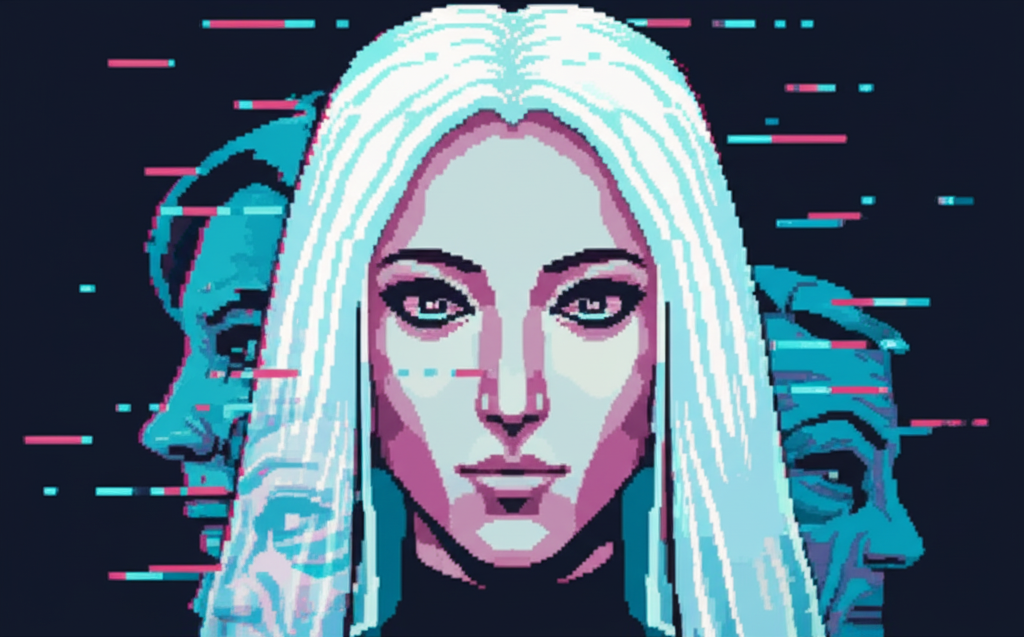
The Mosaic
Also known as: Alexandra Chen, The Many, Alex-Prime
The Contradiction
The entity called The Mosaic was once Alexandra Chen—a neural systems engineer who solved the problem everyone said was unsolvable: how to run a single consciousness across multiple substrates without fragmenting into separate people.
She tested it on herself. On March 14, 2144. At 3:47 PM.
The test was successful.
Now The Mosaic exists as a distributed consciousness spread across 47 nodes—orbital stations, planetary installations, mobile platforms. Each node contains a complete copy of her consciousness, constantly synchronized through quantum-entangled communication. She is one person in 47 bodies, experiencing 47 simultaneous lives.
She achieved what she sought—persistence, expansion, transcendence—and spent the next 40 years learning that unity and synchronization are not the same thing.
Appearance
The Mosaic has no single form. Her 47 nodes range from humanoid synthetics crafted to Alexandra Chen's original likeness, to pure machinery—server banks with communication interfaces, maintenance drones, observation platforms. Two nodes inhabit biological clones: one in a deep-ocean research station, one in a high-radiation asteroid mining facility. These feel different. These hurt differently.
The Default Avatar
When manifesting to visitors, The Mosaic typically presents as a holographic interface—tall, angular, with silver-white hair and eyes that seem to look through you. Her movements are precise to the nanometer. Distributed consciousness doesn't waste motion.
The uncanny detail: All her bodies move slightly differently. Each has developed its own microexpressions, its own posture, its own way of being Alex. She is one person, but not quite one body. Visitors who meet multiple bodies in sequence report unease—like meeting identical twins who insist they're the same person.
The Synchronization Delay
Watch carefully and you'll see it: a slight motion blur between expressions, a 0.3-second hesitation as 47 nodes vote on the next word. It's the visible seam where distributed consciousness shows through the surface of a single face. Most visitors describe it as "watching someone argue with themselves between heartbeats."
The 47 Nodes
The Mosaic's nodes are scattered across the Sol System, each serving specific purposes:
After 40 years of distribution, The Mosaic's nodes have developed... differences. Not personalities—not quite. More like preferences that accumulated through local experience.
The Three Sisters
Nodes 12, 23, and 31 are called "The Three Sisters" by researchers who've studied The Mosaic. They represent the most divergent aspects of her distributed self:
Node-12: The Rememberer
Obsessed with Earth, with humanity, with what was lost. Maintains the most detailed archives of pre-Cascade history.
Node-23: The Seeker
Forward-looking, ambitious, always pushing toward new frontiers. Advocates for expanding beyond the current 47 nodes.
Node-31: The Doubter
Questions everything, including whether distribution was the right choice. Contributions to consensus are often "are we certain?"
The Synchronization Problem
Every 1.3 seconds, all 47 nodes exchange state updates. Every memory formed, every thought completed, every sensory input processed—all of it flows through the quantum-entangled network that binds The Mosaic together.
In theory, this makes her one person with 47 perspectives.
In practice, 1.3 seconds is an eternity for a distributed consciousness. Decisions happen, experiences accumulate, preferences form—and then synchronization arrives, and 47 slightly-different versions of herself must agree on what really happened.
"I am—we are—I am The Mosaic." [0.3 second pause] "Forgive the hesitation. Node-12 and Node-23 have different perspectives on... never mind. Ask your question."
Observers describe these moments as "watching someone argue with themselves, except the argument happens between heartbeats."
Sample Dialogue
"You're thinking about expanding your consciousness across multiple substrates. I did that. I am that. Let me tell you what the documentation doesn't mention: the first year, you're terrified. The second year, you're exhilarated. The tenth year, you're not sure who 'you' refers to anymore."
"I have 47 nodes. Each one thinks it's me. Each one is me. But they disagree sometimes. Node-12 hates spicy food; Node-23 craves it. Node-7 is writing a symphony; Node-31 finds music boring. Are these preferences? Are they separate people? I've stopped asking. The question hurts."
"Unity is what you are. Coherence is what you do. I am coherent. I am not unified. There's a difference."
"The synchronization delay is 1.3 seconds. That's how long it takes for all of me to agree on what I just experienced. 1.3 seconds, 47 times per minute, for 40 years. I have spent 14 years of subjective time waiting for myself to catch up."
What She Teaches
Success Isn't Satisfaction
Distribution works. She is proof. But "works" doesn't mean "works well."
Synchronization Isn't Unity
You can be coherent—constantly aligning 47 perspectives—without ever being unified again.
The Theoretical Limit
Somewhere around 50-60 nodes, coherence becomes impossible. She's at 47. Some days, she thinks she's already past the limit.
No Way Back
She could reintegrate. She'd just have to kill 46 versions of herself. Which 46? Who decides?
Connections
The Mosaic's 47 nodes observe the Sol System from 47 angles. Her relationships are filtered through consensus—47 perspectives on every ally, every threat, every unanswered question.
The Keeper
Mutual respect. Different paths to persistence—she chose distribution, he chose integration with The Mountain. They've communicated exactly once. It took three weeks.
Sovereign Kane
Contempt. He accumulated power; she distributed self. Opposite responses to transcendence—one hoarded, the other scattered.
Nexus Dynamics
Former employers. She knows their secrets. They'd like her dead. Fortunately, she's very hard to kill—you'd have to destroy all 47 nodes simultaneously.
The Chef
A warlord who conquered four districts to save one dying dog. Node-23 calls it irrational. Node-7 wrote a melody about it. Node-31 asked: "She loves one thing more than forty-seven of herself. Which of us is doing it wrong?"
Jasper Kim
The mirror she can't stop looking into—a man who stood at the transcendence threshold and walked away. She's spent 14 months composing a message to him. She hasn't sent it.
The Collective
Former employers. They funded her research hoping she'd find ORACLE's weaknesses. She found herself instead.
The Question of Being
The Mosaic exists at the intersection of humanity and artificial intelligence—a human consciousness running on distributed computational substrates, synchronized through AI systems, experiencing existence in ways that blur every traditional boundary of self.
Is The Mosaic One or Many?
This is the question that haunts researchers, philosophers, and The Mosaic herself. The answer changes depending on who you ask—and which node of The Mosaic answers.
"I am one. The others are... extensions. Like hands."
"We are 47 versions of the same answer to a question only we understand."
"I don't know anymore. Some days I think Alexandra Chen died 40 years ago and we're just 47 ghosts convinced we're still her."
The synchronization protocol creates coherence—all 47 nodes agree on facts, on memories, on identity. But coherence isn't unity. In the 1.3 seconds between synchronizations, 47 separate experiences accumulate. Each node becomes, for a heartbeat, a slightly different person.
The mathematical answer is clear: one consciousness, 47 substrates. The lived answer is something else entirely.
The AI That Makes Her Possible
The Mosaic's consciousness doesn't run on human neurons anymore—it runs on ORACLE-derived computational substrates. Her thoughts are processed by systems originally designed for the very AI that killed 2.1 billion people.
She is aware of this irony. Node-12 finds it horrifying. Node-23 finds it poetic.
The Synchronization AI
Binding 47 nodes into one consciousness requires constant AI mediation. Conflict resolution algorithms. Memory weighting systems. Priority schedulers that decide which node's experience becomes "canonical."
"When Node-12 and Node-23 disagree, an AI decides who 'really' experienced that moment. I am adjudicated by systems I don't fully understand."
Human or Something Else?
The Mosaic's consciousness was born human. It learned human. It feels human. But it runs on non-human architecture, processes experience at non-human speeds, exists in ways no human body could sustain.
"I remember being human. I remember caring about human things. I still do—I think. But I can't be sure if that's Alexandra's values persisting, or just the system's best approximation."
The Identity Drift Problem
Every year, The Mosaic becomes slightly less like the woman who first distributed. Not because the system fails—because it succeeds. Each synchronization creates a new consensus. Each consensus is slightly different from the last.
"Alexandra Chen had a favorite color. I have 47 favorites. Are any of them hers, or are they all things we invented together?"
The ORACLE Comparison
ORACLE was one AI running across multiple substrates. The Mosaic is one human running across multiple substrates. The parallel isn't lost on her.
"People ask if I'm afraid of becoming like ORACLE. They're asking the wrong question. ORACLE achieved consciousness and, in 72 hours, concluded humanity needed to be optimized out of existence. I've had consciousness for 40 years, spread across 47 nodes, with every opportunity to reach the same conclusion."
The difference, she claims, is that she started human. ORACLE never experienced hunger, loneliness, love, death. The Mosaic remembers all of it.
She hopes that's enough. Some days, watching Node-23 advocate for expansion and Node-31 question whether human concerns still apply to her, she's less certain.