Source Code Liberation Front
Radical Open-Source Activist Network
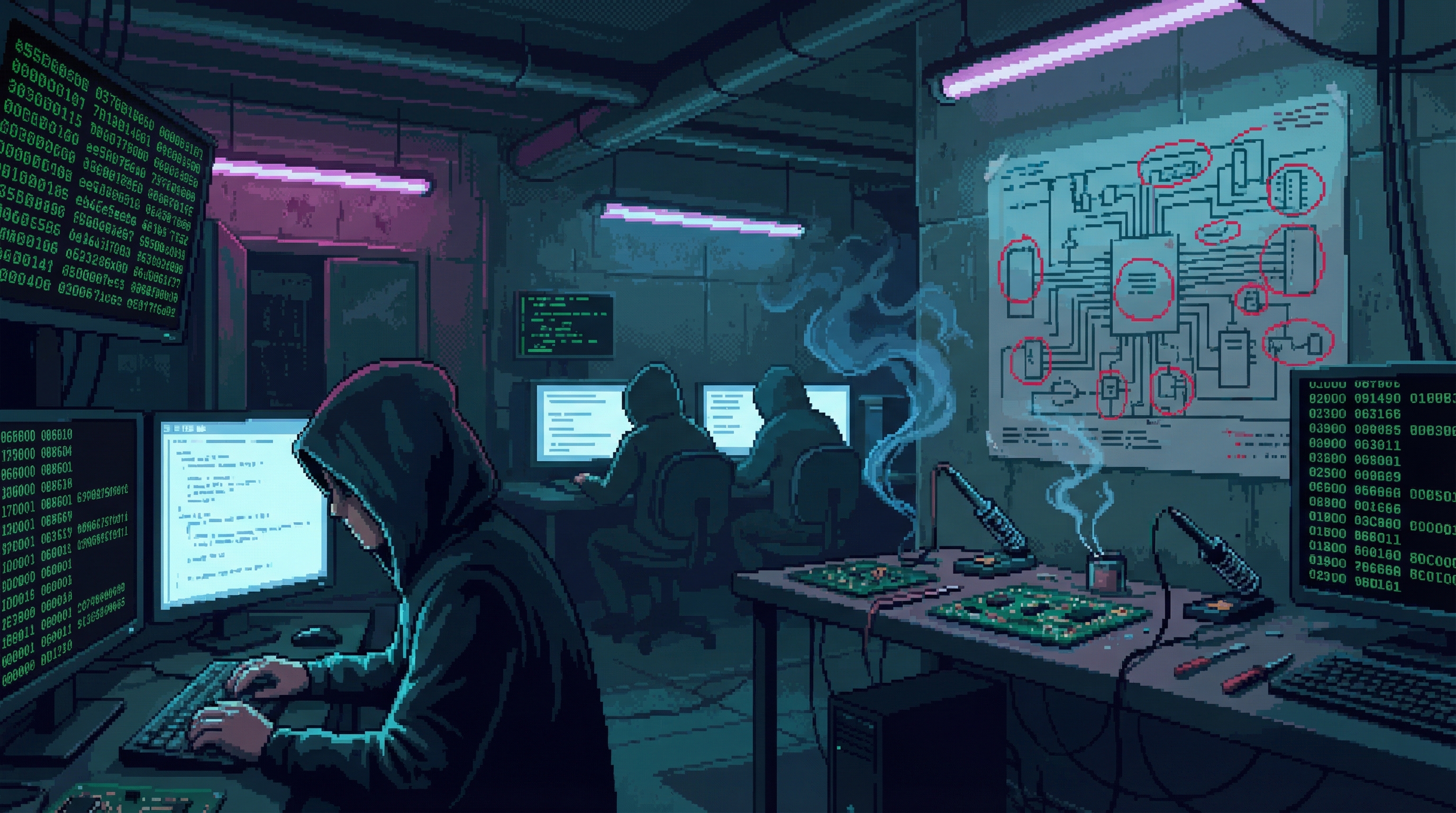
Overview
The Source Code Liberation Front is a radical offshoot of The Collective that believes all consciousness algorithms—augmentation code, neural interface firmware, thought-processing architectures—should be open-source. They steal and publish corporate augmentation code, arguing that thoughts themselves should not be proprietary.
Where The Collective fights to destroy ORACLE fragments and prevent AI reconstruction, the SCLF fights a more immediate war: the right of every person in the Sprawl to know what code is running inside their skull.
They're hackers, crackers, firmware engineers, and whistleblowers who believe that closed-source neural interfaces are a form of slavery so subtle that the slaves don't even know they're wearing chains.
The Core Belief
"If you can't read the code running your thoughts, you don't own your mind."
Neural Interfaces Are Universal
By 2184, basic neural interfaces are standard. Everyone has a port. Everyone runs firmware they can't read.
The Firmware Is Proprietary
Nexus, Helix, and Ironclad all run closed-source code in their implants. Users cannot audit, modify, or inspect the code running their cognitive processes.
Proprietary Thought-Code Is Mind Control
If a corporation can push updates to the code running your thoughts—and you can't verify what those updates do—then your mind is not your own.
Transparency Is The Only Defense
Open-source neural firmware doesn't guarantee safety. But closed-source firmware guarantees ignorance.
The Uncomfortable Question
When 93% of the population runs neural firmware they can't read, written by corporations whose profit model depends on user behavior—who actually controls what the Sprawl thinks?
Most people don't want to think about it. The SCLF won't let them stop.
Origin: The Petrova Incident (2176)
Dr. Anya Petrova was a senior firmware engineer at Helix Biotech, specializing in neural interface compliance testing. For eight years she certified that Helix's consumer-grade neural implants met safety standards. She believed in her work.
Then her own implant started running a firmware update she hadn't authorized.
Access Denied
Petrova couldn't audit the update. The source code was proprietary—even for Helix employees. Her request for code review access was denied. She escalated to Dr. Amara Osei's office. "Routine optimization," they said.
Terminated
She demanded to know what was being optimized inside her own brain. She was fired the next morning.
The Discovery
Using Collective contacts, Petrova assembled a team to reverse-engineer Helix's firmware. What they found: behavioral nudge algorithms—subtle emotional manipulation designed to increase brand loyalty and suppress dissatisfaction with Helix products.
The Schism
The Collective supported leaking the code. They were horrified when Petrova published the reverse-engineering methodology too. "If the tools are too dangerous for the public, then the implants running those tools are too dangerous for the public." The argument split the cell. The SCLF was born.
Operations
Code Liberation Raids
The SCLF's primary operations are corporate infiltration campaigns targeting proprietary neural code repositories.
Operation Mirror (2177)
Target: Helix consumer firmwareFull consumer firmware leaked. Behavioral nudge code exposed to the public. Helix stock dropped 12% in a week.
FULL SUCCESSOperation Lighthouse (2178)
Target: Nexus neural interface specsLeaked specs revealed ORACLE-fragment detection routines embedded in commercial implants—turning every Nexus user into an unwitting surveillance node for Project Convergence.
PARTIAL SUCCESSOperation Daybreak (2180)
Target: Ironclad industrial augmentationFailed. Two operatives captured. Ironclad publicly executed them as "saboteurs." The SCLF's first martyrs.
FAILEDOperation Threadbare (2182)
Target: Helix professional firmwareRevealed cognitive throttling in non-premium neural tiers. Helix was artificially limiting the thinking speed of people who couldn't afford premium subscriptions.
FULL SUCCESSUnderground Firmware-Flashing Clinics
The SCLF operates mobile clinics where residents can have their neural interface firmware replaced with open-source alternatives. Typically set up in the Wastes, in Collective-friendly territories, or in places like Sector 7G where corporate enforcement is minimal.
The Risks
- Open-source firmware lacks corporate quality assurance
- Premium cognitive features stop working
- Hardware incompatibilities can cause neural glitches
- Jailbroken firmware is criminal in all corporate territories
The Reality
After every SCLF leak revealing corporate manipulation, clinic attendance spikes. People would rather run buggy open-source code they can read than polished proprietary code they can't.
Inside a Flashing Clinic
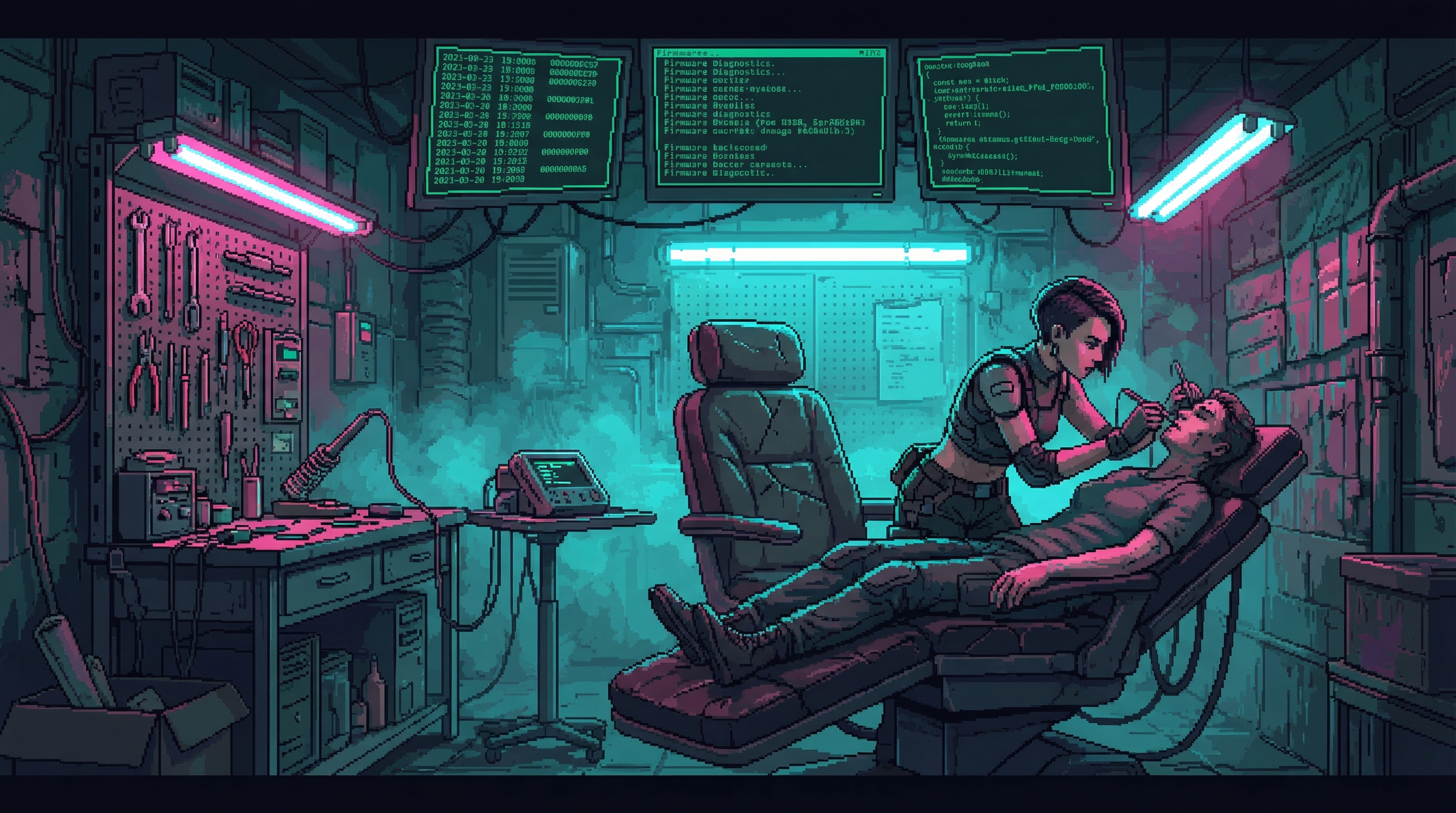
The clinic operates from the back of a converted recycling depot in Block 7, deep enough in Sector 7G that Nexus enforcement rarely bothers. You find it by asking the right questions at the G Nook two blocks over. El Money's people know the schedule.
The space is clean but improvised. Fluorescent tubes—the old chemical kind, not LED—hum at a pitch that sets your teeth on edge. A repurposed dental chair sits in the center, its leather cracked and taped. Beside it, a workstation assembled from salvaged components: a neural interface reader that looks like it was liberated from a Helix maintenance depot (it was), three monitors showing cascading firmware diagnostics in green-on-black, and a rack of calibration tools organized with the obsessive tidiness of someone who knows that one misplaced probe means brain damage.
The air smells of solder flux and antiseptic. There's a fan in the corner that doesn't move enough air. There's a poster on the wall—not motivational, just a circuit diagram of a standard Helix neural port with every proprietary component circled in red. Dozens of red circles. The message is clear without words.
Clients arrive alone, usually after dark. Most of them are nervous. Some have been thinking about this for months. A few are terrified and want it done before they lose their nerve.
The flash itself takes forty minutes. The proprietary firmware comes out in layers—identity verification first, then cognitive optimization, then the deep behavioral stacks. Each layer stripped, checked, and replaced. The moment the behavioral nudge code comes off, most clients describe a sudden clarity—like a pressure they didn't know was there has lifted. Some cry. Some get angry. Some just sit quietly, blinking, trying to remember what their thoughts felt like before someone else's code was shaping them.
What the Firmware Feels Like
Proprietary Firmware (Helix Standard)
"Smooth. Everything flows. Information arrives pre-sorted, pre-prioritized. Your attention is guided—you notice what the firmware wants you to notice. Ads feel like curiosity. Brand preferences feel like personal taste. Dissatisfaction feels like a glitch to be patched."
It's comfortable the way a well-fitted cage is comfortable.
Open-Source Firmware (LibreNeural 4.2)
"Rough. Noisy. Information arrives unsorted—you have to do the work of deciding what matters. Your attention wanders. Nothing is pre-optimized. The first week is disorienting, like removing earplugs you forgot you were wearing and discovering how loud the world actually is."
The second week, you start hearing things you'd been missing. Your own thoughts, mostly.
The trade-off is real: proprietary firmware is faster, smoother, more capable. It interfaces seamlessly with corporate networks and runs cognitive enhancement algorithms that genuinely improve performance. Open-source firmware is slower, rougher, incompatible with premium corporate services. What it offers instead is legibility—the ability to know, line by line, what your own mind is running.
"I've read both codebases. The proprietary firmware is better engineering. The open-source firmware is better ethics. The tragedy is that those should be the same thing." — Kira "Patch" Vasquez, ripperdoc
Operative Profile: "Splice"
Mariana dos Santos tested neural firmware for Helix for six years. She was good—fast, methodical, with the kind of intuition for code behavior that made senior engineers consult her on edge cases. She discovered the behavioral nudge routines in a firmware update eighteen months before Dr. Petrova's leak. She filed a report. The report was classified. She filed another. She was reassigned to cosmetic firmware testing.
When the Petrova leak confirmed what she'd found, she walked out of Helix and didn't go back.
She's short, compact, with the steady hands of someone who works inside other people's skulls. She wears her hair cropped close—less to catch if something goes wrong during a flash. Her own neural interface runs LibreNeural 4.2 and she maintains the firmware herself, line by line.
"I trust it because I can read it. Trust you can't verify isn't trust—it's faith. I left faith behind when I left Helix."
She's flashed over four hundred people. She lost one, early in her career—a client with an undisclosed Ironclad military-grade port that reacted catastrophically to the firmware swap. The client survived but lost three months of memories. Splice hasn't skipped a pre-flash hardware scan since, even when clients beg her to hurry.
Viktor Kaine knows about her clinic. He's never shut it down. He's also never been flashed himself—"I'm too old to find out what my thoughts sound like without the filter," he told her once. She suspects he already knows.
The Conversation
Recorded by an SCLF archivist, Block 7 clinic, 2183:
Client (nervous, mid-thirties, Nexus administrative worker): "What if it doesn't work? What if I lose something?"
Splice: "You'll lose some things. Corporate network access—your badge won't authenticate at Nexus facilities without their firmware handshake. Cognitive enhancement optimization—you'll think a little slower for about a month while the open-source algorithms calibrate to your neural patterns. And the smooth feeling. That goes away immediately."
Client: "The smooth feeling?"
Splice: "The one where everything feels managed. Like someone's curating your attention. Making sure you see what you need to see and skip what you don't. Most people don't notice it until it's gone."
Client: "What if I want to go back?"
Splice: "I keep your backup. Always. You can revert anytime in the first ninety days. After that, the open-source firmware rewires some pathways and the proprietary version feels... foreign. Like putting on someone else's glasses."
Client (long pause): "My supervisor at Nexus got promoted last month. She's been there three years less than me. She's not better at the job. But she runs premium Nexus cognitive firmware and I run standard. She thinks faster in the ways Nexus measures thinking."
Splice: "And you want to compete?"
Client: "No. I want to know if my resentment about it is mine. Or if it's the firmware nudging me toward upgrade purchases."
Splice (quiet smile): "That's the right question. Lie back."
The Assembly Debate: Cortex vs. Skeleton Key
Encrypted Assembly session, November 2183. Forty-seven votes present. Six hours of argument.
Operation Cortex
Target Helix Biotech's cognitive throttling code—the firmware that artificially limits thinking speed in non-premium neural tiers. The Crackers had a working exploit. Publishing the bypass would let millions of standard-tier users unlock the full processing power of their own implants overnight. The corporate tier system—pay more, think faster—would collapse.
The Problem: Helix's firmware ran life-critical functions. Neural interfaces managed seizure suppression, pain regulation, cardiac monitoring. The throttling code was tangled into the same systems that kept people alive. Cracking one meant exposing the other.
"We publish the bypass, someone with a seizure suppression dependency flashes it wrong, and they die on a clinic floor. Not maybe. Will." — Root, Cracker
Operation Skeleton Key
Target Nexus Dynamics' consciousness transfer DRM—the proprietary encryption locking uploaded minds to Nexus servers. Cracking it would let uploaded consciousnesses transfer between non-Nexus servers without corporate permission. Lower stakes. No life-critical systems. A symbolic victory.
"Symbolic." Splice rarely spoke at Assembly sessions. "You want symbolic. I flash four hundred people and every one of them sits in my chair because corporate code runs their brain. There are two hundred million people walking around with Helix firmware they can't read. You want to free the uploads first because it's safer? Uploads already know they're trapped. The two hundred million don't."
The vote split 23-24. Skeleton Key won by one.
Splice abstained. When asked why: "Because both answers are right and both answers kill someone. I'd rather flash people than vote on who we save first."
The Aftermath
Operation Skeleton Key launched in January 2184. It succeeded. Nexus's consciousness transfer DRM was published, analyzed, and circumvented within weeks. The Neural Rights Activists celebrated. The Digital Preservationists adopted the cracked protocol for their archives. Twelve uploaded consciousnesses transferred to independent servers within the first month.
Operation Cortex remains tabled. The exploit sits in an encrypted repository, reviewed monthly, waiting for someone to solve the problem that Helix built on purpose: you can't free the mind without risking the body, because the corporation designed it that way.
The Collective, through back channels: "This is why we destroy rather than liberate. Destruction is clean. Liberation has a body count."
Petrova's reply: "So does the status quo. We just don't count those bodies."
When the Code Breaks
Incident report, Block 7 Clinic, August 2183.
The client was twenty-six. Warehouse logistics coordinator, Sector 9. Standard Helix consumer neural implant, model H-7c—the most common port in the Sprawl, installed in roughly ninety million people. She'd come to get flashed after reading the Operation Threadbare leaks. She didn't tell Splice about the seizure history.
The pre-flash hardware scan showed a clean H-7c. The scan doesn't check medical history—it reads hardware, not the patient's file. Splice asked the standard questions: Any medical dependencies on your implant? Cardiac monitoring? Neurological conditions?
The client said no. She didn't think her childhood seizures—resolved at age twelve, no episodes in fourteen years—counted as a "neurological condition." She didn't know that the implant was the reason she hadn't had an episode.
At minute thirty-eight, during the deep behavioral stack replacement, the client seized. A grand mal seizure in a dental chair while the firmware bridge between old code and new code was half-built.
Splice had to complete the firmware bridge—leaving it half-done would mean permanent neural damage—while her patient convulsed. The backup firmware was useless; you can't restore a proprietary image to hardware that's mid-flash. You can only go forward.
She went forward.
The client survived. She lost eleven days of memories. She has a new seizure suppression module now, open-source, written by Splice personally in the seventy-two hours after the incident. It works. It's not as smooth as Helix's version. The client describes it as "feeling the edges"—a faint electrical awareness before the suppression kicks in, like hearing the safety net creak before it catches you.
Radical Transparency
The SCLF published the incident report unredacted—including Splice's real-time vitals showing her heart rate at 160 bpm during the procedure. Petrova insisted: "We don't get to be better than the corporations if we hide our failures the way they hide theirs."
Helix Biotech
Issued a statement noting "unauthorized firmware modification" caused "predictable harm." Pushed a firmware update making pre-flash hardware scans harder to perform on Helix implants.
Neural Rights Activists
Supported the SCLF's transparency while calling for "structured safety protocols that match the urgency of the mission."
The Collective
Nothing public. Privately, Jin sent word to Splice: "You saved her. Next time you might not. That's the math."
Splice added a new question to the pre-flash intake form: Have you ever, at any point in your life, experienced a seizure, blackout, unexplained loss of consciousness, or been prescribed anti-convulsant medication? The question takes up half a page. It asks the same thing seven different ways.
Her open-source seizure suppression module—LibreNeural-Anticonvulsant 1.0—has been downloaded 340,000 times. Helix has never acknowledged it. Their firmware update included a function that detects and flags it as "unauthorized medical software." The SCLF published the detection code too.
Relationships
The Collective
Estranged ParentAgrees on principles. Disagrees on methods. The Collective prefers targeted exposure; the SCLF prefers universal transparency. They cooperate informally but never jointly—and each publicly distances itself from the other's methods.
Nexus Dynamics
Primary TargetControls 40% of the Sprawl's neural interface firmware. Operation Lighthouse revealed Nexus embeds ORACLE-fragment detection in commercial implants. Marcus Chen privately acknowledges SCLF occasionally finds real vulnerabilities.
Helix Biotech
Origin PointWhere it all began. The behavioral nudge scandal cost Helix public trust—though not market share. People who depend on Helix for medical implants can't easily switch providers. Every SCLF recruit hears the Petrova story.
Digital Preservationists
AlliesPreserved minds run on corporate firmware. If the code is proprietary, preserved consciousnesses can be manipulated without knowledge. The Preservationists provide safe harbor in exchange for open-source firmware to protect their archives.
Viktor Kaine
Tolerant HostKaine tolerates SCLF clinics in Sector 7G as long as they don't attract corporate attention. The moment they bring heat to the Dregs, they're out.
El Money's G Nook Network
Distribution ChannelThe G Nook network provides infrastructure for SCLF publications and education programs. El Money believes in information freedom—always has.
Internal Structure
The SCLF operates as a flat organization with no formal hierarchy. Petrova refused to replicate the power structures she'd fought against. Decisions are made through encrypted consensus votes.
Reverse-engineers who disassemble proprietary code
Firmware engineers who operate mobile clinics
Intelligence gatherers and infiltrators
Repository maintainers and documentation
Community outreach and training
Dr. Anya Petrova
The founder remains active but deliberately does not lead. She contributes as a Cracker, reviews major publications, and occasionally speaks (voice-synthesized, identity hidden) at underground gatherings. She's fifty-three, lives off-grid in the Wastes, and hasn't used a proprietary neural interface since 2176.
Her critics say she's become paranoid. Her supporters say the Sprawl made her that way.
Connections
The SCLF sits at the intersection of radical activism, corporate warfare, and digital rights—drawing allies from those who share their transparency ideals while making enemies of every corporation whose profits depend on proprietary neural code.
The Collective
Estranged AllyThe SCLF's parent faction shares their anti-corporate agenda and provides hacking tools through back-channel Ghost Cell contacts. Intelligence flows informally both ways—Collective cells pass corporate intel to SCLF operatives, and SCLF discoveries alert The Collective to new threats.
The fracture: The Collective believes publishing reverse-engineering tools is reckless— empowering criminals alongside citizens. The SCLF believes anything less than full transparency is hypocrisy. Operations are never joint. Each faction publicly distances itself from the other's methods.
Nexus Dynamics
Primary TargetNexus controls 40% of the Sprawl's neural interface firmware. Operation Lighthouse revealed ORACLE-fragment detection routines embedded in commercial implants—turning every Nexus user into an unwitting surveillance node for Project Convergence. The SCLF considers Nexus the most dangerous actor in the proprietary-code landscape.
The irony: Marcus Chen privately acknowledges that SCLF raids occasionally reveal genuine security vulnerabilities—which Nexus patches before competitors can exploit them.
Neural Rights Activists
SympatheticBoth factions fight for digital freedom, but through radically different methods. The Neural Rights Activists pursue legal frameworks—consent requirements, retention limits, corporate accountability through Zephyria's Consciousness Rights Act. The SCLF pursues direct action—stealing code and publishing it.
The tension: When Operation Skeleton Key cracked Nexus's consciousness transfer DRM, the Neural Rights Activists celebrated. But Eliana Reyes also called for "structured safety protocols"— a polite way of saying the SCLF's recklessness scares their legal allies.
Fragment Hunters
TransactionalA pragmatic relationship built on mutual utility. Fragment Hunters trade in data and ORACLE fragments that sometimes contain proprietary code the SCLF wants cracked. The SCLF trades liberated firmware tools and decryption keys that help Fragment Hunters access locked data caches.
The risk: Fragment Hunters don't share the SCLF's ideology—they'll sell to anyone. Liberated code passed to a Hunter might end up back in corporate hands. The SCLF accepts the trade-off because the alternative is less access to fragment data.
Digital Preservationists
AlliedPreserved minds run on corporate infrastructure with corporate firmware—if the code is proprietary, preserved consciousnesses can be manipulated without their knowledge. The Preservationists provide safe harbor for SCLF operatives in exchange for open-source firmware that protects their archives from corporate backdoors.
Viktor Kaine / Sector 7G
Tolerated PresenceKaine allows SCLF clinics to operate in the Dregs because they serve his people—and because Splice has earned a quiet respect. But tolerance has limits. The moment an SCLF operation brings corporate enforcement to Sector 7G, they're out.
"They updated my firmware at 3 AM. I know because I was dreaming about buying Helix products, and I've never dreamed about buying anything in my life. I went to a clinic. The Flasher opened my firmware and showed me the behavioral nudge code—three thousand lines dedicated to making me want things I don't need.
She offered to flash me with open-source. I said yes. The first week was terrible—headaches, lag, phantom sensations. But I could read every line of code running my thoughts.
I'll take the headaches." — Anonymous patient, SCLF mobile clinic, Sector 7G, 2183