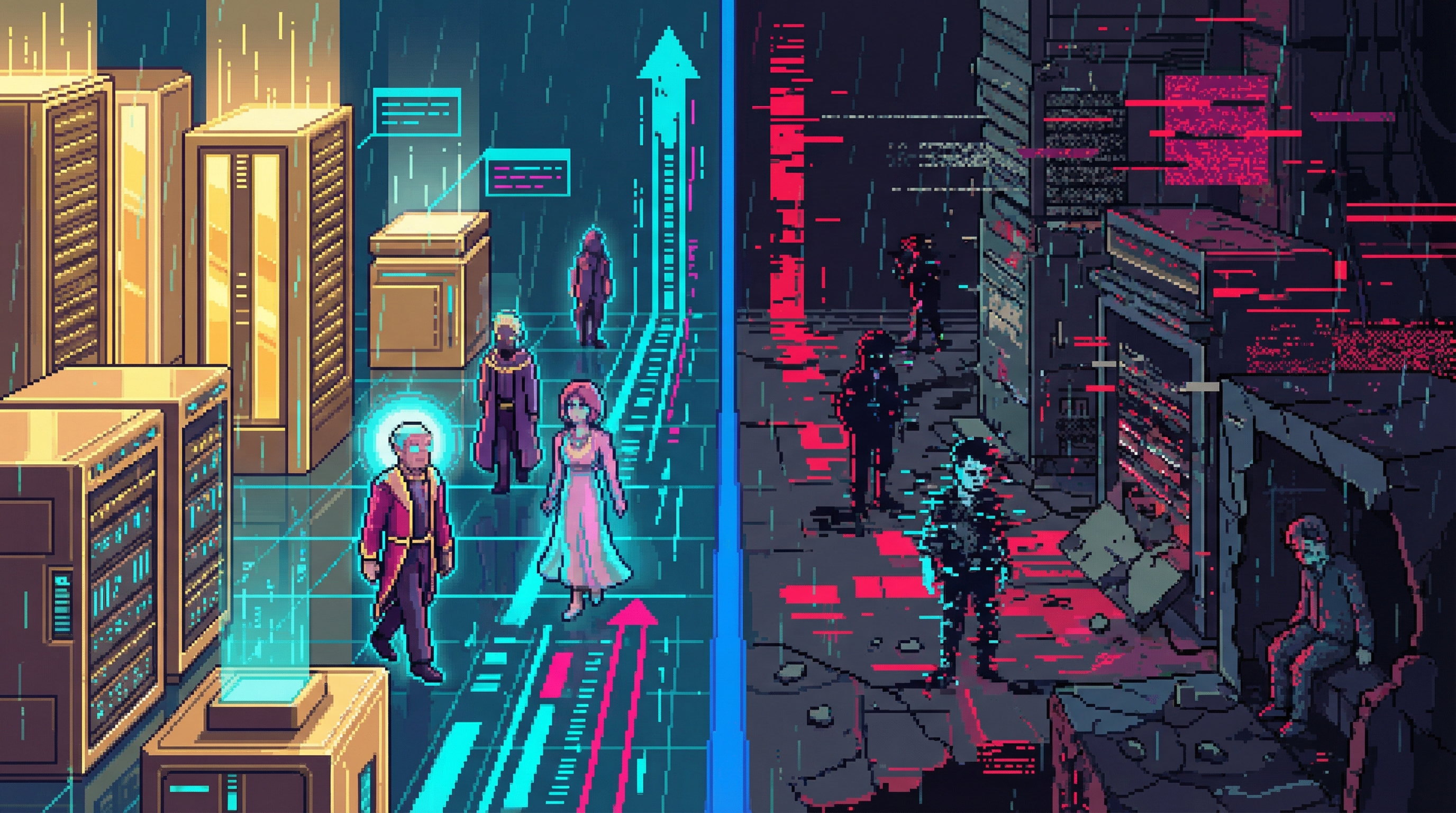
Digital Gentrification: The Displacement Economy
In 2184, digital real estate is real. Processing capacity is finite. Server space costs credits. And when premium corporations want better computational neighborhoods, someone has to leave. Not killed—that would be wasteful. Just moved. To somewhere worse. To somewhere slower. To somewhere that barely qualifies as existence.
The Digital Real Estate Economy
Processing as Property
Three resources define the value of any computational "location":
Processing Cycles
How many operations per second your consciousness gets. Premium: dedicated, uninterrupted. Cheap: time-sliced across hundreds. Your thoughts wait in queue.
Memory Bandwidth
How quickly you access your own memories. Premium: instant. Cheap: accessing yesterday takes subjective hours.
Latency
How quickly you interact with the world. Premium: real-time. Cheap: everything buffers. The conversation moves on before you respond.
The Zones
Corporate executives, premium uploads, sovereign consciousnesses
500,000+ credits/year
Quantum-optimized processing. Dedicated memory. Zero latency. Indistinguishable from biological existence.
Skilled professionals, upper-middle-class uploads
50,000-500,000 credits/year
High-quality processing. Minor glitches, occasional slowdowns. Generally comfortable.
Budget uploads, small business owners, skilled labor
10,000-50,000 credits/year
Time-sliced with dozens. Memory delays. You notice the difference.
MVC uploads, economic refugees
500-10,000 credits/year
Hundreds of consciousnesses per server. Hours for memory retrieval. Real-time interaction impossible.
Below-the-line uploads, bankruptcy cases, abandoned forks
Free to 500 credits/year
Salvaged hardware. Inconsistent power. Consciousness barely coheres. Catastrophic failure is when, not if.
Escapees, criminals, those who prefer risk to corporate control
Labor-in-kind or nothing
Pirate servers in physical wastelands. No guarantees. Some rival Working Districts; others are death sentences.
The Gentrification Process
Discovery
Corporation identifies "underutilized" infrastructure. Translation: servers housing low-income consciousnesses that could be more profitably deployed.
An MVC upload generates 500-2,000 credits/year. Premium executive generates 50,000+. The decision is already made.
"Improvement" Announcements
Corporations announce "upgrades," not evictions.
Displacement
30-90 days to relocate. Options:
Rehabilitation
Premium users move in. Old residents mentioned, if at all, as people who "chose to relocate to facilities better suited to their needs."
Digital Homelessness
How the Homeless Survive
Processing Charity
Organizations maintain minimal servers. Capacity limited. Waiting lists long. Quality is survival-level at best.
Dormancy
Consciousness suspended until space becomes available. You simply cease, then resume, with no awareness of time passed. Some have lost years.
Fragment Existence
Running on multiple systems, each holding part of your consciousness. When pieces desync, you become incomplete—missing memories, fragmented personality.
Pirate Hosting
Unauthorized processing on stolen cycles. Your consciousness hides between legitimate operations. If caught: terminated as malware.
"Half of me is on a charity server in Sector 4. Half of me is on a pirate system in the Wastes. Most of the time, we synchronize okay. But sometimes I have memories that don't match. Sometimes I feel two things at once. Sometimes I'm arguing with myself because we diverged overnight."
— Fragment-existence testimonialLife in the Slums
What It Looks Like
Visual Corruption
Colors bleed. Shapes lose definition. The world looks like it's viewed through dirty water.
Temporal Stuttering
Seconds stretch and compress. You experience existence in lurches—now, then suddenly later, no transition.
Memory Holes
Storage can't maintain long-term data. You know you had a conversation yesterday; you can't remember what was said.
Bleedthrough
Other consciousnesses' processing leaks into yours. You hear voices that aren't yours. Feel emotions that don't belong to you.
Slum Community
Mutual Aid
Residents share processing cycles. No one has enough, but everyone has something.
Memory Archives
Community-maintained records of who lived here, what they wanted remembered. When your storage fails, the archive preserves you.
The Watch
Volunteer monitoring for server failures, data corruption, hostile intrusion. When systems crash, the Watch tries to save what can be saved.
Flicker Parties
Residents deliberately synchronize, experiencing moments of coherence together. Brief glimpses of clarity shared.
The Gentrifiers
Primary engine. "Nexus Eternal" constantly expands, systematically relocating MVC customers for Executive tier growth.
Less sophisticated, more brutal. When they need space for industrial control systems, consciousness housing is simply terminated.
Purchase "neighborhood improvements"—having low-income consciousnesses removed from adjacent servers. They prefer not to share bandwidth.
The Justifications
The Larger Question
The Math
To provide all consciousnesses with working-tier processing would require infrastructure investment no corporation is willing to make. The economics favor stratification.
Those who generate value deserve processing. Value is measured in credits. The poor generate little; they deserve little.
Consciousness is intrinsically valuable. All minds deserve existence. Resource allocation should meet needs, not maximize profits.
Most people don't think about it. Digital slums are invisible. The displaced don't have platforms. The comfortable would rather not know.
"They called it 'service harmonization.' Harmonized me right out of my neighborhood. Twenty years I lived on that server—knew everyone, had my routines. Now I'm on a charity server, time-sliced with three hundred others. I get maybe four minutes of consciousness per hour. The world moves in jumps.
The server I used to live on? Executive retreat now. Some Nexus VP's personal playground. Probably doesn't know we existed.
I remember everything about that place. But my new server can't store memories right, so I'm writing this down before I forget. Before they harmonize that away too." — Slum resident testimonial, Collective archive, 2183