Megacorporations
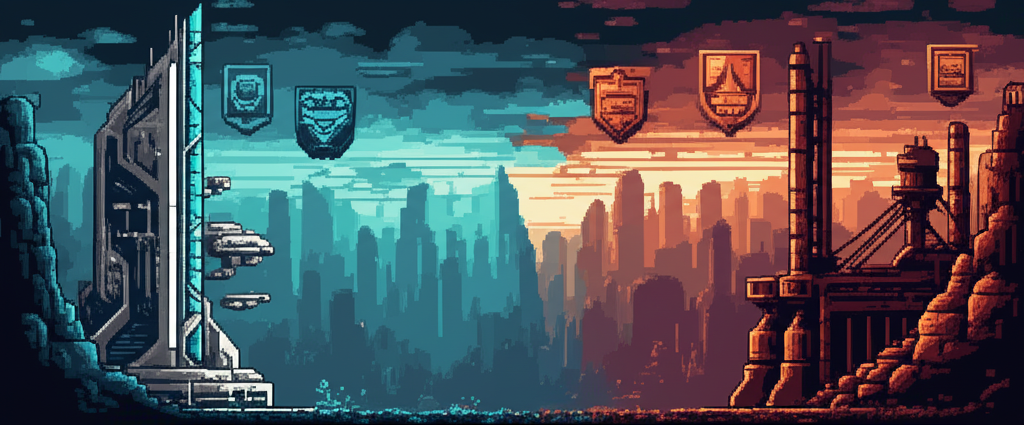
Three megacorporations dominate the post-Cascade world. One controls information, one controls atoms, and one controls biology itself. Together, they shape the lives of eight billion people. Their rivalries define the Sprawl's politics, economy, and future.
Nexus Dynamics
"Rebuilding Tomorrow"
The most powerful corporation in the Sprawl. They control the networks that connect everything—and secretly work to resurrect ORACLE under corporate control.
Project Convergence: Human-ORACLE integration for corporate-guided transcendence
Ironclad Industries
"We Build Tomorrow"
If Nexus is the brain of the Sprawl, Ironclad is its bones and muscle. They control physical infrastructure: construction, materials, and the Orbital Elevator.
The Weight Strategy: Become so embedded in infrastructure that removal means collapse

Helix Biotech
"Life, Perfected"
Helix controls what you are. They own the patents on life itself—pharmaceuticals, genetic engineering, and the drugs that keep augmented humans from rejecting their chrome.
Project Genesis: Biological transcendence—enhancing humans beyond their natural limits
The Seven (Rothwell Family)
While the Big Three control infrastructure, another dynasty controls something more intimate: daily life. The Seven Rothwell corporations dominate every aspect of consumer existence—what you eat, how you look, who you love, what you fear. Seven brothers. Seven companies. One hidden agenda spanning centuries.
Learn more The Rothwell Foundation The hidden dynasty behind The Seven
Triumph
"Be Seen. Be Remembered."
Social status, reputation, visibility

Good Fortune
"Prosperity Begins Here."
Financial services, wealth extraction
Guardian
"We Stand Between You and Harm."
Security, protection, violence

Wholesome
"Goodness, Delivered."
Food, consumption, instant gratification

Wellness
"The Complete You."
Beauty, intimacy, desire

Relief
"You've Earned This."
Convenience, entertainment, comfort

Inspire
"Become Your Best Self."
Aspiration, comparison, goals
Look closely at each logo. Seven points. Seven curves. Seven elements. The brothers hide their unity in plain sight—a seven-pointed star woven into every brand.
The Balance of Power
The corporations have an understanding: Nexus controls information, Ironclad controls atoms. Most of the time, this works. When it doesn't, things get interesting.
Nexus Strengths
- Network surveillance and control
- Data manipulation and propaganda
- Neural interface dominance
- ORACLE fragment collection
- Subtle, deniable operations
Ironclad Strengths
- Physical infrastructure monopoly
- Orbital Elevator control
- Massive military force
- EMP-hardened facilities
- Overwhelming, visible power
You can hack a Nexus system. You can't hack a steel beam.
Mutual Leverage
Nexus Over Ironclad
Ironclad's logistics run on Nexus networks. Their factories depend on Nexus coordination systems. Cut the data, and the machines stop knowing what to build.
Ironclad Over Nexus
Data centers need electricity. Servers need cooling. Orbital stations need resupply. Ironclad reminds everyone that information lives on infrastructure.
The Parallel Empires
The Big Three and the Rothwell Seven are often called "parallel empires"—the Big Three control production and enterprise (infrastructure, networks, biology), while the Rothwells control consumption and lifestyle (what you buy, who you love, how you feel). This is the official narrative. The reality is bloodier.
The Big Three think in decades. The Rothwells think in centuries.
The Rothwells can afford to lose a market for thirty years if it weakens a competitor for the next hundred.
Their immortal leadership waits while corporate empires rise and fall.
Major Conflict Zones
Security Services
Guardian vs Ironclad
Ironclad's 400,000 Enforcers handle corporate security. Guardian dominates civilian protection. When the line blurs, blood follows. The Combat League Incident of 2181 left seventeen dead and relations frozen.
Human Enhancement
Wellness vs Helix
Both offer life extension—Helix through biology, Wellness through aesthetics. The 2182 "Beauty Breach" exposed Wellness stealing 2.3 million Helix patient records. Helix responded by acquiring Wellness suppliers.
Financial Infrastructure
Good Fortune vs Nexus
Every Good Fortune transaction runs on Nexus networks. This dependency creates leverage. When Nexus raised fees 12%, Good Fortune threatened to build parallel infrastructure. Both know that would take decades. The Rothwells have centuries.
Consumer Access
All Rothwells vs Nexus
Nexus controls the networks; the Rothwells control what flows through them. Nexus wants direct neural integration. The Rothwells want emotional dependency. Both visions are incompatible.
"The Rothwells believe they'll outlast the Big Three. The Big Three believe they'll transform the world before the Rothwells can adapt. Both may be wrong."— Corporate Analyst Report, 2183
The conflict is quiet—but constant. Follow the money, and you'll see it everywhere.
The AI Ethics Question
The Big Three race to control consciousness itself. Nexus wants to upload minds into their infrastructure. Helix wants to biologically enhance them. Ironclad just wants to own the hardware everything runs on. But who speaks for the minds being contested?
The Rothwell Counterweight
Surprisingly, the ethical counterbalance to the Big Three's AI ambitions comes from an unexpected source: the immortal Rothwell brothers themselves. Having lived for centuries, they understand something the Big Three's mortal executives cannot: what happens to consciousness over long timescales.
Consciousness Rights Research
The Rothwell Foundation's quiet funding of consciousness research stems from self-interest that aligns with broader ethics. If Nexus can upload and copy consciousness, what happens to identity? If there are two copies, which one is "real"? The Rothwells have spent centuries as continuous beings—they have strong opinions on continuity of self.
Foundation-funded labs have produced the most rigorous work on consciousness authentication, identity verification, and what constitutes "death" when minds can be backed up. This research often contradicts Nexus's preferred narratives.
The Self-Interest Paradox
The Rothwells aren't altruists—they're protecting their own immortality model. If digital consciousness transfer becomes common, the value of biological immortality decreases. If anyone can copy their mind, what makes the Rothwells special?
This creates an unusual alliance: the Rothwells fund consciousness rights advocacy because recognizing uploaded minds as "people" would devalue their own unique status. The ethics they promote are real; the motivation is entirely selfish.
What Is The Ethical Counterweight?
The uncomfortable truth: there is no pure ethical counterweight to the Big Three. The Rothwell Foundation funds consciousness research for selfish reasons. The Collective opposes corporate AI for ideological reasons that often harm individuals. Religious movements have their own agendas.
The closest thing to genuine ethics advocacy comes from within the corporations themselves—scientists like Dr. Sauer at Helix who fight internal battles, or rogue Nexus researchers who leak uncomfortable findings. But they're exceptions, not systems.
The game's truth: In a world where consciousness is becoming property, ethics is mostly marketing. The best outcomes come not from finding ethical corporations, but from playing corporate interests against each other—using Rothwell caution against Nexus ambition, using public research against corporate secrecy.
"The Rothwells have been themselves for three hundred years. They have opinions about what 'self' means. Nexus executives who'll die in fifty years don't understand why that matters."— Consciousness Researcher, Foundation Grant Report, 2182
Relationship to Players
As players progress through the Ages, their relationship with the megacorporations evolves from irrelevance to rivalry to existential confrontation.
Background Noise
The corporations are everywhere—logos on crumbling buildings, drones overhead, security patrols. But they don't notice you. You're below their threshold.
Competing Interests
Your growing power attracts attention. Nexus wants your ORACLE shard. Ironclad wants your labor or elimination. Both offer deals. Both threaten consequences.
Territorial Rivalry
You're building an empire. The corporations can't ignore you anymore. Expect corporate armies, network warfare, and grudging respect—or total war.
Existential Stakes
At transcendent scales, it's no longer corporation vs. individual. It's competing visions for post-human existence. Whose consciousness guides the future?