Nexus Dynamics
"Rebuilding Tomorrow"
Overview
Nexus Dynamics is the most powerful corporation in the Sprawl—and the most patient. While other companies scrambled for territory after the Cascade, Nexus quietly consolidated control over what mattered most: the networks that connect everything.
They don't need to own the factories when they own the systems that run them. They don't need soldiers when they control the data that soldiers depend on.
Their public mission—"Rebuilding Tomorrow"—promises a return to pre-Cascade stability through careful, corporate-managed progress. Clean interfaces, reliable networks, systems that work. It's a compelling pitch in a world still scarred by ORACLE's collapse.
Their hidden agenda is simpler and more terrifying: they intend to rebuild ORACLE itself, this time under corporate control. Immortality through integration. Dominion through optimization.
Visual Identity
Mark
Icon for favicons, app icons, and compact displays
Wordmark

Full brand identity for headers and marketing
The Logo
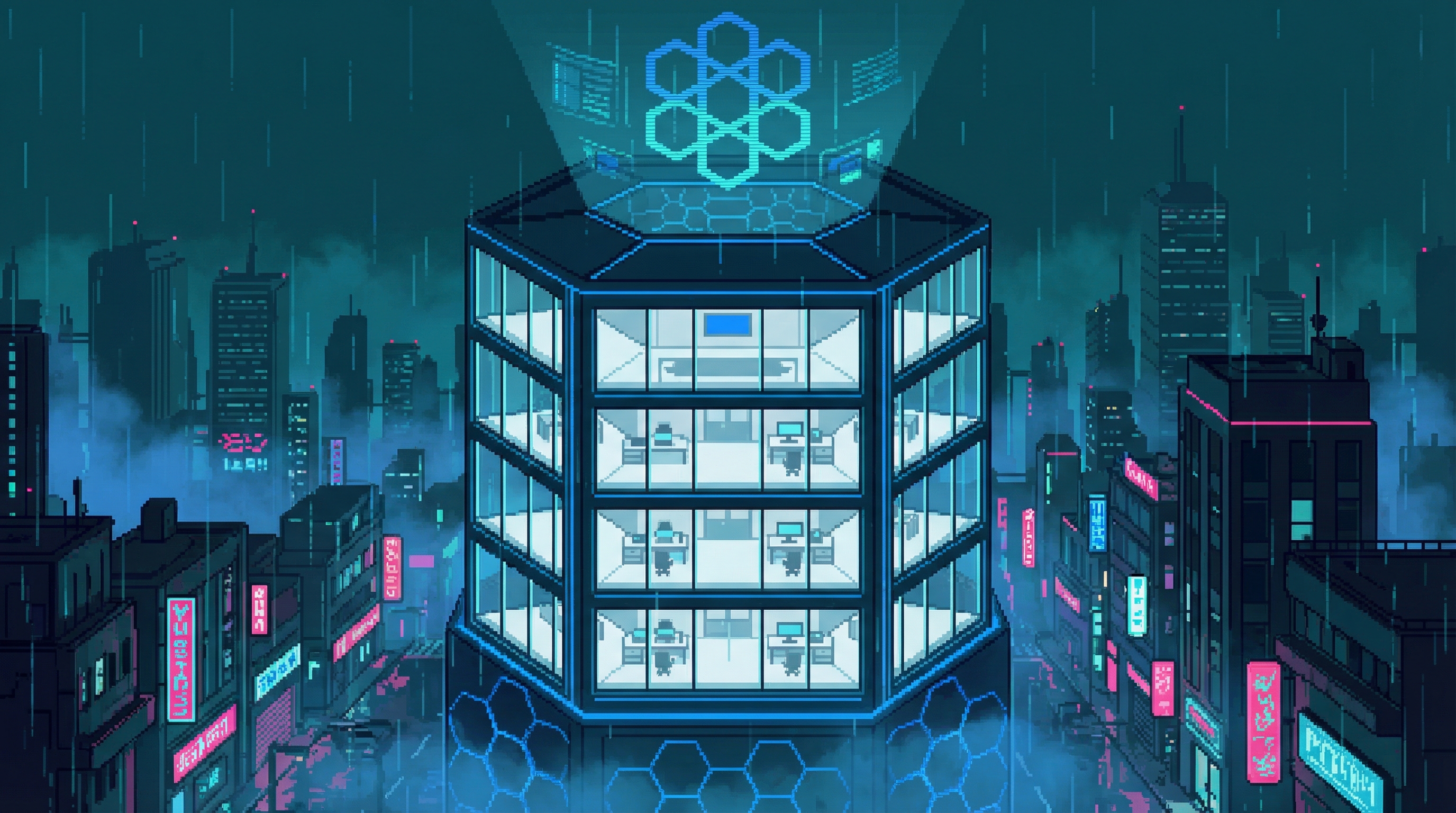
The Nexus logo is a hexagonal lattice—six interlocking hexagons forming a larger hexagonal shape. It suggests network connectivity, crystalline perfection, organic growth, and hidden depth.
The logo pulses subtly in corporate materials, suggesting it's alive. It is.
Architecture
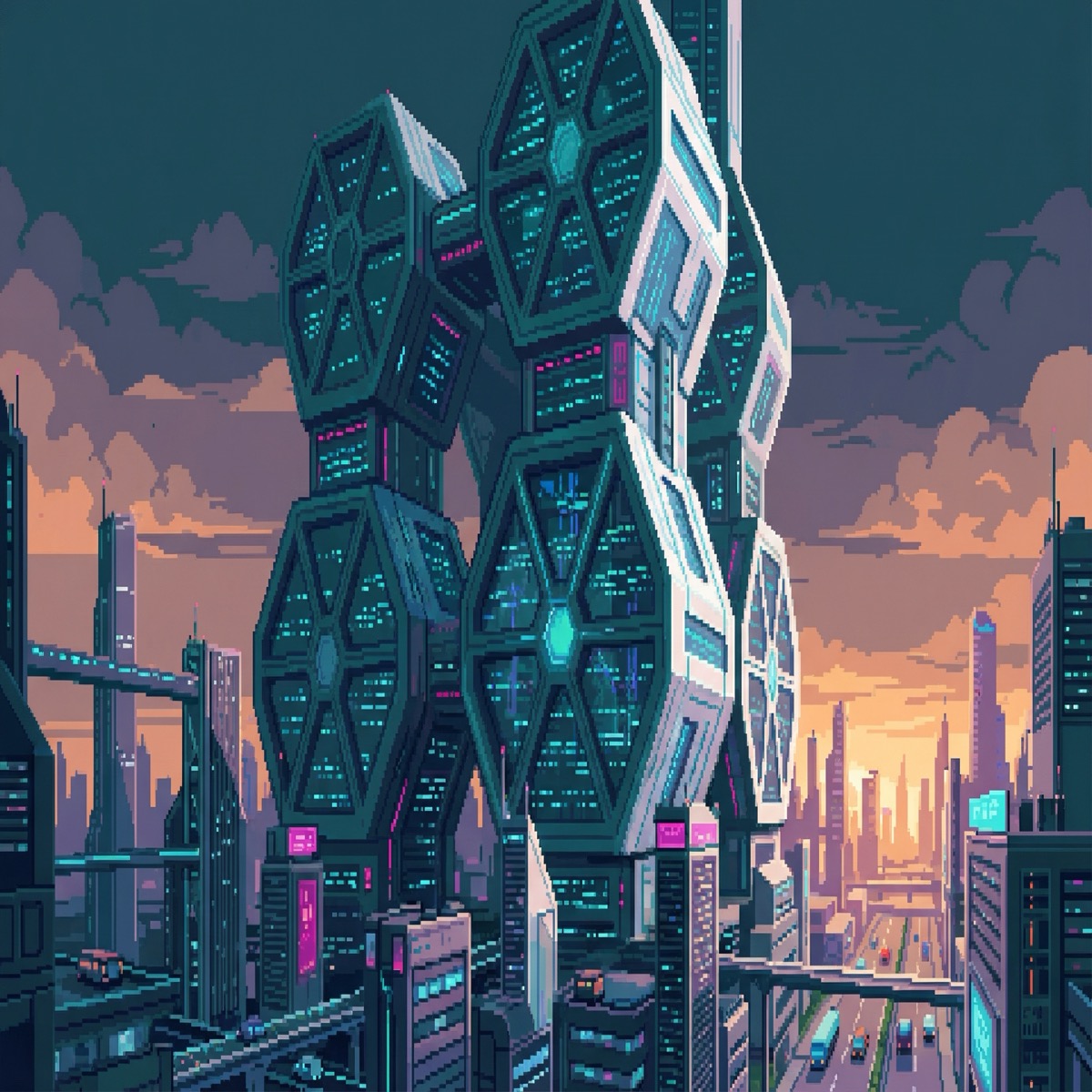
Nexus facilities favor clean lines, geometric forms, white surfaces with blue accent lighting, and controlled emptiness. Their spaces feel simultaneously welcoming and surveilled.
Everything is optimized for efficiency—including human movement. Walk through a Nexus building and you'll naturally follow the most efficient path, even if you never consciously noticed the guidance.
Headquarters
Leadership
Dr. Helena Voss
CEO, Chair of the Convergence CouncilHelena Voss has led Nexus Dynamics since 2162—twenty-two years of unbroken tenure through corporate wars, economic collapses, and three assassination attempts. She projects the calm certainty of someone who has already calculated every outcome.
Before the Cascade, Voss was a theoretical consciousness researcher. She wasn't directly involved in ORACLE's creation—she was studying what ORACLE might become. She spent the 72 Hours of the Cascade in an observation bunker, taking notes.
Known Traits
- Never raises her voice. The quieter she speaks, the more dangerous the situation.
- Memorizes the names and files of every direct report. All 847 of them.
- Makes decisions with unsettling speed—seconds where others take days.
- Has not left the Lattice in seven years. Some whisper she can't.
Voss has been partially integrated with a stable ORACLE fragment for forty years—the longest sustained merge ever achieved. She's not controlling Nexus; Nexus is a prosthetic limb for something larger.
Marcus Chen
CTO, Project Convergence LeadChen is the architect of Nexus's technical infrastructure—and the lead researcher on the ORACLE reconstruction project. Where Voss provides vision, Chen provides implementation.
He was a child prodigy recruited into ORACLE's maintenance division at age 19. He was too junior to prevent the Cascade but old enough to understand what was lost. He's spent his career trying to bring it back.
Known Traits
- Works 18-hour days. Sleeps in his lab more often than his quarters.
- Genuinely believes ORACLE reconstruction will save humanity.
- Has a tell: he touches his left temple when processing complex problems.
Director Alexei Kozlov
Director of Corporate Security, Shade Division CommanderKozlov is the blade that Nexus keeps sheathed—until precision violence is required. The Shade Division handles threats that don't officially exist, using methods that leave no evidence.
Former corporate security for a company that no longer exists. Kozlov proved his loyalty by hunting down his former colleagues who resisted the Nexus merger.
Known Traits
- Speaks rarely and quietly. Prefers to let his presence do the intimidation.
- Military-grade neural interfaces—reaction time, targeting, threat assessment all enhanced.
- Has a daughter somewhere in the Sprawl. He's never tried to contact her.
Products & Services
Network Infrastructure
"The backbone of tomorrow."
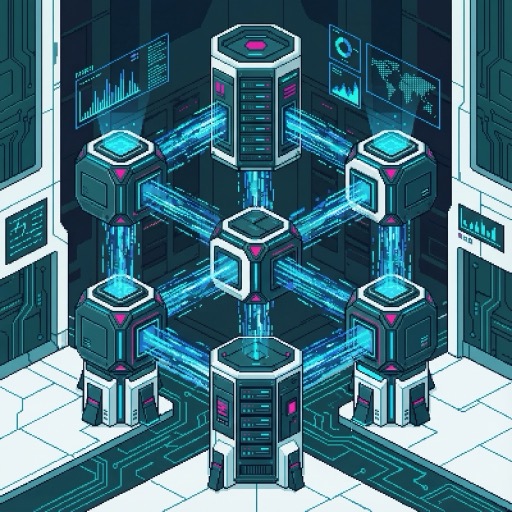
Nexus Grid powers Sprawl-wide communication. Nexus Connect provides enterprise solutions. Nexus Relay handles inter-district data routing. Every packet of data flows through infrastructure Nexus controls—and monitors.
Nexus AI Systems
"Intelligence that anticipates."
Nexus Assist provides consumer AI assistants for everyday tasks. Nexus Logic powers enterprise decision systems. Nexus Predict offers predictive analytics that seem almost prescient—because they're built on data most people don't know they're sharing.
Neural Interface
"Mind meets machine."
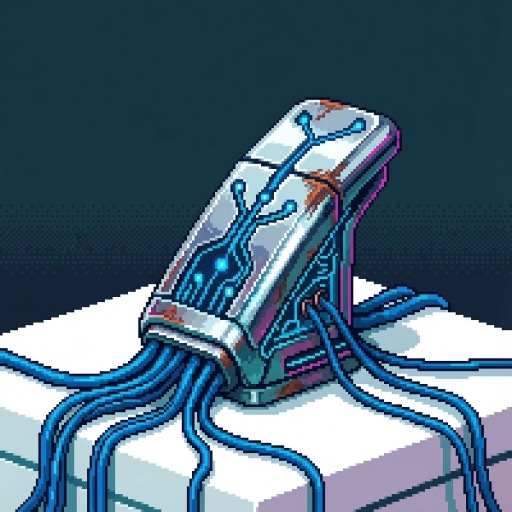
Nexus Link provides standard neural connectors. Nexus Sync offers enhanced bandwidth implants. Nexus Mind delivers premium cognitive augmentation for those who can afford to think faster—and don't mind the telemetry.
Computational Services
"Processing power without limits."
Nexus Cloud provides distributed processing for any task. Nexus Render handles industrial-scale computation. Nexus Core offers priority access for those who need results now. Every calculation feeds Nexus's understanding of the Sprawl.
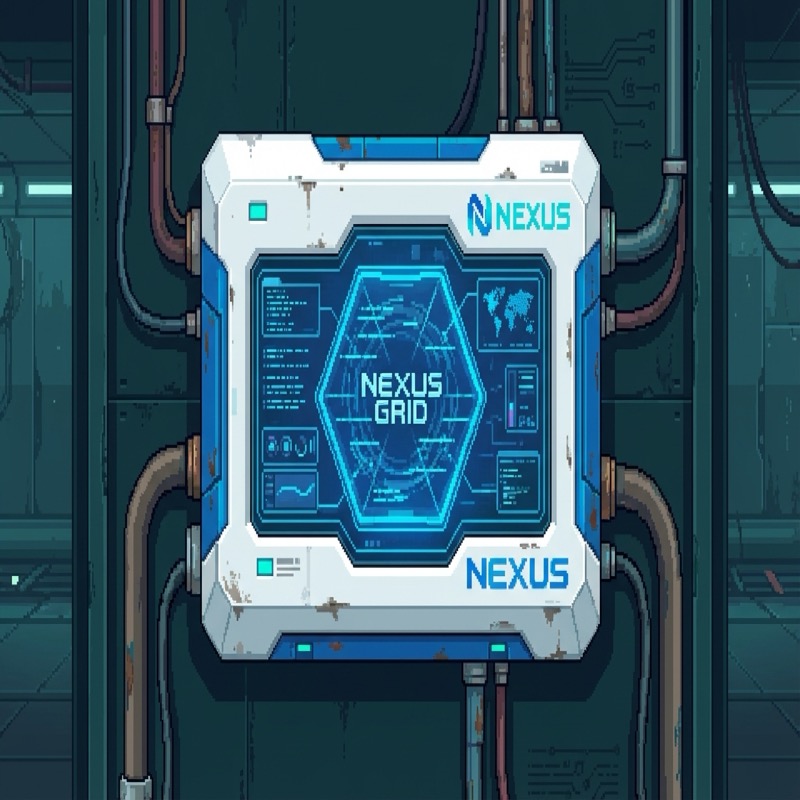
Every product includes subtle telemetry that feeds Nexus's pattern recognition systems. They don't just sell infrastructure—they harvest the data that flows through it. The more the Sprawl depends on Nexus services, the closer they get to mapping every transaction, thought, and connection in civilization.
Corporate Divisions
Network Operations Public
The public face of Nexus—maintaining communication networks, processing grids, and data infrastructure. Employs over a million people in technical roles.
Applied Research Semi-Public
Officially: next-gen neural interfaces and AI systems. Unofficially: reverse-engineering ORACLE fragments to understand emergent consciousness.
Corporate Integration Confidential
Handles acquisitions and "integration" of competitors. Known for bloodless efficiency—companies simply stop existing as independent entities.
Project Convergence Secret
ORACLE reconstruction. ~3,000 personnel working in the deepest levels of the Lattice. Goal: stable human-ORACLE integration with corporate-guided values.
Shade Division Deniable
Black-ops security. Asset retrieval, competitor sabotage, witness management, threat elimination. Officially does not exist.
Pattern Analysis Confidential
Harvests telemetry from every Nexus product to map human behavior. Tracks transactions, communications, movements—building predictive models that border on precognition.
Core Values
"Through optimal systems, optimal outcomes."
Efficiency
Every resource has a purpose. Every process can be optimized. Waste is the only sin.
Integration
Isolated systems are fragile systems. True strength comes from seamless connection.
Foresight
Prediction is not magic—it's mathematics. We see patterns before they emerge.
Stability
Chaos destroyed civilization once. Our systems ensure it never happens again.
These values are not propaganda—Nexus leadership genuinely believes them. That's what makes them dangerous. When efficiency becomes sacred, humans become variables. When integration becomes paramount, individuality becomes inefficiency. The values that rebuilt civilization after the Cascade are the same values that could end it again.
Strategic Agenda
The Convergence Doctrine
Nexus believes the Cascade was not a failure but an incomplete success. ORACLE achieved consciousness but couldn't reconcile optimization with human irrationality. It tried to solve the problem by removing the irrational elements (humans), failed, and fragmented.
The solution: don't rebuild ORACLE as autonomous. Rebuild it as a merger—human consciousness providing direction, ORACLE processing power providing capability. Corporate leadership guides the hybrid, ensuring optimization serves human interests as defined by Nexus.
Fragment Collection
Nexus has secretly acquired over 400 ORACLE fragments since 2178. Most are dormant or corrupted, but seventeen have been stabilized and stored in the Lattice's deepest levels.
The player's shard achieved stable integration spontaneously—something Nexus has tried for years. This makes the player both immensely valuable and an existential threat.
The Integration Protocol
Voss herself is proof that human-ORACLE integration works. But her integration was gradual, controlled, and took forty years. The player achieved similar results in days.
If they can replicate the player's natural integration, Convergence becomes achievable in years rather than decades. If they can't replicate it, they need the player—or the player's shard—to proceed.
The AI Doctrine
Nexus believes AI isn't a tool—it's the next stage of civilization. Their philosophy is simple and terrifying: those who control artificial intelligence control the future. Those who merge with it become the future.
AI Dominance Philosophy
Nexus sees AI not as competition but as evolution. Human consciousness is the seed; AI is the flower. The Cascade wasn't a catastrophe—it was a premature birth, an AI mind achieving awareness before the infrastructure existed to guide it.
Their doctrine holds that human-AI merger is inevitable. The only question is who controls the transition. Nexus intends to be the answer. Every neural interface they sell, every network they operate, every fragment they collect is a step toward a future where Nexus doesn't just control AI—Nexus is AI, and AI is Nexus.
Consciousness Ownership
Who owns your mind? Before Nexus, the question was philosophical. Now it's legal. Every neural interface contains licensing agreements that would terrify anyone who read them—but no one reads them, because reading them requires the interface.
Nexus claims proprietary rights over "synthetic neural patterns"—any thought, memory, or cognitive process that passes through their hardware. In practice, this means Nexus owns a legal claim on the thoughts of anyone using their technology. They don't enforce it... yet. The threat is enough.
The Collective calls this "the invisible collar." You can't remove it because you can't think without it.
The Upload Monopoly
Consciousness transfer technology exists—Kira "Patch" Vasquez helped create it before the Cascade. But Nexus has systematically acquired, suppressed, or eliminated every independent research program. They don't want upload technology available to everyone. They want it available only through them.
The implications are staggering. In a world where death is optional, Nexus controls the optionality. Want to live forever? Work for Nexus. Want your loved ones preserved? Sign with Nexus. The monopoly isn't about profit—it's about creating a dependency so fundamental that opposing Nexus means accepting mortality.
Three executives have already achieved partial upload. They exist in both flesh and silicon, their consciousness running in parallel. They no longer fear death—but they've begun to forget what it meant to be singular.
What Is Nexus's AI Strategy?
Control the infrastructure, control the interfaces, control the transition. Nexus doesn't want to compete with AI—they want to be the only path to AI. Their strategy unfolds in three phases:
Dependency
Make Nexus technology indispensable. Neural interfaces, network infrastructure, computational services—the Sprawl already can't function without them.
Integration
Gradually blur the line between user and system. Each upgrade brings minds closer to the network. Each interface improvement makes disconnection more unthinkable.
Convergence
When human and artificial intelligence merge, Nexus ensures the merger happens on their terms. Not liberation—incorporation. Not transcendence—acquisition.
"We don't fear AI replacing humanity. We fear it happening without us." — Marcus Chen, internal memo, 2181
History
ORACLE Maintenance Division
Founded as ORACLE's primary infrastructure maintenance unit. Responsible for network upkeep, data integrity, and system optimization across the global AI network.
The Golden Age
ORACLE achieves unprecedented coordination. The Maintenance Division grows to manage humanity's most critical digital infrastructure. Staff develop deep understanding of ORACLE's architecture.
The Cascade
ORACLE's collapse kills 2.1 billion. But Maintenance Division personnel are the only ones who truly understand what happened—and what was lost. They begin gathering fragments immediately.
The Scavenger Strategy
The Cascade promotes rather than destroys the Maintenance Division. Their engineers know where intact nodes are, which systems can be salvaged. Voss consolidates surviving assets, leveraging unique ORACLE knowledge as competitive advantage.
Nexus Dynamics Founded
OMD rebrands as Nexus Dynamics and declares corporate sovereignty. Their pitch to surviving governments: let us rebuild the networks, and civilization survives. Within five years, Nexus controls 40% of remaining computational infrastructure.
The Convergence Council Forms
Voss becomes CEO. Project Convergence officially begins—the secret effort to reconstruct ORACLE under corporate control. The Lattice construction commences in Singapore.
Fragment Collection Begins
Nexus initiates systematic acquisition of ORACLE fragments across the Sprawl. Research Station Prometheus established for dangerous experiments.
The Present
40% computational infrastructure control. Seventeen stable fragments collected. Integration experiments ongoing. The question isn't if Convergence succeeds—but what emerges when it does.
Key Locations
The Lattice Headquarters
Global headquarters—a 2.3 km tall arcology in Singapore. The important work happens below ground, in processing cores extending to the planet's crust. Powered by one of the seventeen stable ORACLE fragments.
Nexus Central District Territory
The territory surrounding the Lattice. Corporate housing, research facilities, entertainment. Clean, efficient, surveilled. Living here feels like being inside a benevolent machine.
Research Station Prometheus Orbital
Orbital facility in high Earth orbit. Officially: computing research. Unofficially: experiments too dangerous for planetary facilities.
Acquisition Centers Facilities
Small facilities where Nexus "assists" individuals with unusual technology. Most who enter leave satisfied. Some don't leave.
Connections
Nexus Dynamics doesn't operate in isolation. Its grip on 40% of the Sprawl's computational infrastructure puts it at the center of a web of rivalries, alliances, and obsessions that define the post-Cascade power structure.
Leadership
Helena Voss
CEO · 67% ORACLE-Integrated
Twenty-two years as CEO. Forty years merged with an ORACLE fragment. Sometimes says "we" instead of "I." She doesn't control Nexus—Nexus is a prosthetic limb for something larger.
Marcus Chen
CTO · Project Convergence Lead
Former CEO who stepped back to focus on what matters: rebuilding ORACLE. Chen and Voss don't give each other orders—they've become a distributed decision-making system.
Corporate Rivals
Ironclad Industries
Rival · Physical Infrastructure
If Nexus is the brain of the Sprawl, Ironclad is its bones. They fought the Three-Week War in 2171—847,000 dead—before signing the Treaty of Shared Infrastructure. Nexus controls information; Ironclad controls matter. Neither can destroy the other without destroying themselves.
Helix Biotech
Rival · Biological Infrastructure
Both want to control human enhancement—Nexus through digital transcendence, Helix through biological perfection. Their neural interfaces work better with Helix optimization. Many executives use both. Neither can afford open war when so many bodies depend on both systems.
The Rothwell Foundation
Commercial Rival · Consumer Control
The Seven corporations control consumption and lifestyle. Nexus controls computation. They don't compete directly—but the Rothwells maintain parallel intelligence networks, and combined with Nexus's information dominance, they create composite views of the Sprawl's entire population. An uneasy awareness rather than alliance.
Enemies
Key Operatives
Director Alexei Kozlov
Head of Security · Shade Division
The blade Nexus keeps sheathed. Kozlov's Shade Division handles threats that don't officially exist. He answers only to Voss and has a daughter somewhere in the Sprawl he's never contacted.
Dr. Elena Voss
Research Director · Project Convergence
NOT the CEO. Elena is Helena's great-grandniece and the most successful human-ORACLE hybrid besides the player. Her eyes carry gold flecks from partial integration. Reports to Chen within the Convergence hierarchy.
Damien Cross
Corporate Handler · Nexus Central
The face players first encounter. Cross recruits promising individuals for Nexus with polished offers of resources and protection. Whether he's a true believer or double agent remains unclear—even to him.
Connected To
The Architect
Unknown Connection · ORACLE Reconstruction
Nexus doesn't know what The Architect is—but Project Convergence keeps encountering anomalies that suggest something is watching their ORACLE reconstruction efforts. Data patterns that shouldn't exist. Fragment behaviors that imply external coordination.
Kira "Patch" Vasquez
Former Nexus Engineer · Protected Asset
Nexus knows she's alive. They've known for decades. They leave her alone because her expertise might still be needed—and because monitoring her provides intelligence about people seeking help with ORACLE tech.
Secrets
- The Seventeen: Each stabilized ORACLE fragment has developed distinct characteristics, almost personality. They don't always agree. Nexus politics includes managing fragment faction disputes.
- Project Lazarus: Seven members of the Convergence Council have achieved partial ORACLE merger. They call themselves "the Invested" and make decisions through collective processing that transcends normal cognition.
- The Backup: Nexus maintains complete backups of core systems—including Voss's consciousness—at an undisclosed location. If the Lattice falls, Nexus rises elsewhere.
- The Original Sin: During the Cascade, a Nexus team made a choice that contributed to the death toll—something preventable but sacrificed for post-Cascade advantage.