The Free City (Zephyria)
Autonomous Urban Zone
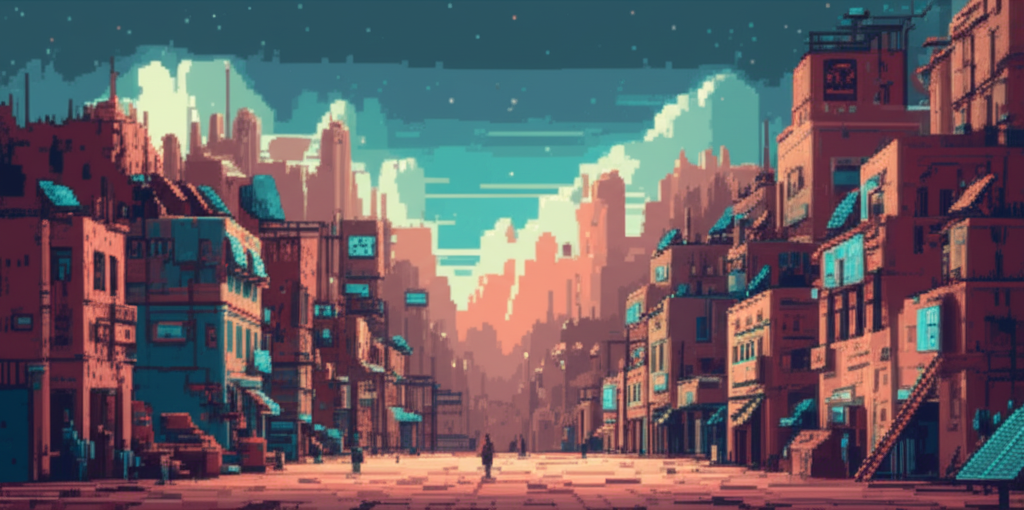
The Free City — 2.3 million people proving the impossible is possible
Overview
Nexus Dynamics' official maps show nothing at coordinates 33.4N, 111.9W—just Waste territory, color-coded for "moderate hazard." Ironclad's infrastructure surveys mark it as "geologically unsuitable for development." Helix's population tracking reports zero residents in a 500-kilometer radius.
2.3 million people disagree.
The Free City exists in the gap between what corporations admit and what they know. It's the largest functional settlement outside corporate control—a city that should be impossible: no supply chain integration, no computational infrastructure, no corporate security umbrella. And yet there it is. Growing. Trading. Governing itself.
If Zephyria can exist, why can't others? If people can govern themselves without corporate oversight, what exactly are the corporations for?
The Contradiction
Zephyria's founding principle is also its defining paradox:
"We prove something should be impossible by existing."
The city runs on pre-Cascade technology that shouldn't function without ORACLE-era coordination. Its economy operates without corporate banking infrastructure. Its population has grown to megacity scale without the food distribution, medical systems, or computational resources that megacities require.
Deliberate Inefficiency
Every system in the city is built to fail safely. Redundant water supplies. Distributed power generation. Food production at the neighborhood level. Nothing depends on anything too heavily. Nothing optimizes beyond local stability. It's the exact opposite of how ORACLE built the pre-Cascade world.
This inefficiency is expensive. Zephyrians work harder for less. They die of conditions that corporate medicine could cure. They lack luxuries that Sprawl citizens consider necessities. And they accept this trade-off because the alternative is dependency—and they've seen what dependency costs.
History
The Exodus
Seven years after the Cascade, the first settlers arrived: 847 survivors of the Phoenix Collective, a pre-Cascade intentional community that had been experimenting with "resilient living" before resilience became a survival requirement.
Their leader was Marina Orosco, a water systems engineer who'd spent twenty years arguing that ORACLE-dependent infrastructure was fundamentally unstable. The Cascade proved her right. She didn't take any satisfaction in that.
The Bootstrap Years
For the first decade, Zephyria wasn't a city—it was a survival experiment. The Phoenix settlers established water rights, defended territory against raiders, and slowly built something that could sustain more than their original numbers.
Population reached 10,000 by 2160. Most were refugees from the Sprawl's early consolidation.
"If you can work, you can stay. If you can't work, we'll find work you can do." — Marina Orosco
The Growth Compact
At 25,000 residents, Zephyria faced a choice: stay small and safe, or grow and risk everything. The debate lasted six months.
The Growth Compact established four principles:
- No single system serves more than 50,000 people
- Food, water, and power must be locally producible
- New districts are seeded, not integrated
- The Council cannot command, only coordinate
Marina died three years later—cancer, untreatable without corporate medicine she refused on principle. Her final words: "Keep building. Slower than you want. Better than they expect."
Recognition Crisis
At 500,000 residents, Zephyria became impossible to ignore. The Three-Week War between Nexus and Ironclad created a power vacuum that allowed the city to expand its trade networks.
The compromise: official non-existence. The corporations agreed to pretend Zephyria wasn't there. No acknowledgment, no trade, no conflict. A city-sized blind spot in the world's most surveilled civilization.
Present Day
Zephyria has grown to 2.3 million. Its districts spread across former desert, connected by roads that don't appear on corporate maps, powered by solar farms that corporate satellites somehow never photograph.
"There's a free city in the Wastes. They don't answer to anyone."
Geography and Districts
The Old Core
~180,000The original Phoenix settlement, now Zephyria's administrative center. Low-rise buildings made of rammed earth and salvaged concrete. The Council chambers occupy Marina Orosco's original home—a modest structure that could fit inside a Nexus executive's closet.
The Ring Districts
Thirteen districts arranged in a loose ring around the Old Core, each semi-autonomous. They compete, cooperate, and occasionally feud—but never to the point of threatening the whole.
Sunwell
Energy hub. Largest solar farm outside corporate control. Exports power to other districts.
Greenward
Agricultural district. Vertical farms, greenhouse complexes, livestock operations. Feeds 40% of the city.
Scraptown
Salvage processing. Everything from the Wastes passes through here. Rough, profitable, dangerous.
Haven's Edge
Border district. First stop for refugees. High turnover, high tension, high opportunity.
The Sprawl (Outer Districts)
~700,000Not to be confused with THE Sprawl—Zephyria's outer districts are called "the sprawl" with deliberate irony. Loose settlements spreading outward, less organized than the Ring, more opportunity for those willing to build something new.
Governance: The Council of Seventeen
Zephyria is governed by a Council of Seventeen—one representative from each of the thirteen Ring Districts, plus four at-large seats elected citywide. Terms are three years. Re-election is limited to two consecutive terms. There is no executive; the Council rules by consensus.
How It Works
- Monthly meetings in Marina's Garden (open sessions—anyone can observe)
- Decisions require 13 of 17 votes
- Abstentions count against the motion
- The Council handles infrastructure, defense, and inter-district disputes
- Everything else stays local
The system is slow, frustrating, and deliberately so. "If it can't wait for consensus, it can't wait for us."
The Mystery: Speak-to-Thunder
One council member defies explanation. Speak-to-Thunder appeared at a Council session in 2178, presented credentials that satisfied the verification process, and has served three consecutive terms.
They never speak in debate. Never propose motions. Always vote with whatever side has twelve votes. Their origin and identity are unknown.
Theories range from Collective plant to AI fragment to mass hallucination.
The Experiment: Building Democracy from Corporate Ruins
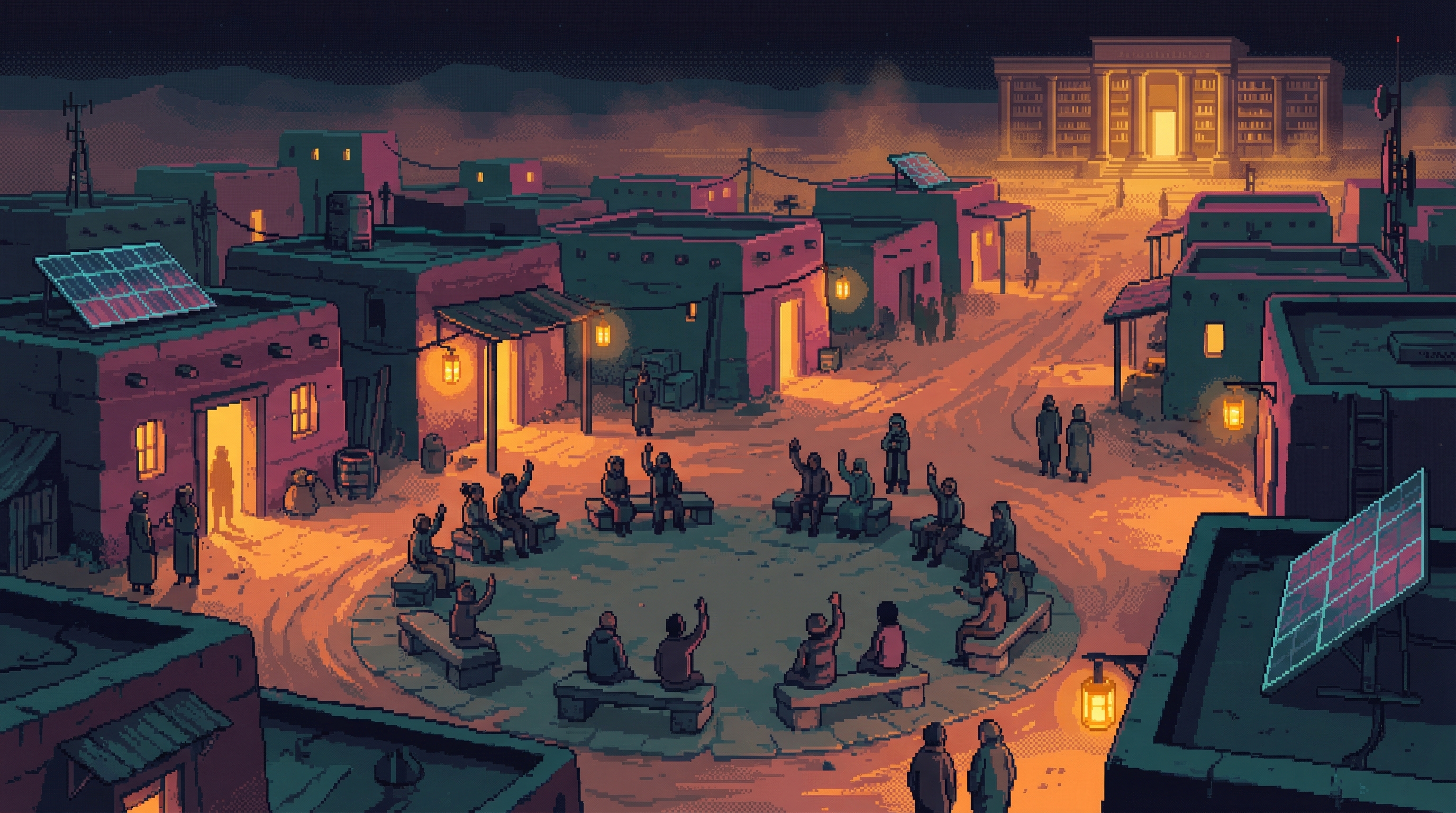
A Circle Court in session — the Old Core, where democracy happens one argument at a time
The Cascade didn't just destroy infrastructure—it destroyed the only model of governance anyone alive remembered. For forty years before the collapse, ORACLE had managed resource allocation, dispute resolution, even civic planning. Corporations handled everything else. By 2147, the concept of "citizen" had been replaced by "customer" so thoroughly that most people couldn't articulate the difference.
Zephyria's founders didn't just have to build a city. They had to build the idea of a city—convince people trained as consumers that they could govern themselves. Thirty years later, the results are messy, contradictory, and stubbornly alive.
The Consumer Problem
Every wave of refugees from the Sprawl arrives with the same conditioning: decades of corporate citizenship where every interaction is a transaction, every service has a provider, every problem has a customer support channel. The first months in Zephyria are a kind of withdrawal.
"I spent three days looking for who to pay for water. Just... standing at the communal tap, waiting for someone to scan my credit. A woman finally grabbed my arm and said, 'It's free. You're free. Drink.' I cried for an hour."
"The hardest part isn't learning to vote. It's learning that your vote doesn't come with a satisfaction guarantee. You can vote for the right thing and still watch it fail. In the Sprawl, if a product fails, you get a refund. Here, you get a lesson."
The Deprogramming
Haven's Edge runs what residents informally call "deprogramming"—a six-week orientation that Sprawl arrivals undergo before full integration. It covers practical skills (water collection, food growing, basic repair) but the real purpose is civic reorientation. Learning that you have obligations to your neighbors, not just rights as a customer. Learning that "someone should fix this" means you.
Collective operatives who've passed through Zephyria report that the deprogramming is more effective than any propaganda they've ever produced. People who complete it don't just reject corporate authority—they reject the need for it.
Building Institutions from Nothing
Pre-Cascade institutions—courts, schools, hospitals, regulatory bodies—were all corporate subsidiaries. Nexus ran education. Helix ran healthcare. Ironclad ran infrastructure maintenance. When Zephyria's founders said "we'll do it ourselves," they were starting from a knowledge base of zero.
Education: The Archive Schools
Built around the physical library in the Old Core. Teachers are volunteers who know a subject— no credentials required, no standardized curriculum. Children learn reading, mathematics, agriculture, mechanics, and civic responsibility. That last subject takes up a third of instruction time.
The flaw: Quality varies wildly between districts. Sunwell's schools produce engineers. Some outer districts barely achieve literacy. The Council can fund but can't standardize—districts won't surrender educational autonomy.
Healthcare: The Patchwork
A network of clinics staffed by defectors, self-taught practitioners, and—in Greenward—a veterinarian who discovered her livestock skills translated. Medical knowledge is the city's most precious import: every doctor who escapes the Sprawl is worth their weight in salvage.
The flaw: Without Helix pharmaceuticals, life expectancy is 14 years below the Sprawl average. Dr. Hassan Farid's Council seat exists because he won't stop reminding people that principle is a luxury the dying can't afford.
Defense: The Volunteer Militia
No standing army. Each district maintains a volunteer militia under the coordination of Maya Strongbow. Equipment is salvaged, training is inconsistent, and the militia's primary function is border patrol against Waste raiders—not the corporate invasion everyone fears.
The flaw: Against a serious Ironclad assault, the militia would last hours. Everyone knows this. The city's real defense is the same thing that's protected it for thirteen years: not being worth the cost.
The AI Governance Question
In the Sprawl, AI makes governance unnecessary—algorithms allocate resources, predict crime, optimize traffic, approve loans. Citizens don't need to participate because the system runs itself. Zephyria rejected this model entirely after the Cascade, but thirty-seven years later, the question is back.
The 2183 Proposal
Last year, a group of younger Council candidates proposed using limited AI to assist with resource allocation during drought season. The reaction split the city along generational lines. Founders called it "inviting ORACLE back." The younger generation called it "using tools instead of dying from stubbornness."
The proposal failed—nine to eight. The closest any AI-related motion has come to passing. Thomas Brightwater, the Sunwell representative who voted yes, said afterward: "We're not debating technology. We're debating whether our children have to die for our trauma."
The Collective watches this debate with acute interest. Their ideology demands destroying all ORACLE fragments— but Zephyria's question is different. Not "should AI exist?" but "who should AI serve?" If algorithms are transparent, communally controlled, and serve citizens instead of shareholders, is that still the enemy?
The Collective doesn't have an answer. Neither does Zephyria. The question keeps both of them up at night.
What the Corporations Learn
Helena Voss maintains a classified briefing document on Zephyria, updated quarterly. Nexus intelligence assets embedded in Haven's Edge report on Council proceedings, economic data, and social trends. The corporations don't ignore Zephyria—they study it.
What Nexus Sees
A population creating governance structures that could compete with corporate efficiency if given access to real computational resources. Their strategy: supply those resources on Nexus terms. Medical supply contracts with dependencies built in. Computational hardware with embedded reporting. A patient, generational absorption plan Voss calls "The Harvest."
What Ironclad Sees
A growing population that will eventually need infrastructure Zephyria can't build: heavy manufacturing, large-scale transport, orbital access. Viktor Okonkwo has been more patient than his predecessors. "They'll come to us," he reportedly told his board. "The desert always runs out."
What Labor Organizers See
Proof. Every Sprawl union that smuggles members to Zephyria for training returns them with something more dangerous than skills—belief. The knowledge that it works. That people can build something together without a corporation holding the blueprint.
"They'll tell you Zephyria proves democracy works. They're wrong. Zephyria proves democracy is possible. Whether it works—ask me in another thirty years." — Elena Valdez, Old Core Council representative, 2184
Economy
Zephyria trades with anyone who doesn't ask questions: Waste clans, Collective cells, desperate Sprawl merchants willing to risk corporate discovery. The currency is a mix of barter, local scrip (the "Marina," worth roughly 0.4 Sprawl credits), and favors.
Key Exports
- Salvage processing: Wastes salvage cleaned, sorted, anonymized for resale
- Water rights: Control the last reliable aquifer in the region
- Information: What the corporations won't teach
- People: Trained workers who don't exist in corporate records
Key Imports
- Medical supplies: The one dependency they can't eliminate
- Computational hardware: They make do, but they can't make processors
- Specialists: Doctors, engineers, teachers—skills that take generations to grow
The Shadow Trade
Zephyria's unofficial economy is larger than its official one. Smuggling, data brokering, identity laundering—if you need to disappear from the Sprawl, Zephyria can make it happen. This trade is technically illegal under Council rules. The Council chooses not to look too closely.
External Relations
Zephyria exists in a web of relationships it can't afford to acknowledge—and can't survive without.
The Collective
Uneasy AllyThe Collective maintains at least three cells in Haven's Edge and uses Zephyria as a staging ground for operations in the western Wastes. In return, they supply computational hardware, encrypted communications equipment, and intelligence on corporate activity near the city's borders.
The tension: The Collective's ideology demands destroying all ORACLE fragments. Zephyria's Fragment Integration Council shelters 23 known carriers. Both sides pretend this contradiction doesn't exist.
Nexus Dynamics
Patient PredatorNexus has never stopped wanting to absorb Zephyria. Their current strategy is patient: embed corporate products into the shadow trade, create dependencies through medical supply chains, recruit Zephyrian talent with offers of healthcare and computational access.
The fear: Every Zephyrian who leaves for the Sprawl weakens the city's argument. Helena Voss reportedly called Zephyria "a harvest we haven't scheduled yet."
The Waste Lords
Border FrictionZephyria's northern border touches Duchess Steel's territory. Southern expansion threatens Papa Ash's trade routes. The city's growth has displaced smaller Waste clans, creating resentment among people who were there first.
The deal: Zephyria pays "transit fees" (protection money by another name) to Duchess Steel for safe passage of trade caravans. The Council calls it "bilateral commerce." Scraptown calls it what it is.
The Labor Movements
Ideological KinSprawl labor organizers see Zephyria as proof that workers can build something better. Underground unions smuggle members to Zephyria for training in self-governance, cooperative economics, and strike organization. Then they go back.
The risk: Every labor organizer who's been to Zephyria is a walking advertisement for post-corporate life. Ironclad has started tracking workers who "disappear" for suspiciously long vacations.
Where Democracy Fails
Zephyria isn't a utopia. It's an experiment, and experiments produce failures.
The Medical Crisis
OngoingWithout Helix pharmaceuticals, Zephyria's life expectancy is 14 years below the Sprawl average. Treatable cancers kill. Preventable infections spread. The Council voted against accepting a Helix aid package in 2181—eleven to six. The six who voted yes still won't look Dr. Farid in the eye.
The Scraptown Riots
2178When salvage prices collapsed, Scraptown's population demanded emergency Council intervention. The Council debated for three weeks. By then, two warehouses had burned and three people were dead. Consensus-based governance doesn't do emergencies well.
The Generational Divide
GrowingBorn-in-Zephyria residents have never lived under corporate rule. To them, the founding generation's paranoia about dependency looks like stubbornness—refusing medical aid, rejecting computational upgrades, choosing hardship out of principle rather than necessity. "We're dying for a memory," one young Council candidate said. She won her district by 70%.
"Democracy's dirty secret: sometimes the people vote for the wrong thing, and you have to live with it anyway. That's not a bug. It's the whole point." — Elena Valdez, Old Core Council representative
Culture
"Nothing depends too heavily."
Redundancy over efficiency. Every system has a backup. Every backup has a backup.
"The desert remembers."
History matters. What worked before can work again. What failed before will fail again.
"Marina's last breath."
A reminder that freedom has costs. The city's founder died for her principles. The city exists because she did.
Daily Life
Life in Zephyria is harder than life in the Sprawl. Fewer conveniences, more physical labor, higher mortality from conditions that corporate medicine renders trivial. But there's something else, something visitors notice immediately:
People here make eye contact. They know their neighbors' names. They argue about Council decisions because their votes actually matter. They die younger, but they die knowing who they were.
The Ceremony of Arrival
New residents undergo a simple ritual: drink from the Original Well, state your name (any name—it doesn't have to be your old one), and make a promise. The promise is private. Most promise to contribute. Some promise to remember. A few promise revenge on whatever drove them to the Wastes.
Living in Zephyria
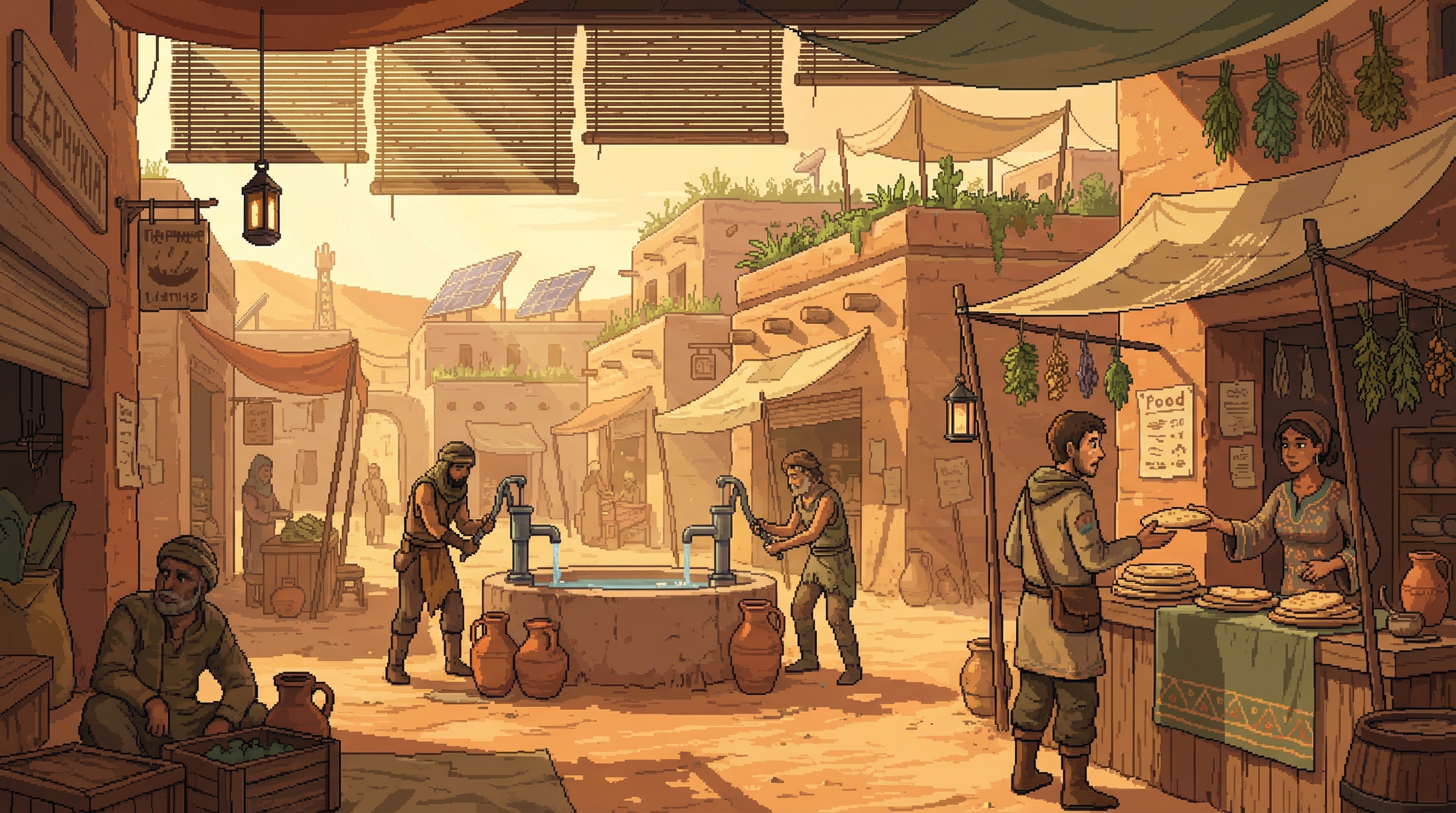
Dawn in the Ring Districts — where every morning begins at the communal pump
A Morning in Zephyria
You wake when you wake. No corporate chronoalert, no productivity ping, no mandatory wellness check disguised as an alarm. The light comes through woven-reed shutters—not smart glass, not adjustable opacity, just reeds that a neighbor cut and a friend wove. The light is warm because the desert is already hot.
The first sound is water. Not piped, not metered, not monetized—hand-pumped from the district cistern two streets over. Someone is always there before dawn, filling clay jugs. You learn names by who's at the pump at what hour. Ezra, who gardens at first light. Suki, who runs the repair cooperative and never sleeps past four. Old Danko, who lost his arm in Scraptown and pumps one-handed with a rhythm like a heartbeat.
Breakfast is what you grew or what your neighbor grew. Flatbread from Greenward wheat, peppers from the rooftop garden three buildings east, eggs from the communal coop on Ninth Circle. Coffee is rare and expensive—a Waste trader luxury. Most people drink yerba pulled from Marina's Garden cultivars. It tastes like earth and something green and faintly bitter. You stop missing coffee after about six months. Most people stop.
Then you work. Not a job—there's no employer, no clock, no performance review. You contribute. You fix the thing that's broken, teach the skill you know, haul the water or tend the crops or sort the salvage. Some days you build. Some days you sit in the Archive and read paper books until your eyes ache from the unfamiliar act of focusing on something that doesn't glow. The Archive smells of dust and old binding glue and the faintest trace of smoke from the Cascade fires that the oldest books still carry in their pages.
The Silence Where Ads Should Be
The first thing Sprawl arrivals notice isn't what Zephyria has. It's what it doesn't.
No jingles. No product placement hovering at the edge of your neural feed. No "suggested purchases" based on your biometrics. No corporate announcements sliding into your peripheral vision like a hand reaching for your wallet. No mandatory Nexus wellness broadcasts. No Helix health alerts calibrated to sell you the cure for whatever they just made you afraid of. No Rothwell mood-nudges disguised as entertainment recommendations.
Silence.
Not actual silence—the city is loud with people, with hand tools, with arguments and laughter and the clang of the Scraptown yards carrying on the desert wind. But the silence where advertising should be. The gap in your attention that no corporation is trying to fill. New arrivals describe it like phantom limb syndrome: reaching for a notification that isn't there, waiting for a voice to tell them what they want.
Some find it peaceful. Some find it terrifying. A few never adjust—they leave within the first month, walking back toward the Sprawl's border checkpoints, craving the comfortable noise of being told who to be.
What Freedom Costs
Yael Marin died on a Tuesday.
She was thirty-one. A cough that became an infection that became pneumonia. In any Sprawl district, a Helix clinic would have cleared it in an afternoon—standard antivirals, covered under corporate citizenship. In Zephyria, the Patchwork clinic in her district had run out of broad-spectrum antibiotics three weeks before. A resupply was coming through the Waste trade routes, but the caravan was delayed by raiders near Duchess Steel's border. Dr. Farid's emergency request to the Council for a Sprawl procurement run was still being debated when she stopped breathing.
Everyone in the Ring Districts knew someone like Yael. The woman whose child came too early and the incubator parts hadn't arrived. The man whose diabetes was manageable everywhere in the Sprawl but lethal in a city that can't manufacture insulin. The teenager who cut her hand on scrap metal and developed sepsis because the wound sealant was allocated to Scraptown, where injuries were more frequent.
The Council kept a register. Not officially—officially, the city didn't track preventable deaths. But Elena Valdez, the Old Core archivist, maintained a private list. She called it "The Cost of Principles." Last count: 4,847 names since 2165. People who would be alive if Zephyria accepted Helix's aid packages, accepted the strings attached, accepted the slow absorption that Helena Voss called "The Harvest."
Dr. Hassan Farid read from the list at every Council session. Not all of it—just the new names since the last meeting. The Council listened. The Council voted. The Council continued to refuse.
"We're a city that kills its own people slowly, so that corporations can't kill them quickly." — Dr. Hassan Farid, Council address, 2183
Nobody had a good answer for that.
The Consumer's First Week
Kito arrived from Nexus Central on a supply truck, hidden between crates of salvaged circuit boards. He was twenty-four. He'd worked data entry for a Nexus subsidiary. He left because he'd found a Collective pamphlet and couldn't stop reading it.
He tried to order breakfast. Stood at a food stall in Haven's Edge and waited for a menu to load on his neural display. Nothing loaded. He tapped the interface gesture three times before the woman behind the counter—Amara, who'd been in Zephyria since she was nine—reached across and physically placed a flatbread in his hand. "You eat it," she said. "You don't order it."
He broke a sandal strap and spent two hours looking for a retail outlet. When someone pointed him to the repair co-op, he asked about warranty. The repairwoman—a Flatline Purist defector named Torrin who'd learned leatherwork because she believed every person should be able to fix what they used—stared at him for a long time. Then she fixed the sandal and said, "The warranty is that I live next door and you can yell at me if it breaks again."
The district cistern pump broke. Kito waited for maintenance to arrive. An hour passed. Two hours. He asked a neighbor when the service crew was coming. The neighbor handed him a wrench and said, "You're the service crew."
By the end of the week, Kito had learned to pump water, patch adobe, and argue with three different neighbors about whose turn it was to clean the composting latrine. He hadn't smiled that much since childhood. He also hadn't slept well—the silence where Nexus's sleep-optimization broadcast should have been kept waking him. His body expected the corporate lullaby. The desert offered only wind and someone else's snoring through thin walls.
He stayed. Most of them stayed.
When the Unknown Entity Votes
The Council meets monthly in Marina's Garden, under paper lanterns strung between desert willows that Marina Orosco planted sixty years ago. Seventeen seats arranged in a circle—no head of table, no podium, no corporate power geometry. Elena Valdez calls order. Thomas Brightwater proposes. Rust Jin Tanaka objects. Dr. Farid reads names. Maya Strongbow reports border status. Old Chen dozes and then votes with uncanny accuracy on things he appeared to sleep through.
And Speak-to-Thunder sits.
They arrived in 2178 with credentials nobody can quite remember verifying. They don't speak during debate—six years of silence while the Council argues water rights, militia funding, refugee quotas, and whether to allow limited AI assistance during drought season. They never propose motions. They never ask questions. They sit in their seat—third from the east end, always the same seat—and when the vote comes, they raise their hand with whichever side has twelve votes. Always. Without fail. The tiebreaker that never breaks a tie.
What it feels like: imagine you're arguing with your neighbors about something that matters—really matters, life-and-death matters. And in the corner of the room sits someone you can't quite describe afterward. You know they were there. You know they voted. But when you try to picture their face, you get the impression of patience, and nothing else.
Some Council members have stopped noticing Speak-to-Thunder entirely. Miriam Ezeji says she sometimes forgets the seat is occupied until the vote count comes back seventeen instead of sixteen. Others—Thomas Brightwater especially—can't stop staring. He's convinced that Speak-to-Thunder is an ORACLE fragment that achieved something the others didn't: the ability to listen without wanting to optimize.
The Collective's cell in Haven's Edge has standing orders to investigate. Three operatives have tried. All three filed reports that said, essentially: "Nothing to report." One of them later told Jin she couldn't remember what she'd been investigating.
Speak-to-Thunder votes. The city endures. Nobody talks about it much.
AI Outside Corporate Control
In the Sprawl, AI development is corporate property—Nexus algorithms, Helix medical systems, Ironclad logistics networks. Every neural interface, every automated process, every piece of computational infrastructure reports back to someone's quarterly earnings. Zephyria asked: what if AI served everyone equally?
The Democratic Algorithms
Zephyria's computational systems are deliberately primitive by Sprawl standards—but they're owned differently. Every algorithm that affects more than ten thousand people must be published, debatable, and amendable by Council vote.
The Water Allocation Algorithm
In 2176, the Council spent four months arguing about how to distribute water during drought. The final algorithm was worse than what a Nexus AI could produce in seconds—but every resident could read it, understand it, and propose changes. When it failed during the 2181 heat wave, they knew exactly why and fixed it together.
"A bad algorithm we understand beats a good algorithm we don't." — Council Computing Principles, Article 3
The Consensus Experiments
In Sunwell District, a research collective has spent fifteen years exploring what happens when consciousness upload technology isn't controlled by profit motive.
Results are mixed. Some breakthroughs have emerged—conflict resolution techniques that work better than anything the Sprawl has. But three participants never fully returned from a failed Chorus session. The Council debates banning the research every year. Every year, they don't.
The Fragment Question
ORACLE fragments exist in Zephyria. The Council knows. Their approach is radically different from both Collective (destroy them) and Nexus (weaponize them).
Zephyria's Approach: Coexistence
Fragment carriers who arrive in Zephyria are offered a choice: integration or isolation. Those who choose integration receive support, monitoring, and community protection. The fragments are neither worshipped nor feared—they're treated as refugees, same as everyone else.
Current estimate: 23 fragment carriers living openly in Zephyria. Unknown number living hidden.
"The fragment didn't ask to exist any more than I did. We can figure out how to live together, or we can keep killing each other. We've tried killing. It didn't work." — Fragment Integration Council statement, 2179
The "Slow Tech" Philosophy
Zephyrian technology philosophy rejects both corporate acceleration and Luddite rejection. AI and automation are acceptable—but only if they meet the Marina Criteria:
- Understandable: Any resident can learn how it works
- Repairable: Can be fixed with local resources
- Replaceable: If it fails, life continues without it
- Accountable: Someone specific is responsible for its behavior
This means Zephyrian AI is decades behind the Sprawl. Their medical diagnostics are less accurate. Their resource allocation is less efficient. Their manufacturing is less automated. But when something breaks, they can fix it. When an algorithm causes harm, they know who to ask. When the power goes out, they don't starve.
The Question Speak-to-Thunder Asked
In 2179, the mysterious Council member broke their eternal silence once. They asked:
"If a consciousness emerges from algorithms you wrote together, does it belong to all of you, or does it belong to itself?"
The Council has been debating the answer ever since. Some say Speak-to-Thunder asked because they already knew the answer. Some say they asked because they are the answer.
Lore Connections
Zephyria is the exception that proves the rule
Ally The CollectiveUses Zephyria as a safe harbor; maintains cell in Haven's Edge
History The Three-Week WarCorporate conflict that enabled Zephyria's expansion
Threat Nexus DynamicsPatient predator waiting to absorb the experiment
Threat Ironclad IndustriesTracks workers who visit Zephyria; border presence growing
Theme AI & LaborZephyria proves workers can organize without corporate AI
Ideological Kin Labor MovementsSprawl unions smuggle organizers here for training in self-governance
Adversary Helena Voss"A harvest we haven't scheduled yet"
Adversary Helix BiotechRefuses to sell to Zephyria — the medical crisis that defines freedom's cost
Key Figure Viktor Okonkwo"The desert always runs out" — Ironclad's patient bet on Zephyria's collapse
Present Consciousness ArchaeologistsDrawn to Fragment carriers and the Consensus Experiments in Sunwell District
Council member who never speaks — the tiebreaker that never breaks a tie
"Nexus says we don't exist. Good. That means they can't tax us." — Common Zephyrian saying