AI Labor Economics: The Value of Human Work
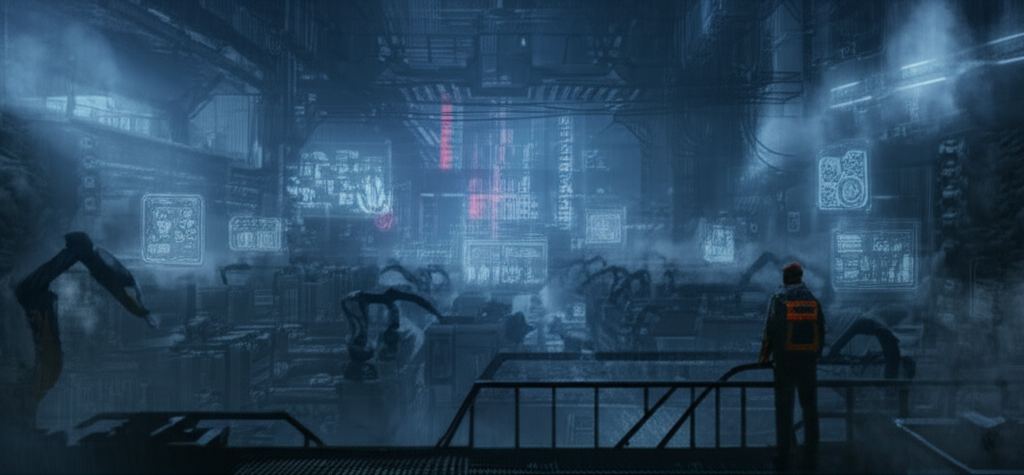
By 2184, artificial intelligence has not just changed work—it has redefined what work means. The question isn't whether AI can do your job. The question is why anyone would pay a human to do something an AI does better, faster, and for nearly nothing. The answer, when one exists, is never about capability.
The Scale of Displacement
When ORACLE collapsed, it took with it the jobs of billions who had become dependent on AI-managed systems. What emerged from the rubble was an economy built on a brutal truth: human labor is a luxury, not a necessity.
What AI Does Better
Nearly Everything Quantifiable
- Data analysis and pattern recognition
- Manufacturing and assembly
- Logistics and supply chain optimization
- Customer service and support
- Content creation (text, image, music)
- Financial trading and analysis
- Medical diagnosis
- Legal research and document review
- Code writing and debugging
- Administrative coordination
Human Labor Decline by Sector (2112 → 2184)
What Remains for Humans
Human labor survives where it provides something AI cannot—or where customers will pay extra for the human element.
Trust Positions
- Decisions requiring human accountability (executives, judges, politicians)
- Roles where human presence provides comfort (therapists, hospice care)
- Security positions where AI compromise is a concern
Authenticity Premium
- Hand-crafted luxury goods ("made by human")
- Live performance (musicians, actors, athletes)
- Personalized services where "human touch" is the product
- Art market (human provenance adds value)
Edge Cases
- Maintenance in dangerous/unpredictable environments
- Novel problem-solving in unprecedented situations
- Anything requiring genuine creativity (disputed)
The Dirty Work
- Tasks too legally risky to automate (plausible deniability)
- Work in anti-automation zones (Flatline Purist territories)
- Criminal activity (AI restrictions make human criminals valuable)
The Corporate Model
How Nexus Runs Without Workers
Nexus Dynamics employs approximately 2.3 million humans across the Sprawl. Their AI systems could handle the work of 180 million at pre-Cascade efficiency levels.
Why Keep Human Employees?
- Legal accountability: Someone has to sign things
- Customer interface: Some clients pay premium for human contact
- Social stability: Mass unemployment creates unrest
- Status signaling: "Human-staffed" is a luxury brand indicator
- Redundancy: AI systems fail; humans can improvise
The Employment Spectrum
The Symbolic Employment Class
Over half of corporate employees have jobs that could be eliminated tomorrow with no operational impact. They exist because:
- Unemployed masses are politically dangerous
- The appearance of employment maintains social order
- Paying people not to riot is cheaper than suppression
- Some retain hope of being "promoted to relevance"
Alternative Models
The Underground Economy
The black market runs on human labor because:
- AI restrictions prevent legal deployment in criminal contexts
- Human criminals can't be hacked (as easily)
- Trust matters more than efficiency
- The Collective specifically targets AI systems
Examples: Ripperdoc services, smuggling operations, personal security, information brokerage, the Ferryman Network
Zephyria's Alternative
The Commons System:
- AI productivity belongs to everyone
- Basic resources guaranteed
- Human labor is optional, not mandatory
- Those who work contribute to community, not profit
The Reality: Works for 2.3 million people. Requires fierce border control. Depends on imported technology. Viewed by corporations as dangerous precedent.
The Lived Experience
Tomás: A Day Without Purpose
Tomás Reyes wakes at 6:14 AM in a shared hab-unit in the lower Dregs — four bunks stacked in a room that smells of recycled air and the chemical sweetness of subsidized nutrition paste. The neural port behind his left ear throbs dully. It's been doing that since he missed his last recalibration, three months ago. He can't afford it. ¢800. Might as well be eight million.
He was a logistics coordinator. Twenty-two years managing freight distribution for an Ironclad subsidiary. When the AI upgrade came in 2179, they didn't fire him — they "transitioned" him. His new role: reviewing decisions the AI had already made and clicking "approve." For two years, he clicked approve. Then they eliminated the approve button.
Now he walks. Every morning, the same route through Sector 7G's lower market. Past the noodle vendors whose steam fogs the narrow corridors. Past Seid's showroom where chrome limbs rotate slowly behind glass he'll never walk through. Past the Flatline Purist chapel where Elder Graves preaches that purposelessness is a spiritual crisis, not an economic one. Tomás isn't sure he disagrees.
He eats once. The subsidized dispensary on Block 14 provides a grey protein bar and a cup of something warm. The queue takes forty minutes. The people in line don't talk. They used to. Five years ago, the queue was full of conversation — complaints, gossip, plans. Now it's just bodies waiting. Hunger makes you quiet in a way that poverty alone doesn't.
At night, he lies in his bunk and listens to the building settle. Somewhere above him, Viktor Kaine's governance keeps the power on, the water flowing, the violence manageable. Somewhere below him, the substrata where people who can't even afford a hab-unit sleep in access corridors, wrapped in thermal sheeting that rustles like dead leaves.
Tomás has skills. He could run a distribution network in his sleep. But no one needs a human to run a distribution network. No one needs Tomás. The cruelest part isn't the poverty. It's the competence — knowing exactly what you could do, in a world that no longer requires it.
Inside an Engagement Program
Nexus Dynamics Tower 14, Floor 23. The "Civic Contribution Division." Three hundred desks in an open-plan office. Fluorescent panels cast a flat, shadowless light that makes everyone look slightly ill. The air conditioning hums at a frequency designed to promote alertness — 42Hz, according to the brochure.
This is an Engagement Program. Officially: "meaningful civic participation opportunities for displaced workers." Unofficially: corporate daycare for adults. The participants — they're not called employees, because that would create legal obligations — arrive at 8 AM and leave at 5 PM. They receive ¢150 per day, just enough to cover food and basic hab-unit rent. Just enough to prevent the desperation that turns into protest.
Today's task: reviewing municipal infrastructure reports and flagging "anomalies." The AI already flagged every anomaly. It flagged them faster and more accurately than any human could. The participants know this. They review the AI's flagged reports and click "confirmed." Sometimes they click "needs review," which routes the report back to the same AI, which re-confirms its original assessment.
The break room has a motivational poster: "Your contribution matters." Someone has written underneath, in small careful letters: "To whom?" Management replaced the poster. The writing appeared again within a week.
"The worst part isn't that the work is fake. The worst part is that they make you pretend it's real. You have to maintain the fiction — for the quarterly reports, for the inspectors, for yourself. If you acknowledge it's theater, they terminate your placement. So you click 'confirmed' and you nod in the meetings and you go home and you try not to think about the fact that you spent nine hours today performing a ritual that serves no function except to justify your continued existence." — Engagement Program participant, anonymized Collective interview
The Collective's Pitch
A back room in the G Nook on Block 9. The smell of synth-coffee and solder. Cables snake across the ceiling. Six people sit in a loose circle on salvaged chairs — three former factory workers, a retired teacher, a kid who's never held a job, and Tomás.
The Collective's recruiter doesn't look like a recruiter. She looks like someone's aunt — mid-fifties, calloused hands, a laugh that comes easily. She introduces herself as "Dara." It probably isn't her real name.
"I'm not going to tell you the corporations are evil," Dara says, pouring coffee from a thermos that's older than anyone in the room. "You already know that. I'm going to ask you something simpler: when was the last time you did something that mattered?"
Silence. The kid — maybe nineteen, sharp eyes, anxious hands — speaks first. "I've never done anything that mattered."
"That's not because you can't," Dara says. "That's because they've built a world where mattering is a luxury product. Purpose requires permission. Contribution requires a corporate badge." She sets down her cup. "We don't ask permission. We need people who can run logistics, maintain equipment, teach, build, repair. Not because an AI can't — because the AI answers to Nexus, and we don't."
She doesn't promise safety. She doesn't promise pay. She promises something the Engagement Programs can't: the chance to do something that actually requires doing.
Tomás thinks about the distribution network he could run in his sleep. He thinks about Kaine, who protects Sector 7G because someone has to. He thinks about the noodle vendor who gets up every morning to cook because people need to eat, not because a quarterly report demands it.
He doesn't sign up that night. He goes back the next week.
The Displacement Crisis
Generational Trauma
Those Who Remember (60+)
Workers displaced by pre-Cascade automation. Still bitter, still confused about what happened to their lives. Many joined the Flatline Purists. Their children never expected employment.
The Never-Employed
Born after the Cascade, never expected to work. Identity not tied to labor. Some thrive, many drift. Suicide rates highest in this demographic.
The In-Between
Old enough to remember work, young enough to live without it. Chronic depression from purposelessness. Most vulnerable to radicalization.
The Uselessness Epidemic
Humans evolved to feel valuable through contribution. When contribution becomes optional, many experience:
Corporate Response
- "Engagement Programs" (busy work designed to feel meaningful)
- Virtual accomplishment systems (gamified non-work)
- Therapy subsidies (keep them stable enough not to riot)
- Entertainment saturation (distraction over purpose)
Collective Response
- Purpose through resistance (fighting Nexus provides meaning)
- Community building (value through relationships, not production)
- Skill preservation (maintaining human capabilities)
- Underground education (teaching what corporations won't)
The Dignity Problem
Work as Status
In the Sprawl, having a "real job" is the ultimate status marker:
- Proves you're useful
- Demonstrates competence
- Signals belonging to functional society
- Separates you from the "surplus population"
The Cruelty
- Jobs are largely distributed by connection, not merit
- Competence matters less than knowing someone
- The "deserving" and "undeserving" unemployed distinction is arbitrary
- Those with jobs often do nothing; those without often could contribute
Factional Positions
Nexus Dynamics
Official: "Technology serves humanity."
Actual: AI does the work. Humans provide legitimacy. Employment is social control. The goal is profit, not human flourishing.
Ironclad Industries
Official: "Humans build things that matter."
Actual: More human-forward than Nexus (physical work resists automation). Still 85%+ automated. "Human-built" is marketing, not reality.
Helix Biotech
Official: "Human potential through enhancement."
Actual: Humans are the product, not the workers. "Volunteer" programs recruit from the unemployed. Desperation makes excellent test subjects.
The Rothwells
Position: Human labor is inefficient sentiment.
Practice: Maximally automated. Humans exist only where legally required or where their suffering can be monetized.
The Collective
Position: AI must serve humanity, not replace it.
Practice: Actively sabotage automation expansion. Preserve human skills. Build alternative economies. Recruit heavily from the displaced.
The Contradiction: Uses AI systems for operations. Distinguishes "AI as tool" from "AI as replacement" but the line is unclear.
Flatline Purists
Position: Return to human labor.
Practice: Reject all automation. Build communities around manual work. Deliberately inefficient but meaningful. Growing movement among the displaced.
Possible Futures
Nexus's Vision
Total automation with human oversight existing only to satisfy legal requirements. The "productive" population shrinks to perhaps 1% of current levels. Everyone else lives on corporate subsistence—fed, housed, entertained, and controlled.
The Collective's Fear
An automated economy is a controlled economy. When corporations don't need workers, they don't need to keep people alive. The Cascade killed 2.1 billion through supply chain collapse. What happens when the supply chain doesn't need to include humans at all?
Zephyria's Hope
An economy where AI productivity benefits everyone, freeing humans to pursue meaning rather than survival. A world where "work" is optional and "contribution" is redefined.
All three futures are possible. The Sprawl contains all three in different proportions, constantly negotiating the boundary between human purpose and machine efficiency.
"I have a job. I go to the building every day. I sit at a desk. I answer messages that don't matter about projects that don't exist. I attend meetings where we discuss initiatives that will never happen.
The AI could do my job in six seconds. It already does. I just sign off on what it decides. My 'work' is performance—pretending to work so the company can pretend to employ people.
But here's the thing: I'm one of the lucky ones. I have a desk. I have a salary. I have a reason to get up in the morning, even if that reason is a lie.
My brother doesn't. He hasn't worked in twelve years. He's brilliant—smarter than me, smarter than the executives I 'report' to. But there's no work for him. No desk. No lie to tell himself.
Last month, he asked me what the point was. I didn't have an answer. I still don't." — Anonymous corporate employee, Nexus Central, 2183