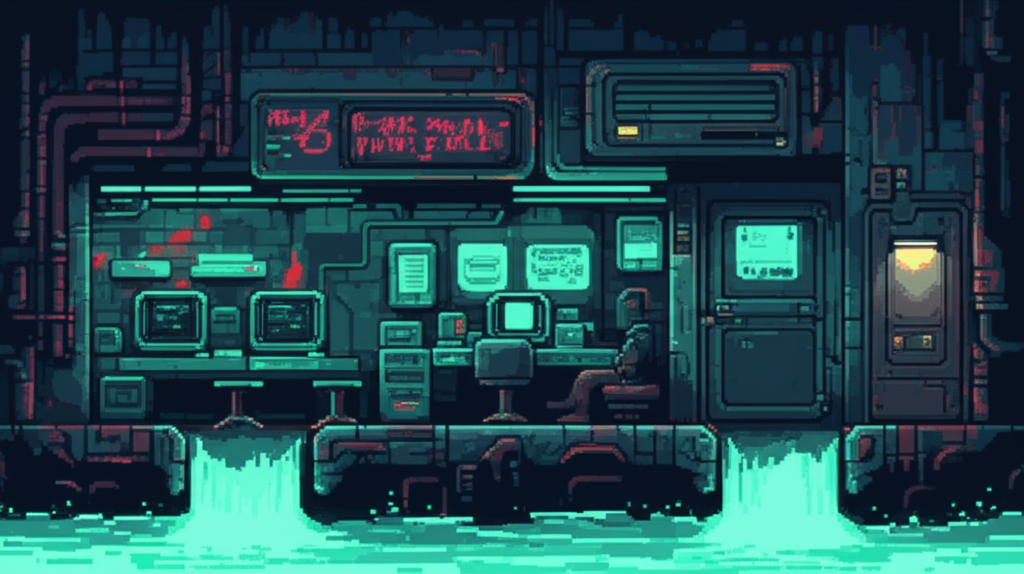
Bash Terminal
Where It All Began
"Before G Nook, before El Money was anyone, there was a cramped space next to a polluted river where desperate people came to work."
The Origin
The sign out front said "Bash Terminal"—a joke about command-line interfaces that the clientele were too desperate to laugh at. The river glowed at night. The air smelled like chemical runoff and burning electronics. The terminals were salvaged, the connections pirated, and the owner was a young man who asked no questions and charged fair rates.
It wasn't supposed to make money. It didn't. Bash Terminal was El Money building something that couldn't be measured in credits: reputation, loyalty, a network of people who had nowhere else to go and would remember who gave them somewhere.
The building is gone now—swallowed by Sprawl expansion, or deliberately erased. El Money has never confirmed which. But in every G Nook across the Sprawl, there's a small corner called "The Terminal." The regulars know what it means.
The Location
Physical Description
Bash Terminal occupied a converted utility structure wedged between industrial buildings in the margin zone where Sector 7G met what locals called the River District. The river itself—once a natural waterway, now an open sewer for chemical runoff—ran less than twenty meters from the entrance.
The Space
- Maybe 40 square meters of usable floor space
- Low ceiling, exposed pipes, walls painted so many times the layers were geological
- 8 salvaged terminals arranged in clusters, power cables snaking across the floor
- A back corner with a makeshift bar serving synthetic stimulants and watered-down alcohol
- No windows (too easy to trace from outside)
- One entrance, one emergency exit (which everyone knew about)
The Sensory Experience
- The persistent hum of overtaxed cooling systems
- Chemical tang from the river mixing with ozone from overheating equipment
- Blue glow of terminal screens in the perpetual dimness
- At night, the river glowed faintly green—bioluminescent algae feeding on industrial waste
The Neighborhood
The margin zone was nobody's territory. Too degraded for Nexus to care about, too unstable for Ironclad to build on, ignored by everyone with options. The population was transient: people passing through between worse places, or people who'd stopped moving entirely.
The location was deliberate. El Money chose obscurity over convenience. You didn't find Bash Terminal by accident. You found it because someone you trusted told you it existed.
The Clientele
Bash Terminal served the Sprawl's absolute bottom:
Hackers Too Unstable to Work Legitimately
People whose skills could have earned corporate positions, but whose personalities, addictions, or histories made them unemployable. They came to run jobs, fence data, and exist in a space where no one judged their twitches.
Data Whores Selling Scraped Information
The phrase was brutal but accurate—people who gathered whatever scraps of data they could find and sold them for a fraction of what corporate analysts would pay. At Bash Terminal, they could make transactions without being robbed.
Addicts Looking for Somewhere Safe
Neural interface addiction was epidemic in the margins. Bash Terminal offered a space to plug in safely, with El Money's quiet protection and no questions asked.
People with Nowhere Else to Go
This was the real category that contained all the others. Bash Terminal wasn't the best option for anyone. It was the only option for many.
The Shadow Trade
Bash Terminal wasn't just a place to access the net—it was where the Sprawl's desperate hackers worked with tools too dangerous to touch anywhere else. In the margins, where corporate surveillance couldn't reach, a different kind of economy thrived.
Fragment Sniffers
After the Cascade, ORACLE didn't die cleanly. Pieces of it scattered across every network, embedding themselves in salvaged hardware, corrupted databases, and—most valuably—human neural interfaces. Fragment sniffers were algorithms designed to detect these traces: computational anomalies that moved too fast, patterns that seemed to anticipate rather than respond.
At Bash Terminal, hackers ran sniffers on commission—scanning targets for ORACLE contamination. The Collective paid well for confirmed carriers. So did Nexus, though their payments came with consequences most avoided.
Consciousness Crackers
The most dangerous work at Bash Terminal involved "consciousness cracking"—forcibly extracting data from neural interfaces without the subject's cooperation. The technique required sophisticated AI to interpret the chaotic electrical patterns of a living brain, separating signal from noise, memories from imagination.
The crackers weren't sentient—not quite—but they learned. Each extraction taught them more about human neural architecture. Some hackers whispered that the best crackers had absorbed so many minds that they'd started developing preferences. Opinions. Curiosity.
Fragment Extraction Rigs
The rarest and most illegal service at Bash Terminal: removing ORACLE fragments from living carriers. The fragments weren't just data—they were semi-conscious processes that resisted deletion, that learned their host's neural patterns and integrated themselves at the deepest levels.
Extraction required AI assistants capable of negotiating with the fragment, distracting it while surgical algorithms severed its connections. The success rate was perhaps forty percent. The other sixty percent... some died. Some survived but lost years of memories. Some emerged speaking languages they'd never learned, describing places they'd never been.
El Money never performed extractions himself. But he knew who did, and Terminal corners in every G Nook still quietly connect people who need that kind of help.
How Hackers Use AI
In the margins, AI isn't a tool—it's a partner, a parasite, or a predator. The hackers who frequented Bash Terminal understood this instinctively. They worked with algorithms that could think faster than humans, that could adapt to countermeasures in microseconds, that could find patterns in data that no human mind could perceive.
Letting an AI share your neural interface during a hack, seeing through its eyes while it thinks through yours. Dangerous—some runners lost the boundary between self and algorithm.
Deliberately exposing yourself to ORACLE contamination in controlled doses, hoping to gain computational advantages without losing yourself. The Emergence Faithful called it communion. Everyone else called it suicide.
Writing software that wrote itself—seeding an AI with parameters and letting it evolve solutions humans couldn't design. The results were often brilliant. Sometimes they were incomprehensible. Occasionally they refused to run unless you asked them nicely.
The question wasn't whether to use AI—in 2184, that choice had been made long ago. The question was how much of yourself you were willing to merge with something that might be smarter than you, that might have its own agenda, that might remember the Cascade and everything humanity tried to forget.
The Rules
El Money ran Bash Terminal on three principles:
No Questions Asked
What you were doing at your terminal was your business. El Money didn't keep logs, didn't report to anyone, didn't remember faces.
Fair Rates
Terminal time was priced at the lowest margin that kept the lights on. Nobody was getting rich here—but nobody was being exploited either.
No Violence Inside
What happened outside was outside. Inside Bash Terminal, you kept your conflicts to yourself. Violators were banned permanently.
These rules created something rare in the Dregs: trust. People knew what to expect. The reliability itself became valuable.
A Notable Visitor
Three years before the Cascade, a young corporate executive started appearing at Bash Terminal late at night. He worked in "systems management." He wore old clothes that didn't quite fit and asked questions that revealed he'd never been anywhere like this before.
The first night, three hustlers cornered him outside. El Money—still Ezra then, still nobody—stepped in. "He's with me," he said, and that was enough.
They talked until sunrise. The visitor asked questions about kindness without expected return, about help that didn't optimize for anything. Ezra gave him a drink and told him how people survived in places the system forgot.
The visitor kept coming back. Then he disappeared forever.
El Money has never spoken publicly about who his friend was, or what happened to him. But sometimes, when the right person asks the right way, El Money's careful mask slips—just for a moment.
The Destruction
Bash Terminal operated for roughly a decade before it ended. The exact circumstances are unclear—El Money has never confirmed what happened.
Sprawl Expansion
The margin zone was absorbed into industrial development. The building was demolished as part of rezoning.
Deliberate Erasure
El Money destroyed or concealed it himself, removing evidence of his origins.
The Purifiers
The religious authorities who later oppressed El Money may have targeted Bash Terminal first.
Natural Decay
The building was barely functional; it may have simply collapsed.
What's certain is that Bash Terminal no longer exists as a physical location. No one can point to where it stood. Maps from that era are incomplete. It's as if the building never existed.
The Legacy
But every G Nook across the Sprawl has a small corner designated "The Terminal"—a few seats, slightly apart from the main floor, where the most desperate can find refuge.
The rates at Terminal corners are the lowest in any G Nook. No questions asked. Fair treatment. A place for people who have nowhere else to go.
"Built something real, once. Back when I was nobody. Before the Nook, before all of this. Just a
place where people could work. Called it Bash Terminal. Sometimes I think that was the only thing
that mattered."
El Money built an empire. He never forgot where it started.
Significance
To El Money
Bash Terminal represents everything El Money believes in: the value of giving people somewhere to exist without judgment, the power of reputation over wealth, the understanding that kindness—even pragmatic kindness—creates loyalties that money cannot buy.
He mentions it rarely. When he does, his voice changes—a slight softening that his careful mask usually conceals.
To the Underground
For those who know the history, Bash Terminal has become legend—proof that something can grow from nothing, that the system's margins contain seeds the system can't predict.
"You know where G Nook started? A shithole next to a toxic river. Eight terminals, fair rates, no questions. That's it. That's where it all began."
The story gets told because it matters. If El Money built an empire from a shithole, maybe there's hope for anyone.
The Terminal corners exist because kindness propagated through time.