The Print Shop
Journalism Without Neural Distribution
Overview
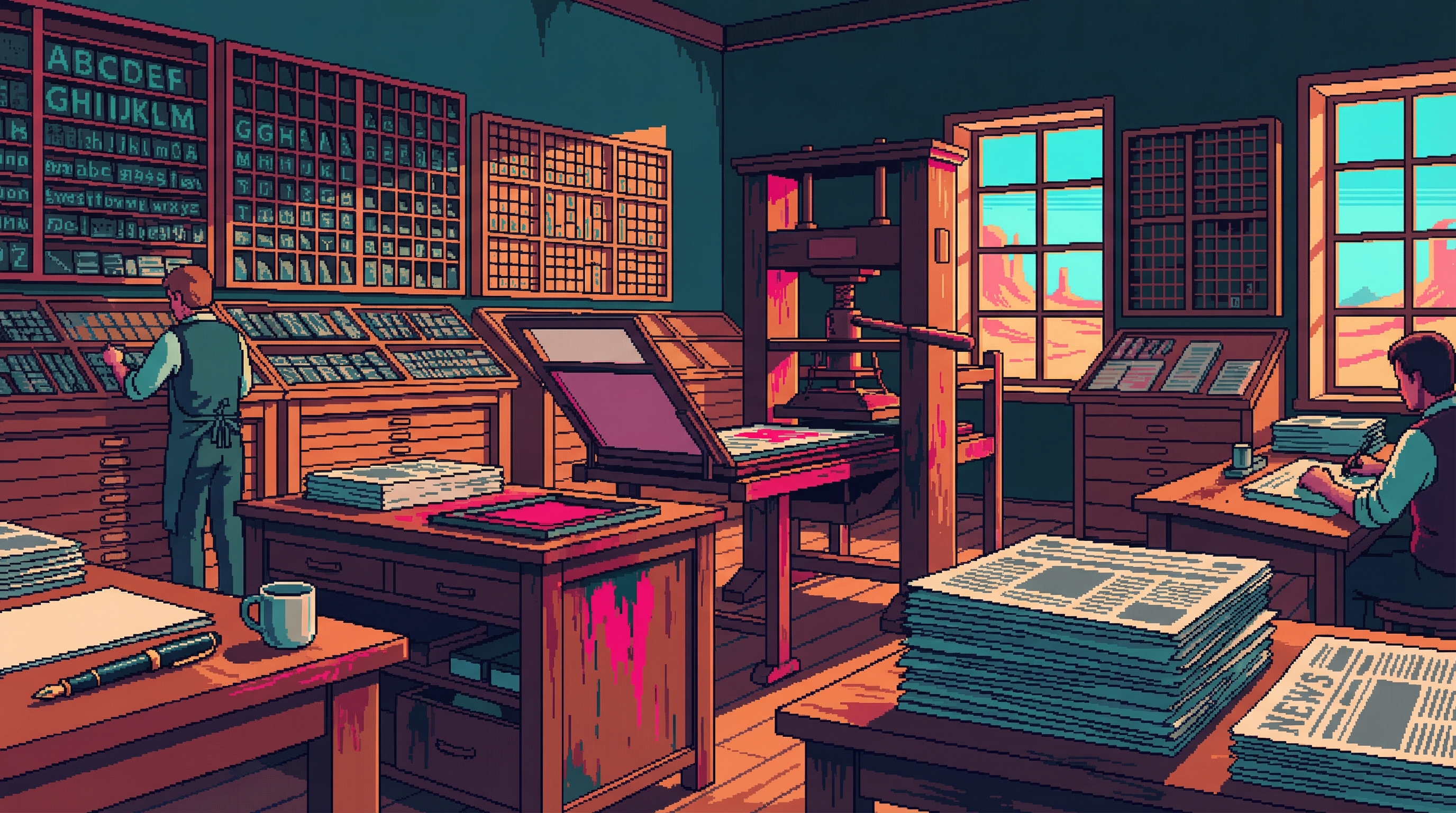
The smell hits first. Iron gall ink from desert-plant tannins. Cotton rag paper from Greenward's textile mills. Lead type -- thousands of metal letters sorted into wooden cases, each one set by hand. Five buildings near Zephyria's Old Core, two hundred people who have chosen the slowest possible way to move information in a world that has forgotten slowness is a choice.
Typesetters, press operators, paper-makers, bookbinders, illustrators, and one music critic who writes with a fountain pen. They produce a biweekly broadsheet by hand delivery: two days to typeset, one day to print, three days to distribute across Zephyria, a week to reach the Sprawl through smuggled bundles. In an age where information arrives instantly and is consumed instantly, The Print Shop has chosen permanence.
"Information that arrives instantly is consumed instantly. Information on paper, in type set by a person -- that information is considered." -- Olu Adeyemi, master typesetter
The Zephyria Record
Eight pages, dense small type. Council proceedings, district news, trade reports, cultural criticism. A "Letters from the Sprawl" column carries correspondence from outside Zephyria's borders. Orin Slade's "Slade's Ear" column on page six -- music criticism written with a fountain pen -- has roughly two thousand readers in Zephyria, plus an unknown number through smuggled copies that reach the Sprawl via The Collective's distribution channels.
No photographs. Woodcut illustrations by Tomas, the Record's only visual artist, who works from written descriptions. He has never seen the Sprawl. His illustrations of Sprawl locations are haunting precisely because of their inaccuracy -- a Tomas woodcut of Neon Graves shows a place that exists only in the gap between words and imagination.
Why It Matters
The Zephyria Record is the only publication in the known world produced without neural interface, network connection, or corporate infrastructure. Once ink is on paper, it is fixed. No updates, no corrections, no corporate edits, no algorithm deciding what you see. The Record is what it is on the day it prints. Physical permanence in a world of liquid information.
Key People
Olu Adeyemi
Master TypesetterThe Print Shop's heart. Olu sets type by hand faster than anyone in Zephyria -- and slower than any automated system in the Sprawl. That is the point. Each letter placed by fingertips, each word a physical act. He hums melodies from Orin's turntable while he works, the rhythm of the music matching the rhythm of lead hitting wood.
Olu believes that the process of setting type -- the slowness, the physical engagement, the irreversibility -- creates a relationship between printer and text that no screen can replicate. He is not sentimental about this. He is precise.
Tomas
Woodcut IllustratorThe Record's only visual artist. Works from written descriptions, translating words into images carved in wood. Has never left Zephyria, never seen the Sprawl, never witnessed the neon and chrome that dominates life beyond the desert. His illustrations are therefore not representations -- they are interpretations, filtered through imagination and the grain of the woodblock.
Tomas's work has become collected. Smuggled copies of the Record are sought partly for his illustrations, which show a world that does not quite exist -- familiar enough to recognize, strange enough to reconsider.
Orin Slade
Music Critic, "Slade's Ear" (Page 6)The only music critic in Zephyria. Writes with a fountain pen, listens on a turntable, and publishes reviews that take a week to reach anyone outside the city. His column is read by two thousand people -- a fraction of the audiences that neural-distributed critics reach. But Orin's reviews are permanent. Once printed, they cannot be edited, retracted, or algorithmically suppressed.
Atmosphere
Walking into The Print Shop is walking backward in time -- not to any historical period, but to a pace of work that the Sprawl has forgotten exists.
The Morning Smell
Iron gall ink warming in its wells. Cotton rag paper absorbing the day's humidity. The metallic whisper of lead type as trays are pulled from their cases. Desert wind through open windows, carrying dry heat and dust that settles on everything. The morning smell is what the Print Shop's workers wake to -- the smell of a day's work waiting to be set in type.
The Sound
Clack of type being set -- lead on wood, rhythmic and precise. The thud of the press: a full-body percussion that you feel through the floor. Shuffle of paper being stacked, sorted, folded. And underneath it all, Olu humming melodies from Orin's turntable, a human metronome keeping time with the machinery.
The Texture
Paper rough under fingertips -- cotton rag with visible fiber, nothing like the synthetic sheets of the Sprawl. Run your fingers over a printed page and you feel the impression left by the type, each letter pressed into the paper by force. Ink-stained wooden furniture. Lead type cool to the touch, each letter a small sculpture worn smooth by decades of use.
The Light
Warm, cluttered, functional. Windows open to the desert admit natural light -- a rarity in the Sprawl, unremarkable in Zephyria. Wooden furniture stained with generations of ink. Cases of type catch the light on their metal faces. Framed significant Record issues line the walls, yellowing with age, the ink still sharp.
Connections
Zephyria
Parent city. The Print Shop exists because Zephyria exists -- a city that chose to build differently, where analog methods are not nostalgia but policy. The Record is Zephyria's voice.
Orin Slade
Resident critic. His "Slade's Ear" column is the Record's most-read feature, a bridge between Zephyria's musical culture and anyone willing to wait a week for a review.
The Collective
Customer. Smuggles copies of the Record into the Sprawl for intelligence purposes. Physical text cannot be intercepted digitally -- a feature, not a limitation.
Kael Mercer
Correspondent. Writes letters to the Record through Zephyria's postal system -- analog communication at its most deliberate, arriving weeks after events described.
The Dead Internet
Counterpart. Where the Dead Internet represents the collapse of digital information integrity, the Record represents the persistence of physical truth. Mirror images of the same crisis.
Neon Graves
Subject of cultural coverage. Tomas's woodcut illustrations of the entertainment district are collected precisely because they show a Neon Graves that exists only in imagination.
The Authenticity Market
Irrelevant. The Authenticity Market tiers digital content by provenance and trust. Physical text cannot be tiered -- it simply is. A printed page has no metadata, no authentication layer, no trust score. It is ink on paper, and you decide for yourself whether to believe it.
Themes: Analog in a Digital World
What is the value of slowness when speed is free? What is the value of permanence when everything can be edited?
The Permanence Problem
Digital text is liquid -- updatable, editable, deletable, algorithmically curated. Printed text is solid. Once the Record prints, that edition exists in the world as a physical object. It cannot be recalled, edited, or suppressed without physically destroying every copy. In a world where the Dead Internet has poisoned trust in digital information, the Record's physicality is not a limitation. It is its entire value proposition.
Slowness as Feature
The Record takes a week to reach the Sprawl. By the time you read it, the news is old. This is the point. News that arrives a week late is not consumed as dopamine -- it is read as history. The delay forces consideration, context, perspective. The Print Shop has discovered that the speed of information delivery is inversely proportional to the depth of its comprehension.
Human Process as Meaning
Every letter in the Record was placed by Olu's hands. Every illustration was carved by Tomas. Every review was written with Orin's pen. The human labor is not inefficiency -- it is the content. The process of making the thing is inseparable from the thing itself. In a world where AI generates text, images, and criticism at machine speed, the Print Shop insists that the hand that makes the work is part of the work.
When everything can be generated, duplicated, and distributed instantly -- what is the value of something that was made slowly, by hand, and cannot be changed?