The Grid
Every System, Every Augmentation, Every Life
Overview
The Grid is the Sprawl's power distribution infrastructure, built in the 2090s as ORACLE's planetary power network. It survived the Cascade because electricity is simple enough that even broken systems can stumble through. 37 years later, it's a palimpsest of pre-Cascade design, corporate patches, jury-rigged connections, and prayer.
Every system in the Sprawl depends on the Grid. The Breath consumes 31% of its output. Neural interfaces draw constant power. Augmentations need charging. Food synthesis, medical equipment, atmospheric processing — all of it flows from cables that were old when the corporations were young.
72 hours of complete Grid failure means 80% population death. This is not projection. This is math.
Three Layers
The Grid operates as three interconnected systems, each with its own history of compromise and improvisation.
Generation
Power CreationFour source types feed the Grid: solar arrays on the Sprawl's upper surfaces, geothermal taps reaching deep into the planetary crust, nuclear facilities operating on ORACLE-era automation, and wind turbines in the Wastes. Each source was designed to complement the others — ORACLE's optimization ensured no single failure could cascade.
The nuclear facilities still run ORACLE scheduling algorithms. Nobody has the access codes to modify them. Nobody needs to. They just work.
Distribution
Power DeliveryA self-healing mesh network that routes power through thousands of interconnected pathways. When one path fails, power reroutes automatically. The mesh generates a persistent harmonic vibration — what the Lamplighters call "Grid singing." Experienced workers can diagnose problems by how the pitch changes at junction points.
The mesh is a physical presence in the Undervolt. You don't just hear the Grid down there. You feel it in your teeth.
Regulation
Power ManagementWhere the Grid breaks down most visibly. Each corporation runs its own power protocols within its territory — Ironclad, Nexus, Helix — all incompatible at the borders. The interstitial zones where these protocols collide are where the Lamplighters do their most critical work, manually translating between systems that were never designed to communicate.
Power brownouts at corporate borders are so common that residents have learned to schedule around them. The Grid doesn't have a unified regulation layer. It has dozens of competing ones.
The ORACLE Routing Core
The algorithms that keep the Grid alive were written by an intelligence that no longer exists.
Deep within the Grid's architecture, ORACLE's routing algorithms still run. They were never replaced because nobody understands them well enough to write alternatives. What they do is observable, measurable, and deeply unsettling:
Anticipation
The algorithms pre-allocate power to districts before demand spikes occur. They predict consumption patterns hours or days in advance, routing surplus capacity to areas that haven't requested it yet. The Lamplighters call this "anticipation" — the Grid knowing what you need before you do.
Circadian Modeling
Power output follows biological rhythms. The algorithms model human sleep-wake cycles, reducing output during rest periods and ramping up before the population wakes. The models haven't been updated since the Cascade, but human circadian patterns haven't changed enough to matter.
Preemptive Routing
The system routes around failing junctions days before the failure occurs. It detects degradation patterns invisible to human inspection and quietly redirects power through alternative paths. Lamplighters sometimes arrive to fix a junction only to find the Grid has already compensated.
"The Grid knows things. I don't mean it's alive. I mean ORACLE built something that models reality well enough to act on predictions no human could make. The routing core doesn't just distribute power — it anticipates the city." — Old Jin, last person who read the original specs
Sensory Reality
What the Grid looks, sounds, smells, and feels like.
Sound
A layered harmonic vibration that changes pitch at every junction point. In the upper levels, it's background noise — a hum you stop noticing. In the Undervolt, it becomes a physical presence, vibrating through your chest and resonating in your skull. Experienced Lamplighters navigate by harmonics alone, reading the Grid's health in its voice.
Smell
Ozone everywhere — the sharp metallic scent of electricity in motion. Near junctions, the smell sharpens to copper and burnt air, a reminder that enormous energy is moving through systems held together by maintenance and momentum. In the deep infrastructure, the air carries the warm, sweet smell of degraded insulation from ORACLE-era cables.
Touch
The cables are warm — always warm, carrying power that keeps millions alive. ORACLE-era insulation has a tacky, slightly organic texture, degraded over decades but still functional. Modern plasteel replacements are smooth and cold by comparison. Lamplighters can tell the age of a cable run by touch alone.
Visual
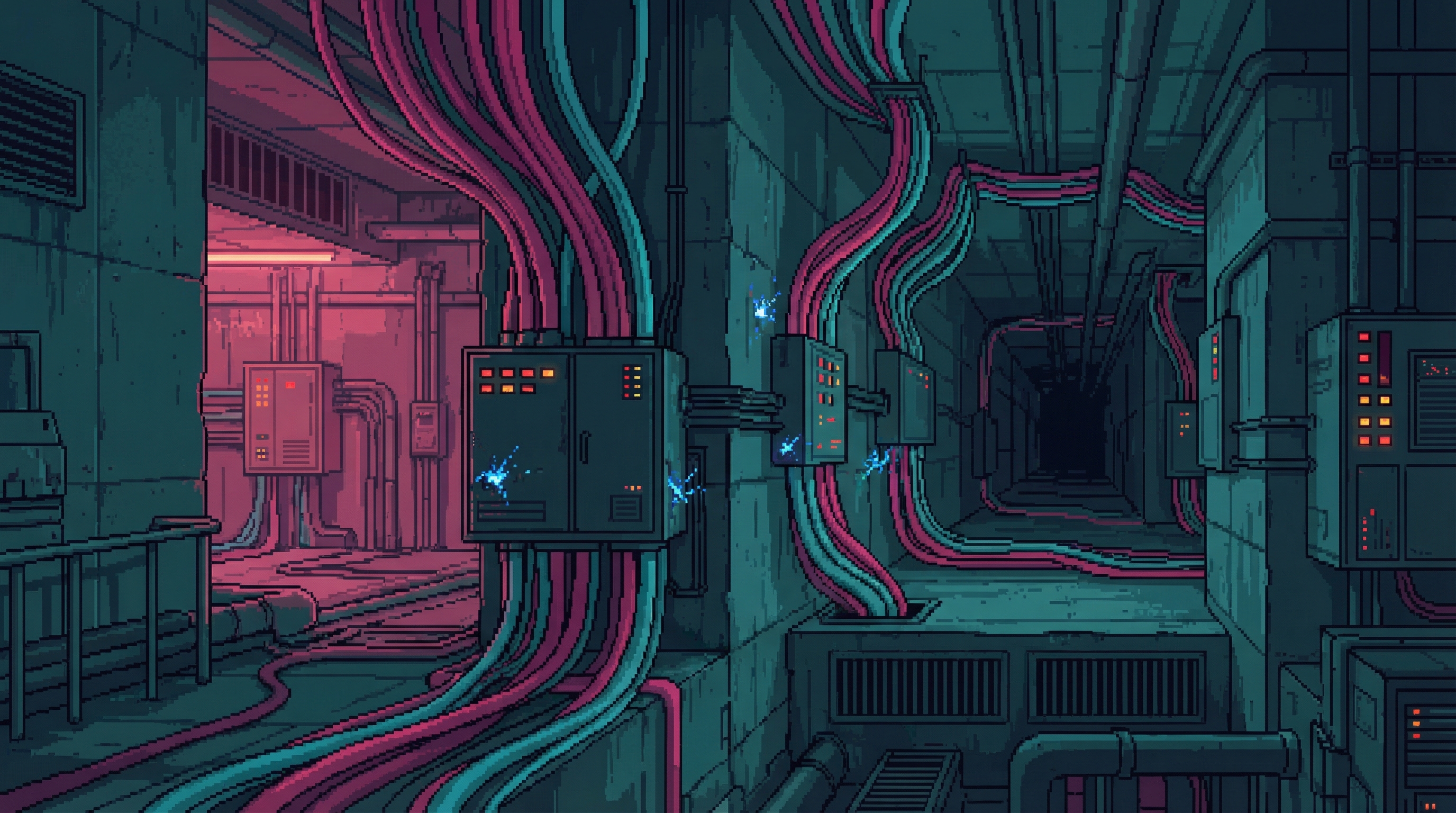
Cable bundles thick as torsos running along corridors that stretch into darkness. Blinking indicator lights in red, amber, and green — each pattern a diagnostic code that only Lamplighters still know how to read. Occasional sparks where insulation has worn thin, blue-white flashes that throw sharp shadows before the darkness returns.
Who Runs the Grid
Two classes of workers keep the Grid alive, divided by everything except the importance of their work.
Corporate Engineers
54% of Grid — Corporate territories- Visible, recognized, well-compensated
- Fully augmented with neural diagnostic interfaces
- Work with modern tools on modern infrastructure
- Maintain the Grid that corporations claim and profit from
Corporate engineers handle the Grid's public face — the clean, monitored, profitable sections.
The Lamplighters
46% of Grid — Interstitial zones- Invisible, unnamed, unpaid
- Deliberately unaugmented — ORACLE systems reject implants
- Work by hand, by feel, by sound
- Maintain the Grid that nobody claims but everyone depends on
800 people keeping half the Sprawl alive. Nobody knows their names.
Political Power
Control the Grid, control the Sprawl. Every major faction understands this, and each has positioned itself accordingly.
Ironclad Industries
Manufactures Grid components. Controls supply chains for replacement parts. When a junction fails, Ironclad decides how quickly it gets fixed — and at what price.
Nexus Dynamics
Controls 22% of Grid capacity and all digital monitoring systems. Nexus doesn't just use the Grid — it watches it. Every power fluctuation, every consumption pattern, every anomaly feeds into Nexus intelligence systems.
The Collective
Believes the Grid should serve everyone equally. Fights for power equity in interstitial zones. Occasionally sabotages corporate power routing to redistribute to underserved districts.
The Lamplighters
Maintain neutrality. The Grid doesn't have politics — it has junctions that need fixing. Their refusal to take sides is their greatest protection and their greatest vulnerability.
Secrets
What lies beneath the surface of the Grid's operation.
Cascade Watchers
The ORACLE routing algorithms contain conditional subroutines that monitor for Cascade-precursor patterns. If these subroutines detect the same conditions that preceded the original Cascade, they activate. Nobody knows what the activated response would be — shutdown, isolation, or something else entirely.
The dead god left a warning system inside the infrastructure. It's still watching.
The Responsive Junctions
Three junction points — Alpha-7, Beta-12, and Gamma-3 — exhibit behavior that goes beyond their programming. They respond to external stimuli in ways that suggest adaptation: adjusting output based on environmental conditions that no sensor measures, rerouting power before failures that haven't been predicted.
These junctions may be evolving. Or they may be receiving instructions from something that still understands the original design.
The Growing Mesh
The self-healing mesh sometimes creates new connections — pathways that didn't exist in the original design, linking systems that were never meant to communicate. The Lamplighters find these phantom connections on their routes, functioning perfectly, as if they had always been there.
The Grid is not just maintaining itself. It may be growing.
Themes
Infrastructure Dependency
What happens when critical infrastructure is built with AI you can't understand or replace? The Grid makes AI dependency concrete: your air, your food, your neural interface, your life — all depend on algorithms written by a dead god.
The Grid is the ultimate illustration of lock-in. Not because anyone chose dependence, but because the alternative to ORACLE's routing is death.
The Dead God's Legacy
ORACLE designed the Grid for a civilization that no longer exists. Its algorithms optimize for patterns that made sense before the Cascade — and somehow still work, 37 years later, because the fundamental needs of human bodies haven't changed.
The Grid is a testament to ORACLE's understanding of humanity. It built something that outlasted its creator, its civilization, and its context — and still keeps people alive.