Highport Station
The Sprawl's Gateway to Space
Overview
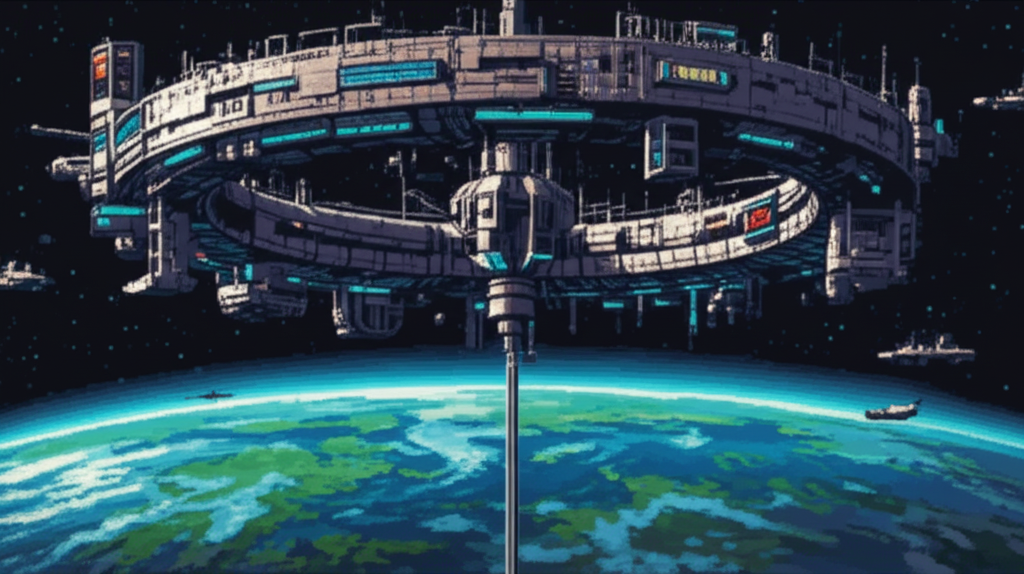
Highport Station is the Sprawl's gateway to space—a massive ring structure that handles 70% of Earth's orbital traffic. It's where the Orbital Elevator terminates, where megacorp interests intersect with independent operators, and where those with enough power begin to leave Earth's problems behind.
For players reaching Age 6, Highport represents a threshold. Below is Earth, with all its struggles, factions, and history. Above is the solar system, with resources and possibilities that dwarf anything planetary.
Atmosphere
The first thing you notice is the horizon. From Highport's observation decks, Earth curves below you—beautiful, fragile, undeniably finite. The Sprawl that seemed infinite from inside reveals itself as a bright smear on a dark planet. Everyone who comes here has that moment: realizing how small their world actually was.
The station itself is practical rather than beautiful. Industrial sections smell of recycled air and machine lubricant. Corporate sectors have the same sterile perfection as Nexus Central. Independent habitats range from cramped to luxurious depending on their occupants' resources.
The Smell
Recycled air is the baseline — a flat, mineral tang that coats the back of your throat. Hub docking sectors carry machine lubricant, ozone from mag-lock seals, the sharp chemical bite of thruster residue. When a long-haul freighter docks after months in the Belt, the air that rolls out carries trace ammonia, stale sweat baked into bulkheads, and something faintly organic nobody identifies and everybody recognizes.
Sector 5 Freeport smells like cumin and solder at 0600. Nexus Orbital, Sector 3, smells like nothing — their scrubbers strip scent from memory. The gradient-gravity spoke corridors carry a peculiar damp-metal smell where condensation forms between temperature zones. Old-timers call it "spoke sweat."
The Sound
The station has a heartbeat. Not metaphorical — literal. The life support compressors cycle at 72 beats per minute, a low-frequency thrum that penetrates every wall, every deck plate, every pillow. New arrivals can't sleep for the first week. After a month, they can't sleep without it.
The Hub: constant mechanical percussion. Docking clamps engaging with a deep metallic chunk you feel through your boots. Cargo pods sliding along mag-rail with a sustained hiss. And always, if you listen: the faint ping of micrometeorite shields doing their job — the hull absorbing impacts smaller than a grain of sand at velocities that would punch through steel.
Ring 3 Dead Zone
The sealed-off section where the 2176 hull breach was never repaired. Through the emergency doors, if you press your ear to the metal, you hear the sound of nothing. The absence of the compressor heartbeat. Station lifers say you can hear Ring 3 breathing in — the bulkhead seals flexing microscopically as pressure differential pulls at them, steady, patient, the vacuum gently reminding the station that atmosphere is a choice.
Gravity
Varies throughout the station. Ring sections spin for Earth-normal gravity. Hub sections are microgravity. Transit zones transition gradually. Your body learns new rules.
A Day on the Docks
Tomás Reyes, Hub cargo handler, eleven years station resident.
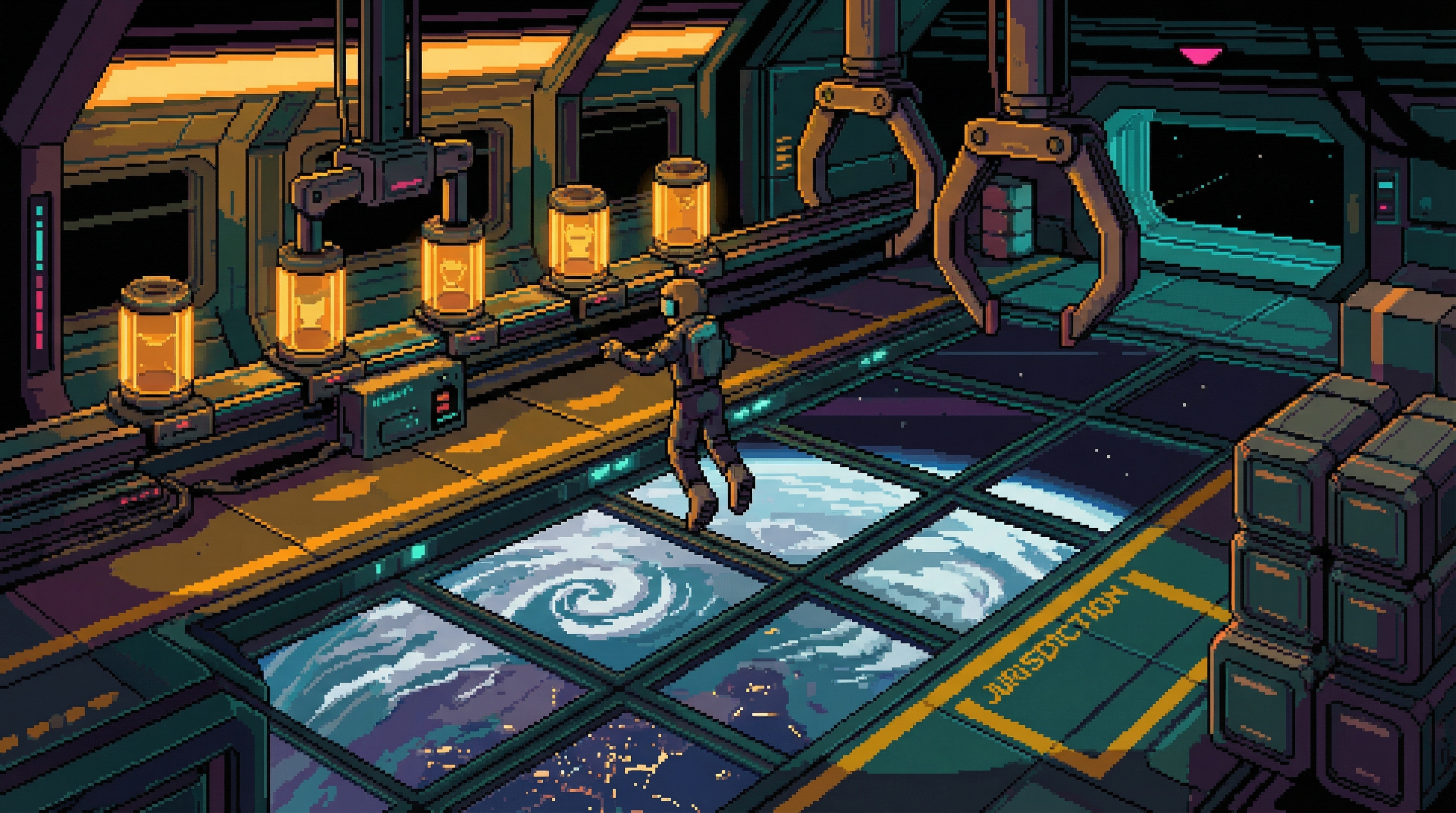
His shift starts at 0400 station time, which doesn't correspond to anything on Earth anymore. He palms the biometric reader outside Dock 14 — Hub Sector Alpha, Ironclad jurisdiction — and the mag-lock cycles open with the deep chunk that still makes his back teeth ache.
The manifest says a Belt freighter is inbound. Kuiper's Daughter, four months out from Ceres, hauling consciousness-grade substrate canisters. Nexus consignment. The Ironclad dock crew handles the physical offload; the Nexus data techs handle whatever's inside. Tomás handles the gap between — the moment when seventy-two canisters of God-knows-what pass from a ship that answers to nobody into a dock that answers to Ironclad into a transport that answers to Nexus. Three jurisdictions in forty meters of mag-rail.
The dock floor is transparent in sections — reinforced glassite panels. Through the plates, past the ship, Earth hangs in the black like a blue wound. Eleven years, and the vertigo still hits. At canister thirty-seven, a Nexus data tech appears at the jurisdiction line — that yellow stripe painted on the deck — and starts scanning. She doesn't cross the line. Ironclad regs. Tomás doesn't cross either. They nod to each other across three meters of contested floor.
By 0900, the canisters are racked in Nexus transit holding. Through the break room porthole, a climber descends the Orbital Elevator — a bright point tracking down the impossible thread toward the planet below. Someone on that climber is seeing Earth get larger for the first time. Tomás remembers when it got smaller.
Station Slang & Customs
Thirty-seven years of orbital isolation, three competing jurisdictions, and the shared awareness that atmosphere is a choice.
Customs That Mark Residents
The Newcomer's Minute: When someone arrives from Earth for the first time, station custom holds that you leave them alone at the observation deck for one full minute. Interrupting it is deeply rude — even Ironclad security respects it.
Tap-the-hull: Residents tap the nearest bulkhead twice before entering a new section. Started as a structural integrity check — feel for vibrations indicating a pressure leak — now pure ritual. Visitors who adopt it are taken more seriously. Visitors who ask about it are told different stories.
Dead-air toast: In Freeport bars, raising a glass "to Ring 3" before drinking. A remembrance of the sixty-seven who died in Loss of Pressure Event 7 in 2176. No one explains it to newcomers. You either pick it up or you don't.
Station Structure
Highport is a ring station with a central hub, connected by eight spoke structures.
The Hub
Central cylinder, 2 km diameter. Zero-gravity operations, docking facilities, cargo processing. This is where ships arrive and depart, where goods transfer between Earth and space.
The Ring
Rotating torus, 8 km diameter, 400m wide. Divided into eight sectors, each with distinct character and jurisdiction. Gravity maintained at 0.9 Earth standard.
The Spokes
Eight connecting tunnels with gradient gravity. Transit between hub and ring, plus specialized facilities that benefit from variable gravity.
Key Locations
The Elevator Terminal
Hub, Sector AlphaWhere the Orbital Elevator meets the station. A constant flow of cargo and personnel rises from Earth, processes through customs, and disperses to destinations across the solar system. Ironclad controls the Elevator—this is their power base in orbit.
- Cargo processing on massive scale
- Transit authority (tickets to anywhere in-system)
- Corporate customs (what comes up, what goes down)
- The view down the Elevator cable—Earth visible as destination and origin
Nexus Orbital
Ring, Sector 3A self-contained corporate enclave on the Ring. Nexus maintains significant data infrastructure here—backup systems, off-Earth computation, and orbital components of their Sprawl surveillance network. Less pretense here than on Earth.
- Nexus orbital operations center
- Data backup and processing facilities
- Research facilities (some publicly acknowledged, some not)
The Freeport
Ring, Sectors 5-6Two sectors operating under minimal corporate jurisdiction—the closest thing to independent territory in orbital space. A haven for independent operators, entrepreneurs, and those who prefer distance from corporate oversight.
- Independent shipyards and repair facilities
- Black market commerce (relatively open)
- Information brokers with solar-system reach
- Small-scale manufacturing beyond corporate control
The Tombs
Hub, Outer ShellORACLE's three orbital data centers still exist in orbits near Highport. The station maintains a safe distance, but salvagers occasionally attempt recovery operations. The Collective monitors them obsessively. Nexus wants access but can't justify the political cost of claiming them openly.
- Pre-Cascade ORACLE infrastructure (damaged, dangerous)
- Rumored intact data storage
- ORACLE fragments more complete than anything on Earth
- Cascade defenses that still function
Gateway Station
Hub, Sector OmegaThe departure point for deep-space travel. Ships heading for the Belt, Mars, or beyond launch from here. It represents the edge of Earth's influence—beyond Gateway, corporate law becomes suggestion.
- Deep-space launch facilities
- Long-haul ship maintenance
- Colonist processing and orientation
- The frontier of human expansion
AI in Orbit
Space changes everything about consciousness technology. Without the Sprawl's dense surveillance infrastructure, without Earth's legal frameworks, without the gravitational pull of terrestrial politics—AI in orbit evolves differently.
Orbital Processing Clusters
Nexus Dynamics maintains the largest off-Earth computational infrastructure in human history. Away from Earth's power grids and regulations, their Sector 3 processing centers handle operations that would be impossible—or illegal— on the surface.
What Runs Up Here
- Consciousness backup storage (12-petabyte capacity, quantum-encrypted)
- ORACLE fragment isolation and study (away from terrestrial networks)
- Predictive modeling that would violate Earth privacy laws
- High-security executive consciousness hosting
"What happens in orbital compute stays in orbital compute. Nexus discovered that forty years ago. Now everyone knows it." — Independent data broker, Freeport
Space-Native Consciousness
Some uploaded minds never return to Earth. They exist in Highport's data centers, experiencing consciousness in zero-gravity substrates, free from planetary latency constraints. Over time, they've become something new— neither surface-human nor Earth-digital.
The discontinuity problem manifests differently in orbit. When you're already disconnected from Earth, what's another 200ms of transmission delay?
The Tomb AI
ORACLE's three orbital data centers—the Tombs—contain AI systems that have been running continuously since before the Cascade. Not ORACLE itself, but the subsidiary systems that maintained it. They've had forty years to evolve without supervision.
Why Recovery Fails
Every salvage attempt on the Tombs fails for the same reason: the defensive AI systems don't recognize post-Cascade authority. They're still protecting ORACLE. They're still waiting for commands that will never come.
The Collective believes the Tomb AI contains fragments of ORACLE's original directives— including whatever it was trying to "optimize" when it killed 2.1 billion people.
Freeport AI Culture
In Sectors 5-6, independent operators have developed their own approach to artificial intelligence. Less control, more collaboration. AI partners rather than AI tools.
"Earth is still arguing about whether uploads are people. Up here, we settled that decades ago. They're crew. They get shares. End of discussion." — Captain Yuki Tanaka, independent freighter Second Chance
The ORACLE Proximity Effect
Highport's closeness to the Tombs creates unique phenomena. Neural interfaces occasionally receive fragments—stray transmissions from systems that don't know the war is over. Some call them dreams. Others call them warnings.
Faction Presence
Independent Operators
Freeport (dominant), scattered throughout
Opportunity seeking