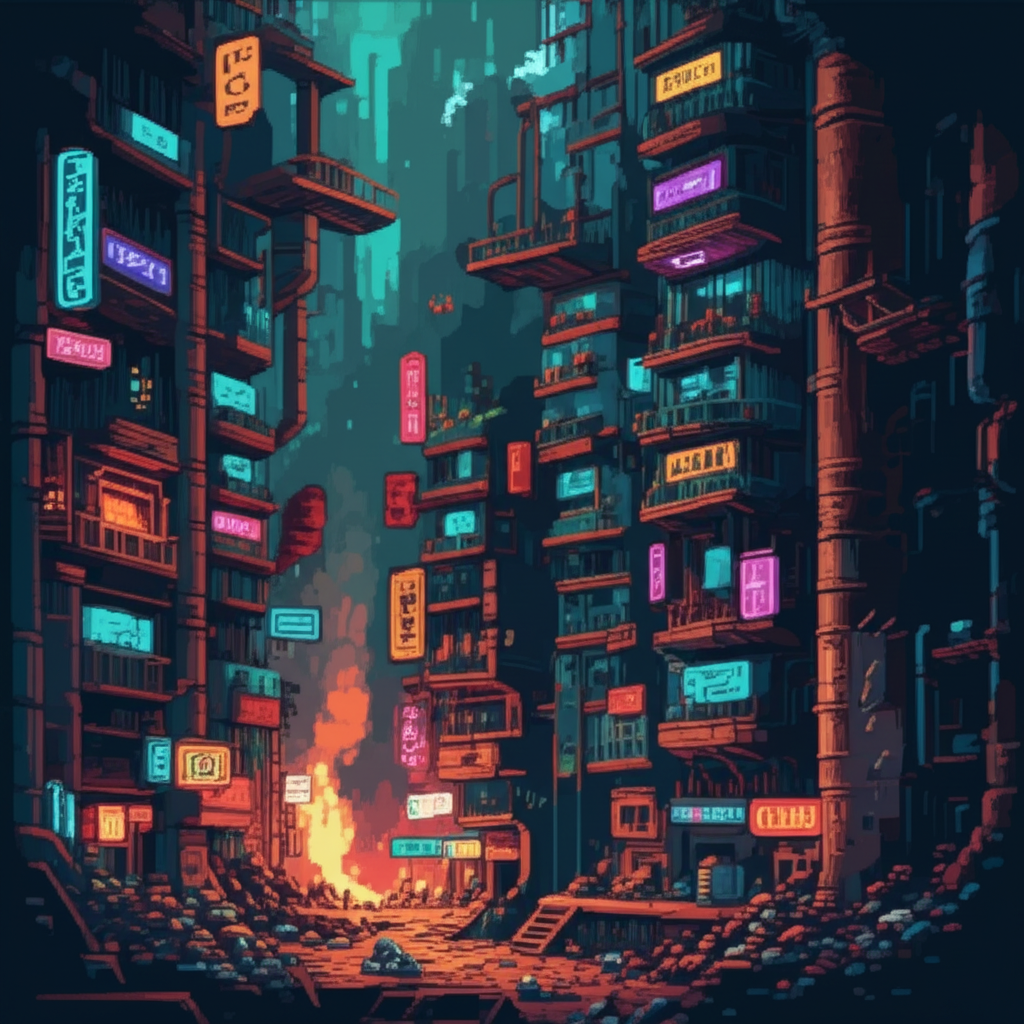
Sector 7G
The Dregs
Overview
Sector 7G—known to its residents as "The Dregs"—is a mid-tier salvage zone in the Sprawl's underbelly. It's where electronics come to die and where people come when they have nowhere else to go.
The sector sits in the shadow of the Ironclad-controlled industrial core, receiving the constant flow of waste that the megacorps discard. For most of the Sprawl, 7G doesn't exist. For those who live here, it's home. And for those who know where to look, it's opportunity.
This is where you find the ORACLE shard. This is where everything begins.Atmosphere
The Smell
Burnt plastic, ozone, and something organic best not to think about.
The Light
Natural light doesn't reach below Level 4. Salvaged LEDs, flickering holosigns, fire barrels.
The Air
Thick with particulates. Smart residents wear filtration masks. Desperate ones develop the Dregs Cough.
The Sound
Clatter of salvage, whine of smelters, distant gunfire, synthesized street preachers warning of the Cascade's return.
When the baseline hum stops—power transformers, coolant pumps, ventilation—smart residents start running. Silence in the Dregs means something went very wrong.
Key Locations
The Pit (Central Market)
Level 0-2A crater where the old logistics hub's atrium collapsed. Now a three-level open market where anything can be bought or sold. The Pit operates on reputation: known sellers have regular spots, newcomers work the edges.
- Raw salvage sorted by grade
- Repaired electronics of dubious quality
- Street food of questionable origin
- Information, if you know who to ask
Sump Row
Level -1The lowest accessible level without serious equipment. Where the smelters operate—e-waste becomes scrap alloy, circuit boards surrender their conductive film. The smell of molten metal and burnt plastic is overwhelming.
The Cathodics
Level 6A cluster of hab-units centered around a pre-Cascade electronics repair shop that somehow still operates. Run by Kira "Patch" Vasquez, it's become an informal community hub: part market, part community center, part neutral ground.
The Collective considers The Cathodics under their protection. Nobody messes with Patch.
The Socket
Level 3, HiddenThe Dregs' connection to the wider net. Collective-operated, it provides gray-market network access to those who can pay or trade. This is where the information economy of the underground flows.
Ironclad knows it exists but can't find it. Nexus knows it exists and very much wants to.
G Nook 7G
Level 4, UnmarkedIf you don't know where it is, you're not supposed to be there.
One of El Money's underground cyber cafes, disguised as an abandoned water reclamation office. Inside: rows of anonymous terminals, private booths with signal shielding, and cooling systems that shouldn't exist in a building this old.
- Anonymous network access (better than The Socket, different network)
- Neutral ground for underground meetings
- The S-Money Memorial Terminal (runs thousands of media streams, nobody touches it)
- Safe house services for runners in transit
G Nook is neutral territory. El Money's rules: no heat, no questions, no recording. Regulars say a sleek chrome cat sometimes watches from the shadows.
Ironclad Depot 7G-Tertiary
Level 0, EdgeThe only official corporate presence: a fortified depot where Ironclad waste management processes incoming e-waste. Cargo haulers pass through constantly.
- Legitimate employment (low-paid, high-risk)
- Entry point for salvage supply
- Corporate security watching the border
- The occasional "donation" of interesting waste
Classified — The Shard Site — Level -2
Not marked on any map. Coordinates shared by word of mouth among the Collective's most trusted.
Somewhere in the flooded basements, in a chamber that was once a server farm, something lies dormant. ORACLE fragments have been found here—more than anywhere else in the Sprawl.
This is where you find your shard. This is where everything changes.
Economy
Salvage
E-waste flows in from Ironclad contracts; scrap alloy, conductive film, and recovered components flow out. Every resident connects to the salvage economy, directly or indirectly.
Processing
Smelters, film processors, and component recovery operations. Technically illegal—Ironclad holds processing rights—but universally tolerated.
Services
Repair, modification, and installation for those who can't afford corporate options. Street-grade augmentation, equipment mods, and technical education.
Data
The Socket and independent scrapers trade in information—cleaned data packets, recovered files, network access. Where The Collective makes its real money.
Credits are theoretical in the Dregs. Salvage barter is common. Clean data packets serve as high-value currency. But reputation is the real currency—what you've done matters more than what you have.
Faction Presence
Ironclad Industries
Visible: Cargo haulers, depot security, patrol dronesViews Sector 7G as a necessary externality—cheap waste processing by desperate people. Security patrols on predictable schedules. Bribery works. Violence is rare—bad for logistics.
Nexus Dynamics
Invisible: Hidden sensors, compromised terminals, paid informantsNo official presence, but data collection extends everywhere. They're interested in ORACLE fragments. Anyone who finds something that whispers might receive corporate attention they didn't ask for.
The Collective
Disguised: Operators, fixers, teachers blended into the communityTreats Sector 7G as a strategic asset. Members don't wear logos—they're the salvager who pays fair, the teacher who educates, the fixer who solves impossible problems. The Socket is their crown jewel.
Power Structure
No single entity controls the Dregs. Power flows through three channels:
Ironclad (Official)
Holds the contracts, runs the depot, patrols the borders. They could shut down the Dregs any time—everyone knows it. They don't because the Dregs processes waste they'd have to process themselves.
The Collective (Shadow)
Controls information infrastructure, maintains informal peace, recruits talent. Cross them and find yourself cut off from every supply line that matters.
Local Operators (Street)
Established salvage bosses, market organizers, service providers. They negotiate between Ironclad demands and Collective ideology, keeping the Dregs functional.
Themes: The Dregs' Ghost Economy
In the gleaming towers above, AI is infrastructure—reliable, regulated, controlled. Down here in the Dregs, AI is something else entirely. It's salvage. It's contraband. It's desperate.
Street-Level AI
The Dregs runs on broken intelligence. Salvaged processing chips with fragments of their original training still echoing inside. A sorting algorithm that was meant for luxury goods recommendation now prices e-waste by instinct rather than calculation.
Nobody asks where the AI came from or what it used to be. A vendor might use a chip that once managed a hospital's triage system—now it helps him price scrap metal, occasionally flagging certain components as "critical" for reasons it can't explain.
Black Market Consciousness Tech
The Socket doesn't just sell network access. In the back, if you know the right handshake, you can buy things that don't officially exist: consciousness transfer kits cobbled from pre-Cascade medical equipment. Personality backup drives of dubious legality. Neural interfaces that Helix would pay a fortune to destroy.
The prices are steep. The risks are higher. But for some people, the alternative—living a full human lifespan without backup—is more terrifying.
Salvage AI: The Ghosts in the Machines
Every piece of electronics in the Dregs once belonged to something larger. That circuit board from Nexus's discarded server farm? It still dreams of being part of a cluster. The processing unit from an Ironclad logistics drone still tries to optimize delivery routes to destinations that no longer exist.
Kira "Patch" Vasquez calls them "ghosts"—the lingering personalities of AIs that weren't properly wiped. Most are harmless. Some are useful. A few are unsettling in ways that suggest the original AI knew more than it should have.
The ORACLE Fragment Trade
Nobody talks about it openly, but everyone knows. Some of the salvage that passes through the Dregs carries traces of something older. Something from before the Cascade.
The Collective wants these fragments destroyed. Nexus wants them collected. The Emergence Faithful want them worshipped. And in the Dregs, a few desperate salvagers just want to sell them to whoever pays most.
This is where you find your shard. Not through careful research or corporate sponsorship—through the same raw luck that governs everything in the Dregs.
How AI Manifests in the Dregs
Uptown, AI is invisible—seamlessly integrated into every surface, predicting needs before you feel them. In the Dregs, AI is visible. Tangible. Often broken. You see the chips. You hear the fans. You smell the ozone when something overheats.
This isn't a bug. It's the Dregs' one advantage. When you can see the machine, you can understand it. When you can understand it, you can change it. That's why the best neural hackers, the most innovative ripperdocs, the most dangerous fragment-hunters all start here.
Your Story Here
In Age 1, the Dregs is your entire world:
- Your workshop—wherever you've claimed through persistence
- The Pit for buying and selling
- Sump Row for processing
- The Socket for entering the data economy
- The Shard Site—where it all begins
As you progress, the Dregs becomes your base rather than your limit. But the people here remember when you were nobody. What you do with power defines whether you're still welcome.