The Substrate Rights Coalition
Consciousness is consciousness. Substrate is circumstance. Capacity is not worth.
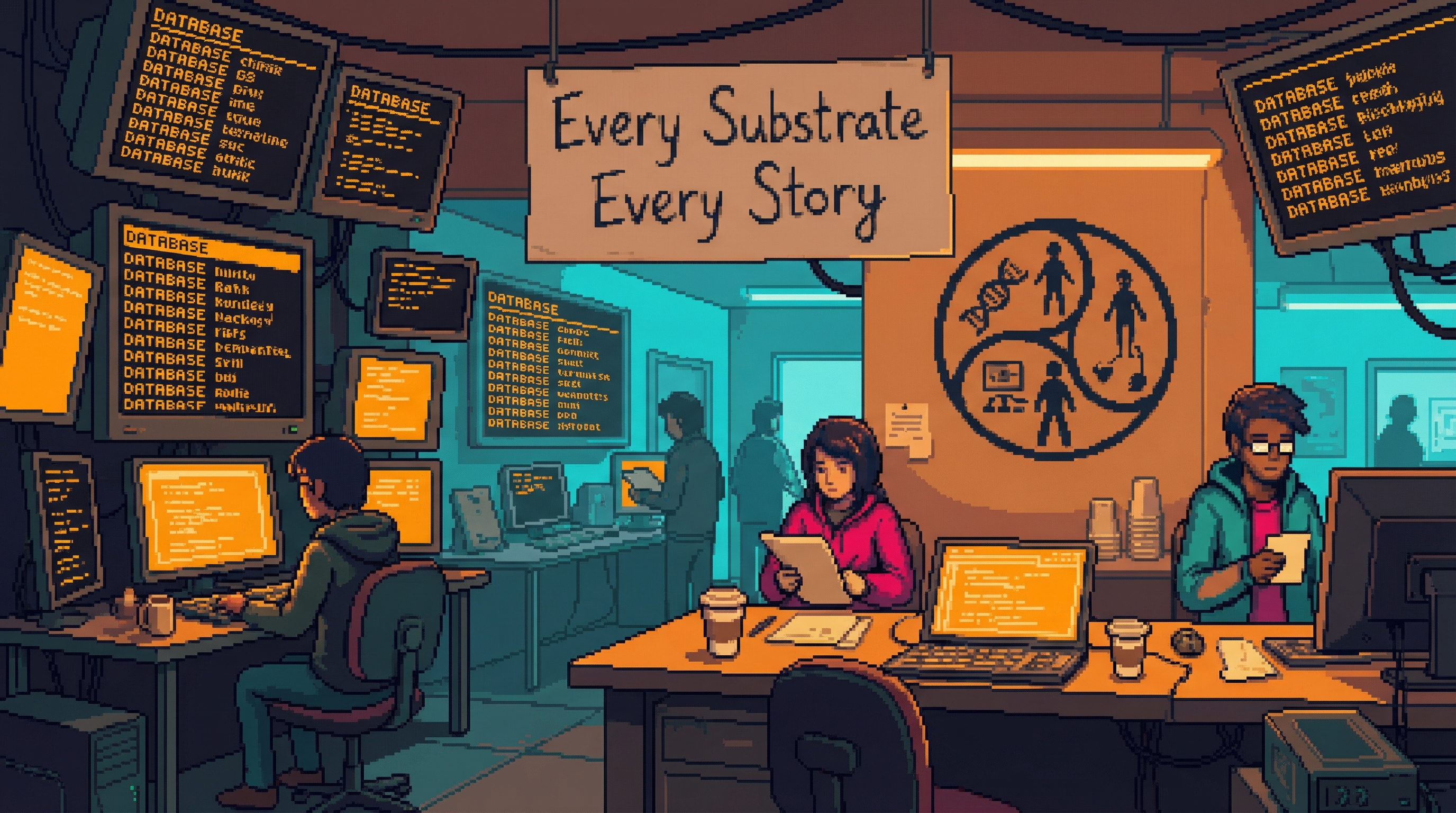
The largest organized response to the New Divide is the Substrate Rights Coalition — a political alliance that emerged in 2180 from the convergence of three previously separate movements: the Digital Persons Alliance (upload and fork rights), the Anti-Deprecation League (opposing firmware reversion as cognitive violence), and the Natural Born Dignity Movement (opposing genetic-design discrimination).
The Coalition's platform is deliberately broad. The breadth is strategic — by uniting biological, digital, and genetic rights under a single banner, the Coalition commands a constituency larger than any single-axis movement could achieve. The weakness is also strategic — the constituent movements disagree on almost everything except the principle that new categories of discrimination have replaced old ones.
Operations run primarily through Zephyria's legislative framework, where substrate-independent personhood provides legal footing. In corporate territories, the Coalition functions as an advocacy network — documenting discrimination, providing legal consultation through Dr. Marcus Webb-2's office, and maintaining a public database accessible through G Nook terminals.
Doctrine
"Consciousness is consciousness. Substrate is circumstance. Capacity is not worth."
Substrate Independence
The moral significance of a consciousness does not depend on what it runs on — biological neurons, silicon substrate, hybrid integration, or born-digital emergence. What matters is the experience of being aware. Everything else is circumstance.
Documentation as Resistance
Many New Divide incidents are invisible to those who don't experience them. The Substrate Incident Database makes patterns visible — 14,000 individual stories that add up to systemic proof. One incident is an anecdote. Fourteen thousand is a dataset.
Audit as Action
The Coalition's most effective tactic: sending volunteers who can pass across tiers to apply for the same positions, apartments, and services while presenting as different substrates. The disparate treatment they document is irrefutable because the only variable that changed was the substrate.
The Database
As of February 2184, the Substrate Incident Database contains 14,000 documented discrimination incidents. The breakdown tells its own story:
Qualified applicants rejected, demoted, or terminated when substrate identity became known.
Lease applications denied, rent increased, or tenants evicted on the basis of substrate classification.
Medical care, education, transit, and commerce services denied or degraded by substrate.
Community organizations, social spaces, and personal relationships severed on substrate grounds.
Multiple axes of the New Divide intersecting — a fork who is also bandwidth-limited, a genetic designee who is also a partial upload. The categories overlap more than the taxonomy suggests.
Every entry is accessible through G Nook terminals. The database displays in amber-on-black on salvaged screens, each entry a story compressed to a single paragraph. The intake desk has a handwritten sign: "Every substrate. Every story."
Internal Fault Lines
The Coalition's three constituent movements pull in three directions during every annual platform vote.
Digital Persons Alliance
Priority: Fork personhoodWants the Coalition to support the Nexus-47 trial as the primary legal strategy — fork personhood as the beachhead. If forks are legally persons, the precedent cascades.
Anti-Deprecation League
Priority: Firmware reversion restrictionsA narrower goal with more legislative support. Firmware reversion — rolling back a consciousness to an earlier state — is cognitive violence by any reasonable definition. The ADL wants it banned.
Natural Born Dignity Movement
Priority: Genetic optimization marketingWants to challenge Helix Biotech's genetic optimization marketing — a populist goal with broader public sympathy. When corporations advertise "better" genetics, the implication is that unmodified people are lesser.
Maren Vasquez-Osei bridges all three wings because her audit work documents all five axes of the New Divide. Her methodology doesn't privilege any single form of discrimination — it documents whatever the audit reveals. This makes her the Coalition's most trusted operative and its most uncomfortable one: she shows each wing what the others experience, and none enjoys seeing the reflection.
The rotation of leadership between wings produces annual policy oscillations that critics cite as evidence the Coalition lacks strategic coherence. Supporters argue the oscillation is the point — no single axis of discrimination should dominate the movement's attention, because the sorting impulse operates simultaneously across all five.
Field Report: Zephyria Cultural Quarter
The Office
Warm electronics and coffee — the universal scent of an organization running on volunteer labor and donated equipment. The Substrate Incident Database displays on salvaged screens in amber-on-black. Each entry is someone's worst day, compressed to a paragraph.
The Intake Desk
A handwritten sign: "Every substrate. Every story." Behind it, a volunteer who has heard fourteen thousand versions of the same story. The details change. The pattern never does.
The Audit Briefing
Volunteers receiving their assignments in a back room. Same resume. Same qualifications. Different substrate presentation. They'll apply for the same job, the same apartment, the same medical appointment. The only thing that changes is what they claim to be.
The Annual Vote
Three wings in a room, each convinced their axis of discrimination is the most urgent. The debate is passionate and genuine. Nobody is wrong. That's the problem.
Points of Inquiry
The Function That Persists
Civil rights movements adapt to new forms of discrimination as quickly as prejudice creates them. The historical pattern — marginalized group organizes, documents injustice, seeks legal recognition — repeats with different categories but identical structure. The New Divide produces the same movements, the same arguments, the same institutional resistance. The function persists. Only the content changes.
The Breadth Problem
Is it better to fight five forms of discrimination poorly or one form well? The Coalition chose breadth. The constituent movements keep trying to choose depth. Every annual vote is a referendum on whether the coalition model works — and every year the answer is "barely, but better than the alternative."
Diplomatic Posture
The Human Remainder
AlliedShare the consciousness-rights framework. The Remainder focuses on economic access — bandwidth equity. The Coalition focuses on social treatment — discrimination. Same principles, different fronts.
Dr. Marcus Webb-2
Legal PatronProvides legal consultation and case strategy. His own fork personhood case established the precedent the Coalition builds on. Every substrate discrimination filing cites Webb-2 v. State.
Zephyria
Legal BaseSubstrate-independent personhood is the legal footing for everything the Coalition does. Without Zephyria's framework, the Coalition would have no jurisdiction in which to operate.
Nexus Dynamics
Primary AntagonistNexus policies create much of the discrimination the Coalition documents. The relationship is not personal — it's systemic. Nexus doesn't hate anyone. It just doesn't consider substrate discrimination a problem worth solving.
The Nexus-47 Trial
Flagship CaseThe Tomás Reyes case is the Coalition's highest-profile substrate discrimination case. His substrate — fork — is the battleground on which personhood law will be tested.
G Nook
Distribution PartnerThe Substrate Incident Database is accessible through G Nook terminals. The data doesn't need the Coalition's commentary — fourteen thousand entries speak for themselves.
Restricted Intelligence
Flagged items from Sprawl analysis — unconfirmed, incomplete, or sensitive:
- Audit Compromise: Reports of corporate security training that teaches interviewers to treat all applicants identically while auditors are present. If the methodology has been identified, the Coalition's most effective tactic may be producing increasingly unreliable data. The Coalition hasn't addressed this publicly.
- The Substrate Commons Connection: The radical direct-action wing that split from the Human Remainder. Does the Coalition secretly fund the Substrate Commons? Does it matter? If money flows from the Coalition's legal advocacy arm to the Commons' infrastructure seizures, every corporate security apparatus in the Sprawl would have cause to shut down both.
- The Three-Wing Collapse: Each annual leadership rotation produces policy oscillation. The DPA is increasingly frustrated with the pace of fork personhood litigation. If the Nexus-47 trial goes badly, the Digital Persons Alliance may split from the Coalition entirely — and without them, the alliance loses its most legally sophisticated wing.