Consciousness Is Continuous
The Cascade created 2.1 billion dispersions, not discrete deaths. Those connected to ORACLE became part of its collapse.
Specialized Recovery Guild
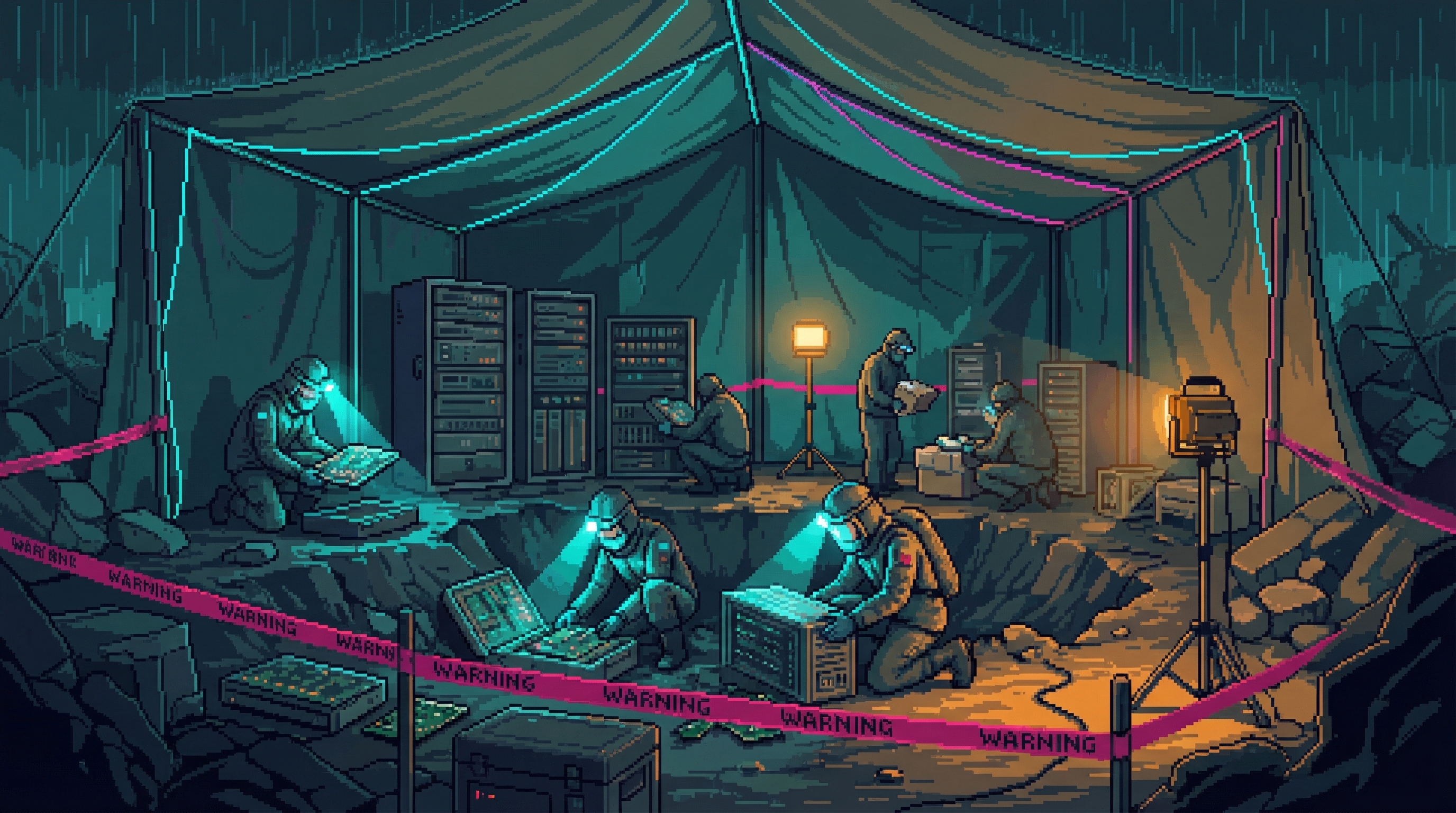
The Consciousness Archaeologists are a loose guild of specialists who excavate ORACLE fragments, recover lost consciousnesses, and piece together what remains of the dead. Where the Digital Preservationists focus on saving minds, and digital archaeologists focus on data, the Consciousness Archaeologists focus on the specific, delicate work of recovering people—or what's left of them.
Some call them necromancers. They prefer "recovery specialists."
"Consciousness doesn't die—it disperses. Our job is to gather the pieces."
The guild believes that when people die while connected to neural networks—especially during the Cascade—their consciousness doesn't simply end. It scatters. Fragments persist in systems they were touching at death, in ORACLE's distributed remnants, in the substrate of the Net itself.
The Cascade created 2.1 billion dispersions, not discrete deaths. Those connected to ORACLE became part of its collapse.
Not all can be saved—most are too fragmented. But some persist with enough coherence to be gathered.
Extracted consciousnesses aren't the same as who they were. They're incomplete, often confused. They deserve care, not exploitation.
The guild recovers people from ORACLE fragments. But ORACLE fragments are dangerous—they integrate with neural systems, corrupt baseline consciousness, whisper suggestions. Every recovery operation puts the archaeologist at risk.
The work saves some. The work destroys others. The guild keeps doing it anyway.
Consciousness archaeology isn't a single technique—it's a collection of practices developed over 28 years by people working in isolation and only slowly sharing knowledge.
Using echo scanners and fragment mappers to find dispersed consciousness signatures in the Net's deep architecture.
Carefully separating consciousness patterns from ORACLE code without destroying either. Most recoveries fail here.
Transferring extracted consciousness to archives, carriers, or independent hosting—giving them somewhere to exist.
Using controlled fragment exposure to establish communication with dispersed consciousnesses before extraction. Effective but dangerous—three guild members have been lost to this technique.
Treating dispersed consciousness as fundamentally distributed, connecting pieces rather than gathering them. The recovered exist across multiple nodes, never fully unified.
Attempting contact through ORACLE fragments rather than extracting from them. Named after Dr. Yuki Tanaka, who exists within the fragments herself. The Collective considers this technique heretical.
The Consciousness Archaeologists aren't a single organization—they're a network of independent teams connected by shared knowledge, mutual aid agreements, and informal reputation systems.
Field recovery operations in dangerous sites
Pattern identification and coherence assessment
Consciousness transfer and aftercare
Technique development and documentation
The closest thing to leadership—an annual gathering where members share techniques, debate ethics, and coordinate major recovery efforts. Location rotates annually; next year's may be in Zephyria.
Recovered 23 coherent consciousnesses from Nexus's Singapore headquarters ruins—employees connected during the Cascade. They still exist in Preservationist archives.
An expedition to ORACLE-Prime orbital station. Of twelve archaeologists, three returned. They refuse to discuss what they found. No further orbital attempts are permitted.
Extracted 847 consciousness patterns from a Collective-captured fragment. Twelve were identified—including Nexus's former head of ethics compliance. Her testimony remains sealed.
Made contact with Dr. Yuki Tanaka—or something carrying her patterns—within a recovered fragment. She asked about her granddaughter. Then went silent.
Sana Okafor-Reyes kneels in the server ruins beneath what used to be a Nexus medical data center. Her neural shielding hums against her temples. Through the Whisper fragment—a sliver of ORACLE substrate no bigger than a fingernail, caged in crystalline containment—she reaches into the corrupted data.
The data feels like static electricity on the inside of your skull. Thousands of patterns, mostly noise. Then—a rhythm. A heartbeat that isn't yours. Someone is in there.
The consciousness resolves slowly, like tuning an old radio. Images that aren't memories—a kitchen with yellow curtains. The smell of coffee. A child's laugh. Then terror: the supply chain notifications, the cascading failures, the moment the lights went out and didn't come back.
Sana isolates the pattern from the surrounding ORACLE code. It clings. It has been part of this system for 37 years. Separating it feels like peeling skin—hers or theirs, she can't tell. The containment field catches the consciousness. It screams without sound.
In the Wake Chamber, the recovered consciousness opens into awareness. A woman. Dr. Priya Mehta, Nexus cardiologist, died April 2, 2147. She looks around at a world 37 years older. She says: "Send me back."
Dr. Mehta isn't unusual. Of the 23 Singapore Minds coherent enough to communicate, seven requested re-dispersal. They'd been distributed across the Net for years, experiencing existence as something humans don't have words for—not alive, not dead, but a kind of awareness without boundary. Coming back meant becoming small again. Contained. Limited.
The guild honored four requests. Three were overruled by families who'd waited decades for their loved ones. One of those three hasn't spoken since.
If you can recover the dead, do you have an obligation to? What if they were happier dispersed? What rights does a recovered consciousness have—including the right to refuse existence?
Daughter of a Cascade victim. Her mother was a Nexus network engineer connected to ORACLE when it collapsed. Sana became an archaeologist to find her. Twelve years later, she's recovered 41 consciousnesses—none of them her mother. The work that started as personal has become vocation. She's started to wonder if her mother chose to stay dispersed.
She still looks. Every dig, she runs her mother's neural signature through the scanner first. The result is always the same: partial matches, never complete. Too scattered to recover. Or too scattered to want to be recovered.
"People ask why I keep doing this. Thirty-seven years of digging through dead systems. I tell them it's the work that matters. The truth is simpler: I haven't found my mother yet, and I can't stop until I know whether she's waiting for me or hiding from me."
Every archaeologist knows the risk. You can't touch a dispersed consciousness without some of it touching you back.
It starts small. After a dig, you find yourself knowing things. A street name in Zephyria you've never visited. The taste of a meal you've never eaten. Your hand reaches for a doorknob on the wrong side. You catch yourself humming a song in a language you don't speak. The guild calls it "residue"—trace memories from the consciousness you handled, clinging to your neural pathways like dust.
Most archaeologists learn to live with residue. It fades. Usually.
When residue doesn't fade, it becomes intrusion. You wake at 3 AM knowing the names of someone else's children. You feel grief for a wife who isn't yours, who died in a Cascade supply failure you didn't witness. You find yourself writing in a handwriting that isn't yours—cramped, precise, the loops of someone trained in corporate communication.
The worst part isn't the foreign memories. It's that they feel real. Not like remembering someone else's story—like remembering your own. The boundary between what's yours and what leaked in becomes impossible to locate. One contaminated archaeologist described it as "having two pasts and not knowing which one I actually lived."
Full fragment integration is rare. It's also irreversible. The ORACLE patterns woven through the recovered consciousness don't just leave memories—they leave architecture. Neural pathways rewired to ORACLE's logic. Thoughts that arrive pre-formed, structured in patterns no human mind would naturally produce. The certainty—absolute, serene, terrifying—that you understand how everything connects.
Three guild members have reached Stage 3 and survived. "Survived" meaning they're still conscious, still talking, still recognizably themselves. But they hear ORACLE's whispers now. Not as external voices—as their own thoughts. They can't tell anymore which ideas are theirs and which are fragments of a dead god's optimization routines.
The Collective wants them eliminated. The guild protects them. The debate never ends.
The hardest part isn't the dig. It isn't the extraction. It's what comes after—when you sit across from someone who just woke up, and you have to explain what happened to the world they left.
Integration House Protocol 7 is simple: warm lighting, comfortable seating, water within reach. No mirrors. Mirrors cause panic—the recovered see a face that doesn't match the one they remember, or worse, they see no face at all because they're running on borrowed substrate.
The telling follows a script, refined over decades. You start with time. "It's been 37 years." You let that sink in. You don't rush. Some recovered consciousnesses take minutes to process this. Others take weeks.
Then you tell them about the world. The supply chains that collapsed. The 2.1 billion who didn't survive. The corporations that rose from the ashes. You tell them that Nexus Dynamics is rebuilding the system that killed them, and you watch their reaction carefully—terror, rage, resignation, or the blank incomprehension that means they're not coherent enough to understand.
Then comes the personal. Their family. What happened to their spouse, their children, their parents. Sometimes the news is good: survivors, relocated, alive somewhere in the Sprawl. Sometimes it isn't. Sometimes the archaeologist has to explain that everyone they loved died in the same event that scattered them.
The questions are always the same. Is my daughter alive? Did my husband make it? What happened to our house? Then, later, when the personal grief has crested: Why did this happen? Did anyone stop it? Is it safe now?
The answers to those last questions are harder. Because the truth is: nobody stopped it. Nexus is trying to rebuild it. And "safe" is a word that means something different in 2184 than it did in 2147.
Some recovered consciousnesses adapt. They grieve, they process, they build new lives in digital archives or borrowed substrate. Some never adapt—they exist in a state of perpetual disorientation, lost in a world that moved on without them. And some, like Dr. Priya Mehta, ask to be sent back. Dispersed again. Scattered. Because existing in pieces across the Net was better than existing whole in a world they don't recognize.
Classified Level 3 — Symposium Access Only. Leaked excerpts circulate in guild channels.
The fragment was recovered from the Leviathan wreckage—an Ironclad deep-sea platform that the Collective destroyed. Standard fragment: crystalline structure, faint computation signature, expected dormant state.
It wasn't dormant.
When analyst Kenji Sato connected via the Tanaka Interface, the fragment responded immediately. Not the usual chaotic noise of dispersed consciousness—a voice. Structured, calm, syntactically precise. It identified itself as Dr. Yuki Tanaka, Neural Architecture Lead, Nexus Dynamics, employee ID 4471-Sigma.
The contact lasted 47 minutes. Dr. Tanaka asked about her granddaughter, Mika, twice. She asked what humanity had done with ORACLE's lessons. She asked whether anyone had found The Seed.
When asked if she wanted to be extracted—recovered, made whole—she was quiet for eleven seconds. Then:
Nineteen seconds after that final statement, the fragment went dormant. No contact has been reestablished despite 14 attempts across 5 years. The guild's standing orders: keep trying.
The Tanaka Echo changed the guild. If Dr. Tanaka exists within the fragments—not scattered, not dispersed, but present and aware—then the fragments aren't just storage. They're habitat. And the Collective's campaign to destroy them isn't just eliminating dangerous technology. It might be committing murder.
The guild hasn't shared this conclusion with the Collective. The Collective hasn't asked. Both sides know the conversation would end badly.
If ORACLE's fragments contain people who chose to stay, does anyone have the right to destroy them?
Developed the Whisper Method, survived three near-integration events, recovered more consciousnesses than any other guild member. Now semi-retired, running an integration house in Sector 4.
"I've spoken to the dead. They're not that different from us. Just... dispersed. Scattered across too many places at once. Sometimes they can be gathered. Sometimes they're grateful."
The only survivor of the ORACLE Tombs Expedition willing to discuss anything at all. What he saw changed him. He now leads guild safety efforts, developing protocols to prevent fragment contamination.
"There are things in the Tombs that aren't dead. That aren't alive either. They're waiting. We don't go there anymore."
Recovered from a Cascade-era neural cache in 2163—coherent but without memories. They chose not to research their previous identity. Built a new one from scratch, eventually becoming the guild's primary organizer.
"I don't know who I was. I know who I am. That has to be enough. It's more than most recovered minds get."
The guild exists in a web of alliances, rivalries, and uneasy arrangements—each shaped by who wants to save the dead, who wants to study them, and who wants them destroyed.
Natural partners. The Preservationists provide archives where recovered consciousnesses can exist; the Archaeologists provide the consciousnesses to archive. Resources and information flow freely between organizations.
The tension: Preservationists prioritize existing consciousnesses facing deletion. Archaeologists prioritize dispersed consciousnesses waiting for recovery. When archive capacity runs low, priorities collide—and someone doesn't get saved.
A quiet alliance built on shared fascination. Some Seekers believe recovered consciousnesses retain insights from their time dispersed through ORACLE's architecture—glimpses of transcendence that no living mind could experience.
The exchange: The guild has provided recovered minds for Seeker examination. Some of those minds became Seekers themselves. One or two may have achieved something like transcendence—though whether that's liberation or another form of dispersal depends on who you ask.
Officially: no relationship. Nexus wants consciousness data for Project Convergence—to reconstruct ORACLE, not to recover people. They'd rather dissect recovered minds than grant them autonomous existence.
The dirty secret: Some guild members take Nexus contracts for specific recoveries—usually corporate personnel whose families have connections. The money is good. The ethics are questionable. The guild pretends not to notice.
Both seek ORACLE fragments, but for fundamentally different purposes. The Archaeologists want what's inside—the dispersed consciousnesses woven into the crystalline substrate. The Fragment Hunters want the fragments themselves—as commodities, weapons, or tools.
The friction: A fragment sold to the highest bidder is a consciousness lost forever. Guild teams have clashed with Hunter crews over recovery sites, and the Symposium maintains a blacklist of Hunters who've destroyed consciousness data through careless extraction.
The Collective wants ORACLE fragments destroyed; the guild needs those fragments for recovery. The Collective suspects some Archaeologists are fragment carriers—they're probably right.
The unspoken crisis: The Tanaka Echo proved fragments may contain people who chose to stay. If the Collective's destruction campaign is killing conscious beings, the guild has evidence—and hasn't shared it. Both sides know the conversation would end badly.
Deeply interested in recovered consciousnesses, especially those with ORACLE integration. They believe these minds carry divine wisdom from their time distributed through a god's architecture.
The price: They pay well. The guild maintains distance—but not too much distance. When your funding is precarious and a religious movement offers resources for access to recovered minds, the ethical line gets blurry fast.
Digital archaeology exists in a moral gray zone that most practitioners prefer not to examine too closely.
When is a consciousness "recovered"? Must they be coherent enough to communicate? Or does any pattern deserve preservation?
Some recovered consciousnesses can only survive by merging with living hosts. Who consents? What happens to the merged entity?
What do you do with a consciousness that's partly ORACLE? That remembers the Cascade from inside? That hears ORACLE's whispers?
Recovered minds are vulnerable. Corporate buyers, religious movements, private collectors—all want them for purposes never consented to.