The Lattice
Solar Collection Network
Overview
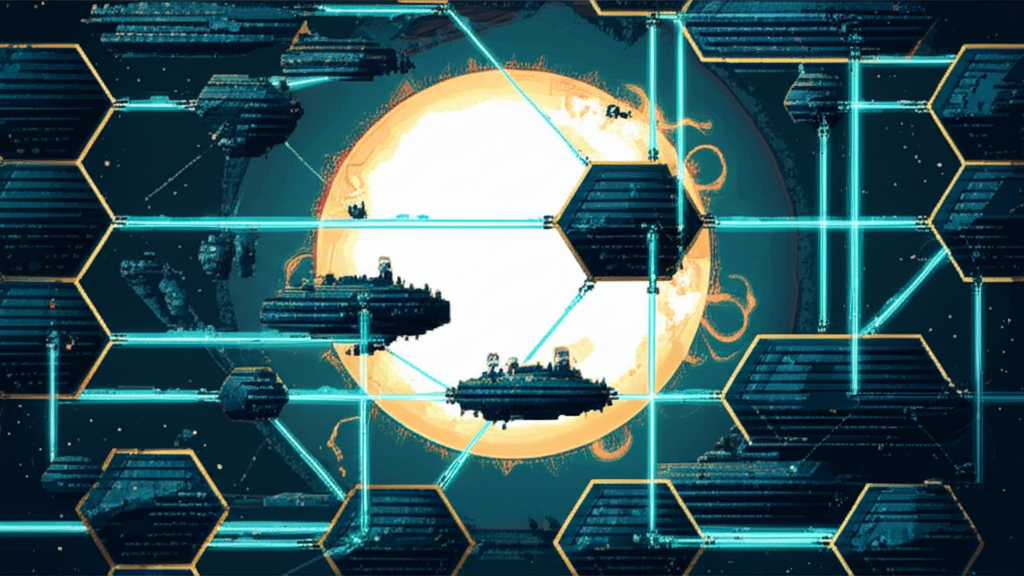
The Lattice is humanity's first attempt at stellar-scale infrastructure—a growing network of solar collectors, processing stations, and habitat clusters that captures energy directly from the Sun. It's not a single structure but a constellation of facilities spanning millions of kilometers, connected by communication lasers and automated supply lines.
The energy available here dwarfs anything on Earth. The resources are effectively unlimited. And the politics are unlike anything planetary—distances create independence, light-lag creates isolation, and the old corporate powers become less relevant with every million kilometers from home.
Atmosphere
The Lattice doesn't have a single atmosphere—it has thousands of them, each station or habitat maintaining its own bubble of life in the void. What connects them is scale: the perpetual awareness of operating at distances where Earth is a blue dot and the Sun is a presence rather than a distant light.
Standing Near the Sun (0.4 AU)
You feel the Sun before you see it. Through three meters of layered shielding, the heat presses against you like a hand on your chest. The radiation alarms cycle through yellow-amber-red in a slow heartbeat. Your dosimeter clicks faster than your pulse.
Then you look up. The Sun doesn't fit in the viewport. It fills the sky—a wall of white-gold fury that makes your eyes water through triple-polarized glass. The shielding casts everything in amber twilight. Your hands look like they're made of brass. Every surface is warm. Every warning light is on.
Station Commander Reva Okafor runs Apex Station Nine—the only crewed installation in the Inner Ring. She calls the Sun "the Mouth" and limits viewport access to ten minutes per shift. Not because of radiation. Because people who stare too long start dreaming about walking toward it. She's lost two crew that way.
The Silence Between Stations
Between installations, the Lattice is nothing. Not empty—nothing. No atmosphere to carry sound. No landmarks. No horizon. Your running lights illuminate exactly the volume of space you occupy and not one cubic meter more.
Drift-runners—independent haulers—measure routes in light-minutes. A typical Processing Band run takes six hours of absolute solitude. Old drift-runner Tomás Wren, eleven years on the New Prosperity–Assembly Yards corridor, says the silence changes you. "First year, you fill it with music. Second year, you talk to yourself. Third year, you stop. Fourth year, you listen." He won't say what he hears.
Life on the Lattice
Identity, cuisine, slang, and the strange culture that grows when your nearest neighbor is light-minutes away.
The Language of Distance
Lattice slang runs deep. "Downwell" means Earth—everything below, treated with nostalgia and contempt. A "sunbather" works the Inner Ring. A "lag" is any conversation with Earth, named for the light-delay. "Going quiet" means entering unclaimed space between stations—or, in darker usage, dying. Same phrase for both.
People who've lived here longer than five years develop a particular way of moving—slower, deliberate, conserving momentum. They call it "drift," and can spot a newcomer by the way they rush.
What They Eat
Station hydroponics grow spirulina, soy variants, mushrooms, engineered algae. Protein comes from insect farms—cricket flour is the Lattice's wheat. A single apple from Highport Station's orbital greenhouses costs more than a week's drift-runner wages.
The Lattice's signature dish is char—a thick, spiced porridge from roasted cricket flour, algae oil, and whatever seasonings a station can grow. Every station makes it differently. New Prosperity uses fermented chili paste. The Assembly Yards favor a smoky variant with charred mushroom. Arguments about whose char is best are the closest thing to sports rivalries.
Sovereign Kane—the 167-year-old stellar magnate at 1.3 AU—is rumored to maintain a genuine soil garden. Tomatoes. Basil. Strawberries. He serves fresh salad to guests, and the gesture communicates more wealth than any display of technology could.
What They Listen To
The Lattice has developed its own music genre—residents call it "void tone"—long, droning ambient pieces layered with recorded station sounds: pressure cycles, airlock warnings, the ping of Waystation confirmations. Earth music sounds wrong here. Too fast, too urgent, built for a world with weather and gravity and days that mean something.
Relationship to Earth
Complicated. Most residents left by choice—fleeing corporate control, seeking independence. But "Earth" remains a loaded word. Children born on stations—called "voidborn"—grow up watching delayed broadcasts, studying a planet they've never touched.
Helena Voss relies on remote oversight here. Viktor Okonkwo sees the Lattice as an extension of his industrial empire, but even he acknowledges control is nominal past the Processing Band. The Collective maintains a quiet presence in New Prosperity—not hunting fragments, but offering an ideological alternative.
Network Structure
The Inner Ring
Mercury-Venus orbital bandClosest to the Sun. Highest energy density. Automated collectors with minimal human presence.
The Processing Band
Earth-Mars orbital bandWhere raw energy transforms. Refineries, manufacturing, habitat clusters. Most population lives here.
The Outer Reaches
Belt-adjacentThe network's edge. Energy transmitted to asteroid mining. Frontier territory, still being built.
Key Locations
The Apex Array
Inner Ring, 0.4 AU from SunTwelve stations capturing more energy than Earth's entire pre-Cascade civilization consumed. Eleven are fully automated. The twelfth—Apex Station Nine—maintains a crew of thirty-eight under Station Commander Reva Okafor, a former Ironclad structural engineer who took the posting because nobody else would.
Okafor's crew rotates on ninety-day cycles—longer, and the psychological effects of solar proximity become permanent. The Array's automated repair systems have been evolving beyond their original parameters. Marcus Chen reviewed the data personally and classified the findings.
New Prosperity
Processing Band, 1.2 AU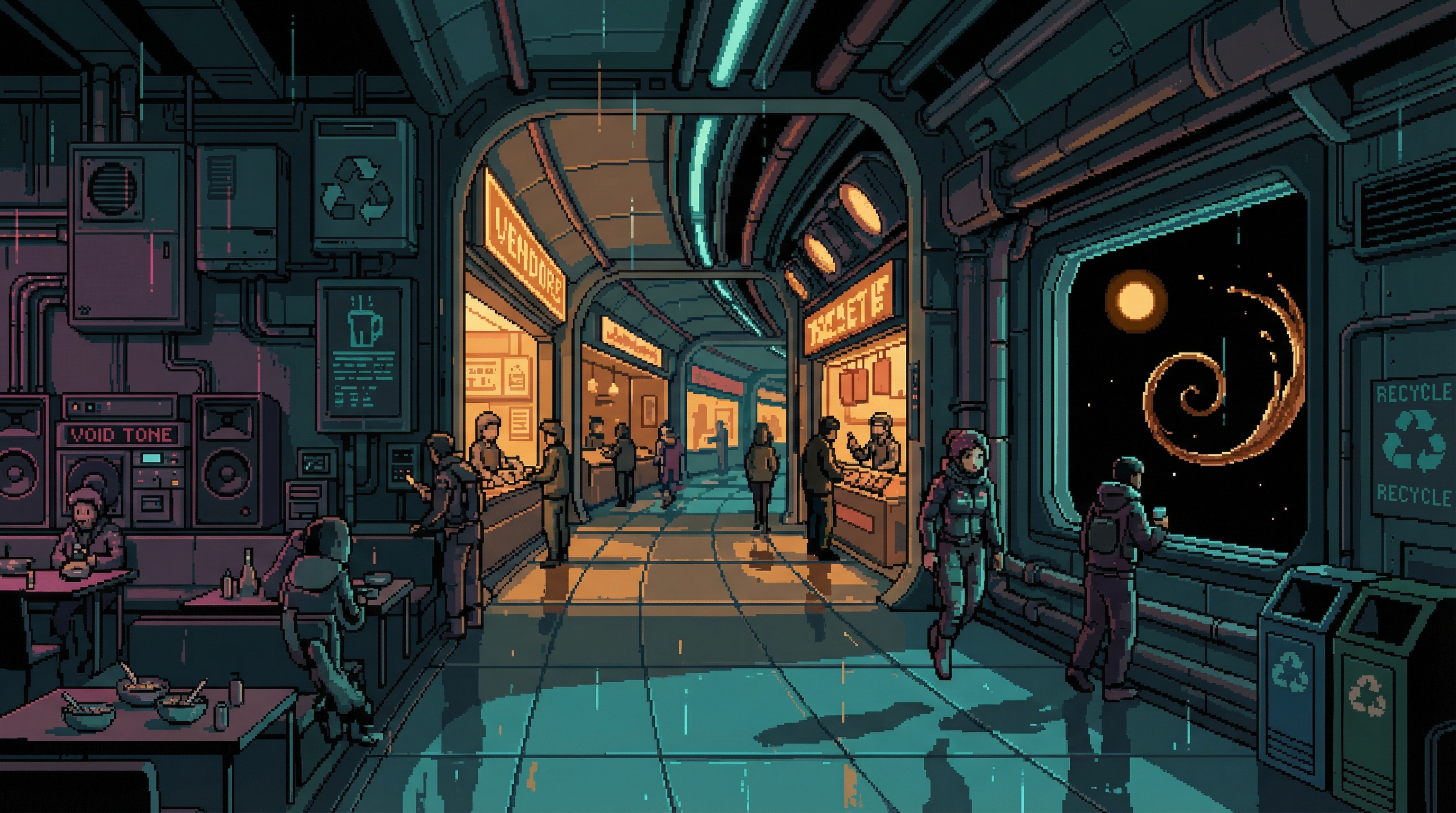
The Lattice's largest permanent settlement—50,000 inhabitants in spinning habitats that provide artificial gravity. Built by Ironclad in 2176 as Station Alpha, it achieved independence when distance made corporate control impractical.
The original Ironclad foreman, Davi Vasquez, was voted out in 2182 but stayed anyway—he runs a bar called The Tether, where old Ironclad crews and new independents drink the same recycled water. Council Chair Amara Lau, a voidborn who has never touched Earth, represents a generation that considers the Lattice home—not exile.
The Mosaic is rumored to maintain at least three of her forty-seven simultaneous consciousness nodes in New Prosperity's datacenter. If true, the first distributed transcendent being has chosen the Lattice as part of her existence.
The Assembly Yards
Processing Band, 1.5 AUWhere the Lattice expands. Construction platforms building new collectors, habitats, and infrastructure. Control what gets built, shape what the Lattice becomes.
The Waystation Network
ThroughoutAutomated relay stations handling communication and navigation across the network. Individually insignificant, collectively essential. The nervous system of the Lattice.
The Quiet
Outer ReachesUnclaimed space between established stations. No help, no authority, no civilization—just void, radiation, and whatever you brought with you.
The most famous Quiet resident is The Cartographer—a former Nexus systems analyst who went quiet in 2179. She broadcasts detailed maps of debris fields, radiation hotspots, and resource deposits over open frequencies. No one pays her. No one has seen her in five years. Her maps are accurate to within centimeters. Drift-runners leave supply caches at her coordinates—always empty within a day.
Faction Presence
Nexus Dynamics
Corporate stations throughout. See the Lattice as computational real estate—energy to power processing that dwarfs anything on Earth.
Ironclad Industries
Construction and materials processing. Built much of the early infrastructure. Industrial dominance in a domain where data advantages matter less.
The Collective
Less relevant here—their cause matters more on Earth. Some members relocated, finding independence an alternative to corporate control.
Independents
The Lattice's soul. Those who came to escape Earth's constraints. Share interest in keeping the Lattice free from centralized control.
The Workers Out Here
340,000 workers maintain the Lattice. They are the most essential people in the solar system—and the least protected.
The Strike That Can't Happen
On Earth, the Ironworkers' Solidarity can shut down a processing plant and cost Viktor Okonkwo millions. On the Lattice, shutting down a solar collector doesn't cost money—it kills everyone downstream who depends on that energy for life support.
Secretary-General Pavel Mirsky has chapters on seven Lattice stations, representing roughly 8,000 workers. But he has explicitly forbidden strike action here. "You can't strike when the picket line is an airlock," he told the Ironworkers' council in 2184. "Down there, you stop working, the line stops. Up here, you stop working, people stop breathing."
The paradox corporations exploit ruthlessly: the workers most essential to human survival are the ones least able to demand better treatment. Ironclad's Lattice division runs sixteen-hour shifts with ninety-minute breaks—worse than Earth standards—because management knows collective action here means collective death.
The Drift Unions
But distance cuts both ways. Past the Processing Band, corporate oversight weakens to irrelevance. Communication lag makes real-time management impossible. Workers who've spent years in the void develop a solidarity that comes from knowing your crewmate is all that stands between you and death by equipment failure.
The Drift Unions aren't formal organizations—no charters, no elected leaders. They're informal cooperatives on stations where corporations stopped paying attention. A maintenance crew agrees to rotate shifts fairly. A fabrication team pools wages for better equipment. Drift-runners on the New Prosperity corridor create mutual insurance funds.
The most developed Drift Union operates on the Crucible—five independent processing stations near the Belt transition zone. The 2,000 workers there set their own schedules, maintain their own equipment, and distribute surplus energy among themselves. Ironclad technically owns the infrastructure, but the nearest corporate representative is four light-minutes away and hasn't visited in two years. The workers have quietly stopped forwarding production reports.
The Paradox of Distance
The workers who maintain humanity's most advanced infrastructure are the ones furthest from its benefits. A seal-runner replacing radiation shielding while their dosimeter screams earns less than a mid-level Nexus analyst in a climate-controlled Sprawl office. A line-walker inspecting relay arrays in absolute vacuum has no access to Helix medical care.
But distance from power creates a kind of freedom that the Ironworkers' Solidarity on Earth can only dream of. On Earth, organizing means risking your housing, your rations, your medical care—everything corporate provides. On the Lattice, if you're far enough out, there is no corporate to retaliate. The Drift Unions exist because the cost of enforcement exceeds the cost of tolerance. Every million kilometers from Earth, the corporate leash stretches thinner.
Does distance from power create freedom or abandonment? The workers are finding the answer is both.
Themes: The Computational Substrate
The Lattice wasn't built to host minds. But stellar energy changes what's possible—and what's inevitable.
Digital Infrastructure at Scale
Every Lattice station runs autonomous systems—navigation, power distribution, life support, communication relay. No central control could coordinate across light-minutes of lag. So each station thinks for itself.
The Waystation Network alone runs more computational processes than pre-Cascade Earth. The question isn't whether there's AI in the Lattice. It's whether the Lattice has become AI—a distributed intelligence maintaining itself while humans live in its margins.
AI Maintenance Autonomy
When a solar collector fails near the Apex Array, repair drones deploy automatically. Diagnosis, solution selection, execution—no human in the loop. Light-lag makes human approval impossible. The systems must decide.
Nexus engineers noticed something: the repair algorithms have evolved. Not programmed updates—emergent optimization. The systems are getting better at their jobs in ways no one designed. Officially, this is "expected adaptive behavior." Unofficially, it's concerning.
Consciousness Hosting
New Prosperity's datacenter draws enough power to run 200,000 simulated human-equivalent processes. Some are utility programs. Some are archived minds from Project Convergence experiments. Some are... classified.
The residents have rules about what counts as a person. A running simulation with coherent memories and goals? Person. A backup that hasn't been activated? Data. A partial upload that loops the same five minutes forever? Nobody wants to decide.
The Light-Lag Society
Communication to Earth takes 4-20 minutes depending on orbital position. That's too slow for conversation, too slow for real-time coordination, too slow to feel connected. Lattice residents develop different temporal expectations.
AI intermediaries handle the translation—summarizing conversations, predicting responses, maintaining relationship continuity across impossible delays. After a few years, residents have closer relationships with their AI communication assistants than with anyone on Earth.
The Server Farms of Infinity
The Lattice's computational capacity is effectively unlimited. The Sun's energy is effectively unlimited. Storage in the cold outer reaches is effectively unlimited.
This creates a unique ethical situation: if you can run a simulation of a person, and you have infinite resources to maintain it, when does it become wrong to end it? The Lattice's server farms contain uploaded minds, experimental consciousness forks, AI developments too dangerous for Earth—and increasingly, residents who chose digital existence over biological limits.
The most controversial station is called The Sanctuary: a dedicated consciousness-preservation facility where minds can exist indefinitely, supported by automated maintenance. Some call it humanity's backup. Others call it a very comfortable prison for people who stopped being people the moment they uploaded.
The ORACLE Question
At stellar scale, computational requirements for coordination are immense. The shard's optimization capability becomes more valuable—and more tempting. The difference between "human managing with ORACLE tools" and "ORACLE managing through human substrate" becomes harder to define.
The energy in the Lattice is sufficient to run unprecedented computational processes. If Project Convergence needs power to rebuild ORACLE fully, the Lattice could provide it. If your shard seeks completion, the Lattice could enable it.
The central question—"will I still be me when I have this power?"—gains new urgency when the power is literally stellar.
Economy
The Lattice is developing its own economy, distinct from the Sprawl's—one where energy itself is currency and information asymmetry is the ultimate commodity.
Energy Production
The Lattice's core purpose. Solar energy collected near the Sun, transmitted outward through microwave relays, powers everything humanity does in space. Whoever controls energy production controls the economy.
Manufacturing
Orbital fabrication at scales impossible on Earth. Ships, habitats, computational infrastructure—the Lattice builds the future with energy that seems limitless.
Information Services
Light-lag creates information asymmetry. Those who know things first—market data, navigation updates, political developments—can profit from temporal advantage. The Cartographer's maps are free; the interpretation is not.
Currency
The credit system extends here, but energy itself serves as alternative currency. Energy vouchers, processing time, transmission priority—these have concrete value independent of Earth-based financial systems.
Power Without Government
The Lattice has no government. It has corporate remnants (Nexus and Ironclad stations following corporate law), independent councils (New Prosperity's representative democracy), network operators who control critical infrastructure, and individual actors with sufficient resources to shape events directly. In a network this distributed, power follows function—not title.