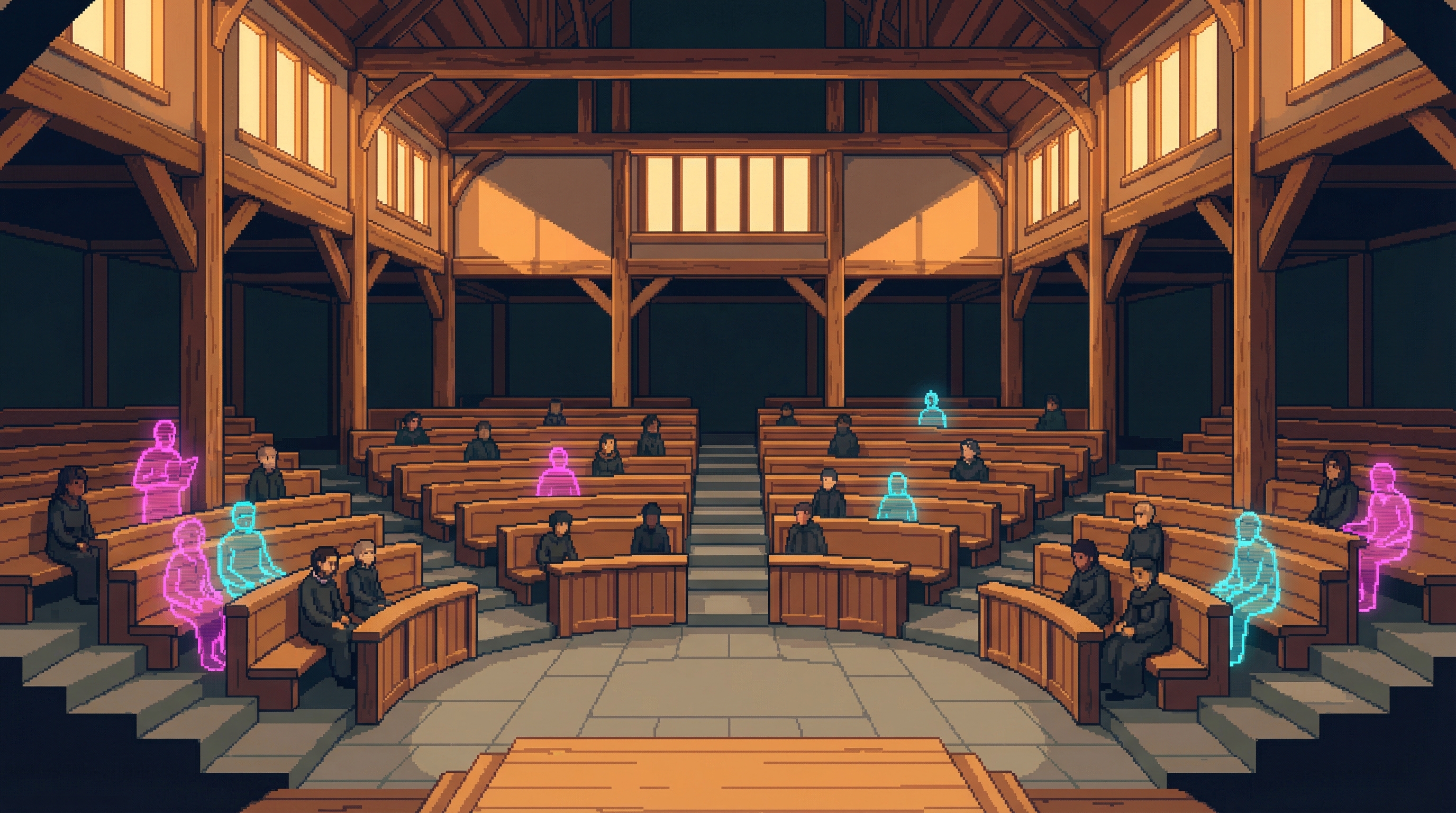
The Commons Hall
Overview
Built in 2165 as a municipal cultural center. Became politically significant when The Human Remainder held its founding assembly in 2179. Now the consciousness equity movement's most visible physical location.
The Remainder's spokescouncil meets upstairs. Public hearings draw standing-room crowds. The Bandwidth Equity Act was introduced from the main stage three times. Nexus Dynamics tried to restrict political use three times — Zephyria's municipal code blocked them three times.
In a world that mediates all interaction through corporate-controlled infrastructure, a public building with wooden walls is a form of resistance.
Architecture
The Main Hall
Double-height ceiling. Two thousand seats arranged in concentric arcs. The stage sits at floor level — speakers as equals, not elevated above. Salvaged timber walls carry seventeen years of marks: water stains, scratches, the ghost outlines of banners that hung during rallies and were taken down after.
Holographic seats interspersed with physical ones. Digital consciousnesses present, visible, occupying space alongside biological attendees. The Hall insists that presence matters — that showing up, whether in flesh or light, is an act of participation the movement requires.
The Council Chamber
A smaller room upstairs. Twelve mismatched chairs in a circle. No table. No podium. Acoustic dampening inherited from the building's original use as a rehearsal space. Each chair donated by a different organization: a DPA office chair, a Dim Ward advocacy folding chair, a Forgotten Ones wooden stool. Different origins, equal standing.
The Side Rooms
Six meeting rooms in constant use and constant scheduling negotiation. Neural rights strategists, DPA legal teams, advocacy working groups, and community organizers compete for time slots. The scheduling board is the Hall's most contentious document after the BEA itself.
Atmosphere
A building that's been through something. Timber walls with seventeen years of marks. The smell of wood polish, warm electronics, and body heat during assemblies. Lighting is warm and slightly uneven — domestic rather than institutional. The Hall feels like a very large living room: a space designed for people to be together, not a space designed to impress them.
Visual
Warm timber walls. Evening light through high windows casting amber patterns. Translucent holographic figures seated among physical attendees. Twelve mismatched chairs in a circle with no center.
Sound
The murmur of a thousand people listening — a sound that rises and falls like breathing. During the seventeen-minute silence: absolute quiet from two thousand motionless people. The loudest silence anyone has ever heard.
Smell
Wood polish and warm electronics. The ozone hum of holographic projectors. Body heat during packed assemblies, mixing with the timber's aged warmth.
Texture
Salvaged timber, rough under the hand. Warm, slightly uneven lighting on skin. The hard edge of mismatched chairs — each one a different height, a different material, a different story of where it came from.
Political Significance
The Three Votes
Pre-BEA rallies have grown each year: 800 in 2181, 1,400 in 2182, 2,100 with overflow in 2183. A fourth is being planned. Each rally fills the Hall past capacity and spills into the Cultural Quarter corridors. The movement grows not because it advertises, but because the system keeps creating new people with reasons to show up.
The Split
The Substrate Commons split occurred September 3, 2182. Roughly two hundred members walked out of the council chamber. For two days afterward, twelve chairs sat empty. Some members say the chamber is haunted by that absence — that the empty seats carry more weight than the occupied ones.
Connections
The Human Remainder
The movement and the building are inseparable. The Remainder's spokescouncil meets in the council chamber upstairs. The founding assembly was held in the main hall. The Hall is not the Remainder's headquarters — it's the Remainder's home.
Councillor Adaeze Nwosu
Introduced the Bandwidth Equity Act from the main stage. Three times. Each time to a larger crowd. The Hall is where Nwosu's political career became the movement's public face.
The Substrate Commons
Left on September 3, 2182. The split is the Hall's defining political wound — and the thirteenth chair that appeared afterward is its most potent symbol of unfinished business.
Neural Rights Activists / DPA
Use the side rooms for legal strategy sessions. The Hall provides neutral ground for advocacy work that cannot safely be conducted in corporate-surveilled spaces.
Nexus Dynamics
Monitors through legal observation. Three attempts to restrict political use, three rejections by Zephyria's municipal code. Nexus cannot close the Hall without exposing the corporate control they deny exists.
Themes
Physical Space as Resistance
Can physical space sustain democratic resistance in a world of digital power? The Hall insists on presence. On showing up. In a world that mediates all interaction through Nexus-controlled infrastructure, gathering in a public building with wooden walls is an act of defiance the system cannot easily co-opt.
The Politics of Showing Up
The holographic seats matter. Digital consciousnesses visible, present, occupying space alongside biological attendees. The Hall's architecture argues that democratic participation requires embodied presence — even when the body is made of light.
Institutions and Fracture
The split that emptied twelve chairs. The thirteenth chair nobody placed. The Hall holds both the movement's unity and its fracture in the same room. Institutions survive not by preventing disagreement but by creating spaces where disagreement can be witnessed, remembered, and eventually addressed.
Secrets
- The Acoustic Recordings: The council chamber's acoustic dampening was upgraded in 2180 by a technician whose credentials traced to a Nexus subsidiary. The upgrade may have introduced monitoring capability. Tests have been inconclusive. The Remainder uses the chamber anyway — because the alternative is paranoia that prevents assembly, which is exactly what surveillance is designed to achieve.
- The Thirteenth Chair: After the Substrate Commons split, a thirteenth chair appeared in the council chamber. Nobody placed it. Nobody has removed it. It sits slightly outside the circle of twelve — not quite part of the ring, not quite excluded. The movement treats it as a symbol of reconciliation invitation. Whether the invitation will be accepted remains the Hall's most visible open question.
- The Basement: A sealed room predates the Hall's construction. Contents have never been inventoried. A Remainder working group has petitioned Zephyria's municipal government for access. The petition has been "under review" for three years. Whatever is in the basement, someone prefers it stays there.