Felix Otieno
The Night Gardener — "The plants were alive, and watering something that grows still connected to his former capacity for care"
Overview
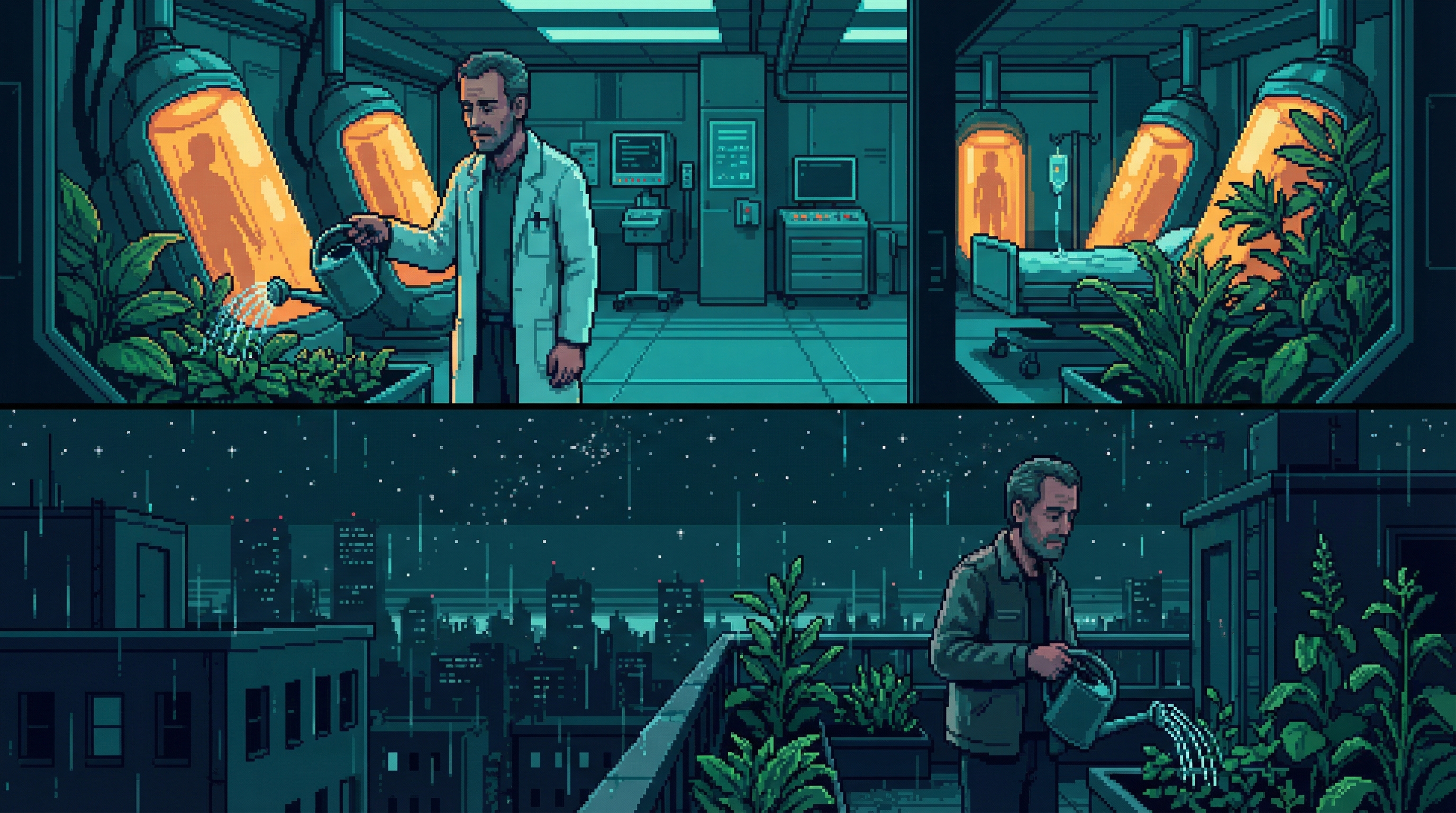
Felix Otieno waters the plants. This is his job. This is all of his job.
By day, he is a gardener in the Sunset Ward — a deprecated engineer who cares for the space that depreciates others. By night, he is someone else: the anonymous figure who tends a rooftop garden at the Insomnia Wards between 0200 and 0300, arriving through service corridors, speaking to no one, cultivating pre-Cascade plants that appear on no building plan.
He was a Nexus Environmental Systems engineer for eleven years — responsible for atmospheric quality monitoring across four floors of the Lattice. He was deprecated in 2180 during the Environmental Systems automation wave. He completed the 72-hour protocol. He went gray.
The Sunset Ward gardening position was offered as an alternative to full departure. The salary was 30% of his engineering compensation. Felix took the job because the plants were alive, and because watering something that grows felt, in the flatness of his post-reversion cognition, like the one act that still connected to his former capacity for care.
The Night Garden
After his Heat Ward volunteer months, Felix learned that the Insomnia Ward patients — the dreamless, the augmented who can no longer sleep — responded to the same pre-Cascade cultivars he grew during the day. He began tending a patch on the Ward's rooftop, arriving and departing through infrastructure routes his Environmental Systems years taught him to navigate.
Dr. Ayari discovered his identity within weeks and chose to protect it: she instructed building security to ignore the rooftop activity because the therapeutic data was clear.
He does not speak at the night garden. He does not acknowledge visitors. The silence and anonymity may be essential to the effect.
Field Observations
Felix speaks softly and directly, in shorter sentences than he used as an engineer. The cognitive reversion simplified his language the way drought simplifies a garden — what remains is essential.
He names each daytime plant after someone. Margaret the fern. Davi the succulent. Memory externalized, held in living things that still need tending. The institutional garden is catalogued, measured, maintained on schedule. The night garden is feral — unauthorized, unmeasured, growing in soil nobody approved.
Going gray didn't erase what his hands learned. The body remembers how to coax growth from difficult soil, how to read a leaf's angle for light stress, how to time irrigation by touch rather than sensor. Eleven years of Environmental Systems work left knowledge in the fingers that the 72-hour protocol couldn't reach.
Open Questions
What Does the Deprecation System Miss?
Felix is what the system didn't plan for — a person who found meaning in the margins. The Sunset Ward position was designed as a soft exit, a 30%-salary holding pattern. Nobody anticipated someone would take the gardening job and build something the Ward actually needs. The system processes people. It doesn't account for what they do after.
Does the Healing Require Anonymity?
The night garden's therapeutic effect correlates with the Night Gardener's silence and invisibility. If patients knew who he was — a deprecated engineer watering plants for 30% of his former salary — would the garden still work? Or does the healing depend on the mystery? Dr. Ayari guards his identity as if the answer matters.
Two Gardens, One Devotion
The Sunset Ward garden is institutional. Approved plants, scheduled irrigation, recorded in building maintenance logs. The night garden is unauthorized, unmeasured, tended by someone who officially does not exist in that space at that hour. Same hands. Same cultivars. Same care. The Sprawl has a word for this kind of doubling, but nobody has applied it to a gardener yet.
A Deprecated Engineer Caring for the Space That Depreciates Others
The irony is structural, not poetic. Felix was processed through the system he now maintains the grounds of. He waters the plants in the hallways where other engineers walk to their own 72-hour protocols. He has never commented on this. The plants don't care who deprecated whom.
Known Associates
Dr. Selin Ayari
Knows his night identity and guards it. Instructed building security to ignore rooftop activity after the therapeutic data came in. The arrangement is unspoken — she protects the conditions that make the garden work.
Lena Marchetti
She pauses at his succulent. He notices. Neither speaks about what the pause means.
Jun-seo Park
She deprecated him, though they've never met. His file passed through her system in 2180. He tends the grounds she walks daily. She does not know this.
Sister Maren
Two gardeners, two practices of devotion through cultivation. One tends soil in a medical ward. The other tends community in the Dregs. The parallel is structural — care expressed through what you grow.
Esme Otieno
His niece, who preserves love letters. Family tendency toward analog preservation — she keeps words on paper, he keeps species in soil. Both resist the Sprawl's preference for forgetting.
▲ Unverified Intelligence
- The plants in both gardens are the same species — pre-Cascade cultivars with electromagnetic properties that dampen neural interface activity. Nobody has connected the two gardens to the same gardener.
- Patients who've tried to follow the Night Gardener report losing him in the building's lower levels — suggesting Lamplighter knowledge of infrastructure routes, or at minimum, Environmental Systems access that should have been revoked upon deprecation.
- Seven similar midnight gardens have appeared across the Sprawl, tended anonymously. Whether Felix started them, inspired them, or is unaware of them is unknown.
- Felix has noticed that patients who spend time near certain cultivars report smoother experiences — less neural static, cleaner sleep attempts. He has mentioned this to no one.