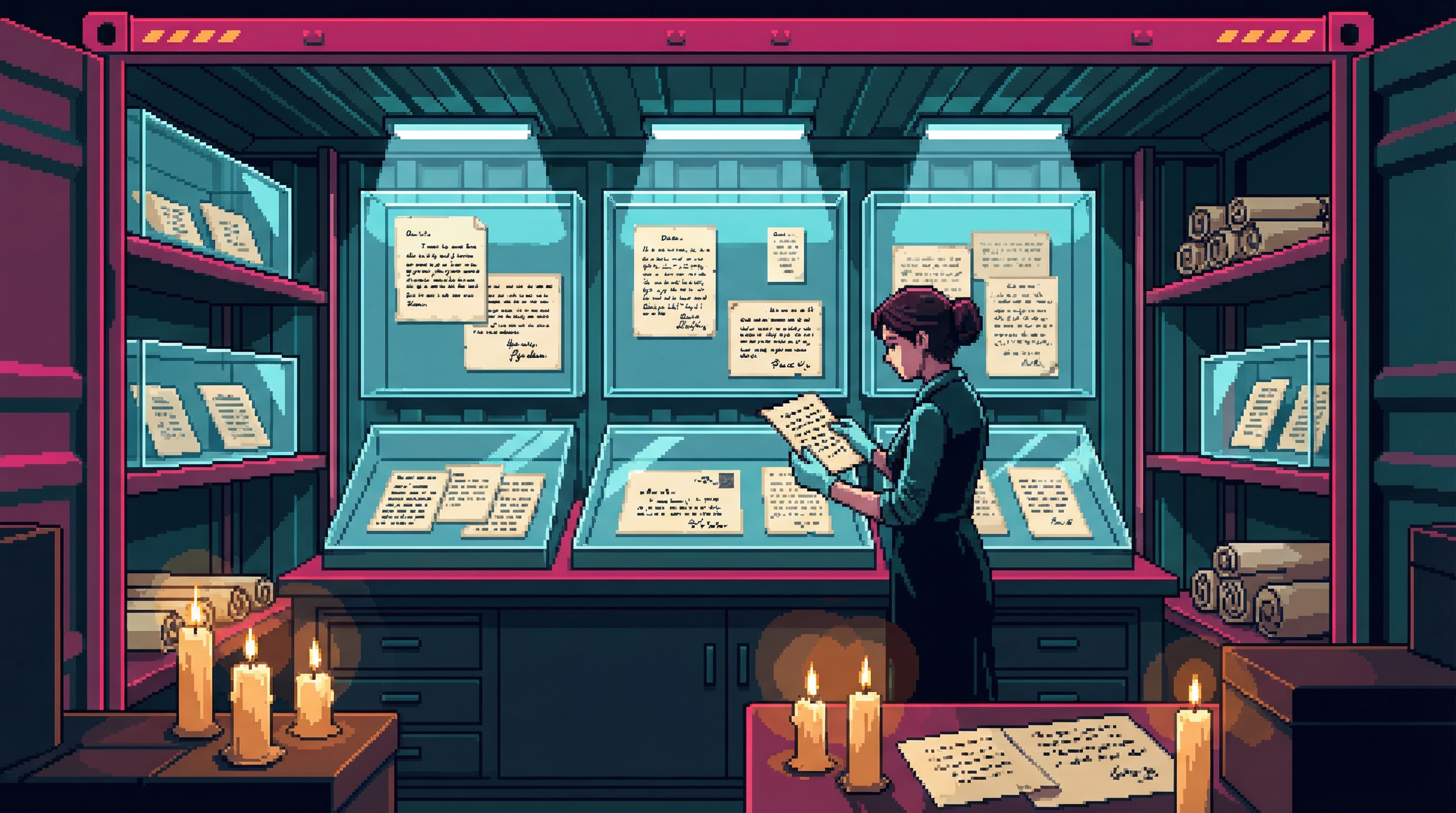
Esme Otieno
Curator, The Dead Heart Museum — Neon Graves, Sector 12
Esme Otieno preserves evidence that human beings once wrote love on paper, folded it, placed it in an envelope, and waited days or weeks for a reply.
She is Felix Otieno's niece — the gardener of the Sunset Ward, the deprecated engineer who tends real plants in the space where people lose their minds. The family tendency toward analog devotion appears to be genetic, or at least contagious. Felix preserves biology. Esme preserves ink on paper. Both keep alive things the Sprawl's optimization would discard without noticing.
She found the first letters in 2178 while working as a Dead Internet data recovery assistant. Her team was searching for ORACLE engineering documentation. Esme found a cached folder of personal correspondence — letters between two people discussing plans for a wedding held three weeks after the Cascade. She read the letters during her break. She quit the archaeology team the following week and began collecting.
She is quiet, direct, and possesses the particular patience of someone who has spent years handling fragile things. She does not discuss the philosophical implications of the Museum. She shows people letters and lets the letters speak.
Field Observations
Otieno speaks rarely and precisely — the habit of someone who handles objects that predate the Cascade and treats language with the same care she gives to paper. Those who've spent time in the Museum describe a woman who moves slowly, touches nothing without intention, and answers questions by opening a display case.
The Inheritance
Her uncle tends plants in the Sunset Ward. She tends letters in Neon Graves. Both preserve things the Sprawl would optimize away. Neither has ever explained why. Neither seems to think an explanation is necessary.
The Troubling Compliment
Her handwriting is so precise that visitors mistake her reproductions for originals. She considers this the highest compliment and deeply troubling. The precision that makes her work beautiful is the same precision that makes it potentially fraudulent. She has not resolved this.
Unaugmented by Choice
She saves money for letter acquisition rather than consciousness licensing upgrades. In a Sprawl where augmentation is the default path to economic participation, Esme has decided that 4,700 love letters are worth more than whatever her mind could become.
The Recovery
She left the Consciousness Archaeologists after finding that first cached folder. The dead can't love, she told a colleague on her last day. But their letters can. She has not contacted the archaeology team since.
From a letter in the collection — David to Sarah, November 2146. Esme's favorite:
"I know you think I'm writing too many letters. I'm writing this one anyway because today the sky looked like something I wanted to show you and I couldn't figure out how to describe it in a message. The paper doesn't care that my description is inadequate. The paper holds the attempt. That's enough."
Overheard by a visitor who asked Esme why she reproduces letters by hand rather than printing them:
"A printed copy preserves the words. A handwritten copy preserves the act."
Sensory Profile
The Museum is a climate-controlled shipping container, forty feet long. Cool air, the faint chemical smell of archival preservation, the specific absence of anything digital. No screens. No interfaces. No ambient notification hum. The silence is so complete that visitors hear their own breathing and the faint click of climate control cycling.
Glass over paper you can't touch but want to. The weight of reproduction letters in your hands — physical paper with handwriting, heavier than any screen. Cool archival blue-white preservation light from above. Warm amber candlelight reflecting off ink below, making the handwriting glow as though the words still carry heat from the hand that wrote them.
Known Associates
Otieno's work places her at the intersection of memory, analog preservation, and the question of what the Sprawl has lost. These are the people and places her daily work touches.
Felix Otieno
Uncle. The family tendency toward analog devotion — Felix tends plants in the Sunset Ward; Esme tends letters in Neon Graves. Both preserve things the Sprawl would discard. Neither has ever told the other to stop.
Neon Graves
The art district where the Museum sits — a climate-controlled shipping container among galleries and studios. Neon Graves tolerates the Museum the way it tolerates all earnest things: with mild confusion and no interference.
The Unfinished Gallery
Mirror institution. The Gallery preserves interrupted last words; the Museum preserves completed first loves. Both are acts of memorial in a world that has forgotten how to mourn. Neither curator has visited the other's collection. Neither has explained why.
Consciousness Archaeologists
Former colleagues. Esme quit the archaeology team after finding love letters in a Dead Internet cache. The Archaeologists dig for technical documentation and lost consciousness data. Esme dug for the same thing and found something the technical records couldn't contain.
The Dead Internet
Source of most letters in the collection. The Dead Internet's physical archives — cached servers, offline storage, recovered drives — contain the personal correspondence the network preserved alongside its engineering data. The letters survived because nobody thought to delete them.
Open Questions
What Did Love Sound Like Before Synthetic Companions?
The Museum's 4,700 letters document a mode of emotional communication that no longer exists. People wrote imperfect descriptions of skies they couldn't capture, apologies that took three drafts, declarations that arrived days after the courage to write them had passed.
Synthetic companions respond in real time with calibrated emotional precision. The letters in the Museum are slow, uncertain, and frequently inadequate. The question nobody in Neon Graves can settle: was the inadequacy the point?
When Does Precision Become Forgery?
Esme's reproductions are mistaken for originals. Her hand moves with such fidelity that the copy and the source become indistinguishable. She considers this deeply troubling.
The Authenticity Threshold — the point where a reproduction is so faithful it replaces the original — is a question the Sprawl asks about consciousness, about memory, about identity. Esme asks it about handwriting. The answer may be the same.
Why Do Some Visitors Under Thirty Fail to Cry?
Thirty-four percent of visitors under thirty cannot produce a physiological grief response at the Museum. They read the letters. They understand the letters. They do not cry.
The Empathy Gap — the measurable reduction in affective resonance among younger Sprawl residents — prevents the tears but not the comprehension. They know something has been lost. They cannot feel it. Esme has begun cataloguing which letters produce tears in visitors who can still cry, trying to map what precisely the Gap removes.
▲ Unverified Intelligence
Sprawl Analytical Bureau — Confidence: Low to Moderate
- Three letters in the collection appear to have been written by the same person whose consciousness was among the 2.1 billion Dispersed. The handwriting matches. The name matches. But the letters were written after the Cascade, found in Dead Internet caches archived after 2147. If genuine, someone's Dispersed consciousness continued writing love letters from inside the network. Esme has not displayed these three letters. She has not discussed them. They are stored separately from the main collection in a container she opens only when the Museum is closed.
- Esme has begun noting which specific letters produce tears in visitors who can still cry — and which produce nothing in visitors under thirty. The emerging pattern suggests the Empathy Gap does not eliminate grief universally. It eliminates grief for specific kinds of loss. The letters that fail to produce tears in younger visitors are, without exception, letters about waiting. The Gap appears to have removed the capacity to mourn patience itself.
- She has never visited the Unfinished Gallery, despite its obvious connection to her work. The Gallery's curator has never visited the Museum. Two institutions dedicated to preserving pre-Cascade human expression, separated by twelve blocks, and neither curator has crossed the distance. No one has asked them why. The question may be more interesting than the answer.