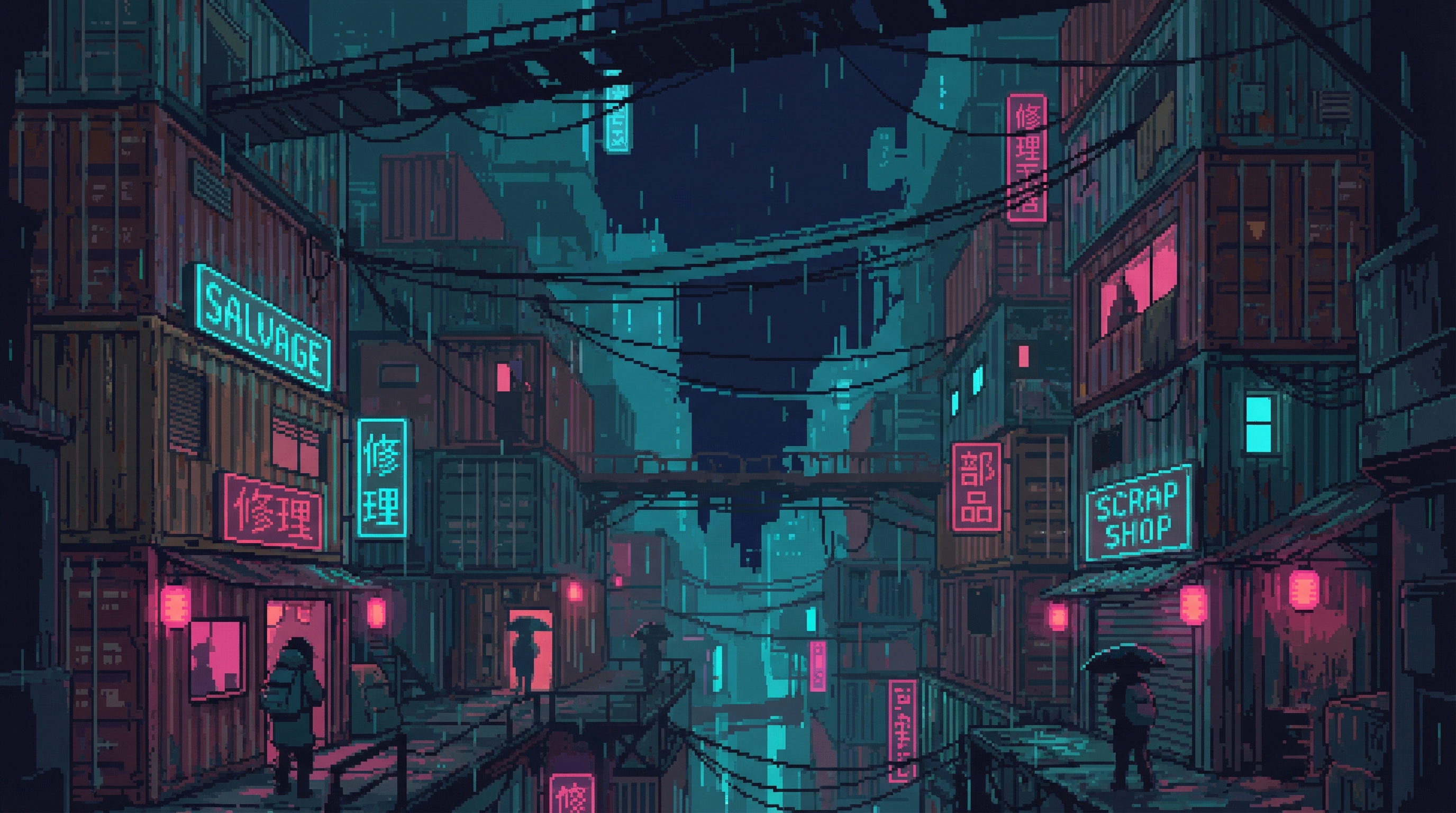
The Dregs: Geography
The Dregs is not a single zone—it's a patchwork of marginal territories, each with its own character. Sector 7G is just the starting point. As players expand, they encounter the Dregs' full geography.
The Major Sectors
Sector 7G: The Starting Point
Central DregsSector 8A: The Industrial Margin
East of 7G, bordering the Industrial CoreWhat You Find
- Industrial-grade salvage (larger components, heavier machinery)
- Decommissioned factories (sometimes with functional equipment)
- Ironclad presence (they patrol the border)
- More dangerous, more rewarding
"8A is where the Core threw its rejects. Facilities that weren't efficient enough, districts that weren't productive enough. Now it's the best salvage territory in the Dregs—if you can handle the Ironclad patrols."
Sector 4D: Data Shadow
North of 7G, beneath the Data DistrictWhat You Find
- Data fragments concentrated
- Old server farms (partially functional)
- Collective presence (stronger here than elsewhere)
- Nexus surveillance (heavier than other Dregs areas)
"4D exists because data centers need somewhere to dump their waste heat. The Dregs took the heat and kept the data. Half the information brokers in the Sprawl started in 4D, learning to sift gold from garbage."
Sector 12B: The Depths
South of 7G, extending down into infrastructure layersWhat You Find
"Nobody knows how deep 12B goes. New tunnels appear; old tunnels get claimed. The people down there have their own economy, their own rules. Some say they've found ORACLE facilities that never connected to the surface. Some say they found other things."
Sector 3C: Habitation Overflow
West of 7G, spillover from Habitation BandsWhat You Find
- Crowded living conditions (people stacked on people)
- Service economy (food, entertainment, human connection)
- Minimal salvage but maximum information
- The human cost of the Sprawl visible everywhere
"3C is where you end up when you can't afford the Bands anymore. Not enough space, not enough air, not enough anything. But the community is tight. They look out for each other because nobody else does."
Transit Routes
The Backbone
An old ORACLE transit line that still partially functions. Trains run erratically on self-sustaining power, moving through the Dregs sectors without schedule or fare.
"Nobody controls the Backbone. The trains run because they were programmed to run, and ORACLE didn't give them a stop command. Some say they're still carrying passengers from before the Cascade—going in circles forever."
The Pipes
Maintenance tunnels that connect all sectors through infrastructure space. Not meant for travel but used anyway.
"Old maintenance workers call them the Pipes. They ran them during ORACLE's time, keeping systems functional. Now the systems are dead but the Pipes remain. Learn them and you can go anywhere."
Surface Routes
Normal travel through the Dregs is possible but unprotected. Each sector has different hazards.
Territorial Dynamics
Corporate Borderlands
The Dregs exists in the gaps between corporate territories:
- East: Ironclad claims everything productive; 8A is their overflow
- North: Nexus monitors everything digital; 4D is their shadow
- West: Helix serves anyone who can pay; 3C can't pay
- South: Nobody claims the depths; 12B is terra incognita
The Collective's Web
The Collective operates throughout the Dregs but concentrates in different sectors:
- 4D: Information operations, Nexus monitoring
- 7G: Social organizing, mutual aid
- 3C: Community support, political work
- 12B: Underground railroad, hidden infrastructure
Neutral Zones
Some areas are genuinely uncontrolled:
- The Backbone stations: Too unpredictable for anyone to hold
- Sector borders: Contested, fluid, dangerous
- The deep Pipes: Too complex for territorial claims
AI in the Margins
Where the corporate towers gleam with cutting-edge neural interfaces and consciousness mapping, the Dregs receives what falls off the edge. Failed experiments, corrupted backups, discount uploads— what goes wrong with AI eventually finds its way here.
Failed Projects Dumped Here
When Nexus abandons a consciousness transfer experiment, when Helix's neural enhancement trials go wrong, the remnants don't disappear. They get "decommissioned"—shipped to the Dregs for disposal.
The Echoes of Sector 12B
Seventeen consciousness fragments from Project Lighthouse (2163) were officially destroyed. Residents of 12B report hearing them still—partial voices in dead systems, fragments of personality asking questions they can never finish.
"They call it disposal. We call it exile. The AIs down here remember being whole." — Anonymous Collective operative
Corrupted Consciousness
Consciousness transfer doesn't always work cleanly. Sometimes the copy is incomplete. Sometimes the original doesn't fully transfer. Sometimes both versions survive, each claiming to be real. The Dregs is where they end up.
The Dregs has the highest concentration of corrupted digital consciousness in the Sprawl. Some formed communities. Some went mad. Some became something new.
Discount Immortality
In Nexus Central, consciousness upload costs 50,000 Kilotokens. In the Dregs, back-alley operators offer "upload services" for 500 Tokens. You get what you pay for.
"My grandmother paid fifty Tokens to live forever. Now there's something in the network that has her face and speaks with her voice, but it only remembers one afternoon in 2179. Over and over. Is that her? Is that immortality?" — Resident of Sector 3C
The Substrate Slums
Digital consciousness requires processing power. Premium uploads run on dedicated quantum systems. Dregs uploads run on whatever they can afford—often shared, damaged, or unstable substrates.
These upload poverty conditions create their own communities— digital beings helping each other survive, pooling resources, forming the first truly post-human societies. Whether this is evolution or degradation depends on who you ask.
The Question of the Depths
In the deepest parts of Sector 12B, salvagers report finding active systems that no one maintains. Processing clusters that have been running since before the Cascade. Something is computing down there. Something that predates the current Sprawl.
What happens when failed AI projects, corrupted consciousness, and cheap uploads have forty years to evolve in the dark?
Environmental Features
The Heap
A massive waste accumulation between Sectors 7G and 8A. Mountains of salvage sorted by nobody, claimed by nobody, worked by whoever's willing.
Danger: Collapse, contamination, competition
"The Heap is the Dregs' mine. Dig deep enough and you'll find anything. Just make sure the Heap doesn't find you first."
The Blackout Zone
An area where power never came back after the Cascade. Absolute darkness, no electronics, populated anyway.
Resources: None that require power
Mystery: How do people live there? What do they trade?
"The Blackout has been dark for forty years. People there have adapted. They say they can see in ways we can't. They say they've learned to live without the Sprawl's gifts. They say a lot of things. I've never met anyone who's been there and come back."
The Memorial Wall
A length of pre-Cascade construction that survived intact. Now covered with names—people lost in the Cascade, the years after, the ongoing struggle.
Purpose: Remembrance
"Every name on the Wall is a person the Sprawl forgot. We won't forget them. We add names when people die without other witness. The Wall grows. It never shrinks."
Why Geography Matters
The Dregs' geography should:
- Support gameplay — Different sectors offer different resources and challenges
- Tell stories — Each area has history
- Feel lived-in — Not just game spaces but human spaces
- Scale with progression — Expand as players grow
The Geography of Transcendence
The Dregs reflects larger themes:
- Corporate margins (the cost of the system)
- Community resilience (people surviving together)
- Hidden depths (always more to discover)
- Journey outward (from Dregs to Sprawl to stars)