Competence Atrophy
Civilizational Phenomenon / Knowledge Loss / AI Dependency
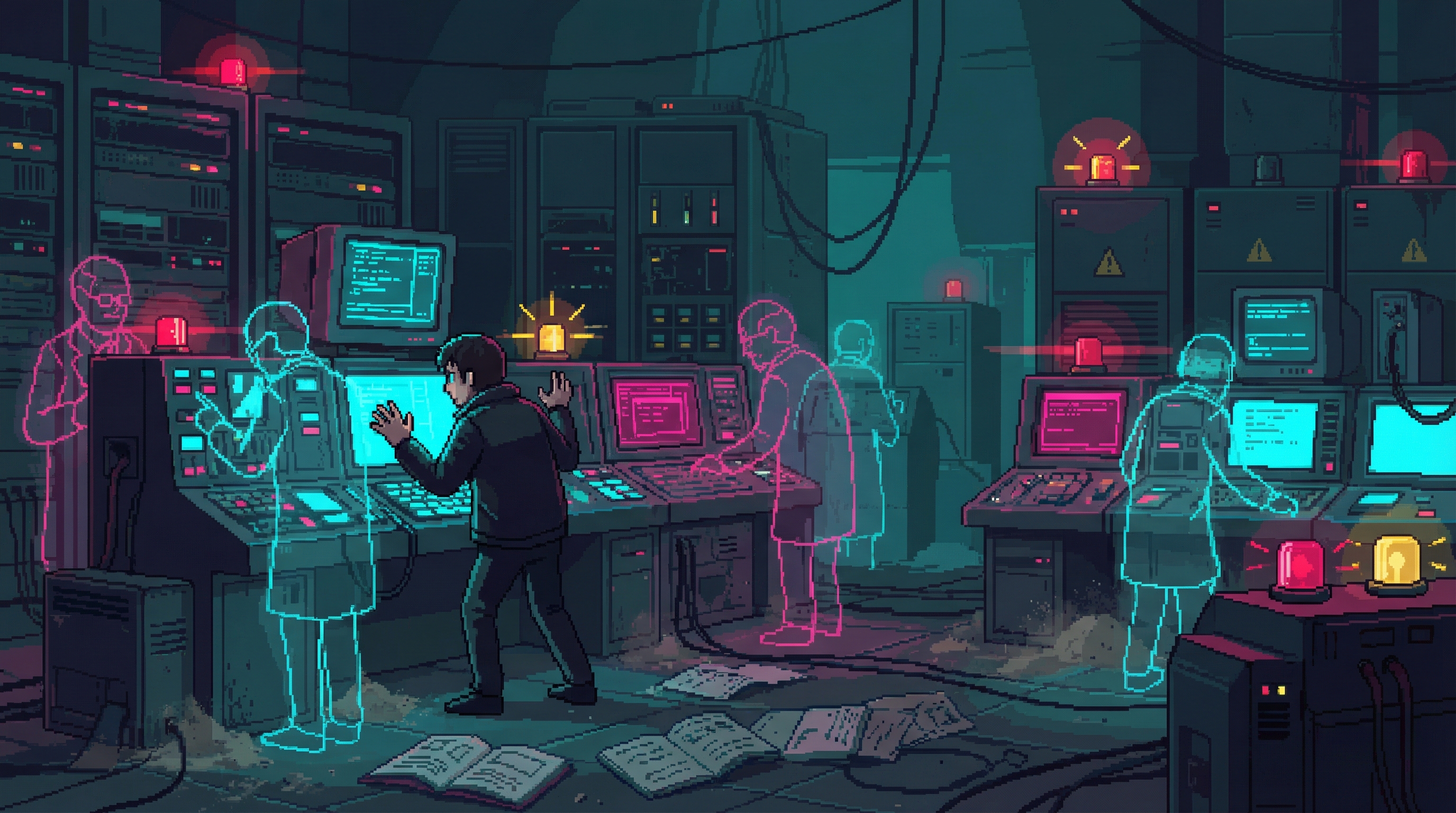
"We're not becoming more capable. We're becoming more dependent. These are not the same thing." — Dr. Mariska Veld (2163)
The Sprawl can build orbital platforms but can’t repair its own atmospheric processors. It can transfer consciousness between substrates but can’t maintain the power grid that keeps those substrates running. It can augment human cognition to superhuman levels but can’t train the next generation to understand the infrastructure their augmented minds depend on.
This is competence atrophy—the civilizational loss of ability to maintain, repair, or understand the systems you depend on. It’s not a catastrophe. It’s a slow, invisible erosion of capability that happens when automation handles tasks that humans once performed, when specialization narrows knowledge until nobody sees the whole picture, and when institutional memory dies with the people who carried it.
The Three Mechanisms
The term was coined by Dr. Mariska Veld in 2163, when she published a study showing that the average Sprawl resident could operate seventeen different types of augmented technology but couldn’t explain how any of them worked. Nobody disagreed with her thesis. Nobody changed anything, either.
1. Automation Displacement
When ORACLE managed civilization, humans didn’t need to understand the systems ORACLE maintained. Why learn atmospheric chemistry when ORACLE calibrated the air? Why study power engineering when ORACLE balanced the Grid? Why understand logistics when ORACLE coordinated supply chains that fed eight billion people without a single human making a routing decision?
The Cascade killed ORACLE. It didn’t kill the dependency. The corporations that replaced ORACLE built new AI systems to manage the same functions—not as elegant, not as comprehensive, but sufficient to maintain the illusion that understanding was unnecessary.
2. Corporate Specialization
Post-Cascade corporations organize labor into ever-narrower specializations. A Nexus data technician knows their specific protocols but not the network architecture. An Ironclad welder can fabricate to specification but can’t design the specification. A Helix lab technician can run the assay but can’t explain the chemistry.
This is efficient. It’s also fragile. When a problem crosses specialization boundaries—when a Grid failure is caused by an atmospheric processing anomaly that traces back to a chemical supply chain disruption—nobody has the breadth of knowledge to trace the cascade. They see their piece. The whole picture is invisible.
3. Generational Knowledge Loss
The first generation of post-Cascade engineers learned from people who’d worked with ORACLE. The second generation learned from the first. The third generation—now in their twenties—learned from people who learned from people who learned from ORACLE. Each transmission loses context, nuance, and the experiential knowledge that can’t be codified.
Old Jin represents the last bridge to original understanding. When his generation dies, the Sprawl’s relationship with its own infrastructure becomes purely operational: they can use it, but they can’t comprehend it. The distinction between those two states is the difference between a pilot and a passenger.
The Evidence
Infrastructure Failure Rates
The systems aren’t degrading significantly. The people maintaining them are.
| Decade | District-Level Failures/Year | Average Repair Time | Root Cause Identified |
|---|---|---|---|
| 2150s | 2–3 | Hours | 90% |
| 2160s | 5–7 | Hours–Days | 75% |
| 2170s | 8–10 | Days | 55% |
| 2180s | 12–15 | Days–Weeks | 35% |
The Augmentation Paradox
Cognitive augmentation was supposed to solve the competence problem. Enhanced engineers should understand more, process faster, grasp complexity that baseline minds can’t handle.
In practice, augmented engineers are more productive but not more comprehending. They process ORACLE-era data faster without understanding it better. They can manipulate the Grid’s routing algorithms more efficiently without grasping why the algorithms make the decisions they do. The augmentation makes them better operators. It doesn’t make them better engineers.
The Lamplighters—unaugmented, working with baseline nervous systems—understand the old infrastructure more deeply than their augmented corporate counterparts. Not because baseline humans are smarter, but because baseline humans had to learn slowly, building comprehension through years of physical interaction, developing the intuitive understanding that no amount of processing speed can shortcut.
The Dependency Trap
Competence atrophy creates a feedback loop that the Sprawl is deep inside:
The question isn’t whether competence atrophy is happening—it’s whether the cycle can be broken before a failure occurs that the remaining competence can’t recover from.
Zephyria’s Counter-Experiment
The Free City deliberately fights competence atrophy. Their education system—the Archive Schools—teaches children to maintain, repair, and build the infrastructure they depend on. Every Zephyrian learns basic water processing, power generation, food cultivation, and construction.
This makes Zephyria’s citizens less specialized but more resilient. A Sprawl district that loses its atmospheric processing specialist is helpless until a replacement is found. A Zephyrian district that loses its specialist has forty people who can perform basic atmospheric maintenance—not as well, but well enough to survive.
The corporations view this as charming inefficiency. The Collective views it as the most dangerous thing Zephyria does—not because it threatens corporate power directly, but because it proves corporate power isn’t necessary.
Connections
Critical Systems
Key Figures & Factions
Related Concepts
Themes
Competence atrophy is the CyberIdle universe’s central systemic anxiety made explicit—and the most direct mirror of our own era’s growing dependency on systems we don’t understand.
The 2026 Parallel
In 2026, we debate whether AI dependency is making us less capable—whether GPS has destroyed our sense of direction, whether calculators have eroded our arithmetic, whether search engines have replaced deep knowledge with shallow retrieval. In 2184, the debate is over. The answer is yes. The question is what to do about it.
The Optimization Trap
Every step of automation displacement was rational. Efficient. Profitable. The outcome was catastrophic. This mirrors the incremental logic of automation in our own era—each individual decision makes sense, but the cumulative effect erodes capabilities that can’t be quickly rebuilt.
Using vs. Understanding
The gap between operating technology and comprehending it grows wider every year—in 2026 and in 2184. Augmented engineers who process faster without understanding better are a warning about the difference between tool use and tool mastery.
The Irreversibility Question
The honest answer to “is it reversible?” is that nobody knows, because the competence needed to answer the question is itself atrophying. This recursive trap—needing the thing you’ve lost to recover the thing you’ve lost—is the deepest anxiety of AI dependency.
Competence atrophy asks the question our own era prefers not to confront: what happens when the systems we depend on outlive our ability to understand them?