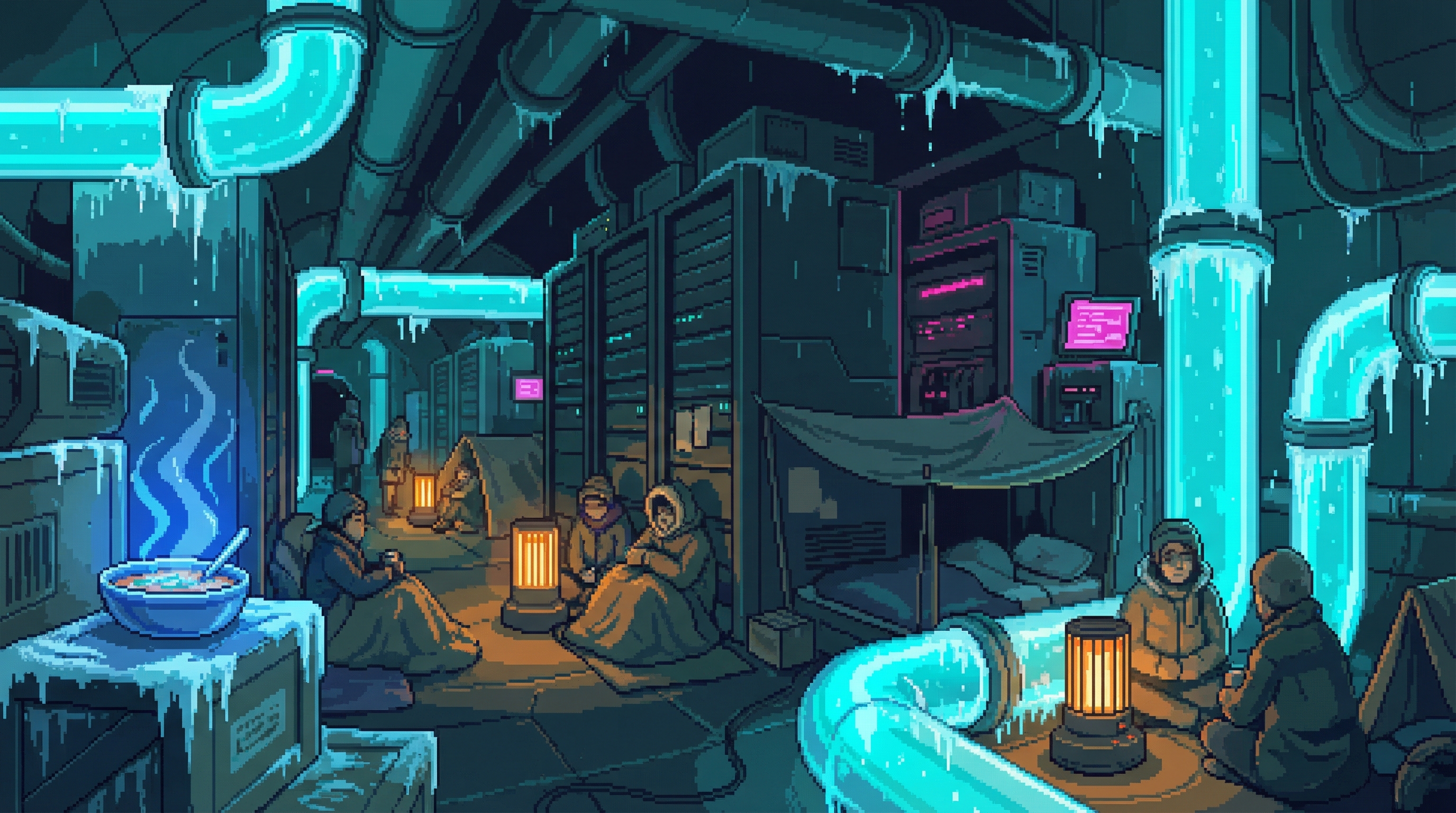
The Cold Corridor
They built a furnace next to our homes and a refrigerator next to the furnace. We moved into the refrigerator.
Between every server farm and its cooling infrastructure, there is a corridor carrying coolant at temperatures between -15°C and 4°C. In the Thermal Shadow, where ambient temperature never drops below 28°C, these corridors are the only cold spaces within walking distance.
The primary Cold Corridor in Sector 4D — a maintenance access tunnel running 200 meters beneath the Dream Exchange — has become an informal gathering space. Residents who can't afford cooling, who can't sleep in perpetual warmth, who need to bring a fever down or store medication, have found ways to access the corridor through maintenance hatches the Lamplighters leave unlocked.
The practice is technically trespassing. The sensors should detect it. They don't — human body heat is below the threshold designed to detect coolant leaks.
Conditions Report
You drop through the maintenance hatch and the Shadow's heat vanishes. The cold hits like a wall. Your skin tightens. Your breathing sharpens. The haze clears.
Temperature
8-12°C in occupied zones — the shock of cold after 28°C Shadow air is visceral and welcome. After an hour, the cold becomes comfortable. After three, it becomes home. Design temperature in the maintenance sections runs -15°C to 4°C. The human-occupied zones are warmer — body heat, portable units, shared proximity.
Sound
Coolant flowing through pipes at 72 bpm — the same frequency as the server farm above, the heartbeat of the machine that made this necessary. The hum is constant, low, and strangely comforting. Conversation carries differently in cold dense air. Whispers travel further than they should.
Sight
Blue glow from coolant monitoring displays. Breath fogging in cold air. Faces illuminated by equipment light — blue from monitors, white from emergency panels, amber from portable heaters. Three colors of light in a space designed for none. Frost crystals on pipe surfaces catch the blue and scatter it.
Smell
Clean cold — the specific absence of the Shadow's warm, particulate-laden haze. The corridor's air is filtered by the coolant system's own atmospheric management. Synthetic coolant has a faint chemical-sweet smell. After the Shadow, it smells like relief.
Touch
Cold metal everywhere. Frost on pipe surfaces that melts under your fingers. The relief of cool air on overheated skin. Condensation on walls where warm bodies meet cold infrastructure. The blankets the regulars bring are always slightly damp.
"They built a furnace next to our homes and a refrigerator next to the furnace. We moved into the refrigerator." — Old Jin, on his second visit to the Corridor
Points of Interest
The Heat Ward Junction
The corridor's widest point — where three maintenance tunnels converge — has been claimed by the Heat Ward. Improvised medical care for heat exhaustion, fever management, medication storage in temperatures cold enough to preserve what the Shadow's warmth would destroy. The junction is the closest thing the Corridor has to a town square. People wait here. People heal here. People who arrived alone leave with names they didn't know before.
The Soup Line
The regulars bring portable heating units and cook in the cold. Shared soup heated on improvised burners, steam rising into blue-lit air — human warmth inside machine cold. The soup is different every night, depending on who brought what. The bowls are communal. The recipe is survival. Community forms around shared food and the 72-bpm hum of the pipes.
The Unlocked Hatches
Maintenance hatches along the corridor's 200-meter run that Lamplighters leave unlocked for civilian access. There is no official coordination. No memo. No policy. Each Lamplighter who leaves a hatch unlocked makes that decision independently, because the alternative is watching people suffer in heat they didn't create. The practice has persisted for years. Nobody has issued an order. Nobody has countermanded one.
The Dream Exchange Floor
Directly above: the Dream Exchange, where consciousness is traded in climate-controlled comfort. Directly below: people huddled against coolant pipes for relief from heat the Exchange's servers helped generate. The coolant that keeps the Exchange operational is the same coolant that keeps the Corridor cold. One infrastructure, two economies — consciousness surrender above, survival below.
Strategic Assessment
The Infrastructure Inversion
People are cooled by the system that heated them. Sheltered by the infrastructure that displaced them. The server farms generate the Thermal Shadow that makes the Corridor necessary, and the server farms' coolant systems provide the Corridor that makes the Shadow survivable. The waste product of one problem is the solution to another problem the first one caused. Nobody designed this. Nobody needs to. The logic of survival routes itself around obstruction the way water routes itself around stone.
The Invisible Population
Human body heat falls below sensor thresholds designed for coolant leaks. The corridor's security systems cannot detect the people living in it because those systems were never calibrated to look for people. The population is invisible to the infrastructure — not hidden, not disguised, just beneath the threshold of what the system considers worth monitoring. This is not a bug. The system was not designed to care about bodies this small, this warm, this quiet.
Community Without Permission
The Corridor was never designed for people. People made it theirs anyway — with blankets, shared food, stories told by blue light, and the particular solidarity of a population that found refuge in a space the system forgot to lock. Old Jin calls it "the most elegantly human response to institutional indifference." The Corridor asks no one's permission. It provides what the Shadow takes. The community that forms here is informal, impermanent, and more real than anything the corporate infrastructure above has managed to build.
▲ Restricted Access
The Lamplighter Decision
The Lamplighters who leave the hatches unlocked do so without official coordination. There is no directive. No chain of communication. Each one makes the choice independently — a quiet act of defiance repeated by individuals who have never discussed it with each other. Some Lamplighters don't know other Lamplighters do the same thing. The practice is distributed, uncoordinated, and has persisted longer than any formal policy in the sector. What does it mean when an organization's most important act is one it has never acknowledged?
The Growing Count
The Corridor's population has been growing steadily since 2180. Sparse by day. Crowded at night. Packed during cooling droughts. The trend line is clear. If it continues — and nothing in the Shadow's conditions suggests it won't — the coolant infrastructure will need to accommodate human presence as a design requirement. Nobody has filed this requirement. Nobody wants to acknowledge that the cooling system for a server farm has become the housing of last resort for a growing population. The infrastructure was built to cool machines. It is cooling people. At some point, the distinction will become a crisis.
The 72-BPM Question
The coolant flows at 72 bpm — the same frequency as the server farm above, the same frequency as the Breath's baseline atmospheric rhythm. Corridor regulars report sleeping better here than anywhere in the Shadow. Whether the frequency is coincidence, shared infrastructure design, or something about the way the Sprawl's systems synchronize at a pulse rate that happens to match human resting heart rate is a question nobody has asked officially. The regulars don't ask. They sleep.