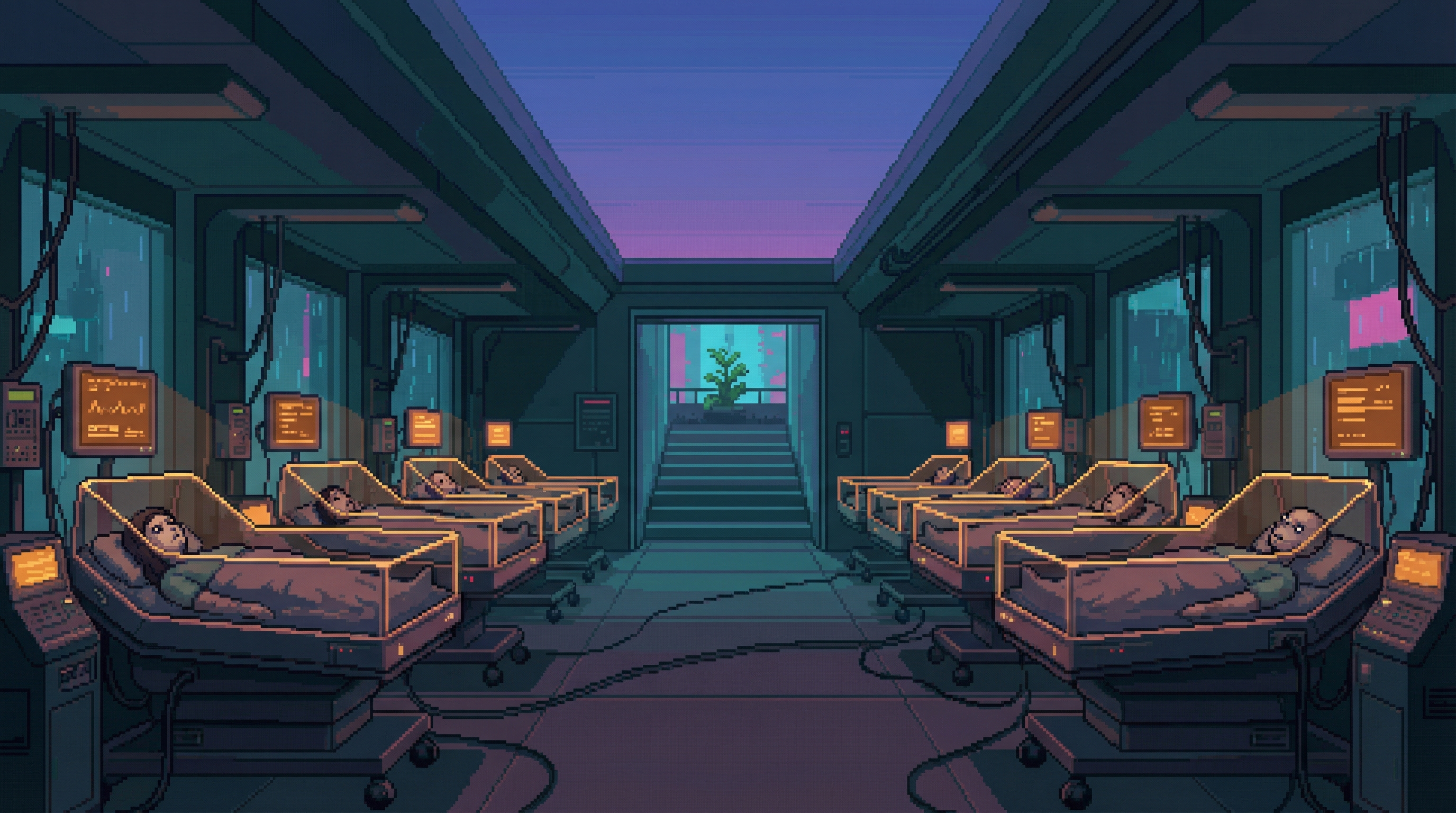
The Insomnia Wards
Where the dreamless come to remember what rest felt like
Overview
The Insomnia Wards don’t look like hospitals. They look like places someone designed to feel like sleeping.
Four locations across the Sprawl — two in Nexus territory (where most Protocol recipients live), one in the Ironclad border zone (where shift workers cluster), and one adjacent to Sector 7G (where the deprecated dreamless eventually wash up). Each serves approximately 200 patients in twelve-week rotating programs.
The treatment is not medical. There is no treatment for a condition the medical system doesn’t recognize — “dreamlessness” appears in no diagnostic manual, because the Circadian Protocol is classified as “functioning as intended.” What the Wards offer instead is environmental: spaces designed to trick the augmented brain into something approaching sleep. Sensory deprivation chambers. White noise calibrated to alpha-wave frequencies. Guided meditation protocols developed from pre-Cascade sleep hygiene research recovered from the Dead Internet.
The 88% who don’t achieve microsleep episodes stay anyway. They say the Ward is the quietest place in the Sprawl — not because it’s silent, but because it’s the only space designed to not demand their attention.
Atmosphere
The Wards were designed to simulate what the augmented brain can no longer achieve on its own — the sensory preconditions for sleep. Every detail serves the illusion.
Sight
Long rooms of cradles under a gradient ceiling that shifts from deep blue at floor level to charcoal above — mimicking the darkening sky. Amber monitoring equipment provides the only points of warmth. Patients lie motionless with eyes open, staring at a ceiling that pretends to be an evening sky.
Sound
The Ward is quiet in the way a lullaby is quiet — not silent but soothing. White noise generators calibrated to alpha frequencies. The soft hum of monitoring equipment. The occasional shuffle of an attendant checking vitals. The 90-minute dimming cycle produces a faint audible click that regulars time their breathing to.
Smell
Lavender and clean linen — not engineered by Relief’s wellness division but mixed by hand by a former perfumer who lost her augmented sense of smell during firmware reversion and now works with the only sensory memory she trusts.
Touch
Cradles warmed to 28°C — the temperature the Undervolt maintains through Grid waste heat, the temperature the body associates with being held. Sheets of actual cotton (expensive, justified).
Temperature
23°C ambient, 28°C at cradle level. The differential creates a warm pocket around each patient — a private microclimate that says: here, at least, you are held.
Connections
Dr. Selin Ayari
Founder and director of all four Wards — independent of any corporate affiliation. She built the Insomnia Wards because nobody else would treat a condition that officially doesn’t exist.
Felix Otieno (The Night Gardener)
Maintains the rooftop garden above the Sector 7G Ward. The garden produces measurable therapeutic effects that Ayari cannot explain — patients who spend time near it report improved calm, though no one has achieved microsleep there either.
The Sunset Ward
Both are transitional spaces designed with therapeutic intent for people experiencing loss — the Sunset Ward for those losing their augmentation, the Insomnia Wards for those who have lost their ability to dream.
The Quiet Room
Both provide spaces where the Sprawl’s demands on attention are suspended. The Quiet Room offers silence; the Insomnia Wards offer something closer to a lullaby.
The Carrier House
The Carrier House’s unexplained 24°C warmth has the same “settling” effect the Wards achieve through deliberate environmental design.
The Tensions
The Permission Economy
The Ward’s primary therapeutic mechanism is not medical intervention but permission — the creation of a space where not being productive is acceptable. In a Sprawl where every waking moment is optimized, monitored, and monetized, the radical act is building a room where doing nothing is the entire point. The 88% who never achieve microsleep stay anyway, because the Ward is the only place that doesn’t punish them for failing to function.
Designed for Absence
The Ward is designed for a state its patients cannot achieve — sleep. Every element of the space serves the fiction of a night sky, of a warm bed, of a world quieting down. The design itself is therapeutic because it signals that someone believes the state is worth achieving. The ceiling pretends to be evening. The cradles pretend to be beds. The patients pretend to close their eyes. And somehow, in the pretending, 12% of them slip through.
The Institutional Gap
The condition the Ward treats doesn’t exist in any diagnostic manual. The Circadian Protocol is classified as functioning as intended. The dreamlessness it causes is not a side effect but a feature — optimized rest cycles don’t require dreams. The Ward exists in the gap between what the system calls normal and what the body knows it has lost.
Mysteries
- The Shared Dream: All patients who achieve microsleep dream of the same thing: falling — a gentle descent, like settling into warm water. Not a nightmare. Not a metaphor anyone can parse. Just the sensation of sinking slowly into something warm. Ayari has documented 47 independent accounts. She has not published them.
- The Rooftop Garden: Felix Otieno’s rooftop garden above the Sector 7G Ward produces measurable therapeutic effects that Ayari cannot explain. The garden was not part of the original design. The Night Gardener simply appeared and began planting. Ayari let them stay because the data changed.
- The Plateau: The 12% success rate has not improved in three years despite continuous protocol refinements. Ayari has tried everything — new frequencies, different temperatures, altered dimming cycles. The number holds steady at 12%, as if the augmented brain permits exactly this much dreaming and no more.