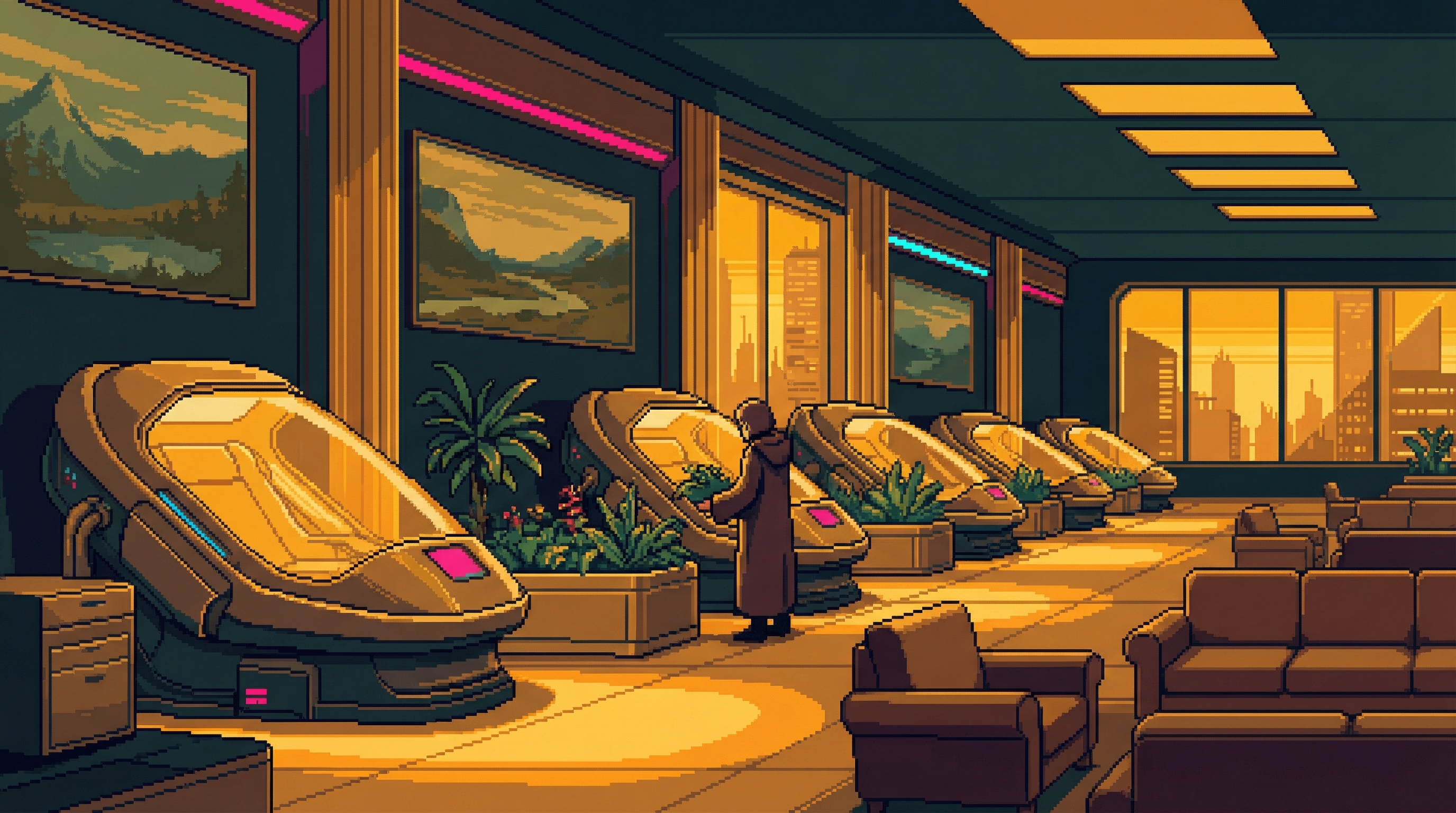
The Sunset Ward
Transition Services — Lattice 14
Overview
On Level 14 of the Lattice, between a corporate fitness center and a meditation pod cluster, there is a floor that doesn’t appear on Nexus Dynamics’ public directory. The elevator button exists but it’s grayed out unless your neural interface carries a specific administrative authorization. The floor’s internal designation is “Transition Services — Lattice 14.” Its residents call it the Sunset Ward.
The Ward houses approximately 120 employees at any given time — people in the 72-hour window between receiving their Deprecation Notice and completing their firmware reversion. They are neither employees nor civilians during this period. Their corporate access is suspended but their civilian identity hasn’t been reinstated. They exist in an administrative limbo that has its own culture, its own rituals, its own quiet desperation.
Atmosphere
The space was designed by Dr. Lian Zhou’s team in 2179, and it shows: everything is calibrated for psychological comfort. Warm lighting at 3200K, curated ambient sound (ocean waves, not white noise), temperature at 23°C, and furniture deliberately chosen to feel domestic rather than institutional. The chairs have cushions. The walls display landscapes — not corporate art. There are plants. Real plants, maintained by a human gardener who works the Sunset Ward and nowhere else.
Smell
Clean linen and something faintly botanical — the real plants and the particular organic scent of a space where someone tends living things. Beneath it, the sterile mineral tang of medical pod environments during hours 12–36.
Sound
During hours 0–12 and 36–72: muffled conversation, the soft tones of counseling rooms, Felix humming to plants. During hours 12–36: silence. Rows of occupied medical pods, each containing a person whose mind is being quietly diminished. The pods display vital signs in soft amber. The silence is the worst part.
Touch
Cushioned furniture, textured surfaces — everything designed to feel like home. The medical pods during reversion are precisely 36.8°C, body temperature, so the patient doesn’t feel the transition. They wake in the same warmth they fell asleep in. Only the world outside the pod has changed.
Light
Warm, golden, 3200K — deliberately non-corporate. The photovoltaic glass is tinted amber. Even the medical pods emit soft amber rather than clinical white. The message encoded in the lighting: this is not a hospital. This is not a punishment. This is a transition.
The 72-Hour Process
The deprecation unfolds in three phases. Hours 0–12 are administrative: documentation, access revocation, exit planning. Hours 12–36 are the reversion itself — firmware rollback conducted in the medical pods, the patient sedated while their neural interface capabilities are systematically reduced. Hours 36–72 are recovery and exit interview, conducted by Transition Specialists in the Ward’s counseling rooms. The entire process follows the Graceful Degradation Protocol — 340 pages of managed kindness.
The most distinctive sensory experience is the transition between hours 11 and 13 — the moment when the occupied medical pods begin their reversion sequence. The room’s ambient sound shifts imperceptibly: the ocean waves continue, but a subsonic hum joins them — the pods’ neural interface calibration process. The hum is below conscious awareness but above physiological threshold. Visitors report feeling slightly heavier, slightly more present, as if the room’s gravity has increased. Felix feels it every day. He has never mentioned it. He waters the plants instead.
Connections
Felix Otieno
The Ward’s gardener — himself deprecated from Nexus Environmental Systems in 2180. A deprecated engineer caring for the space that deprecates others. He tends the real plants, hums while he works, and has never once mentioned the subsonic hum that fills the room during reversion hours.
Lena Marchetti
Transition Specialist who conducts exit interviews in the Ward’s counseling rooms. Her notebook accumulates marks — one for each person she guides through the final hours of their corporate identity.
The Deprecation
The Sunset Ward is where the 72-hour deprecation process physically occurs — the space between receiving the notice and completing the firmware reversion.
The Graceful Degradation Protocol
The Ward’s operating manual — 340 pages dictating how every aspect of the deprecation process should unfold, from ambient lighting to counseling scripts. The Protocol’s physical implementation occurs in these facilities.
Dr. Lian Zhou
Zhou’s team designed the Ward’s therapeutic environment in 2179 — every detail calibrated for psychological comfort during a process that systematically diminishes the mind.
Nexus Dynamics
Operates the Ward as part of its Transition Services division. The corporate infrastructure that both enhances its employees and manages their diminishment when they are no longer needed.
The Tensions
Comfort as Control
The Sunset Ward is the Deprecation’s most devastating achievement — a space so carefully designed for human comfort that the people being diminished within it feel cared for. The amber lighting, the cushioned furniture, the real plants: every element exists to make the surrender painless, the loss of capability feel like a gentle transition rather than a corporate termination. The kindness is real. The function it serves is not.
The Gardener’s Paradox
Felix Otieno was deprecated in 2180. Now he tends the space that processes others through the same system that diminished him. He waters plants that grow between medical pods. He hums while minds are being quietly reduced. Whether his presence is a mercy or a cruelty — whether a deprecated man caring for the soon-to-be-deprecated constitutes solidarity or complicity — depends on whom you ask. Felix has never been asked.
Administrative Limbo
For 72 hours, the Ward’s residents are neither employees nor civilians. Their corporate access is suspended, their civilian identity not yet reinstated. They exist in a gap that Nexus designed but no legal framework fully addresses — a transitional non-status with its own culture, its own rituals, and its own quiet desperation. The Ward is the physical architecture of that limbo.
Mysteries
- The Garden Connection: The plants in the Sunset Ward are the same species as those in the Garden of Signals — pre-Cascade cultivars from Dead Internet biological archives. Felix doesn’t know this. Sister Maren, who tends the Garden of Signals, doesn’t know about Felix. But the same plants that dampen neural interface activity in Nexus Central’s sacred garden also grow in its most administrative room. Whether the calming effect extends to the Ward’s occupants — whether the plants’ electromagnetic properties ease the cognitive reversion process — has never been studied because nobody has noticed the connection.