Neon Graves
Everything Here Is Dying Beautifully
Overview
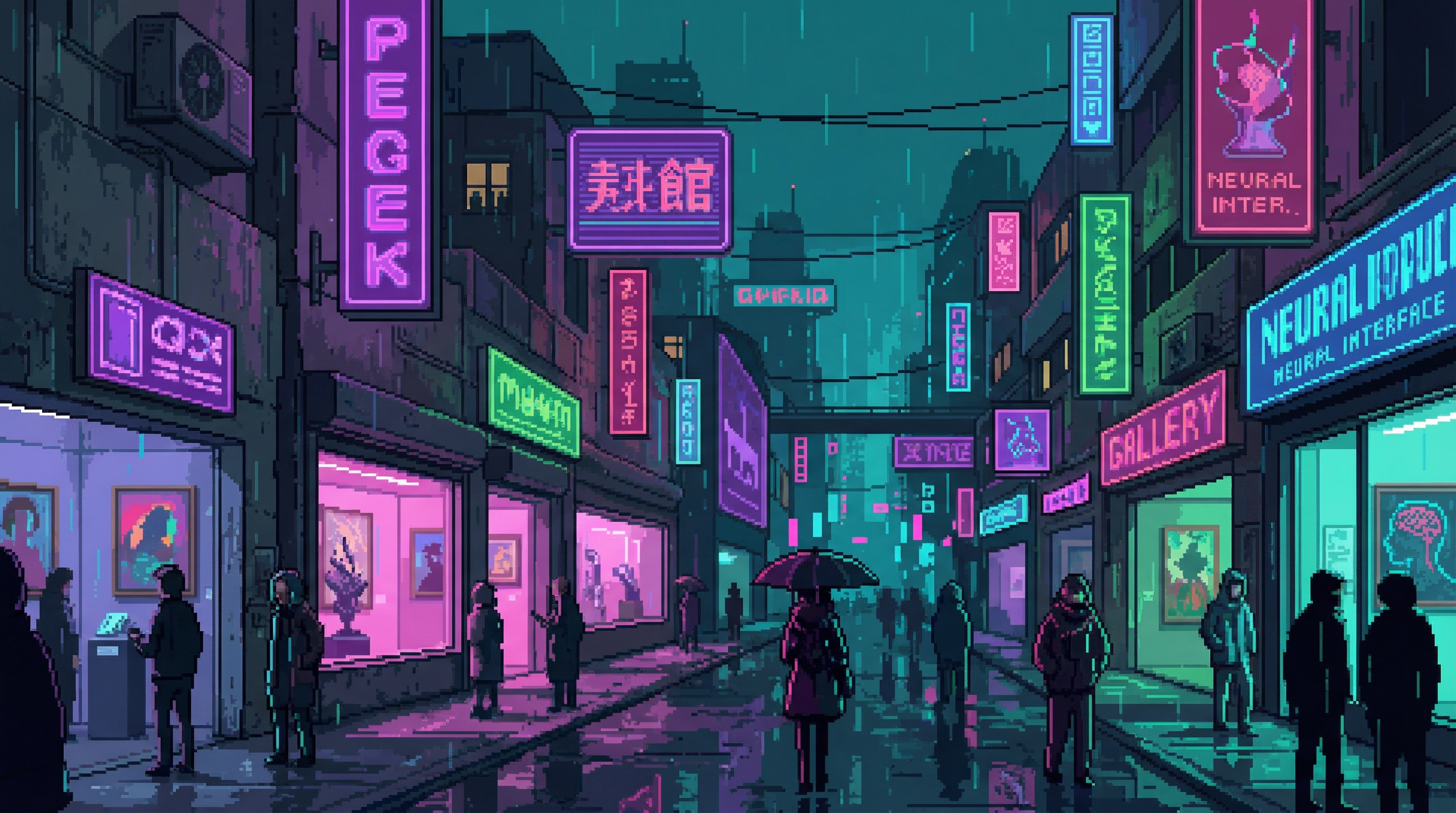
They call it the Neon Graves because everything here is dying beautifully.
The district occupies six blocks of Sector 12's mid-level -- abandoned entertainment infrastructure Relief Corporation built in the 2150s and walked away from. The shells of performance halls, streaming studios, and VR lounges sat empty for a decade before the artists moved in.
By 2170, the Neon Graves had become the Sprawl's only surviving art district. The name comes from the neon -- kilometers of neon tubing originally installed for corporate signage. RELIEF STREAM PREMIUM flickers above a gallery showing pre-Cascade oil paintings. EXPERIENCE THE DIFFERENCE illuminates a studio where a lived-canvas artist paints with her nervous system.
Walking the Neon Graves at night is temporal vertigo. Pre-Cascade art hangs beside lived-canvas originals. AI compositions play from speakers outside venues where fragment carriers channel the Dispersed.
"The Neon Graves is the Sprawl's confession. We know we've lost something."-- Orin Slade, Chronicler
The District
Gallery Row
400-meter converted service tunnelThe spine of the Neon Graves. A 400-meter service tunnel lined with galleries, divided into two distinct halves that mirror the district's central tension.
Legacy Galleries
Pre-Cascade physical art. The crown jewel is The Wake -- a gallery curated by Sena holding 847 works, including the oldest verified original artwork in the Sprawl. These pieces survived the Cascade through accident, stubbornness, and the simple fact that you cannot delete a painting.
Contemporary Galleries
Lyra Voss's studio-gallery anchors this side -- lived-canvas originals created through neural interface, where the artist's nervous system becomes the brush. Art that could not have existed before the technology that destroyed so much else.
The Resonance Hall
End of Gallery RowThe premier performance venue in the Neon Graves, positioned at the far end of Gallery Row like a destination at the end of a pilgrimage. Where fragment carriers channel the Dispersed and AI compositions receive live performance alongside human musicians.
Studio Null
Behind Gallery RowAn experimental art space dedicated to the unrecordable. Works created here exist only in the moment of their creation -- no recordings, no reproductions, no digital traces. In a world where everything is captured and archived, Studio Null insists that some experiences should be singular and unrepeatable.
The Underhang
Below Gallery Row -- Artist ResidencesThe residential heart of the Neon Graves. Forty credits a month buys you a space beneath the galleries -- cheap enough that artists can survive while making work that does not pay. The Underhang is why the Neon Graves still exists: without affordable housing, the artists would scatter to districts that do not want them.
- 40 credits/month rent
- Artist-only residency requirement
- Self-governed by artists' council (est. 2170)
- Supports ~8,000 permanent residents
The War: Authentic vs. Synthetic
The question that defines the Neon Graves -- and that the Neon Graves cannot answer.
The Mirror Gallery
The Mirror displays AI-generated art alongside human-created work. No labels. No attribution. Visitors are invited to identify which is which.
Statistically random. No better than a coin flip. The gallery has been vandalized three times. The accuracy rate has not improved.
The Mirror is the Authenticity Market's ground zero -- the place where the philosophical war between authentic and synthetic creation is fought with data instead of arguments. Kael Mercer is rumored to visit anonymously, possibly connected to the gallery's founding.
Sensory Experience
The Neon Graves is not just seen. It is inhaled, felt, heard in the bones.
Visual
Neon and shadow. Purple, pink, green, blue light washing over rough concrete. At night from above, the district is a rectangle of color -- a wound that glows. Corporate signage from a dead era spelling out promises nobody believes, illuminating art nobody expected.
Sound
The subsonic buzz of kilometers of neon tubing forms a constant background -- felt more than heard. Layered over it: whispered gallery conversations, bass bleeding through walls from The Resonance Hall, the occasional crack of conductive pigment drying on canvas.
Smell
Neon gas and old concrete. Turpentine from legacy painters who still work in physical media. Copper from conductive pigments used in lived-canvas pieces. A faint ozone edge from aging electrical infrastructure that nobody has the budget to replace.
Texture
Rough, unfinished concrete walls -- the original entertainment infrastructure was designed to be covered with screens and projections, never meant to be seen bare. The floors are worn smooth by decades of foot traffic, polished by the passage of fifteen thousand daily visitors.
Connections
Lyra Voss
Resident artist. Her lived-canvas studio-gallery on Gallery Row represents the cutting edge of neural interface art -- creation through direct nervous system expression.
Orin Slade
Chronicler of the Sprawl. His observations frame the Neon Graves as cultural confession -- evidence of what was lost and what stubbornly persists.
Relief Corporation
Built the original entertainment infrastructure in the 2150s, then abandoned it. The corporate ghosts haunt the district in the form of neon signage spelling out slogans for products that no longer exist.
Authenticity Market
The broader cultural battleground where authentic and synthetic art collide. The Neon Graves -- and The Mirror gallery specifically -- is the physical front line of this war.
Kael Mercer
Anonymous visitor. Possibly connected to The Mirror gallery. His presence in the district is rumored, never confirmed -- which is precisely how he operates.
The Echo Bazaar
Underground counterpart to the Neon Graves. Where the Graves shows art to the public, the Bazaar trades in experiences and fragments that cannot bear the light.
The Dead Internet
Source of pre-Cascade art. The digital ruins that feed the legacy galleries with recovered works -- paintings, compositions, performances pulled from servers that survived the collapse.
The Blank Canvas Movement
Active presence in the Neon Graves. Artists who reject both traditional and AI-mediated creation, searching for a third path that owes nothing to either side of the authenticity war.
Themes: The Indistinguishable Line
What happens when the distinction you stake your identity on turns out to be empirically unmaintainable?
The Authenticity Crisis
The Neon Graves is the physical manifestation of the AI art crisis. Human and machine creation coexist in the same galleries, under the same neon. The Mirror's 51.2% accuracy rate is not a failure of the audience -- it is a failure of the premise. The distinction artists stake their identities on is empirically unmaintainable.
Coexistence Without Resolution
Unlike other spaces in the Sprawl that have chosen sides, the Neon Graves holds both truths simultaneously. Pre-Cascade oil paintings and lived-canvas neural art exist meters apart. AI compositions and human performances share the same venue. The district does not resolve the tension -- it inhabits it.
Creation vs. Classification
The artists of the Neon Graves keep making work. The critics and markets keep trying to classify it. The gap between the act of creation and the system of classification grows wider every year. The art does not care what category it belongs to. The people who buy, sell, and judge it care desperately.
If you cannot tell the difference between human art and machine art -- and The Mirror proves you cannot -- then what exactly are you defending when you defend authenticity?