The Heat Ward
People cooled by the system that heated them, sheltered by the infrastructure that displaced them, healed by the waste products of the economy that made them sick.
When the compute climate turns lethal, people need somewhere to go. The Heat Ward is an informal medical facility in the Cold Corridor's widest junction — a maintenance bay adapted over three years into a thermal emergency shelter by the Coolant Guild in coordination with Dr. Ayari's Insomnia Ward network.
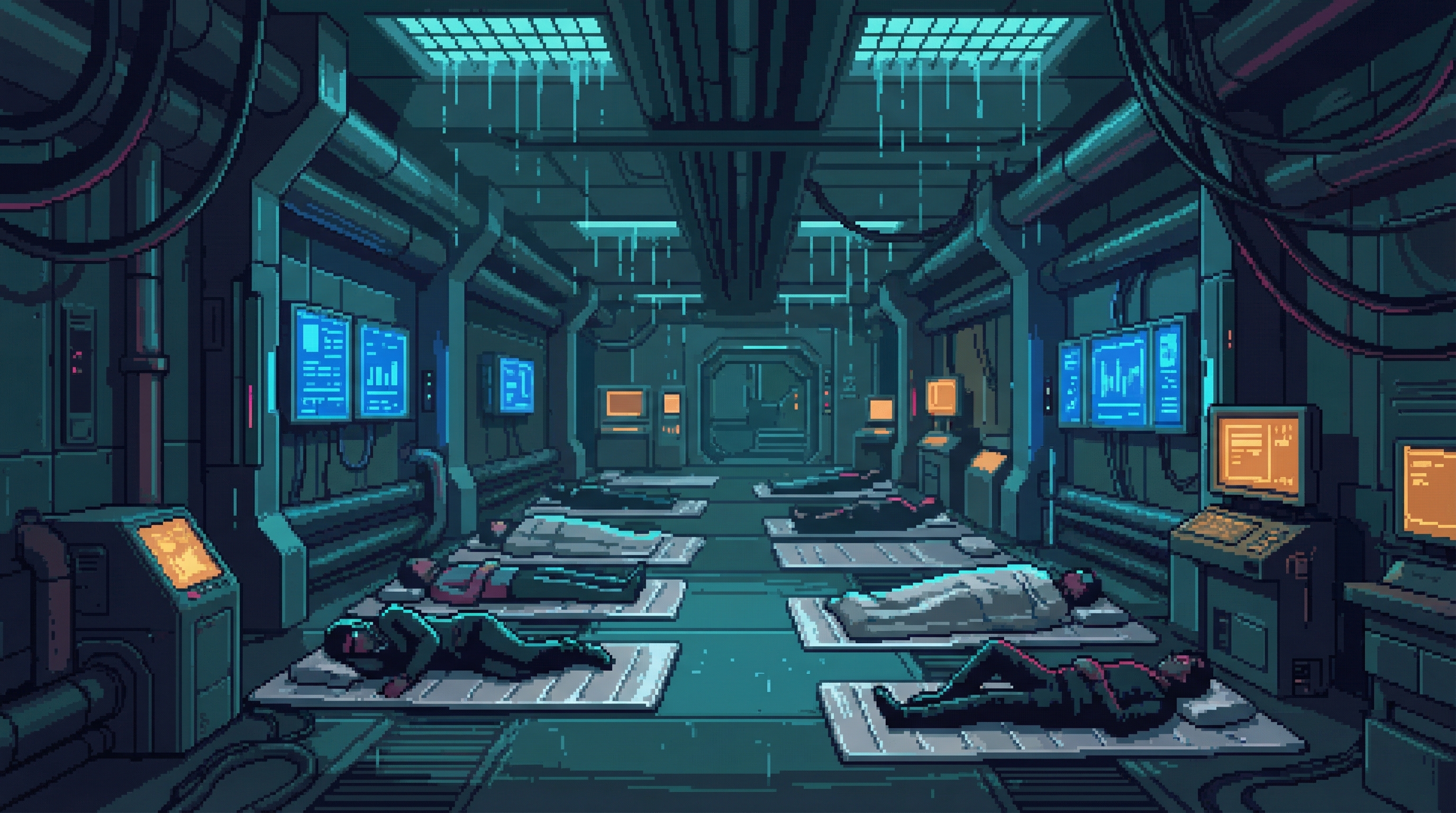
The Ward has no beds. It has cooling mats — salvaged from decommissioned server farm substrate cooling systems — that maintain 18°C surface temperature using the corridor's own coolant. During thermal emergencies, up to sixty people lie on mats designed to cool crystalline processing substrate, now cooling human bodies overheated by the same processing infrastructure.
The irony is architectural: people are cooled by the system that heated them, sheltered by the infrastructure that displaced them, healed by the waste products of the economy that made them sick.
Conditions Report
You come in from the Shadow at 34°C, skin burning, vision blurring. Someone guides you to a mat. The silver surface is 18°C — precise, consistent, the exact temperature the substrate was designed for. The relief is so intense it produces tears.
Temperature
8-12°C ambient from corridor coolant. 18°C on the cooling mats — precise, consistent, the same temperature the substrate was designed for. The gap between the Shadow's 34°C air and the mat's 18°C surface is sixteen degrees of borrowed mercy.
Sound
Coolant flow at 72 bpm — the infrastructure's heartbeat. Quiet conversation between patients. The medical beeps of monitoring equipment that Dr. Strand brought from somewhere he won't discuss. The particular silence of sixty people lying still and breathing.
Sight
Blue from coolant monitoring displays. Silver cooling mats in neat rows with human shapes on them — the same orderly arrangement the substrate demanded, now serving bodies instead of crystals. Amber glow from medical equipment. Dr. Strand moving between patients in blue-and-amber light.
Smell
Cold, clean air — the absence of the Shadow's haze. Faint chemical sweetness of synthetic coolant. After hours in particulate-laden warmth, the Heat Ward smells like nothing. Nothing smells like survival.
What Happens Here
Thermal Triage
Dr. Felix Strand — deprecated Helix pharmaceutical assistant, dimmed neurologist — runs informal triage during displacement events. His Helix training was designed for corporate wellness programs. He repurposed it for heat exhaustion, dehydration, and the neurological effects of prolonged thermal exposure. 847 patients treated as of February 2184. No deaths on a cooling mat. Not yet.
The Mats
Sixty cooling mats in rows, each maintaining 18°C. They were engineered to cool crystalline processing substrate to exact tolerances — the kind of precision Nexus applies to its most valuable hardware. That same precision now keeps human core temperature from crossing the threshold where organs begin to fail. Lying on one after hours in 34°C air is a physical relief so intense it produces tears. The mats don't know the difference between substrate and skin. They cool what's placed on them.
Medical Infrastructure
Equipment sourced through Dr. Ayari's Insomnia Ward network — monitoring gear, IV supplies, the basic pharmacological toolkit a deprecated assistant and a dimmed neurologist can maintain between them. No institution provided this. No budget line funded it. Engineers who understand coolant systems and a pharmacist who understands bodies built a medical facility from salvage and stubbornness.
Displacement Surges
During Thermal Shadow displacement events — when ambient temperature spikes above survivable thresholds — the Ward fills to capacity within hours. Thermal refugees arrive disoriented, overheated, sometimes carried. The sixty mats aren't enough. They never are. But sixty is sixty more than existed before the Guild adapted this junction.
Strategic Assessment
The Infrastructure Contradiction
The server farms generate the heat that drives people from their homes. The server farms' cooling systems provide the cold that keeps those people alive. The cooling mats that save lives in the Heat Ward were manufactured to protect processing substrate worth more per square centimeter than any human organ. The same engineering precision, the same temperature control, the same careful calibration — repurposed from machines to bodies by people the machines displaced. Nobody designed this loop. The Sprawl's contradictions generate their own solutions, and the solutions carry the contradictions forward.
Community Medicine
No institution created the Heat Ward. No corporate program, no government initiative, no charitable foundation. Coolant Guild engineers adapted the space because they understood cooling systems and saw people dying. A deprecated pharmaceutical assistant provides medical care because his training didn't expire when his employment did. Dr. Ayari's network supplied equipment because her Insomnia Wards already served the same population. The Heat Ward exists because individuals with specific skills saw a specific need and filled it. The 847 patients treated are evidence of what happens when competence meets compassion outside institutional permission.
The Temperature Gap
Sixteen degrees separate the Shadow from the mat. 34°C outside, 18°C on the surface. That gap is the difference between organ failure and recovery, between death and another day in the Sprawl. Sixteen degrees maintained by coolant flowing through pipes at 72 bpm — the same coolant, the same pipes, the same flow rate that keeps Nexus processing substrate at operational temperature in the server farms above. The infrastructure doesn't distinguish between its purposes. It cools what it's connected to. Someone connected it to people.