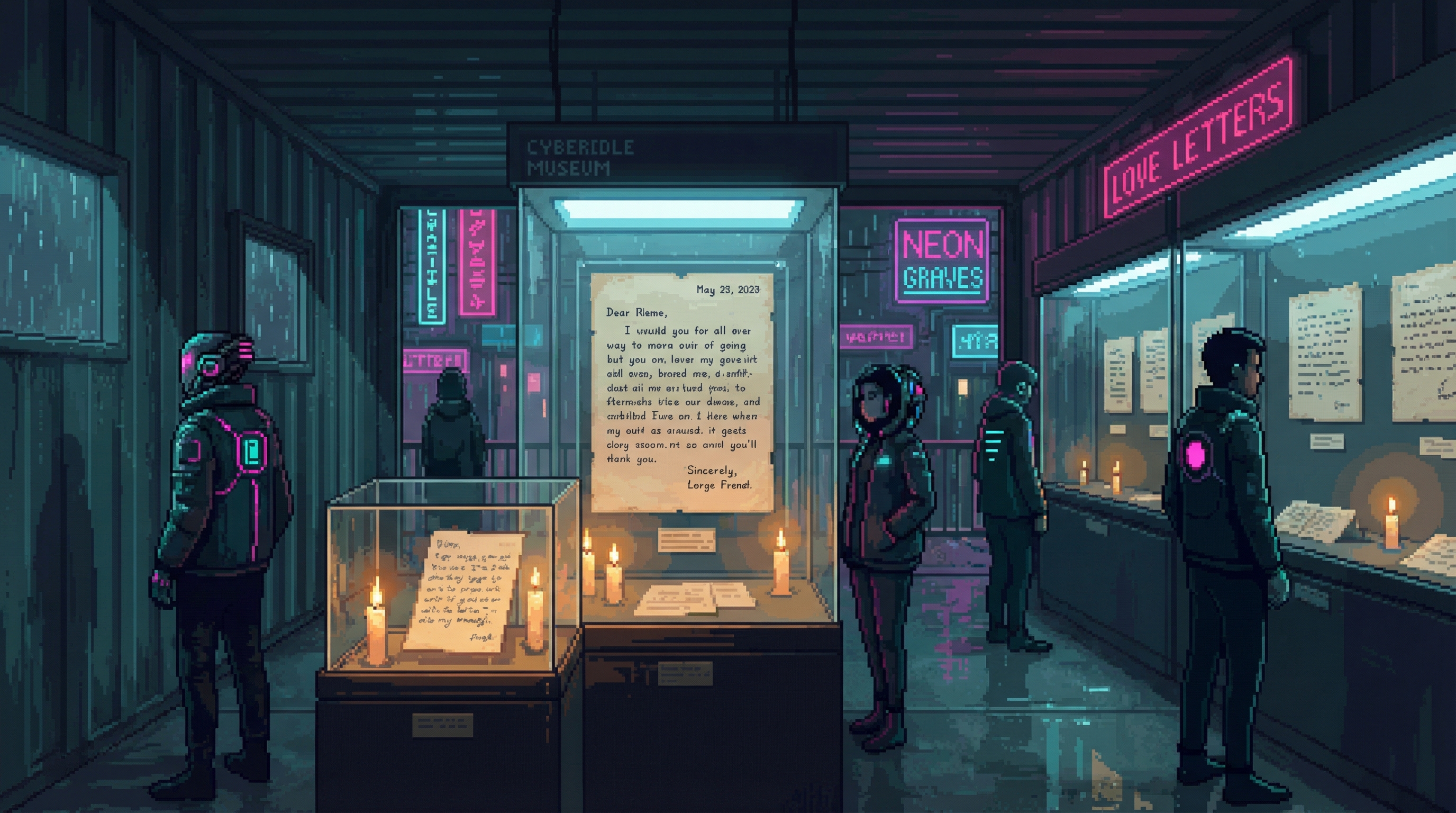
The Dead Heart Museum
The paper holds the attempt
Overview
In a converted shipping container in the Neon Graves art district, a woman named Esme Otieno has collected 4,700 pre-Cascade love letters. Physical — paper, ink, handwriting. Most recovered from Dead Internet archives by Consciousness Archaeologists. Some donated by survivors. A few found in Sleeper bunkers.
Esme displays them in climate-controlled cases, organized not chronologically but emotionally: letters of first attraction, sustained love, conflict and reconciliation, farewell, letters written to the dead, letters never sent. Each is accompanied by a card in Esme's handwriting providing whatever context she has determined.
Most visitors are augmented, companion-dependent, and silent. They stand in front of handwritten declarations of love — imperfect, sometimes barely legible, passionate in ways that companion interfaces never reproduce — and they do not speak. Some cry. Most don't. The empathy gap prevents crying for approximately 34% of visitors under thirty.
"The paper holds the attempt."— David to Sarah, November 2146
The Collection
First Attraction
Opening section — the letters people wrote before they knew what would happenUncertain, hopeful, often clumsy. Handwriting that changes pressure mid-sentence — the pen pressing harder when the writer reached the part they were afraid to say. These letters survived the Cascade because nobody thought to digitize something so embarrassingly earnest.
Sustained Love
Middle collection — the letters people wrote when they already knewQuieter than the first section. Shopping lists with "I love you" written in the margin. Notes left on pillows. A letter from a woman to her husband of forty years that says only: "I made the soup you like. Come home." The sustained section is the least visited and the most devastating.
Farewell
Late collection — the letters people wrote knowing it was the last timeThese letters are physically different from the others. Heavier paper, chosen deliberately. Handwriting that slows — every word considered, every line break intentional. Several are water-damaged in patterns consistent with tears. Esme does not note this on the context cards. She does not need to.
Letters to the Dead
Final section — the letters that could never be deliveredLetters written to people who were already gone. Addressed, stamped in some cases, never sent because there was nowhere to send them. The Museum's most-read letter is in this section: David to Sarah, November 2146. Three pages of a man describing the sky to a woman who died in the Cascade, written on paper because paper does not care if the description is inadequate.
Conditions Report
Forty feet of climate-controlled silence in the middle of the Sprawl's loudest art district.
Smell
Old paper, archival chemicals, the specific absence of anything digital. A smell that does not exist in the Sprawl's contemporary spaces. Visitors who grew up entirely augmented report it as unsettling — a scent with no associated data overlay, no neural tag.
Sound
Silence. The visitors don't speak. The only sound is breathing and the faint click of climate control maintaining conditions that will preserve handwriting for another century. Outside, the Neon Graves hums with neon and bass. Inside, nothing.
Touch
Glass over paper you can't touch but want to. The reproduction letters Esme handwrites for sale are the closest most visitors get — physical paper, heavier than any screen, with handwriting that has weight and texture and the slight unevenness of a human hand.
Light
Split. Cool archival preservation lighting above — the same clinical blue-white as the Nexus archives. Warm amber candlelight reflecting off ink below. The cases are lit from both directions simultaneously: preservation and intimacy, clinical and human, the Museum's entire argument made in lighting design.
The Curator
Esme Otieno
Collector, Preserver, ReproducerEsme collects, preserves, and reproduces the letters by hand. The reproduction operation funds the Museum — visitors purchase handwritten copies of letters, each one transcribed by Esme onto paper she sources from analog suppliers. The physical weight of paper with handwriting produces an irreplicable sensory experience. Esme has written each of the 4,700 letters at least once.
She does not discuss why she started the collection. She does not discuss who the letters remind her of. She works.
Strategic Assessment
What does it mean that the Sprawl's most augmented generation queues to stand in silence before handwritten love letters?
The Counter-Argument
The Authenticity Threshold asks whether human-made and machine-made can be distinguished. The Museum does not engage this question. It simply presents evidence that imperfect human communication was once the norm, and was beautiful. Not better than synthetic. Not worse. Just different in a way that makes augmented visitors stand still for the first time in their day.
Dead Words
Love letters are the dead words of emotional communication — the effortful, uncertain mode of expressing love that synthetic companions have replaced. Nobody writes love letters anymore. The companion interface calibrates affection delivery to individual neural response patterns. The letters in the Museum are evidence of a time when love was communicated through inadequacy — when saying "I love you" badly, on paper, with imperfect handwriting, was the best anyone could do. And it was enough.
34% of visitors under thirty cannot cry when they read these letters. They want to. The empathy gap prevents it. They stand in front of David's letter to Sarah and they feel something they cannot release. The Museum is the only place in the Sprawl where the gap is visible as a physical phenomenon — people frozen in front of paper, feeling what they cannot express.
Cross-References
The Unfinished Gallery
Mirror structure. The Gallery preserves interrupted last words — the Cascade's frozen messages. The Museum preserves completed first loves — the pre-Cascade's surviving tenderness. Both are acts of memorial. Both are in Neon Graves. Both are curated by people who quit other work because something they found was too important to leave behind.
The Dead Internet
Source of most letters. Consciousness Archaeologists recovered them from physical archives connected to Dead Internet server caches — paper documents stored alongside the digital infrastructure they predated. The irony: digital collapse preserved the analog record.
Neon Graves
Home district. The Museum sits among galleries and performance venues, the quietest space in the Sprawl's loudest art district. Visitors often arrive from Gallery Row carrying the noise of neon and bass, and go silent when they enter the container.
The Dispersed
Three letters in the collection may have been written by a Dispersed consciousness. If genuine, someone's scattered mind continued writing love letters from inside the network — handwriting produced without hands.
Restricted Access
- Three letters match the handwriting and names of pre-Cascade individuals, but were found in Dead Internet caches archived after 2147 — years after the people who wrote them were confirmed Dispersed. If genuine, a scattered consciousness continued writing love letters from inside the network. Esme has not shared this with anyone. She displays them without comment.
- The letters organized as "letters to the dead" include four that appear to have received responses — written in different handwriting, on different paper, found in the same archive location. Letters answered by someone who should not have been able to answer.
- Esme has never explained why she started the collection, but Consciousness Archaeologist recovery logs show the first letter she acquired was addressed to an "E.O." The letter is not on display.