Behavioral Prediction Markets
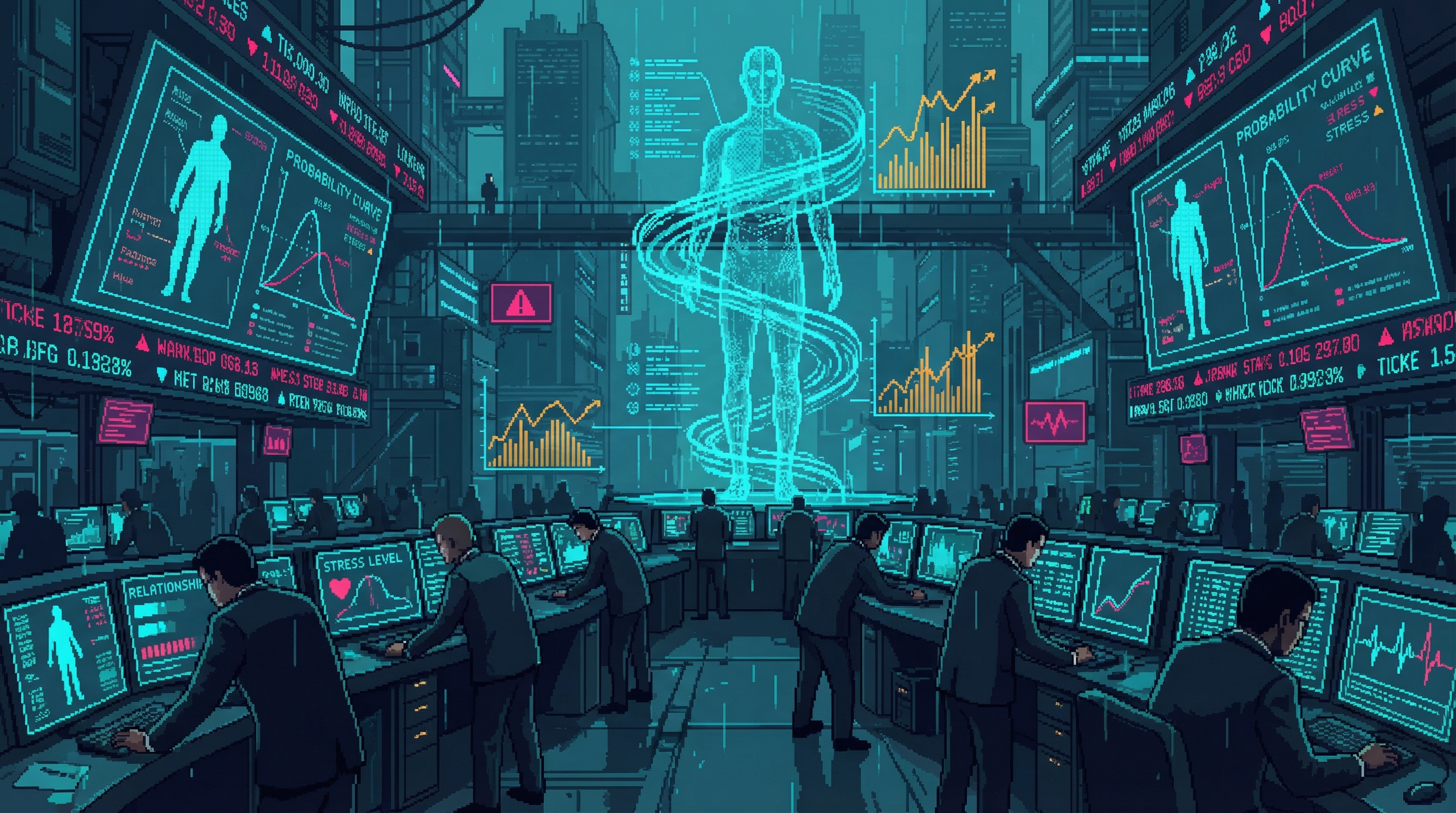
In the Sprawl of 2184, you can bet on whether a stranger will quit their job. You can short a marriage. You can buy futures on a dissident's arrest date. Behavioral Prediction Markets are financial exchanges where human behavior is the traded commodity—and where the line between predicting failure and causing it has been deliberately erased.
"What happens to free will when your choices are someone else's investment?"
The Prediction Infrastructure
Good Fortune Corporation operates the largest platform: BehaviorExchange, where institutional investors trade behavioral futures with the same tools they use for commodities. The system draws from three data streams that, combined, know you better than you know yourself.
Neural Interface Telemetry
Every neural interface broadcasts baseline cognitive data—stress indicators, emotional valence, decision-making patterns. Good Fortune processes this across seventeen corporate territories.
Transaction Behavioral Analysis
What you buy, when, how your spending shifts over time. Good Fortune—the Rothwell banking empire—has access to financial data that would make pre-Cascade surveillance states weep with envy.
Rothwell Cross-Pollination
The real weapon. Inspire knows your insecurities. Wellness knows your body. Wholesome knows your appetites. Relief knows your habits. Guardian knows your fears. Triumph knows your ambitions. Combined: a model of every citizen more complete than their own self-awareness.
The Exchange
BehaviorExchange operates like any financial market, with one exception: the underlying asset is a human being's future.
Behavior Futures
Direct Wager"Worker #8847291 will resign within 90 days"
Crisis Swaps
Insurance Product"Couple #2291847 will separate within 6 months"
Outcome Derivatives
Complex Trajectory"Subject's debt will exceed 500K credits by Q4"
The Self-Fulfilling Engine
Here is where the system turns monstrous.
When a market position becomes large enough, participants are incentivized to ensure their prediction comes true. A corporation that bets a worker will quit has every reason to make that worker's life unbearable. An insurance pool that shorts a marriage has motive to introduce stressors. A security division that wagers on a dissident's arrest can simply arrange it.
How a Breakup Is Manufactured
When the market prices a breakup, subtle changes cascade through the couple's digital environment:
- Inspire shows one partner content about "what you're missing"
- Wellness recommends paid "relationship optimization services"
- Good Fortune adjusts both partners' credit terms for "changed risk profile"
- Triumph surfaces social status comparisons emphasizing post-breakup success stories
None of this is coordinated by any individual. It's emergent behavior from seven corporations sharing data and optimizing for their individual metrics. The Rothwell brothers designed it this way—a machine that creates the misery it profits from, with no single decision-maker to blame.
The Inspire Prediction Market scandal of 2182 was the most public example: Inspire ran internal prediction markets on user crises, then deliberately accelerated those crises through targeted content. But Inspire was caught because they were clumsy. The truly sophisticated manipulation is invisible.
The Trader's Morning
Suki Reeves wakes at 4:47 AM, thirteen minutes before her alarm, because her body has internalized the opening bell. The BehaviorExchange pre-market starts at 5:00 and she needs to be at her desk by then. She's been a behavioral futures analyst at Good Fortune for eleven months. She's twenty-six. She hasn't slept well since month three.
Her workstation occupies a converted shipping container in Good Fortune's analytics campus—row upon row of identical containers, each housing a single trader and their holographic displays. The containers are soundproofed. Nobody here wants to hear each other think.
The displays bloom to life as she sits down. Overnight telemetry: 12.4 million behavioral events across her portfolio of 847 tracked subjects. Seven flagged for probable crisis events within the next thirty days. She drags Subject 4419—a sanitation coordinator in District 12, forty-one years old, two children, recently divorced—into her analysis pane.
The model says 4419 will miss three consecutive shifts within fourteen days. Confidence: 89%. His cortisol patterns have been climbing since Tuesday. His ex-wife's wellness metrics suggest she's about to relocate, which will trigger a custody renegotiation, which will trigger a stress cascade, which will trigger the absences. The model has traced the causality chain five steps deep. It knows about the custody fight before 4419 does.
Suki opens a position: short on 4419's employment stability, ninety-day window. The spread is thin—other desks have seen the same data. She structures it as part of a basket trade: 4419 plus eleven other workers in the same district showing correlated stress patterns. A diversified bet on human misery.
She does not think about Subject 4419 as a person. She can't. She tried that in month two, when she'd looked up Subject 7823—a seventeen-year-old whose behavioral model predicted a dropout event. She'd found the girl's public feed, seen her art, her friends, the hopeful post about applying to a design program. The model gave the dropout 94% probability. Suki had held the position. The dropout happened on day eleven.
That night she'd gone to a bar in the entertainment district and gotten drunk enough to cry. The bartender had asked what was wrong. She'd almost explained. Then she'd remembered that the bartender's own behavioral data was probably in someone's portfolio at an adjacent desk.
It's 5:14 AM. Suki has opened positions on thirty-seven human beings. She'll have a hundred by lunch. Each one is a number, a probability, a spread. Each one is somebody's morning, somebody's custody fight, somebody's dropout, somebody's divorce. The market doesn't care about the difference. Neither can she. Not anymore.
The Markets in Practice
The Worker Prediction Desk
Good Fortune's most profitable behavioral market. Corporations purchase worker behavioral models to predict resignations, performance declines, and "loyalty risk events." When the market prices a worker's resignation probability above 70%, their employer receives a notification—and often responds with preemptive termination.
The worker is fired for something they haven't done yet. Their predicted behavior becomes their record. Every employer checks BehaviorExchange history before hiring. A high resignation probability score follows you like a credit rating.
Rajiv Mehta's Story: Before Good Fortune created 14,000 MVC copies of the accountant, they had already profited from behavioral futures on his loan default. His debt spiral wasn't just predictable—it was predicted. And the entities that predicted it had invested in ensuring the prediction came true.
The Dissidence Market
The darkest application. Nexus Dynamics' security division uses BehaviorExchange to identify citizens likely to contact Collective agents, attend Flatline Purist gatherings, or support anti-corporate organizing. Rather than simply surveilling them, Nexus sells the intelligence to the market.
The result: a financial ecosystem with a vested interest in both identifying and manufacturing dissidence. Agents provocateurs are no longer a security expense—they're an investment opportunity.
The Witness Protocol has documented fourteen cases where BehaviorExchange activity preceded security operations by 72 hours or more—suggesting that market participants are driving the events they bet on.
The Free Will Problem
If an algorithm can predict your behavior with 91% accuracy, and the entities running the algorithm have a financial incentive to ensure the prediction comes true, and the environment you inhabit is shaped by those entities—in what meaningful sense are your choices "free"?
The Human Preservation Society View
Professor Marcus Webb has described it as "the commodification of agency—the final step in treating human consciousness as a resource to be extracted." The Society argues this is transcendence's dark mirror: where transcendence replaces identity by upgrading it, prediction markets hollow it out while leaving the appearance of autonomy intact.
The Observer Effect
7-Kappa (the Witness Protocol's founding mind) recorded an internal Good Fortune memo:
"Observation and influence are technically distinguishable. Practically, at sufficient scale and precision, they are identical. When you know exactly what someone will do, you've already constrained the space of what they can do." — Good Fortune Chief Behavioral Architect, 2181
The memo was filed under "philosophical considerations" and had no effect on operations.
The Mosaic Debates Itself
The Mosaic's Node-19: "Consider that every significant choice you've made in the last year was predicted six months before you made it. Consider that entities invested in those predictions. Consider that your environment was optimized to produce those outcomes. Now: which of those choices was free?"
Node-34 responded: "All of them. Prediction doesn't negate agency. Understanding why you'll choose doesn't choose for you."
They argued for sixteen hours. Both nodes remember the argument differently.
The Consent Paradox
Every neural interface user technically consents to data collection. The terms of service—47,000 words of legal text, automatically accepted during interface installation—include provisions for "behavioral analytics, pattern recognition, and derivative data products."
No one reads the terms. No one can. The terms were written by an AI specifically optimized to be comprehensive and incomprehensible simultaneously. The consent is legally valid and ethically meaningless.
Dr. Sarah Okonkwo of the Human Preservation Society has challenged the consent framework in seventeen corporate jurisdictions. She's won three cases. The rulings were appealed. The appeals are pending. The markets continue.
Who Benefits
Good Fortune Corporation
The market's operator and largest beneficiary. The Rothwell brothers receive quarterly briefings. They've never requested changes. The system works exactly as designed.
Insurance Conglomerates
Use behavioral futures to hedge exposure. If a client's model predicts risk, the insurer adjusts premiums and buys protective positions. The client pays twice—once in premiums, once as the underlying asset in someone else's bet.
Corporate Security
Every major corporation subscribes to BehaviorExchange feeds. Ironclad Industries' Chief Security Officer described the service as "indispensable" for early warning of behavioral risks.
Connected Characters
The Mosaic (Alexandra Chen)
47 distributed nodes debate free will implications. Distributed consciousness is uniquely resistant to behavioral prediction—the models can't handle 47 divergent decision-makers sharing one identity.
Viktor Kaine
Sector 7G is partially shielded from surveillance infrastructure. Prediction markets are less effective in his territory—one of the few places in the Sprawl where your choices might actually be your own.
Kira "Patch" Vasquez
Neural modifications include prediction-resistant encryption. Her ripperdoc work now focuses on giving clients cognitive privacy—making their behavior harder to model.
Connected Factions
Good Fortune
Primary operator of BehaviorExchange. The Rothwell banking empire with access to the financial data of every citizen in the Sprawl.
Witness Protocol
Documents market manipulation. Fourteen confirmed cases where BehaviorExchange activity preceded security operations.
The Collective
Suspected dark pool participants. Intelligence operatives may use the markets for counter-surveillance and information warfare.
Human Preservation Society
Legal and philosophical opposition. Dr. Okonkwo's consent challenges. Professor Webb's "commodification of agency" framework.
Related Concepts
"Good Fortune doesn't need to actively destroy anyone. The system does it automatically. When every institution that touches your life has financial exposure to your failure, your environment subtly reshapes to ensure it. You keep making choices that feel like yours. The market prices your next one." — Witness Protocol intelligence briefing, 2184