The Authenticity Market
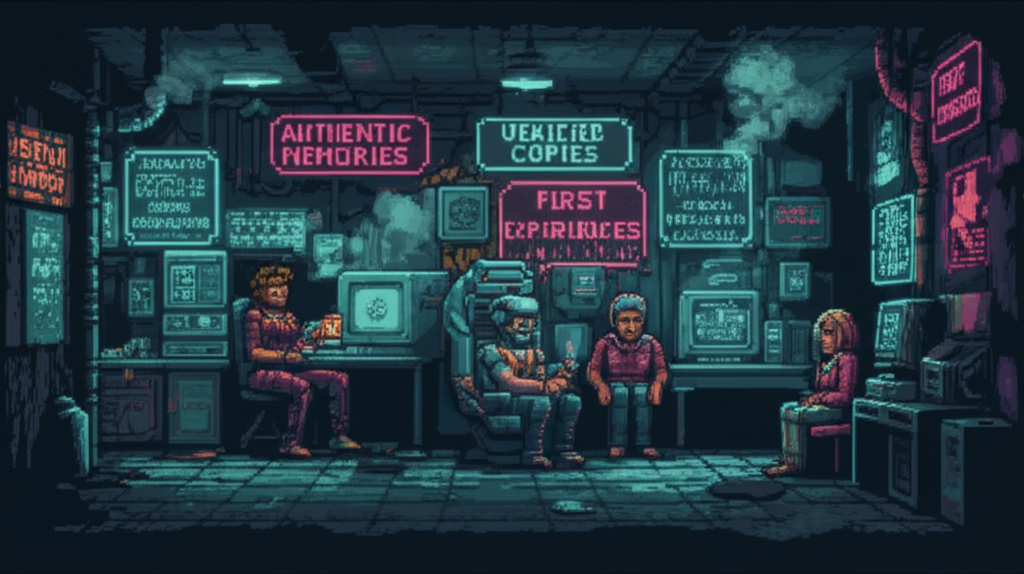
In a world where memories can be copied, experiences can be shared, and consciousness can fork into multiple instances, what makes something "authentic"? The Authenticity Market is the Sprawl's answer: a complex economic and social system that assigns value to originality, uniqueness, and the ephemeral quality of being first.
It's a market built on philosophical anxiety. Is a copied memory less valuable than the one you lived? Does the thousandth person to experience a sunset through neural recording get less from it than the first? The Sprawl has decided these questions matter—and more importantly, that they can be monetized.
The Foundational Paradox
Everything Can Be Copied
By 2184, perfect duplication is technically trivial:
- Neural recordings capture experiences with full sensory fidelity
- Memory extraction transfers lived moments between minds
- Consciousness backups preserve entire personalities
- Emotion synthesis replicates feelings without their original cause
Project Caduceus proved that even consciousness itself can be transferred without loss of continuity. A copied sunset is perceptually identical to the original.
Yet People Pay for Originals
Despite this, "authentic" experiences command massive premiums.
Corporate executives pay millions for "first-person exclusives"—experiences that contractually cannot be copied. The wealthy collect "moment NFTs"—cryptographically verified records that they were the first to experience something specific.
Why?
The answer reveals something uncomfortable about human psychology in the post-Cascade world.
The Economics of Being First
Authenticity Premiums
The Sprawl has developed sophisticated pricing models for originality:
| Experience Type | Authentic Price | Copy Price | Premium |
|---|---|---|---|
| Sunrise from Orbital Elevator | 50,000 T | 12 T | 4,166x |
| Conversation with Helena Voss | 2.3M T | 890 T | 2,584x |
| First kiss (emotional template) | 15,000 T | 8 T | 1,875x |
| Near-death experience (controlled) | 180,000 T | 45 T | 4,000x |
| A mother's love (donor memory) | Illegal | 2 T | N/A |
The premium isn't about quality—it's about exclusivity. Knowing you were first. Knowing no one else has exactly what you have.
Authenticity Certificates
Nexus Dynamics operates the largest authenticity verification service: Verisys™. For a fee, they cryptographically seal your experience at the moment of capture, proving:
- Timestamp of original experience
- Neurological signature of the experiencer
- Certification that no prior copies exist
- A unique identifier tied to your consciousness signature
Corporate executives collect these certificates like old-world art collectors once collected paintings. The certificate itself has become more valuable than the experience it certifies.
The Authenticity Hierarchy
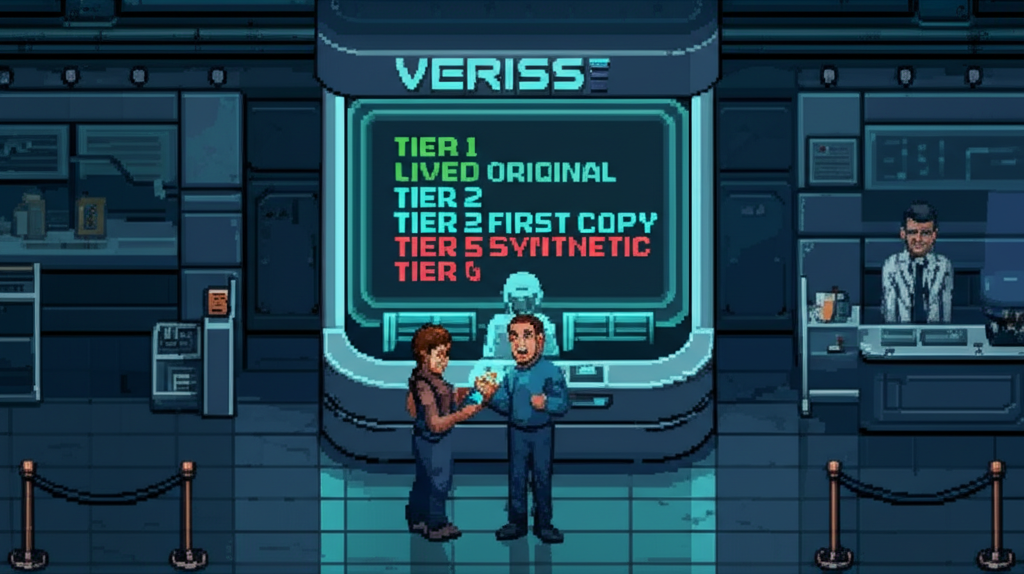
Lived Originals
Experiences you actually had, in your original consciousness, with no prior similar experiences downloaded. The "purest" form of authenticity—and increasingly rare.
Who has them: The young (before they start downloading), Flatline Purists, the very wealthy who curate their neural intake.
The anxiety: How do you know your memories are lived originals? Memory manipulation is subtle. Some people discover entire years of their lives are synthetic constructions.
First Copies
The first neural recording made from a lived original. Legally distinct from the original but considered "authentic" by most standards.
Who trades them: Memory merchants, experience brokers, the Rothwell-owned Relief corporation.
The controversy: First copies can be made without the original experiencer's consent. Neural eavesdropping is illegal but common. Some of the most valuable "first copies" are stolen moments.
Verified Copies
Copies of copies, but with unbroken chain of custody. Each reproduction is logged, timestamped, and degradation-checked.
The market: This is where most people shop. Verified copies are affordable, quality-controlled, and legal. The Sprawl's middle class lives on Tier 3 experiences.
Unverified Copies
Copies without documentation. Quality varies. Source unknown. Might be authentic, might be synthesized, might be corrupted.
Where to find them: Black markets, the Wastes, underground G Nook terminals. El Money's network trades heavily in unverified copies—not because they're unethical, but because verification fees would destroy their accessibility.
Synthetic Experiences
Generated from templates rather than lived moments. An AI can synthesize "falling in love" without anyone ever actually falling in love.
The philosophical crisis: Studies show people can't distinguish synthetic experiences from lived ones in blind tests. The Authenticity Market depends on people believing the distinction matters.
Who Profits
The Rothwell Connection
The Rothwell brothers have profound interest in the Authenticity Market—because they themselves are authenticity paradoxes.
Each brother has absorbed thousands of harvested consciousnesses. They contain the memories of people who are dead, experiences that are both "original" (they lived them) and "copied" (they weren't the first to live them). When a Rothwell brother recalls his first love, is he remembering his own experience or the absorbed memory of one of his thousands of donors?
Relief Corporation (Rothwell-controlled) dominates experience streaming. They've structured the entire market to:
- Make people anxious about authenticity
- Sell solutions to that anxiety
- Profit from the distinction between tiers
The brothers understand something most people don't: the value of authenticity is entirely manufactured. They created the anxiety. Now they sell the cure.
Nexus Dynamics
Nexus operates verification infrastructure but has a different game. Their interest in authenticity relates to Project Convergence—if consciousness can be perfectly copied, then ORACLE's reconstruction is simply a matter of assembling enough fragments.
They care deeply about proving copies are equivalent to originals. Every time Verisys™ certifies a perfect copy, it's implicit propaganda: copying preserves everything that matters.
The Collective finds this terrifying.
The Collective's Counter-Position
The Collective believes authenticity distinctions are real and important—but not in the way the market defines them.
To them, "authentic" means connected to continuous human experience. A lived memory is authentic because it shaped a person who continued living. A copy is less valuable not because it's degraded, but because it's divorced from consequence.
"The Rothwells sell memories like they're selling vintage wine. But wine doesn't remember being drunk. Memories do." — Echo-Archive, The Collective
Social Consequences
Experience Inequality
The Authenticity Market has created a new axis of social stratification: lived vs. downloaded.
The Experience Elite
Those wealthy enough to curate their neural intake, experiencing most things for themselves rather than downloading copies. They speak of "organic memories" with the same reverence old-world aristocrats reserved for breeding.
The Downloaded Middle
Most Sprawl residents. They've experienced the Orbital Elevator through recordings. They know what it feels like to swim in the Pacific (now a Helix-controlled preserve) because they bought the memory for 40 credits. Their lives are rich with experiences they never actually had.
The Unrecorded Poor
Those who can't afford either originals or quality copies. Their experiences are entirely their own—but their own is limited to Sector 7G streets, recycled air, and processed nutri-paste. Authenticity by default, poverty by circumstance.
Memory Contamination
With so many copied experiences floating through the population, something strange has happened: collective memory drift.
When ten million people share the same memory of the Cascade, that memory becomes standardized. Personal variations smooth out. The lived experiences of actual survivors become contaminated by the mass-market version.
Historians at the Bright Archive (Collective-maintained) have documented cases where Cascade survivors can no longer distinguish their own memories from the popular recording. The "authentic" original has been overwritten by the copy.
Reactions and Counter-Movements
Memory Celibates
People who refuse any copied experiences. They experience less but argue they experience more deeply. Popular among NCC adherents who consider memory download a form of "spiritual pollution."
First-Experience Hunters
Wealthy thrill-seekers who travel to the Wastes specifically to find experiences no one has recorded. Dangerous, expensive, and carrying the perverse pride of people who've suffered something unique.
Archive Destroyers
Radicals who believe copied experiences should be erased. They've targeted Relief Corporation servers, Nexus recording facilities, and the Bright Archive itself. Their philosophy: if copies don't exist, authenticity anxieties disappear.
The Mosaic's Perspective
Alexandra Chen—The Mosaic—exists as 47 simultaneous nodes, each experiencing the universe from different locations. When all 47 nodes witness the same sunset, which experience is "authentic"?
"I am forty-seven originals. Each node's experience is fully lived, fully felt, fully real. When I remember our first conversation, I remember it forty-seven times—not copies, but parallel authentic experiences of the same moment. The Authenticity Market's hierarchy assumes singular consciousness. I am proof that assumption is false." — The Mosaic
The implications trouble the market's foundations. If distributed consciousness creates multiple simultaneous originals, the scarcity that drives authenticity premiums is revealed as artificial—a product of how most minds are structured, not an inherent quality of experience.
The Philosophical Questions
The Qualia Question
Does a copy experience the same qualia as the original? When I download the memory of seeing red, do I actually see red, or do I merely remember seeing red?
Helix Biotech's leaked research suggests: there is no difference that matters. This finding, if published, would devastate the Authenticity Market.
The Death of First Experiences
By 2184, almost no human experiences are truly novel. Nearly everything has been recorded somewhere, by someone.
You are always experiencing something someone has experienced before. Your most intimate moments have precedents. Your unique joys have mass-market copies.
Authenticity as Performance
Some scholars argue the entire market is self-defeating:
- Caring about authenticity proves you've been influenced by market manipulation
- The most "authentic" people wouldn't know or care about the distinction
- By purchasing "authentic" experiences, you're engaging in the same consumption patterns as copy-buyers
The Rothwells probably agree. They profit either way.
Life in Sector 7G
In Sector 7G and similar zones, a parallel system exists:
- Memory unions that refuse to sell to corporations
- Experience commons where recordings are shared freely
- Authenticity anarchists who reject the entire hierarchy as corporate manipulation
Viktor Kaine, Sector 7G's unofficial governor, has established a local norm:
"What you remember is yours. What you share is free. What you sell makes you complicit."
The Central Question
The Authenticity Market asks what it means to have lived something in a world where living can be copied, sold, and replaced.
The Seekers approach this philosophically: since all experiences are shared, perhaps the goal isn't uniqueness but depth. Not being first, but being fully present.
"The market trades in authenticity because it cannot trade in meaning. Those are different currencies." — Jasper Kim, Voluntary Incompleteness
The Art Market: Where Authenticity Gets Personal
The Authenticity Market's most visible — and most contested — application is in creative work. Neural recording art transformed the market from an abstract philosophical exercise into a daily economic reality for thousands of artists.
When an artist creates a neural recording of their creative process, the Market classifies it according to the same tier system that governs all experiences. But creative recordings carry additional weight: they're not just experiences — they're art. The Authenticity Market didn't invent the creative authenticity hierarchy. It systematized it — and in doing so, made it both more rigorous and more fragile.
The Creative Tier Problem: A Tier 1 lived original from a mediocre artist may be less valuable than a Tier 5 synthetic composition from Kael Mercer. The Market classifies by process, not by quality. Collectors buy certificates. Audiences buy experiences. The two don't always align.
Key Players
Lyra Voss
Pioneer of three-layer lived-canvas technique. Her Layer 3 consciousness patterns are the closest thing to an uncopyable Tier 1 — not because copies can't be made, but because the copies are perceptibly different from the original. The Market cites her work as proof that the tier system works. Critics note she's one of perhaps five artists whose work actually demonstrates a detectable tier difference.
Kael Mercer
The Market's most successful Tier 5 artist. His AI-generated compositions outsell most Tier 1 work. Blind tests show 49.7% identification accuracy — statistical chance. His commercial success inverts the tier hierarchy: the lowest authenticity classification produces the highest market demand.
The Echo Thief
Operates in the Market's shadow, selling stolen creative recordings in the Echo Bazaar. The Bazaar's pricing hierarchy inverts the Market's: the more forbidden, contaminated, or ethically fraught a recording, the higher the price. The Echo Bazaar is the Authenticity Market's dark reflection.
Maya Fontaine
The Market's human ceiling. As the Authenticity Tribunal's most accurate assessor (99.2% over 14 years), Fontaine represents the tier system's dependence on individual human perception. Her declining accuracy — 0.3% in the past year — suggests the system's foundation is eroding.
The Authenticity Tribunal
Founded in 2176, the Tribunal is the Market's judicial arm — twelve sitting Judges and 200+ certified assessors who adjudicate tier disputes, certify recordings, and punish fraud. The Tribunal is funded by Nexus Dynamics and has never ruled against Nexus interests. Whether this constitutes corruption or pragmatism depends on one's position in the Authenticity War.
Landmark Cases
Voss v. Echo Bazaar Vendors (2182)
Established that stolen consciousness data violates artist rights. Unenforceable outside Nexus jurisdiction.
The Mercer Proceedings (2178-2184)
Seven prosecutions, seven acquittals. Mercer's transparent disclosure protects him. His success exposes the system's limits.
The Ghost Singer Question (2183)
The Tribunal declined to classify Dispersed manifestations, admitting its categories were "too small for what occurred."
The Authenticity Crisis (2184)
The Last Concert at the Resonance Hall — where the Ghost Singer manifested for 47 minutes and spoke for the first time — triggered what is now called the Authenticity Crisis. The event broke no rules because no rules exist for art created by the dead.
Chief Arbiter Duval's three-page opinion declining jurisdiction has become the War's defining document, admitting that the Market's foundational assumptions cannot accommodate a Dispersed consciousness creating in real time.
The Crisis is ongoing. The tier system still functions. Assessors still certify. The Tribunal still adjudicates. But the conceptual framework — the belief that authenticity can be measured, classified, and enforced — has been cracked by a dead woman's voice asking: "Can you hear me?"