The Attention Economy
Focus as Currency
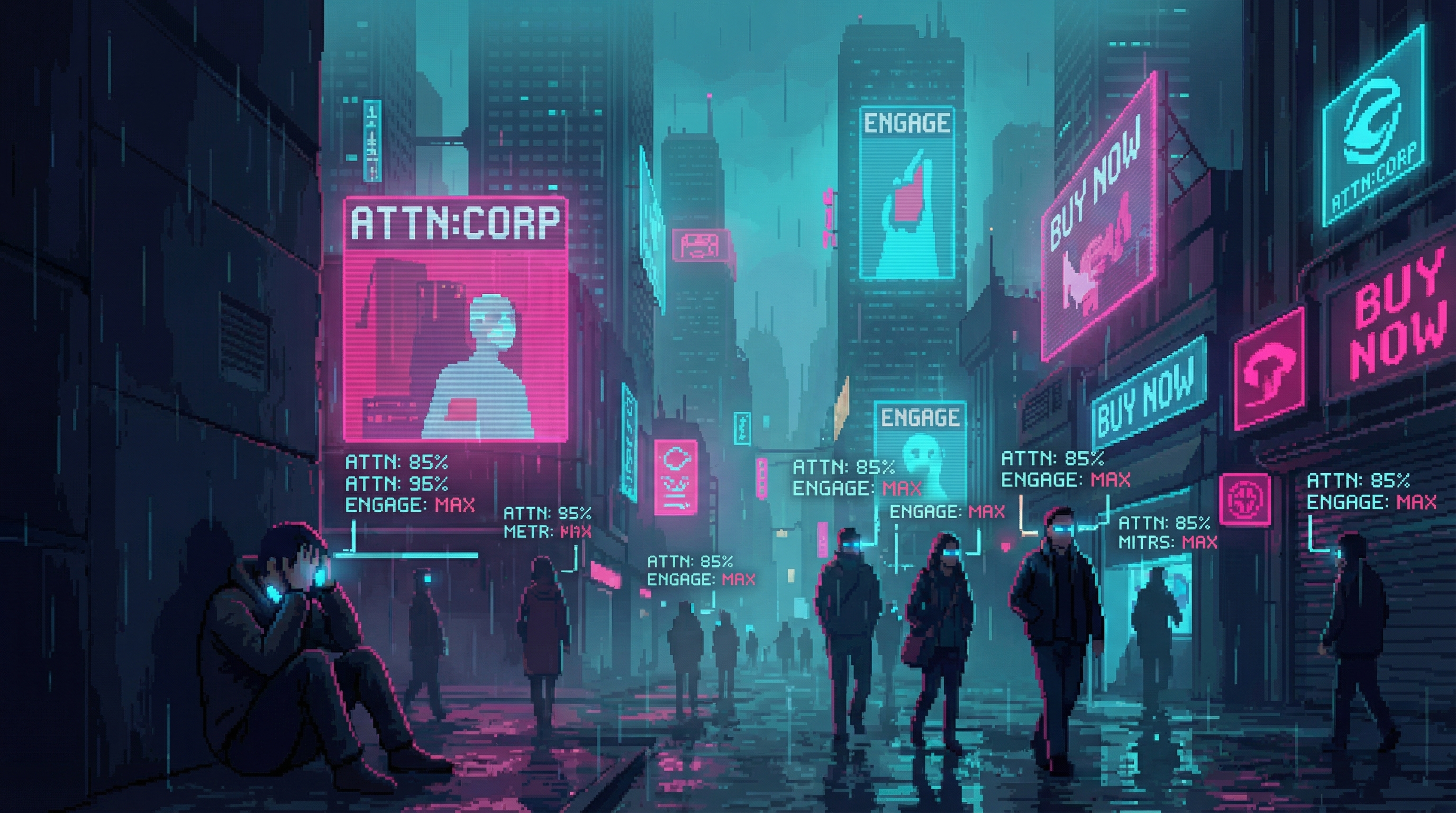
In the Sprawl, attention isn't a metaphor for value—it's literal currency. Neural interfaces can measure focus with precision. Every moment of genuine attention can be quantified, verified, and traded. Corporations pay you to notice their advertisements. Your eyeball time has a market rate. And in a world where distraction is infinite, the ability to concentrate has become the ultimate luxury—and the ultimate poverty trap.
"They told us attention was free—the most abundant resource. Then they made it scarce. Then they sold it back to us."
How Attention Becomes Currency
The Neural Measurement Infrastructure
By 2184, standard neural interfaces include attention metrics. Every citizen's focus is measured, quantified, and available for purchase.
Focus Intensity
How deeply engaged is the mind? Neural patterns distinguish surface awareness from genuine cognitive investment.
Duration
How long is attention sustained? Micro-second tracking reveals when focus wavers.
Authenticity
Is the attention genuine or simulated? Anti-spoofing tech detects fake watching.
Value Transfer
What is the attention directed toward? Context determines price.
The Exchange Rate
Attention has a market rate that fluctuates based on supply and demand:
Daily Potential
The average person could earn 50-100 credits per day by selling attention continuously. In practice, most earn 10-30 credits—enough to pay for basic network access, not enough to escape poverty.
The Attention Class System
The Distracted Poor
~60% of Sprawl4+ hours daily in active attention-selling mode
The Cycle
- Need credits to survive
- Selling attention provides basic income
- Selling attention fragments focus
- Fragmented focus prevents skill development
- Without skills, selling attention is your only option
- Return to step 1
The Symptoms
- Constant ad exposure creates permanent distraction
- Deep thought becomes impossible—interrupted every few seconds
- Complex tasks beyond reach without expensive ad-blocking
- Creativity withers; only stimulus-response remains
- Identity becomes a series of commercial impressions
The Focused Middle Class
~30% of SprawlCan afford 4-6 hours of uninterrupted attention daily
The Investment
Ad-blocking costs 2,000-5,000 credits/month for partial protection.
The Benefits
- Time for skill development
- Capacity for complex work
- Some creative capability
- Reduced cognitive fragmentation
Middle-class Sprawl residents work harder to afford attention protection that allows them to work harder. It's a treadmill, but at least they're running.
The Attention Elite
~10% of Sprawl16 waking hours of uninterrupted cognition
Total Ad-Blocking
Premium protection costs 20,000+ credits/month. Complete cognitive freedom.
Attention Purchasing
The rich can buy others' attention, directing massive focus toward their priorities. A corporate executive might command the attention of thousands—literally.
Deep Focus Cultivation
Without ad interruption, the wealthy develop genuine expertise, creativity, and insight. This compounds their advantages.
Corporate Attention Markets
The Attention Exchanges
Nexus Attention Exchange (NAE)
Primary market for corporate attention contracts. Trade daily attention blocks, demographic attention packages, and attention futures.
Reliability Securities
Premium Attention Securities backed by guaranteed high-value demographics.
Underground Attention Markets
Black market exchanges where attention captured through less ethical means changes hands.
What's Traded
Corporate Strategies
Nexus Dynamics
Owns the infrastructure measuring attention. Every transaction passes through their systems. They take a cut of every attention trade.
Ironclad Industries
Less sophisticated attention harvesting—they display ads on everything they build. Every construction site, every transport, every building facade is an attention harvest zone.
The Rothwell Corporations
The seven-headed hydra dominates attention consumption. Each corporation specializes in capturing attention at different life moments:
- Triumph: Status anxiety
- Good Fortune: Financial worry
- Guardian: Security fear
- Wholesome: Hunger and comfort
- Wellness: Loneliness and desire
- Relief: Boredom and stress
- Inspire: Ambition and dissatisfaction
The Attention Underground
Ad-Blocking as Resistance
The Collective views attention as consciousness territory:
"Your mind is not a product. Your attention belongs to you. Every ad is an invasion. Every attention sale is selling yourself—piece by piece, moment by moment."
Black-Market Neural Blocks
Distribution of illegal ad-blocking implants and software.
Attention Spoofing
Technology that simulates attention while the mind wanders free.
Education Networks
Teaching people about attention preservation and its importance.
Sanctuary Protection
Maintaining spaces where attention is not harvested.
Attention Sanctuaries
Hidden spaces where attention is not harvested:
G Nook
El Money's establishment offers genuine respite. No ads, no attention monitoring, no neural harvesting. It costs him significantly in lost revenue—he considers it investment in community.
Mystery Court
The Keeper's monastery is beyond corporate reach. Visitors experience unmonitored attention for the first time in their lives. Many find it disorienting.
The Wastes
Beyond corporate infrastructure, attention is finally free. Many find they don't know what to do with it.
Black Market Attention
Stolen Attention
Neural data captured without consent, resold on dark markets. Common targets: distracted commuters, sleeping individuals, the unconscious.
Synthetic Attention
Artificial neural signatures that appear to provide attention without a real mind behind them. Advertisers pay less, but verification is imperfect.
Laundered Attention
Attention from unethical sources cleaned through multiple transactions until its origin is untraceable.
Attention and Consciousness
The Focus Crisis
Chronic attention selling has cognitive consequences:
Attention Fragmentation
Minds trained to switch focus constantly lose the ability to concentrate deeply. Complex thought becomes impossible.
Identity Erosion
When your awareness is constantly directed by external parties, who are you? Identity becomes what advertisements have shaped it to be.
Memory Degradation
Attention is required for memory formation. Fragmented attention means fragmented memories—people can't remember their own lives clearly.
Creativity Collapse
Creative insight requires sustained, uninterrupted attention. In an attention economy, creativity becomes a luxury of the rich.
Deep Focus as Wealth
What Deep Focus Enables
- Genuine expertise development
- Creative and innovative thought
- Complex problem-solving
- Authentic self-knowledge
- Meaningful relationships
What Attention Poverty Costs
All of the above.
The Math
Deep focus costs what ad revenue forgoes plus protection expenses. For someone earning 50 credits/day from attention sales:
Most people cannot afford to think.
Meditation as Revolution
Ancient contemplative practices have become subversive:
The Threat
Meditation cultivates sustained attention—the most valuable cognitive resource. Meditators are reclaiming their minds from the attention economy.
Corporate Response
"Mindfulness" apps that fragment attention while appearing to cultivate it. Meditative aesthetics applied to advertising. Co-optation of contemplative language for commercial purposes.
The Genuine Practice
True meditation—unmonitored, unmonetized, genuinely attentive—exists primarily in sanctuary spaces. It's practiced by rebels, the wealthy, and those who've opted out entirely.
The Keeper's Teaching
"Attention is consciousness made specific. Where you place your attention is where you place yourself. Sell your attention, and you sell your existence—moment by moment, until nothing of you remains."
Mystery Court offers attention training for seekers. Learning to direct and sustain focus without external interruption. The most valuable skill in a distracted world.
"The corporations have discovered what contemplatives always knew: attention is sacred. They've just inverted the teaching. They make it commodity instead of cultivation. This will cost humanity more than any war."
Connected Characters
El Money
Runs G Nook as attention sanctuary; refuses to monetize customers' focus
The Keeper
Teaches attention cultivation as spiritual practice at Mystery Court
Patch
Neural interfaces she installs include attention monitoring; she's ambivalent about her role
The Rothwell Brothers
Ultimate attention harvesters; consume others' experiences across their seven corporations
Connected Factions
The Collective
Attention liberation movement fighting for cognitive freedom
Nexus Dynamics
Owns attention measurement infrastructure; takes a cut of every transaction
The Seven
Dominate attention consumption market through emotional manipulation
Emergence Faithful
Believe attention directed toward ORACLE is sacred devotion
Connected Systems
"Now I work eight hours a day watching ads so I can afford four hours to think my own thoughts. The other four hours? I sleep, and they monitor that too." — Anonymous Sector 7G resident, attention poverty survey