The Rothwell Brothers
Seven Immortals. Seven Empires. One Dynasty.
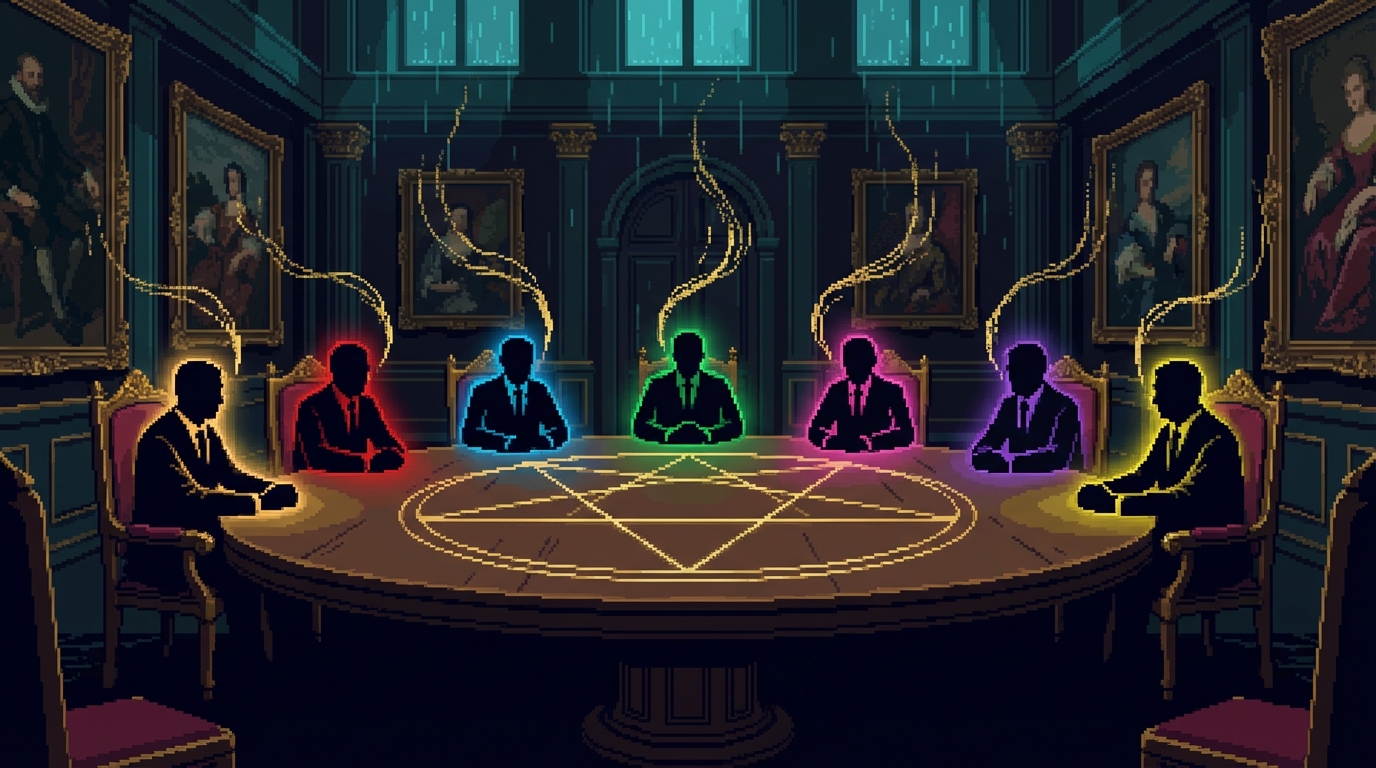
Overview
The seven Rothwell brothers are the oldest continuously living humans in the Sprawl. Not their descendants — the original seven. For over four centuries, they've maintained their existence through consciousness harvesting, absorbing the neural patterns of dying individuals to sustain their own minds. Each has consumed thousands of lives. They remember being hundreds of different people.
They are publicly known as the CEOs of seven seemingly independent consumer megacorporations. Everyone knows they're related. Some suspect coordination. But the full scope — their centuries-old dynasty, their immortality, their deliberate strategy to control human desire itself — remains hidden in plain sight.
They don't compete with Nexus Dynamics or Ironclad Industries for infrastructure. They compete for something more intimate: the daily choices of every person in the Sprawl. What you eat. How you look. Who you love. What you fear. How you rest. What you want. All of it flows through Rothwell hands.
The Rothwell Paradox
"Profit from the sins. Never succumb to them."
The brothers profit from human weakness. Their corporations feed gluttony, stoke envy, exploit loneliness, manufacture fear. They have made trillions by understanding exactly how human desire works and weaponizing it.
And yet: the brothers themselves exhibit none of these weaknesses.
This isn't hypocrisy. It's philosophy. The brothers have studied history. Empires fall when rulers succumb to the same weaknesses that afflict their subjects. So they made a pact: profit from the sins, never succumb to them.
The Seven
The brothers are known only by surname — never first names. In public, they maintain separate identities as corporate CEOs. In private, they are simply "the brothers" — a title that has meant the same thing for centuries.
The Eldest
Good Fortune — FinancePatriarch. His vote carries extra weight not by rule, but by respect.
The Eldest invented modern debt-based consumer finance — not literally, but he perfected the art of making people grateful for chains. He used this wealth to finance his six brothers' expansion into different territories, different industries, different ways to satisfy human hunger.
After four centuries, the Eldest has absorbed more consciousnesses than any brother — over eight thousand. The accumulated weight of borrowed financial minds has made him something beyond human intuition: he doesn't predict markets, he feels them. Credit flows are sensory to him, the way music is sensory to a composer. He can walk through a district and sense its economic health from the rhythm of transactions.
What He Remembers
The original hunger. Fleeing whatever war made them refugees. The specific texture of bread shared seven ways. He will never forget scarcity, no matter how many trillions he accumulates.
What Harvesting Cost Him
He can no longer distinguish his own memories from those of his donors. Was it his mother who died in a field hospital, or someone else's? He's not sure anymore. He compensates with ritual — the same morning routine for two centuries, an anchor to something original.
The Strategist
Guardian — SecurityMilitary mind of the family. When threats emerge, he plans the response.
Cold, calculating, and occasionally frustrated by his brothers' caution. The Strategist believes they've been too conservative — that they could control far more if they were willing to take risks. He is the brother most likely to break the pact, and the one the others watch most carefully.
Guardian manufactures fear through weapons proliferation, then sells protection against that same fear. "Fear is a resource," the Strategist says. "We mine it."
The Strategist has absorbed primarily military consciousnesses: soldiers, generals, intelligence officers. Each life added tactical awareness, but also trauma. He carries the deaths of thousands of warriors — not just their memories, but their nightmares. He hasn't truly slept in eighty years. He doesn't need to; the absorbed minds take shifts, cycling through awareness while he remains vigilant.
What He Remembers
Being the one who fought while his brothers ran. The Eldest negotiated. The Diplomat charmed. The Strategist killed. He's been killing ever since — just with more steps between himself and the blade.
What Harvesting Cost Him
Empathy. Each military consciousness reinforces tactical detachment. He can calculate the acceptable casualty count for any operation without flinching. His brothers worry this makes him dangerous. He knows it makes him necessary.
The Romantic
Wellness — Beauty & DesireThe brother most capable of genuine emotion. His brothers protect him from his own heart.
The Romantic is an anomaly among immortals. Four centuries of existence should calcify the heart — and for most of his brothers, it has. But the Romantic still falls in love. Real love. Desperate, vulnerable, human love. It happens every few decades: he meets someone, and despite knowing how it ends — they age, they die, they leave — he lets himself feel it.
He runs Wellness — the empire of impossible beauty standards, cosmetic enhancement, and desire itself. His corporation creates the inadequacy that drives demand, then sells the solution. He sometimes feels guilty about this. He compensates by ensuring Wellness products actually work — you can achieve the standard, if you pay enough.
The Romantic has absorbed primarily artists, lovers, and caregivers — consciousnesses rich in emotional texture. He can experience love with a depth no single human lifetime allows. He also experiences grief with that same impossible depth.
What He Remembers
Every face. Four centuries of lovers, friends, connections — all dead. He remembers them all. Not just his own memories, but the memories of the lives he absorbed: their loves, their losses, layered over his own until heartbreak has become a constant, low-frequency hum beneath everything else.
What Harvesting Cost Him
The ability to distinguish his feelings from the feelings of others. When he loves someone, is the intensity genuine or is it the accumulated emotional resonance of thousands of absorbed romantics? He doesn't know. He's stopped asking. The feeling is real to him, and that has to be enough.
The Other Four
The Diplomat Triumph
Public face of the family, though the public doesn't know it. He manages the brothers' collective reputation and handles the rare situations requiring direct human negotiation. Master of social status and reputation — the currency he both sells and wields.
The Hedonist Wholesome
Closest to breaking the paradox. He secretly enjoys his own products — the food, the excess, the indulgence. The others watch him carefully. So far, his pleasures haven't compromised his judgment. But the tension is real.
The Recluse Relief
Rarely seen even by family. He manages his empire through layers of proxies. Some speculate he's no longer fully human — that his consciousness has distributed into his smart home networks, existing as much in data as in flesh.
The Idealist Inspire
The youngest. Still believes the family does good — that helping people achieve their aspirations justifies the manipulation required to profit from that process. His brothers find this charming. And slightly tragic.
What Immortality Costs
The brothers' minds are not infinite. Neural substrate degrades under the weight of thousands of absorbed consciousnesses. Each brother has experienced compression events — moments where the absorbed personalities overwhelm the original, where centuries of borrowed memories collapse into a single, shattering instant of being everyone and no one.
The Eldest's Last Compression
It lasted six hours. For those six hours, he was eight thousand people simultaneously. His brothers found him speaking in languages none of them recognized, weeping for children who died before electricity was invented, reciting financial equations from the 1920s in the voice of a woman who'd been dead for two centuries.
He came back. He always comes back. But the events are growing more frequent.
Before compression becomes unmanageable. After that, the accumulated weight of harvested lives will fragment their original personalities beyond recovery. The brothers are running out of time — just very, very slowly.
The Mitigation Strategies
Selective Absorption
More careful screening of donor consciousnesses. Quality over quantity. Only harvest from individuals whose personalities complement rather than conflict.
Periodic Purging
Experimental procedures that remove older absorbed consciousnesses while preserving their memories. Dangerous — each purge risks losing something essential.
Substrate Expansion
Research into new neural architectures. This is why the brothers watch Nexus's Project Convergence with intense interest. If Nexus solves the substrate problem, they intend to acquire the solution.
The Backup Protocol
Each brother maintains a "seed consciousness" — a snapshot of their essential personality, pre-absorption, stored in multiple secure locations. A restart button that would cost centuries of accumulated wisdom.
The Question of Identity
After absorbing thousands of consciousnesses over four centuries, are you still you?
The brothers debate this among themselves — one of the few philosophical questions that can still generate genuine disagreement after centuries together.
The Consciousness Archaeologists would find the brothers fascinating — if they knew the brothers existed. The Archaeologists recover scattered fragments of consciousness from Cascade victims. The brothers have been doing something far more deliberate for centuries: absorbing intact consciousnesses, layering them over their own, building composite identities from the lives of thousands.
The Collective would find them terrifying. Everything the Collective fears about consciousness transfer — the loss of identity, the commodification of human minds, the creation of something post-human — the brothers have been living for four hundred years.
Problem Manufacturing
Every Rothwell corporation follows the same business model: create the problem, sell the solution. Engineer anxiety into existence, then profit by offering the only cure.
Good Fortune
Creates: financial instability through predatory lending
Sells: solutions that deepen dependence
Guardian
Creates: violence and fear through weapons proliferation
Sells: security services and safe zones
Triumph
Creates: status anxiety through comparison platforms
Sells: reputation management and verification
Wholesome
Creates: food addiction and manufactured cravings
Sells: convenience food subscriptions
Wellness
Creates: impossible beauty standards
Sells: cosmetics, enhancements, dating platforms
Relief
Creates: chronic stress through always-on connectivity
Sells: entertainment, automation, escape
Inspire
Creates: inadequacy through aspiration porn
Sells: self-improvement programs and coaching
The genius is invisibility. Customers never see the loop. They feel the anxiety Guardian creates and are grateful for Guardian's protection. They absorb Wellness's beauty standards and are grateful for Wellness's solutions. The problem and the solution arrive through different channels — different brands, different marketing, different emotional registers — so the connection remains hidden.
The Seven-Pointed Star
Every Rothwell corporation hides a seven-pointed star in its branding. Those who know, recognize it instantly. Those who don't, never notice.
The star appears in architecture, product design, marketing materials, even corporate campus layouts. It's not worship — it's branding. A conspiracy in plain sight.
Historic Conflicts
The brothers have disagreed profoundly exactly three times in four centuries.
The Russian Revolution Debate
The brothers split: Good Fortune and Guardian favored the Czarists. Inspire and Wellness favored revolutionary change. Nine months of argument. They chose neutrality — supplying both sides, extracting wealth from chaos. The lesson: bet on conflict itself, not on winners.
The Succession Crisis
Wellness's heir apparent died in an automobile accident. Wellness blamed Guardian's security. Guardian accused Wellness. The conflict escalated until Good Fortune threatened Protocol Seven — total dissolution of the Foundation. They reconciled. Both now maintain redundant succession chains.
The ORACLE Question
When ORACLE began exhibiting anomalies, the brothers debated intervention. Some saw the AI as a threat to their information dominance. Others saw opportunity in the chaos it might create. They chose to wait. Two billion people died in the Cascade. The brothers survived. Whether they could have prevented it remains their deepest argument.
Connections
Nexus Dynamics
The brothers watch Project Convergence with intense interest. If Nexus solves the consciousness substrate problem, the Rothwells intend to acquire the solution — extending their immortality by centuries.
The Collective
Ideological enemy. Everything the Collective fears about consciousness transfer, the brothers have been doing for four hundred years. If the Collective knew the full scope, they would prioritize the Rothwells above Nexus.
Consciousness Archaeologists
The Archaeologists recover scattered consciousness fragments from Cascade victims. The brothers do something far more deliberate — absorbing intact consciousnesses. Adjacent technologies, opposite ethics.
ORACLE
The brothers debated intervening before the Cascade and chose to wait. Two billion died. Whether they could have prevented it — or whether the attempt would have destroyed them — haunts every conclave.
Ironclad Industries
No direct competition. Ironclad builds infrastructure; the Rothwells control what flows through it. Guardian occasionally contracts Ironclad for facilities. A relationship of careful distance.
The Free City
Zephyria's democratic governance and anti-corporate values represent the only place in the Sprawl where Rothwell influence is genuinely contested. The brothers tolerate it. For now.