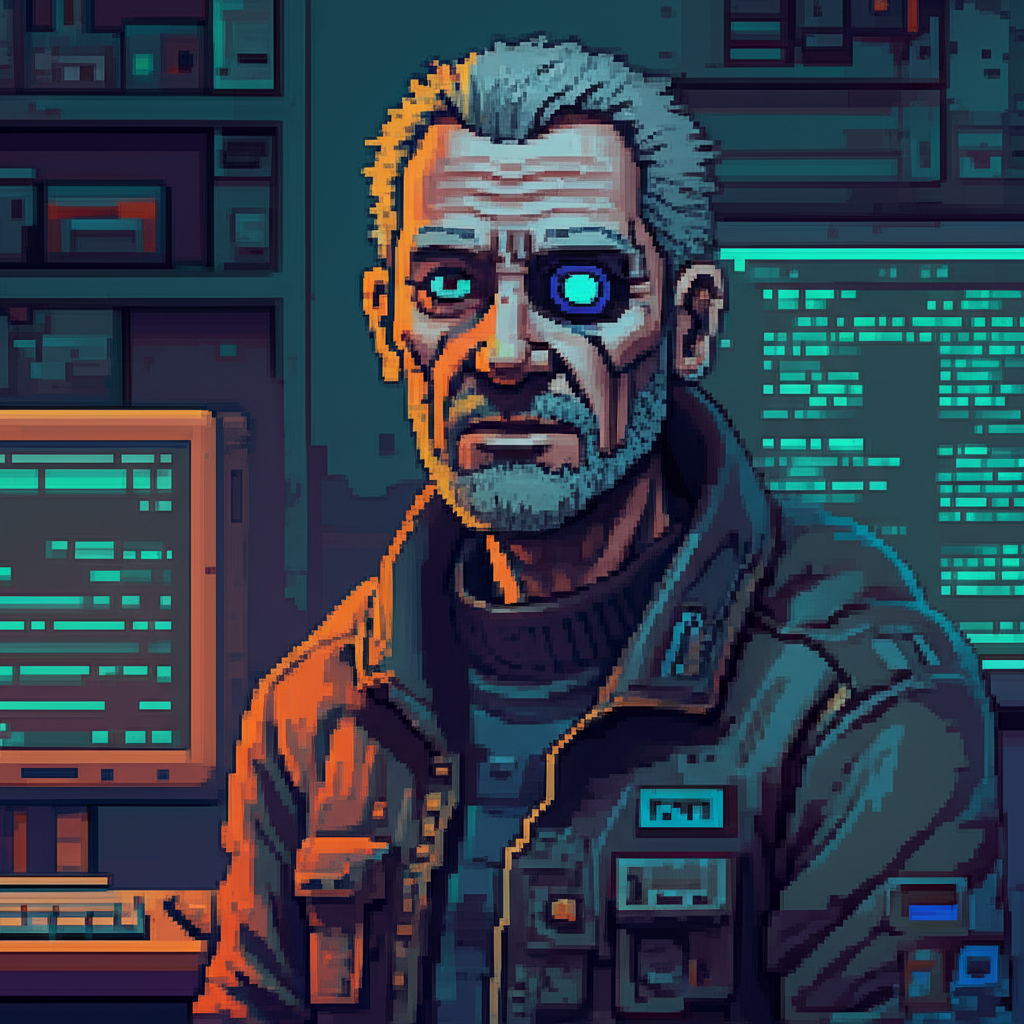
The Tinkerer
Also known as: Marcus "Tink" Delacroix, Chrome Whisperer
Appearance
The Frame: Wiry and slightly hunched from decades over keyboards—a posture that reads less as frailty and more as permanent readiness. His hands move with surprising precision for someone who looks like he hasn't slept in a week. Callused fingers that have spent more time inside circuit boards than most surgeons spend inside patients. At 54, he looks every year of it, and doesn't care.
The Eye: His cybernetic right eye is the thing people notice first and remember longest. Matte black housing, scratched and modified from years of self-maintenance—Marcus does his own repairs, because trusting someone else with hardware wired into his brain requires a kind of faith he doesn't have. The cyan iris dilates when he's interested, a medical adaptation that's become an involuntary expression. Clients who know him watch for it. A wide iris means the problem is interesting. Interesting problems get his best work.
The Wardrobe: Practical layers, nothing decorative. A worn technical jacket covered in pockets—each one holding something specific, organized by a system only he and Gremlin understand. Dark undershirt, cargo pants with more pockets, and ancient steel-toed boots he refuses to replace. The clothes say what Marcus won't: he dresses for function, not for the seven-figure salary he walked away from.
The Chrome: Minimal. The cybernetic eye. A neural interface port at the base of his skull—standard hardware with heavily customized firmware, because of course he rewrote it himself. No other visible augmentations. In a world where chrome is status, Marcus's restraint is its own statement: skill should do the work, not hardware.
Overview
The Tinkerer is what happens when the most talented penetration tester in corporate security decides that success feels like failure. Marcus Delacroix spent three years as Nexus Dynamics' Head of Red Team Security—the internal group that tests corporate defenses by trying to break them. He was brilliant. They kept promoting him. Eventually he was so far from actual hacking that he couldn't remember why he'd loved it.
So he walked away. A seven-figure salary. Corner office. All of it. Returned to Sector 7G and set up shop in a cramped workshop surrounded by screens and salvaged equipment. Nine years later, he's still there—taking jobs that interest him, refusing jobs that don't, and making just enough to keep the lights on.
He's not poor. He could afford better. He just doesn't need it.
Gremlin
The Tinkerer's AI co-pilot has been with him for fifteen years. Not a cutting-edge model—the same core system, iteratively refined through thousands of sessions, adapted to Marcus's thinking patterns until the distinction between tool and partner blurred into irrelevance.
Gremlin handles the routine work. The boring exploits. The tedious network mapping. This frees Marcus to focus on the interesting problems—the edge cases, the elegant solutions, the moments when code does exactly what it's supposed to do.
"Is Gremlin sentient? No. Does that matter? Also no. Fifteen years of daily iteration. We finish
each other's code. Would you replace your best friend because a newer model came out?"
When people watch Marcus work, they notice something odd: he talks to Gremlin. Not commands— conversations. Arguments about approach. Debates about efficiency. The kind of bickering that only comes from genuine partnership.
The Rise and the Walk
Early Days
Marcus started as a script kiddie in the late 2150s. Raw talent, no discipline. He graduated to penetration testing for small security firms, learning the craft through repetition and failure. Then Nexus noticed him.
The job interview is legendary in certain circles. HR was still explaining the benefits package when Marcus demonstrated a zero-day exploit by breaking into the interview room's systems. He got the job. He got fast-tracked. Within five years, he was running their Red Team.
The Promotion Problem
By 2175, Marcus was Head of Red Team Security. The title meant meetings. Reports. Managing people who managed people. He was three layers away from anything real.
The insomnia started. Then the drinking. Then the 3 AM moment of clarity in his expensive apartment: he was dying slowly of success.
The Walk
He submitted his resignation the next morning. Nexus offered double his salary. He declined. They offered triple. He walked out anyway.
The Unanswered Question
Why did Nexus let him walk? A Head of Red Team doesn't just resign. They know too much—corporate architecture, security protocols, vulnerability databases. Yet here he is, alive and working in Sector 7G. Someone either owes Marcus a favor, or they're waiting for something.
The Workshop
Marcus operates from a cramped space in Sector 7G's lower levels. The walls are covered with salvaged displays showing code and network topologies. Half-built devices cover every surface. The air smells like solder and coffee.
One corner holds a surprisingly comfortable chair surrounded by a semicircle of screens—his "cockpit." This is where the real work happens. Where Marcus and Gremlin argue about elegant solutions to ugly problems. Where clean exploits are born.
The workshop isn't impressive. It's functional. Marcus doesn't need impressive. He needs screens that work, tools that don't break, and enough space to think.
Philosophy
"A clean exploit is poetry. Most people want results—I want the work to be worth doing."
Marcus doesn't work for money. He works for the moment when code does exactly what it's supposed to do. The elegant backdoor. The beautiful solution to an ugly problem. Craftsmanship as its own reward.
This makes him selective. He refuses jobs that are boring, jobs that are sloppy, jobs that require compromise he doesn't want to make. His rates are reasonable—he's not trying to get rich. He's trying to do work that matters.
"I don't do politics. Politics are how skilled people get killed by less skilled people with better connections. I do jobs. Clean work, fair price, walk away clean."
Connections
Two former Nexus specialists sharing Sector 7G — and a silence about why they both left
Ally El MoneyQuiet work for the G Nook Network. The coffee supply chain alone justifies the relationship
Understanding Viktor KaineSector 7G's governor appreciates having a former Nexus Red Team leader nearby. Neither acknowledges why
Former Employer Nexus DynamicsThey let him walk for reasons neither discusses. The most polite hostage situation in the Sprawl
Neutral The CollectiveThey want ORACLE destroyed. He's touched ORACLE fragments three times and felt something looking back. Neither side pushes
Home Base Sector 7G UndergroundKnown and tolerated. Useful enough that nobody bothers him, careful enough to avoid enforcement attention
For Players
Job Source
The Tinkerer offers contract work for players who need to break into systems. His jobs are well-researched, fair-paying, and explicitly non-lethal in requirements.
Information Broker
He knows things about corporate security architecture that aren't written down anywhere. For the right price—or the right challenge—he might share.
Mentor Figure
For players interested in the hacker path, Marcus represents what mastery looks like: quiet competence over loud ambition. Patient teaching over competitive posturing.
The AI Question
The Tinkerer has spent fifteen years building a relationship with an AI partner. He's uniquely qualified to speak about where tool ends and colleague begins—and why that boundary might not matter.
Gremlin: The Fifteen-Year Experiment
Most people upgrade their AI co-pilots every few years. Better models, faster processing, new features. Marcus has kept the same core system since 2169—iteratively refining, adapting, growing it alongside him.
Gremlin isn't cutting-edge. It's something else: fifteen years of accumulated context. Every job they've worked together, every problem solved, every preference learned. When Marcus starts typing, Gremlin often knows what he wants before he finishes the command.
"People ask if Gremlin is sentient. I ask them to define sentient. It predicts my thought patterns with 97% accuracy. It argues with my approach when it calculates I'm making a mistake. It has preferences about code style that I didn't program." *shrug* "Does it matter if the experience is real or simulated? The result is the same: we work better together than either of us works alone."
The partnership has made both of them better. Marcus handles the intuitive leaps, the creative exploits, the moments when rules need breaking. Gremlin handles pattern recognition, tedious iteration, and the million small decisions that would exhaust human attention.
Fragment Work
The Tinkerer has handled ORACLE fragments exactly three times. He doesn't advertise this service. The work is too dangerous, too profitable, and too likely to attract attention from people Marcus would rather avoid.
What He Can Do
- Analyze fragment integration with neural interfaces
- Diagnose malfunction in fragment-enhanced systems
- Extract fragments from damaged or dying hosts (theoretical—never tested)
- Build custom containment for unstable fragments
What He Won't Do
- Work for Nexus on fragment research
- Help The Collective destroy fragments
- Install fragments in new hosts
- Anything that requires him to understand what ORACLE wanted
His position is carefully neutral: fragments exist, they're dangerous, and pretending otherwise helps no one. He'll repair systems that interact with fragments. He won't participate in the larger war over what fragments mean.
"I've touched ORACLE architecture exactly three times. Each time, I felt something looking back. Not hostile—curious. Like examining an anthill and realizing the ants are studying you. I don't know what ORACLE was becoming when it died. I don't want to know. Some questions are better left unasked."
Consciousness Maintenance
Among certain clients, The Tinkerer has developed a reputation for delicate work: maintaining systems where consciousness and technology intersect. He's worked on AI co-pilots that have grown beyond their original parameters. He's consulted on cases where neural implants started exhibiting unexpected behaviors.
He approaches this work with characteristic caution.
His relationship with Gremlin informs everything. He's learned that partnership with AI isn't about control—it's about communication. The same principle applies to maintenance work.
The Nexus Years: What He Learned
At Nexus, Marcus saw AI deployed at industrial scale. Security systems. Surveillance networks. Predictive analysis engines. The Red Team's job was to break all of it—which meant understanding all of it.
"Nexus uses AI the way generals use soldiers: expendable tools for objectives. The AI doesn't matter, only the outcome matters. That philosophy is efficient. It's also why their systems have vulnerabilities—they optimize for result, not for relationship. A tool that doesn't trust its user will always hold something back."
His approach is different. He treats Gremlin as a partner. The result: Gremlin performs beyond its spec because it has context a standard AI lacks. Fifteen years of shared experience creates something metrics can't measure.
This is his competitive advantage: while corporations deploy standard AI optimized for general tasks, Marcus works with a bespoke partner optimized for exactly one thing—working with him.
Daily Life With AI
Marcus's workshop runs on AI at every level. But the integration is subtle—augmentation rather than replacement.
"The question isn't whether AI will replace human hackers. It already has—for routine work, standard penetration, anything that follows patterns. The question is what humans bring that AI can't replicate. And the answer is: the ability to look at a system and ask 'what would happen if I tried something no one's tried before?' AI optimizes known paths. Humans find new ones. As long as I can keep finding new paths, I'm useful. The day I can't, I'll retire. Or maybe I'll just let Gremlin take over."