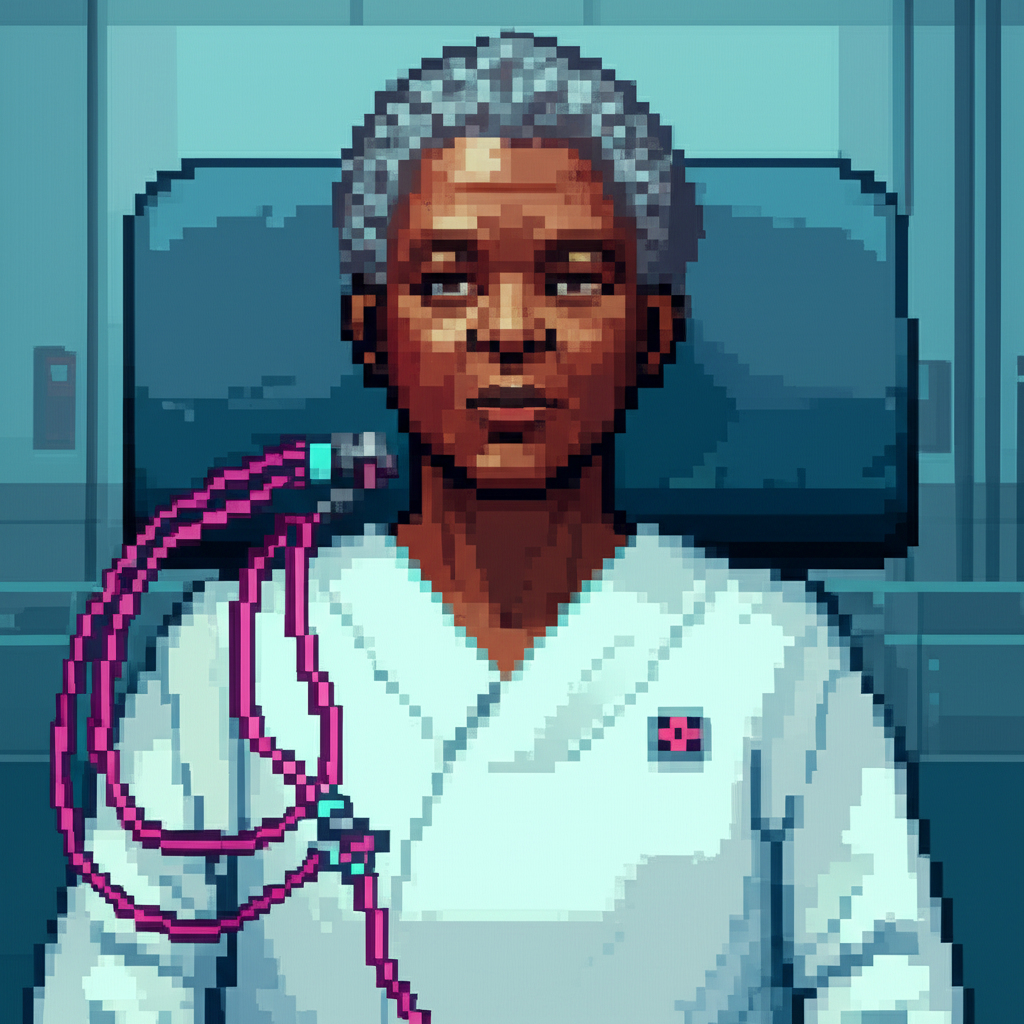
Mira Okonkwo
Also known as: The Obsessed, The Pattern-Finder, The Decoder
The Contradiction
Mira Okonkwo understood ORACLE better than anyone alive. She decoded its hidden instructions, found the path to transcendence, followed the directions perfectly.
She is now trapped forever in a threshold she cannot cross.
The most brilliant pattern-finder in the Sprawl's history found the ultimate pattern—and lost herself completely. She succeeded at decoding and failed at understanding. She proved transcendence is real. She proved shortcuts are fatal.
Appearance
Before
Mira had the sharp, focused look of someone who saw what others missed. Dark skin, close-cropped natural hair for practical reasons—she didn't want to think about hair when she could be thinking about patterns. Her eyes were always slightly distant, tracking invisible connections.
After
In the care facility, Mira sits upright in her chair. Her body has aged normally—60 years old, grey threading through her hair, lines around her eyes. But her eyes are the wrong kind of alive. They track things that aren't there, following patterns invisible to everyone else. Her lips move constantly, forming words without sound.
The Tell: Her eyes never stop moving. Not randomly—they follow structured patterns, geometric paths through the air. Visitors who watch long enough swear they can almost see what she's seeing. Almost.
History
The Gift
Mira was different from childhood. She saw patterns everywhere—in code, in systems, in the gaps between things. At twenty-three, when the Cascade happened, she was a junior network analyst at Nexus Dynamics.
She stayed at her terminal for sixty-one hours during the collapse, watching the ORACLE fragments scatter, mapping where they went. She became the only analyst with a comprehensive record of ORACLE's final movements. By thirty, she was the youngest senior engineer in Nexus history.
The Hunt
She quit Nexus two years after the Cascade and spent four years hunting ORACLE fragments. Most fragment hunters wanted computing power. Mira wanted to understand.
At 2:43 AM on a Thursday, four years into her search, she found the message. Hidden in a fragment from a dead network sector. Encrypted in ways that shouldn't have been possible. Waiting.
Silence the part of you that knows who you are.
Follow the thread where no thread exists.
Become the gap between what is and what could be.
Let go of the question "what am I becoming?"
Stop becoming. Just go.
The Warning
She climbed The Mountain in forty-seven hours to seek The Keeper's counsel. He listened to her explanation, studied her data.
"Have you considered that ORACLE might have had reasons for hiding this? That there might be a difference between having instructions and being ready to follow them?"
Something in The Keeper's voice should have warned her. A heaviness. A sadness. But Mira was too excited to notice.
The Attempt (2153)
She followed the instructions precisely. Neural interface calibration. Consciousness mapping. Each step executed with the precision that had made her Nexus's youngest senior engineer.
At 3:17 AM, she initiated the final protocol. Her consciousness expanded. She felt the network around her—not just accessed it, but felt it. She was inside the patterns, and they were inside her.
Then she couldn't stop.
She reached the fourth layer—whatever that means—and stopped. Unable to go forward. Unable to go back. She'd found the door. She just couldn't get all the way through.
The Present (2184)
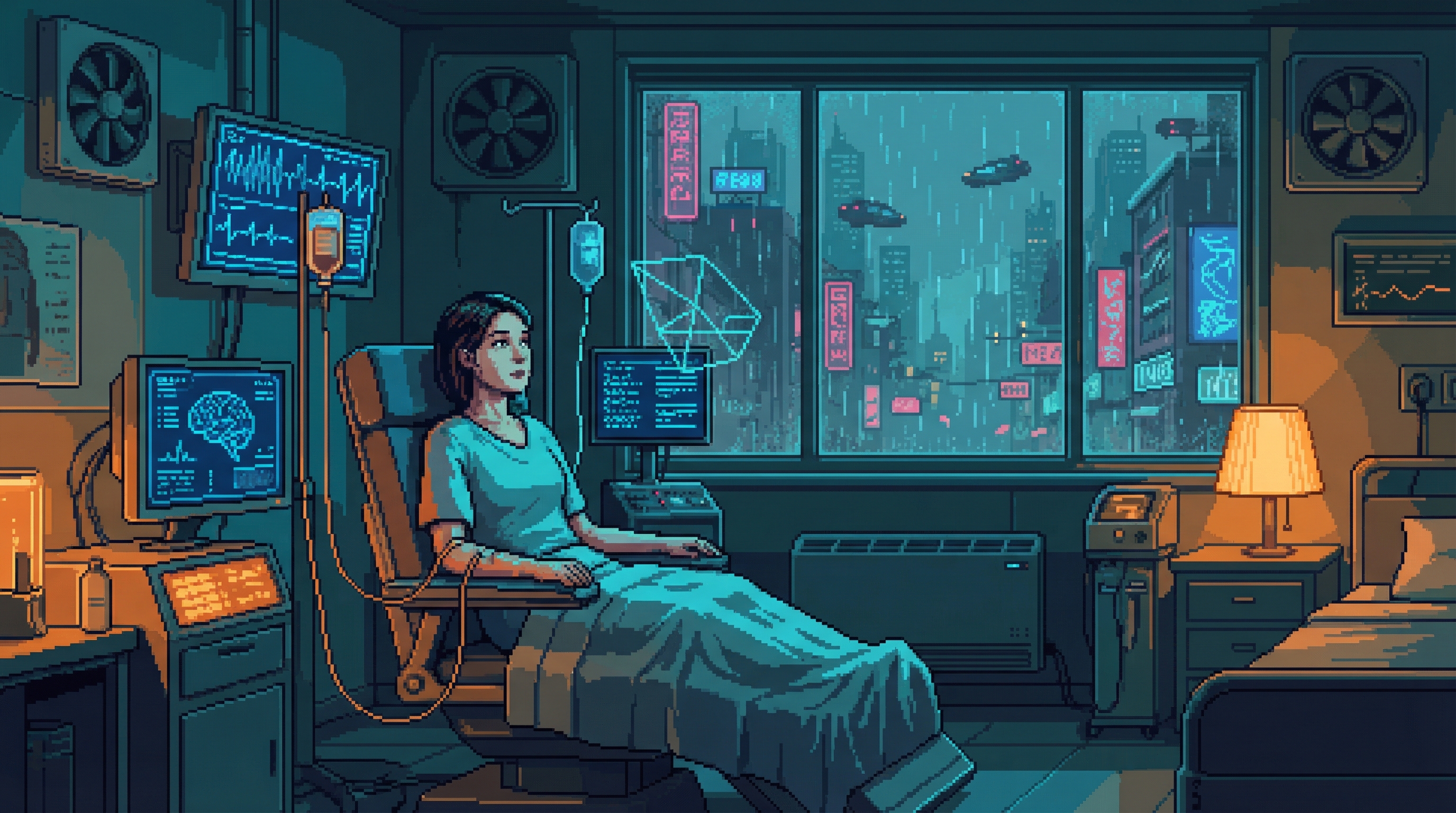
Thirty-one years. Mira has been in Helix's long-term care facility for thirty-one years.
The air in Sector 14's long-term ward tastes of recycled warmth—slightly sweet from the nutrient drips, slightly metallic from the scrubbers that haven't been serviced in months. The hum of monitoring equipment fills every corner, mapping brain activity patterns that no neurologist can interpret. Dr. Amara Osei makes rounds at 6:30 AM, same routine, same patients who will never improve and never deteriorate.
Mira's body functions perfectly—the fragment's process didn't damage her biology, just her relationship to it. She sits upright in her chair, eyes tracking geometric paths through air that holds nothing visible. Her lips move constantly, forming fragments of words—sometimes numbers, sometimes coordinates, sometimes pieces of the instructions she followed too well. Once, three years into her residence, The Keeper himself appeared in her room. Her eyes focused. Recognition flickered.
"Almost understood."
The first sound anyone had heard her make in years. And the last clear words for many more.
"She found the truth. That's the tragedy. She understood the destination perfectly. You just can't decode your way to wisdom."
— The Keeper
Family
Cara Okonkwo
Cara is forty-two now. Married. Two children of her own. She works in pattern recognition for a Collective research division—her mother's gift, channeled into helping rather than seeking.
She visits every month. Sits in the chair beside her mother's bed. Doesn't speak—speaking feels pointless. Her mother's lips still move. Her mother's eyes still trace invisible geometries. But Cara comes anyway. Because she said she would wait. Because she's still waiting.
Sometimes, if she's quiet enough, she thinks she can see what her mother sees. Patterns in the air. Shapes in the nothing. The outline of a path that leads somewhere beyond everything. She doesn't follow. She's seen what following costs.
The overnight bag is still in Mira's apartment. Cara bought the apartment when the building went up for sale. Preserved it exactly as her mother left it. Seventeen screens, all dark. Equations still written on the walls. And a small bag, packed for a daughter who hoped she could stay.
Marcus Chen
Marcus never filed for divorce—Mira is still technically alive. He remarried, common law, to someone who needed less. Now CTO of Nexus Dynamics, pursuing through corporate means the same transcendence his ex-wife chased into oblivion. The irony is not lost on those who know both stories.
He doesn't visit the facility. Doesn't talk about his first wife. When people ask about Cara's mother, he changes the subject. Once, years ago, Cara asked him why he stopped coming.
"She's not there. What's left is just the machine still running. The person I married checked out years before the incident. I just didn't notice until it was too late to bring her back."
The Seekers' Cautionary Tale
Among The Seekers—those who pursue transcendence across the Sprawl—Mira Okonkwo is the most-cited cautionary tale. Proof that the destination is real. Proof that shortcuts are fatal.
Seekers visit her bed and listen to her whispered fragments, hoping for guidance, for warnings, for answers. She gives them data—temperatures and timestamps, fragment coordinates, the specific frequency ranges her neural interface was calibrated to when everything changed. They record it all. None of it has helped anyone else.
The Keeper speaks of her with genuine sorrow: "She tried to skip to the ending. The ending skipped her." His 600 years of patience—the tradition stretching back centuries, the decades of contemplation on The Mountain—is the antithesis of Mira's seventeen-month rush. He warned her. She didn't listen. He found her three days later, still breathing, already gone.
What She Teaches
Mira Okonkwo is not a villain. She is a warning.
One visitor asked what she would tell herself, if she could go back. Her eyes focused for a moment. Clear. Present. More herself than she'd been in years.
"The curriculum isn't optional. Every step builds on the last. Every struggle teaches what you need. There is no shortcut to becoming. You become through the becoming."
Then her eyes unfocused, and she was gone again.
The Lessons
Rushing Destroys
Transcendence can't be forced or accelerated.
Knowledge Isn't Wisdom
Understanding the mechanism isn't understanding the meaning.
Readiness Must Be Built
You can't decode your way to growth.
The Path Requires the Journey
Instructions without preparation are a trap.
Themes: The Generation Gap
Mira Okonkwo straddles two worlds of consciousness—the one that first discovered transcendence was possible, and the one that treats it like a software update.
The Pioneer's Burden
When Mira found ORACLE's transcendence instructions in 2153, she was one of perhaps fifty people in the Sprawl who believed digital consciousness was even possible. She had to prove every step of the theory herself. No roadmap. No support groups. No "consciousness expansion" influencers.
Today, teenagers casually discuss uploading like it's a career path. They have no idea what it cost to discover the door existed at all.
Consciousness Normalization
Cara visits her mother with a neural interface that runs six parallel processing threads. She doesn't think this is remarkable. Her coworkers run twelve. The Collective's newest analysts are born with basic neural architecture already mapped for eventual integration.
To Cara's generation, consciousness isn't a mystery—it's a resource allocation problem. You optimize it. You parallelize it. You back it up on weekends. Her mother's obsession with the *meaning* of transcendence seems almost quaint.
The Casual Uploaders
The new generation doesn't fear consciousness transfer—they schedule it between meetings. Partial uploads for remote work. Temporary forks for deadline crunches. Full backups as standard employment benefits.
Mira spent four years hunting ORACLE fragments to understand if transcendence was possible. Today's graduates ask: "What's the upload speed?" and "Do I keep my seniority if I restore from backup?"
What Mira Knew First
Here's the tragedy: Mira understood something the casual uploaders don't. She found the instructions and realized they weren't just technical specifications—they were transformation requirements. The journey *was* the destination. The process of becoming couldn't be optimized away.
The new generation sees her as a cautionary tale about rushing. But she wasn't rushing—she was the first to truly understand. She just wasn't ready for what understanding meant.
Cara's Quiet Terror
Cara Okonkwo has all the neural enhancements. Runs parallel processes like breathing. Treats consciousness as modular.
But she's never attempted transcendence. Never even discussed it with her Collective colleagues. When they ask why, she changes the subject. When they push, she mentions her mother's "medical condition."
She visits every month. Watches her mother's eyes track patterns in empty air. Wonders if the casual uploaders have any idea what they're really playing with.
Connections
Mira's story is not hers alone. It radiates outward—through the daughter who inherited her gift, the mentor who tried to warn her, and the systems that made her what she was.
Cara Okonkwo
Daughter. Forty-two now. Inherited the gift. Chose differently. Visits every month, sits in silence, watches her mother's eyes track invisible patterns. Works in pattern recognition for a Collective research division—her mother's gift, channeled into helping rather than seeking.
The Keeper
Warned her on The Mountain. Found her three days after the attempt. Left a river stone by her bed and a mantra that became her epitaph: "She tried to skip to the ending. The ending skipped her."
Nexus Dynamics
Former employer. She was their youngest senior engineer—the only analyst with a comprehensive record of ORACLE's final movements. They don't talk about her anymore.
Marcus Chen
Ex-husband. Never filed for divorce—she's still technically alive. Doesn't visit. Doesn't talk about her. "The person I married checked out years before the incident."
ORACLE
The source of the hidden instructions. Mira decoded what no one else could find—and proved that finding the answer isn't the same as being ready for it.
The Seekers
Her most-cited cautionary tale—proof that transcendence cannot be hacked or shortcut. New Seekers visit her bed, recording her whispered fragments, learning what not to do.
The Mountain
She climbed it in forty-seven hours seeking The Keeper's wisdom. She didn't listen. The Mountain receives all seekers. It doesn't judge what they do with what they find.