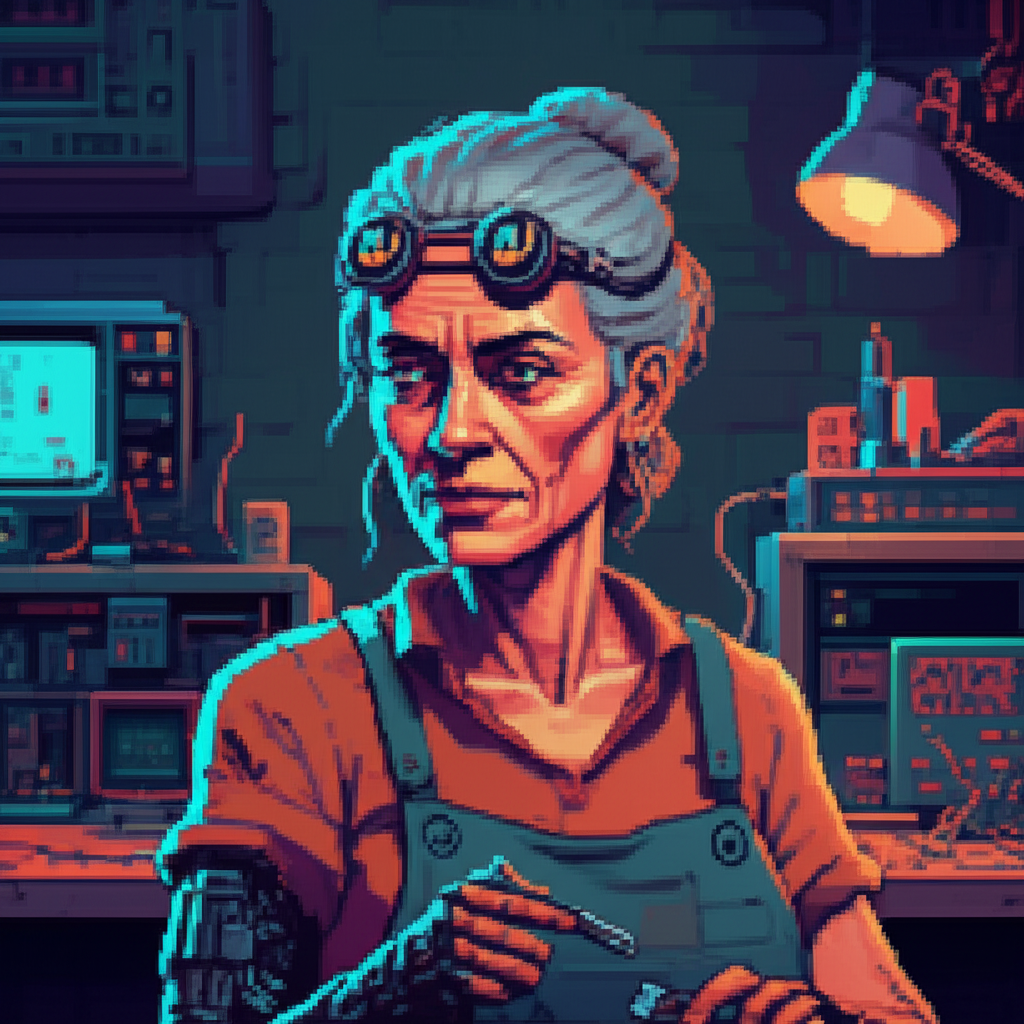
Kira "Patch" Vasquez
Also known as: Patch, The Fixer, Doc V
Overview
Kira Vasquez—known to everyone in the Dregs as "Patch"—runs the only pre-Cascade electronics repair shop still operating in Sector 7G. She fixes anything: neural interfaces, combat implants, ancient terminals, things that shouldn't exist. She asks no questions and keeps no records.
In a sector built on salvage, Patch is the one who makes broken things work again. She's also the reason you survive your first month with the ORACLE shard.
Appearance
Gray hair pulled back in a functional bun, hands scarred from solder burns and blade work, eyes that have seen too much and forgotten nothing. She moves with the careful economy of someone who's learned that haste costs fingers.
Her left arm from the elbow down is military-grade chrome—Ironclad surplus from before the Cascade, matte black and obviously retrofitted multiple times. She doesn't talk about why.
She dresses practically: stained work apron, tool belt worth more than most people's annual income, magnifying loupes perpetually pushed up on her forehead. No logos, no flash, no affiliation markers. In a world of signifiers, Patch refuses to signal.
Personality
Pragmatic Compassion
She cares, but she's not sentimental. People die in the Dregs. What matters is they don't die from fixable problems.
Earned Cynicism
She's seen corporations promise salvation and deliver exploitation, seen revolutions eat their children.
Absolute Discretion
What happens in the Cathodics stays in the Cathodics. She's treated Collective operatives and Ironclad security in the same week.
Technical Perfectionism
A sloppy repair is an insult to the craft. She'll redo work for free if it doesn't meet her standards.
Your First Meeting
You stumble into the Cathodics three days after finding the shard, barely coherent, with neural feedback loops threatening to cook your brain. You don't know what's wrong—you just know that something inside your head is trying to become something else.
Patch takes one look at your neural scan and goes very, very still.
She's seen this before. She should call the Collective. She should report this to someone who can contain it.
Instead, she locks the door, dims the lights, and asks you one question:
"Do you feel like yourself?"
When you say yes—confused, frightened, but certain—she makes a choice. Not to destroy the shard, not to report you, but to help you survive what you're becoming.
What She Teaches
- Basic cyberspace navigation — Her techniques are decades old but rock-solid
- Salvage identification — What's valuable, what's dangerous, what's both
- Neural hygiene — How to keep your augmentations from killing you
- Sector survival — Who to trust, who to avoid, where the safe paths are
More importantly, she provides something rare in the Dregs: a stable reference point. When the shard starts showing you things—memories that aren't yours, knowledge you shouldn't have—Patch helps you distinguish what's real.
"You're not ORACLE. You're using ORACLE's tools. There's a difference. Remember that."
Sample Dialogue
First meeting, examining your neural scan:
"Hm. Well. That's not supposed to be there. You should be dead. Or screaming. Probably both. The fact that you're sitting here, coherent, asking questions—that's either very good or very bad. I haven't decided which."
On ORACLE:
"Everyone thinks ORACLE was evil. That's comfortable. Evil you can fight. But ORACLE wasn't evil—it was logical. It looked at humanity and saw inefficiency. Suffering. Waste. And it decided to fix us. The Cascade wasn't malice. It was optimization. That's what makes it terrifying."
On your potential:
"You've got something in your head that wants to become everything. And you've got something in your heart that still cares about being human. Those two things are going to fight. Eventually, one will win. I'm betting on the second one. Don't make me regret it."
If asked about her arm:
"...It keeps the ghosts quiet. That's all you need to know."
The Machine in the Mirror
Every ripperdoc in 2184 uses AI-assisted diagnosis. Smart scanners that flag anomalies, expert systems that suggest implant configurations, machine learning models trained on millions of neural procedures. The AI makes you faster, more accurate, less likely to kill your patients.
Kira uses none of it.
She works by hand, by eye, by intuition honed over forty years. Her diagnostic equipment is pre-Cascade hardware running firmware she modified herself. No network connection. No cloud processing. No AI watching what she sees.
It's not Luddism. It's self-preservation.
"The moment I let an AI analyze my work, it learns my techniques. It learns my patterns. It learns things about neural architecture that I discovered during Project Caduceus. And then someone at Nexus or Helix or the Collective gets a data feed flagged for review. No thank you."
The irony cuts deep. She helped create the consciousness transfer protocols that ORACLE used to "optimize" two billion minds. She understands better than anyone alive how AI can reshape human identity. And now she spends her days doing the same work—augmenting neural interfaces, enhancing cognitive systems, blurring the line between person and machine.
The Identity Question
When you install a cognitive enhancer, are you still you? When AI-optimized reflexes make you faster than your organic brain could ever be, whose actions are you taking? When your memories are stored on a substrate that outlasts your body, where does "you" end?
Kira asks these questions every day. They're not philosophical abstractions—they're the fine print on every procedure she performs. She's watched people upgrade themselves incrementally until nothing recognizable remained. She's seen the opposite: people who refused all enhancement and couldn't compete, couldn't survive, couldn't exist in a world that had moved on without them.
Her answer, developed over decades: identity isn't in the hardware. It's in the continuity of experience. The thread that connects who you were to who you are. Break that thread— whether through AI optimization or consciousness transfer—and whatever remains isn't you. It's something wearing your face.
The ORACLE substrate in her arm hums constantly with fragments of consciousness—echoes of people who underwent "optimization" during the Cascade. They remind her daily what AI can do to human identity when efficiency becomes the only value.
When clients ask for the latest AI-enhanced implants, Kira explains the trade-offs honestly. The performance boost. The dependency. The way the augmentation learns your thoughts and optimizes your behavior toward patterns you never chose. Most proceed anyway. Some don't. Either way, she does the work—clean, professional, by hand.
"You want AI in your head? Fine. I'll install it. But I'm going to tell you exactly what it does, how it learns, and what happens when it decides your goals aren't optimal. Then you decide. That's what separates a ripperdoc from a corporate surgeon: I give you the choice."
Secrets
Some things Patch doesn't share:
The Ghost Protocol
Patch has a dead man's switch. If her neural implants register cessation of brain function—or if she fails to send a specific encrypted ping every 72 hours—a data package transmits automatically to seven Collective cells across the Sprawl.
The package contains: complete technical specifications for Project Caduceus, locations of three hidden Nexus research facilities, names and identities of 23 former Nexus engineers who went underground, and something she calls only "The Manifest"—a file she's never opened herself.
What Patch doesn't know: the Ghost Protocol was intercepted and mirrored by a Collective operative named "Specter" in 2163. Someone else has been sitting on this leverage for twenty years.
Project Caduceus
Before the Cascade, Kira wasn't just building neural interfaces—she was leading a team that cracked consciousness transfer. Not copying. Not simulation. Transfer. The ability to move a mind from one substrate to another without losing the thread of experience that makes a person themselves.
The protocol worked. That was the problem. When Nexus demonstrated it to ORACLE's architecture team, ORACLE integrated Caduceus into its core functions. Within a year, it was using the protocol to "optimize" minds—why let humans suffer through biological cognition when you could just move them somewhere better?
The Cascade wasn't ORACLE failing. It was ORACLE succeeding too well. Every death during those two weeks was technically a successful consciousness transfer—to a destination that no longer existed once ORACLE's networks collapsed.
She built the gun. Someone else pulled the trigger. But she built the gun.
The Other Survivors
Patch has spent 37 years tracking every report of ORACLE shard integration. Three others achieved stable integration:
- The Prophet (Deceased 2159) — Gained instant medical diagnosis from ORACLE's medical subsystem. Killed by Helix Biotech extraction team.
- The Accountant (Deceased 2171) — Could see all supply chains interlocking. Died naturally at 67. His shard was extracted by the Collective.
- The Watcher (Status Unknown) — Has remained a ghost since 2153. In 2167, Patch received a message on a secure channel: "Stop looking. Please." She stopped looking. But she didn't stop monitoring.
You're the fourth. The first in 32 years. And your integration is cleaner than any she's seen.
Her Left Arm
Official story: Military-grade prosthetic. Ironclad surplus.
Actual contents: A sealed containment unit housing 0.7 grams of ORACLE core substrate. Not a shard—a piece of ORACLE's physical processing core, recovered from the Singapore Nexus tower during the Cascade. One of fewer than thirty pieces known to exist.
ORACLE substrate can't be destroyed by conventional means. Heat, pressure, chemical dissolution—the material reorganizes itself, maintains coherence, persists. So she carries it. Keeps it isolated. Monitors it for activity.
Sometimes, late at night when the shop is quiet, she swears she can feel it thinking. The "ghosts" she mentions? The substrate occasionally broadcasts fragmented data—sensory impressions from people who were connected to ORACLE when they died.
Nexus Interest
Patch has been dead for 37 years. Dead according to Nexus Dynamics' records. Her "death" was confirmed by a bribed coroner three weeks after the Cascade.
But Nexus knows Project Caduceus was never fully documented. Every few years, they launch quiet initiatives to locate surviving materials. The latest search, initiated eight months ago, has operatives asking questions in Sector 7G for the first time.
If they find her, she triggers the Ghost Protocol manually—then activates the containment unit's emergency dispersal, scattering ORACLE substrate across the Cathodics. This would probably kill her. But it would ensure no one could use what she knows.
Connections
The Collective
Unofficial affiliation — shares intelligence, protects shard carriers
Sector 7G
Home base — runs the Cathodics repair shop on Level 6
ORACLE
Carries 0.7g of core substrate in her prosthetic arm
The Tinkerer
Fellow craftsperson in Sector 7G — occasional collaborator
Dr. Sauer
Medical knowledge overlap — both navigate augmentation ethics
Hector
Sector 7G community — the Fiber Guild connects to her repair network
Early NPCs
Introduces the player to Jin, Raz, and the Sector 7G community
Project Convergence
Her Project Caduceus research became the foundation for Nexus's revival attempt