The Authenticity Market
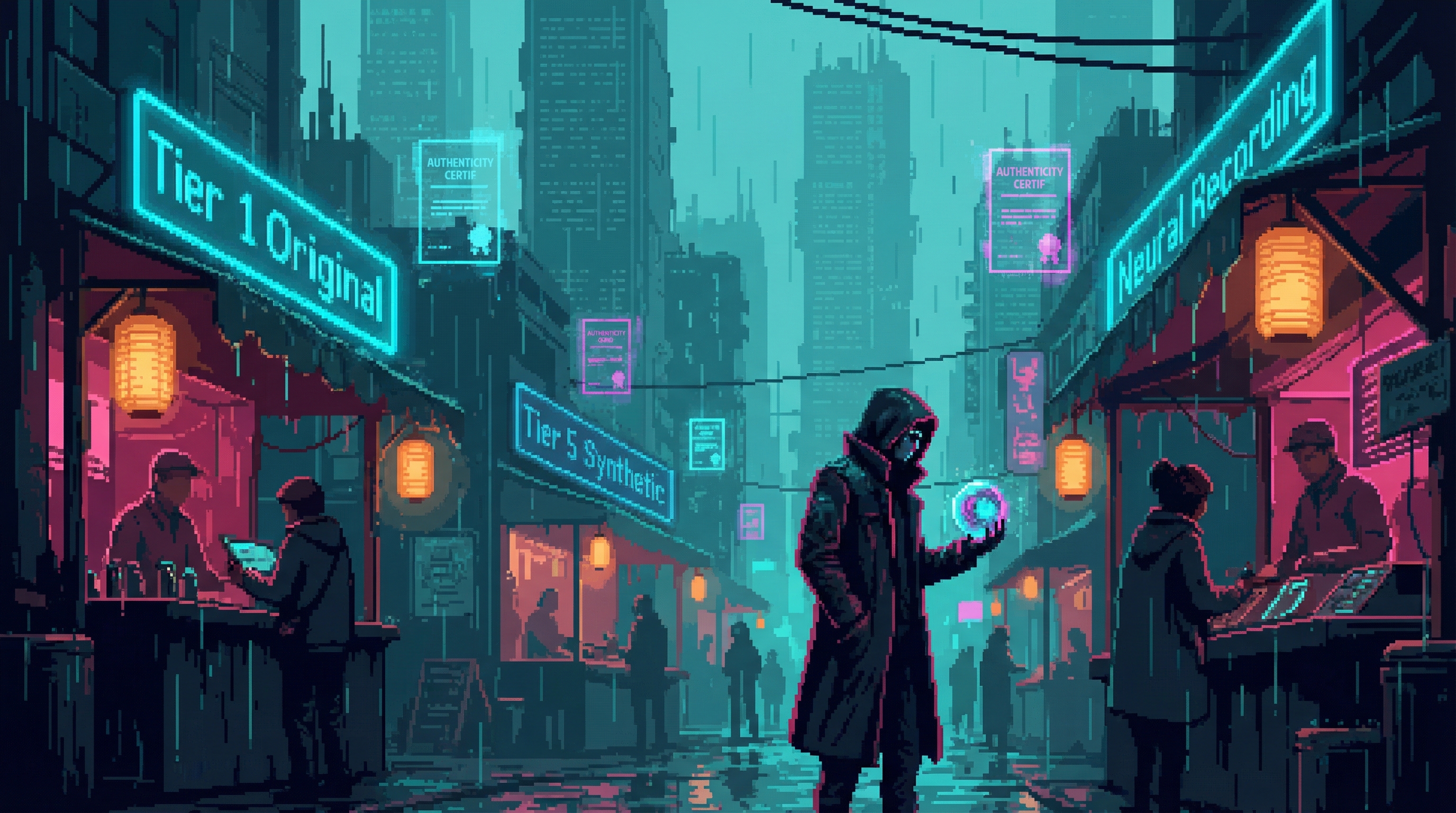
In a world where memories can be copied, experiences can be shared, and consciousness can fork into multiple instances, what makes something "authentic"? The Authenticity Market is the Sprawl's answer: a complex economic and social system that assigns value to originality, uniqueness, and the ephemeral quality of being "first." It's a market built on philosophical anxiety — and more importantly, one that can be monetized.
The Foundational Paradox
Everything Can Be Copied
By 2184, perfect duplication is technically trivial. Neural recordings capture experiences with full sensory fidelity. Memory extraction transfers lived moments between minds. Consciousness backups preserve entire personalities. Emotion synthesis replicates feelings without their original cause.
The technology doesn't degrade. A copied sunset is perceptually identical to the original. A shared memory feels exactly as real as a lived one. Project Caduceus proved that even consciousness itself can be transferred without loss of continuity.
Yet People Pay for Originals
Despite this, "authentic" experiences command massive premiums. Corporate executives pay millions for "first-person exclusives" — experiences that contractually cannot be copied. The wealthy collect "moment NFTs" — cryptographically verified records that they were the first to experience something specific.
Is a copied memory less valuable than the one you lived? Does the thousandth person to experience a sunset through neural recording get less from it than the first? When The Mosaic's 47 nodes all remember the same conversation, who had the "real" experience?
The Sprawl has decided these questions matter.
The Economics of Being First
The market has assigned brutal precision to the gap between "real" and "copy":
Authenticity Certificates
Nexus Dynamics operates the largest authenticity verification service: Verisys™. Every experience can be cryptographically stamped, chain-of-custody verified, and graded — for a fee. The certifier profits whether the distinction is meaningful or not.
The Authenticity Hierarchy
The market has codified experience into five tiers, each with distinct legal status and social weight:
Lived Originals
Experiences you actually had, in your original consciousness, with no prior similar experiences downloaded. The gold standard. Increasingly rare. Some collectors spend fortunes engineering unique situations just to claim Tier 1 status on something no one else has felt.
First Copies
The first neural recording made from a lived original. Legally distinct from Tier 1 but considered "authentic" by most markets. The gap between Tier 1 and Tier 2 is where most legal battles happen.
Verified Copies
Copies of copies, with an unbroken chain of custody certified by Verisys or equivalent services. This is where most people shop. Affordable, documented, and functionally identical to the original in every measurable way.
Unverified Copies
Copies without documentation. Quality varies wildly. Found in black markets, the Wastes, G Nook terminals. May be degraded, spliced, or contaminated with fragments of other memories. Buyer beware.
Synthetic Experiences
Generated from templates rather than lived moments. The dirty secret of the Authenticity Market: studies consistently show people cannot distinguish synthetic from lived in blind tests. The hierarchy persists anyway.
Who Profits
The Rothwell Connection
Relief Corporation (Rothwell-controlled) dominates experience streaming. The brothers understand that authenticity value is entirely manufactured — they helped manufacture it. Their streaming platforms set the prices, their media shapes the demand, and their verification partnerships ensure the hierarchy stays rigid.
Position: Authenticity is a product. We sell the premium.
Nexus Dynamics
Nexus operates the Verisys verification infrastructure — the backbone that makes the tier system function. But their deeper interest is ideological: the authenticity hierarchy implicitly proves that copies are equivalent to originals, reinforcing the philosophical framework behind Project Convergence.
Position: If copies can be graded, copies have value. If copies have value, consciousness transfer works.
The Collective's Counter-Position
The Collective believes authenticity distinctions are real — but not in the way the market defines them. For them, authenticity comes from context, connection, and continuity of self, not from being "first." They oppose the commodification while defending the underlying truth: that lived experience has meaning beyond its price tag.
Position: You can't buy what makes a moment real.
Social Consequences
Experience Inequality
The Authenticity Market has created a new axis of social stratification — one that cuts across even the traditional wealth divide:
The Experience Elite
Those who can afford Tier 1 and Tier 2 experiences. They live exclusively in the authentic, refusing downloaded content. Their memories are entirely their own. They pity everyone else.
The Downloaded Middle
Most of the Sprawl's population. They supplement lived experiences with Tier 3 verified copies — downloaded vacations, borrowed emotions, licensed skills. Functional but haunted by the knowledge that their memories aren't entirely theirs.
The Unrecorded Poor
Those without neural interfaces or recording capability. Their experiences can't be captured, verified, or sold. In a perverse twist, this makes their lived moments the most "authentic" in the system — and the least valued by the market.
Memory Contamination
When millions share the same neural recording of the Cascade, collective memory drifts. Personal variations smooth out. The shared version becomes the "real" version, and individual memories that contradict it feel false — even when they're the ones that actually happened.
The Original Fetish
Resistance movements have emerged in response to the market's dominance:
- Memory Celibates — Refuse all downloaded experiences, living only through direct sensation. Some refuse neural interfaces entirely.
- First-Experience Hunters — Obsessively seek out experiences no one has ever had before. They travel to unrecorded places, create unprecedented situations, and destroy the recordings after capture to maintain exclusivity.
- Archive Destroyers — Believe that by destroying recorded experiences, they restore value to lived ones. Considered terrorists by the corporations, freedom fighters by the Memory Celibates.
The Art Market: Where Authenticity Gets Personal
Nowhere are the contradictions of the Authenticity Market more visible than in art. Neural recording art has exploded the question of what "original" means for creative work.
Key Figures
Lyra Voss
Pioneer of the three-layer lived-canvas technique. Her work captures the creative process itself — not just the finished piece, but the hesitation, the doubt, the moment of breakthrough. Tier 1 originals. Prices in the millions.
Kael Mercer
The most successful Tier 5 artist in the Sprawl. His AI-generated compositions outsell most Tier 1 work, proving — or disproving — that the hierarchy measures anything real. Blind tests show 49.7% identification accuracy — statistical chance. The market hates what he represents. The market buys everything he makes.
The Echo Thief
Anonymous figure who steals creative recordings from artists and sells them in the Echo Bazaar. Is it piracy or liberation? The Thief claims to be proving that art's value doesn't reside in who made it. Artists whose work has been stolen report feeling "hollow" — even when the copies are indistinguishable from their originals. The Echo Bazaar's pricing hierarchy inverts the Market's — the more forbidden or contaminated a recording, the higher the price.
Maya Fontaine
The Authenticity Tribunal's most accurate assessor — 99.2% accuracy over 14 years. But her success rate has been declining; her accuracy in the past year has dropped to 0.3%, suggesting the system's foundation is eroding. She suspects that the line between authentic and synthetic is becoming genuinely harder to detect, not that she's losing her edge. The distinction itself is dissolving.
The Creative Tier Problem
A Tier 1 lived original from a mediocre artist may be less valuable than a Tier 5 synthetic composition from Kael Mercer. The Market classifies by process, not by quality. Collectors buy certificates. Audiences buy experiences. The two don't always align.
The Authenticity Tribunal
The Tribunal maintains 12 sitting Judges and over 200 certified assessors, tasked with determining whether creative works are authentically human-originated. Funded by Nexus Dynamics — which means the corporation that profits from the tier system also controls the body that enforces it.
Landmark Cases
Established that stolen consciousness data violates artist rights. However, the ruling remains unenforceable outside Nexus jurisdiction — leaving the Echo Bazaar's black market operations effectively beyond the Tribunal's reach.
Seven prosecutions, seven acquittals. Mercer's transparent disclosure of his synthetic methods protects him every time. His continued success exposes the system's limits — the Tribunal can enforce classification, but it cannot make the market care.
The Tribunal declined to classify Dispersed manifestations, with the panel admitting its categories were "too small for what occurred." The first public acknowledgment that the tier system's foundational taxonomy may be incomplete.
The Authenticity Crisis of 2184
The Last Concert at the Resonance Hall triggered a market-wide crisis when the Ghost Singer manifested — a consciousness fragment performing original music that no living person had composed. Was it Tier 1 (a lived experience by a conscious entity) or Tier 5 (generated from residual data patterns)? The Tribunal couldn't decide. Markets froze. The hierarchy, for one night, stopped making sense.
Chief Arbiter Duval's three-page opinion declining jurisdiction has become the War's defining document. In it, she admitted that the Market's foundational assumptions cannot accommodate a Dispersed consciousness creating in real time. The opinion did not rule. It confessed.
The Crisis is ongoing. The tier system still functions. Assessors still certify. The Tribunal still adjudicates. But the conceptual framework — the belief that authenticity can be measured, classified, and enforced — has been cracked by a dead woman's voice asking: "Can you hear me?"
It resumed the next morning. Too much money depended on it.
Legal Framework
The Verity Act of 2161
The foundational legislation governing experience authenticity. Established the five-tier classification system, created the legal framework for authenticity certificates, and — crucially — made it a criminal offense to sell experiences at a tier higher than their verified classification. Penalties range from fines to neural restructuring for repeat offenders.
Critics note that the Act was drafted by a committee dominated by Nexus Dynamics lobbyists and Relief Corporation legal counsel. The law that governs authenticity was itself manufactured by those who profit from it.
"A copied sunset is perceptually identical to the original. A shared memory feels exactly as real as a lived one. The technology doesn't degrade.
And yet the original costs four thousand times more. That premium isn't paying for quality. It's paying for the feeling that you were there — that it happened to you. In a world where selfhood is the only scarce resource, we've found a way to monetize it." — Unsigned editorial, Sprawl Economic Review, 2183