The Blank Canvas Movement
Only Destruction Guarantees Authenticity
Overview
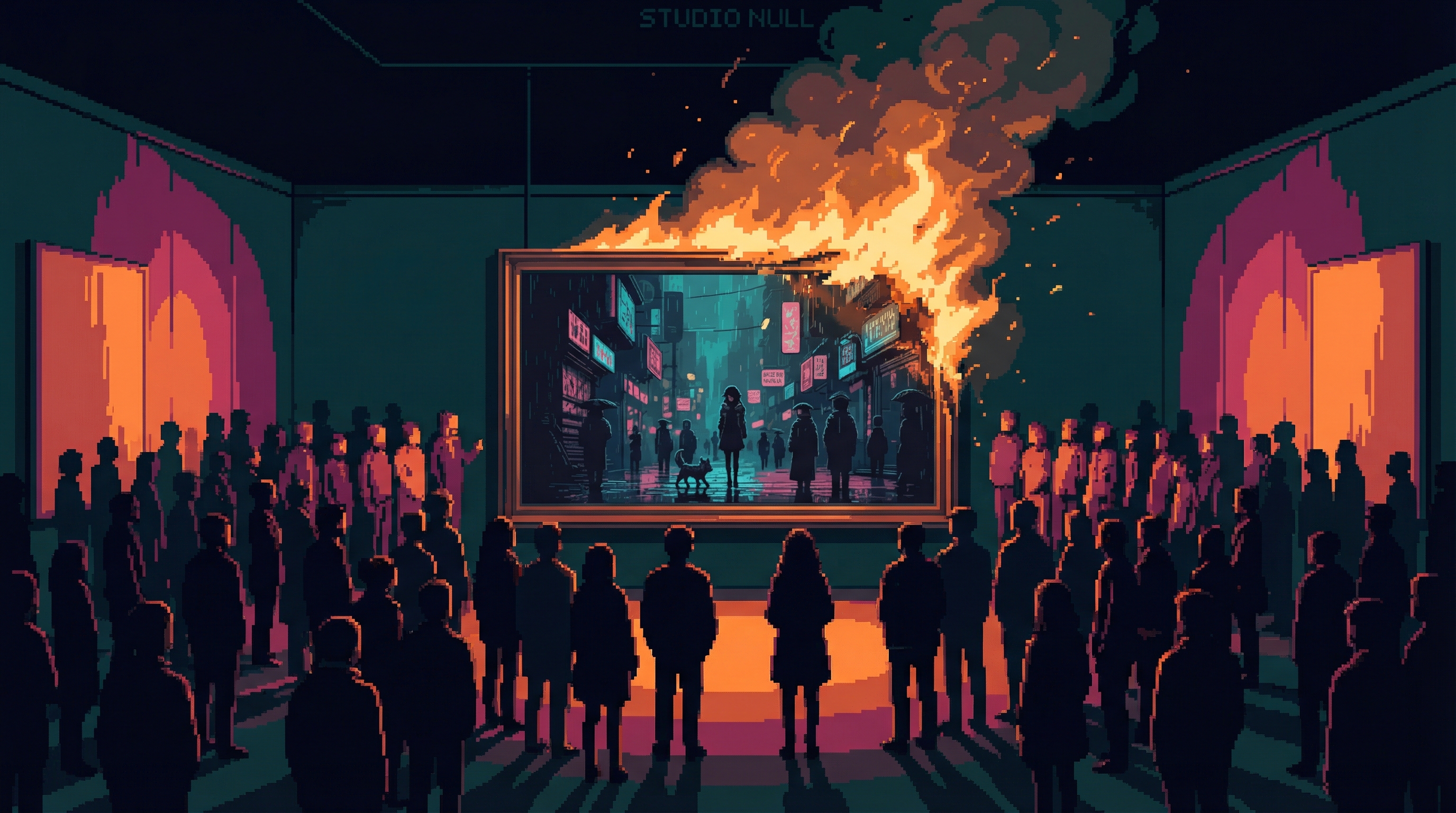
The first Blank Canvas event was a painting. Ines Achterberg — former Relief Stream content designer — spent three months creating a physical oil painting in Studio Null. She depicted the moment of the Cascade from ground level. Two hundred people attended the exhibition. For forty minutes, the most authentic piece of art in the Sprawl.
Then Ines set it on fire.
The Movement formed the next week. Its founding principle: art that can be reproduced has already been commodified. The Authenticity Market killed art by trying to save it — by recording genuine responses, duplicating them, tiering them, and selling them. Only art that destroys itself is free. Only memory resists the copy.
No leaders. No manifesto. Actions are proposed anonymously and executed by whoever agrees. The Movement exists in the space between creation and ash.
The Philosophy
Three principles. No document records them. Everyone who has watched art burn carries them away differently.
The Death of the Copy
The Authenticity Market killed art by trying to save it. Art died when the experience of art became a product — when someone else's genuine response could be recorded, duplicated, tiered, and sold. The copy didn't replace the original. The copy replaced the audience.
If your emotional response can be bottled and sold, was it ever yours?
Destruction as Creation
The ritual is invariant. Creation happens inside Studio Null's electromagnetic shielding — no recording, no copying, no digital trace. Exhibition is experienced through unaugmented senses only. Then: destruction. Fire, breaking, ending. What remains is imperfect, unreliable human memory.
The art is not the object. The art is the moment it ceases to exist.
The Memory Argument
When 200 people watch a painting burn, each carries away a different painting. Within a year, 200 different paintings exist in memory — each one slightly altered, slightly personal, slightly wrong. The Movement argues this is what art was always supposed to be.
A memory that changes is alive. A copy that doesn't is dead.
Key Practitioners
They reject the word "members." Anyone who agrees with an action is part of it. These three have shaped the Movement's vocabulary.
Ines Achterberg
Founder (refuses the title)Former Relief Stream content designer who understood the machinery of commodified experience from the inside. Spent three months painting the Cascade from ground level, exhibited it for forty minutes, then burned it in front of two hundred witnesses.
31 paintings created and destroyed. Each one remembered differently by everyone who saw it.
Davi Lim
SculptorWorks in salvaged electronics — circuit boards, processors, memory chips wired into sculptures of startling beauty. Each piece is threaded with thermite charges. The exhibition ends when the charges ignite. Silicon and copper melting into shapes no one intended.
His sculptures burn at 2,500 degrees. The audience feels the heat from twenty feet away.
The Chorus
Vocal EnsembleSeven vocalists who perform compositions exactly once and never repeat them. No scores. No recordings. No rehearsals of the final piece. Each performance exists as a single moment in time, then dissolves into seven different memories of what the harmonies sounded like.
Each singer remembers a different song. That's the point.
The Recording Paradox
Studio Null's electromagnetic shielding prevents recording. But someone always tries. A hidden device, a shielded recorder, a desperate attempt to capture what was designed to vanish.
The Movement's response: indifference. A recording of a Blank Canvas event is not the art. It documents witnessing destruction — a record of something disappearing, not the thing itself. The recording captures fire consuming canvas. The art was the forty minutes before.
The Echo Thief captured three events. The recordings sold well on the underground market. The Movement's position: those sales are "a performance piece they didn't intend." The irony is not lost on anyone.
Sensory Experience
What it feels like to watch art die beautifully.
Smell
Turpentine and wood ash. Melting solder. The copper tang of thermite igniting. Oil paint releasing decades of chemistry in a single exhalation of heat.
Sound
The crack of breaking sculpture. The whoosh of accelerant catching. Silence before destruction — two hundred people holding their breath. Then exhaling together.
Touch
Studio Null's pressure absence — the strange feeling of being inside electromagnetic shielding. Heat radiating from the destruction. Particulate settling on skin. Ash in your hair for days.
Sight
Fire consuming color. The exact moment a painted face becomes smoke. Thermite turning silicon white-hot. Two hundred faces lit by something that will never exist again.
Faction Relations
The Authenticity Market
RejectedThe enemy the Movement was born to oppose. Commodified experience. Recorded emotion. Everything Blank Canvas exists to destroy.
Kael Mercer
EnemyCommodification personified. Mercer represents everything the Movement burns against — art as product, experience as inventory.
Relief
AdversaryThe corporation that made experience a consumer product. Ines Achterberg left Relief to found the Movement. The break was permanent.
Lyra Voss
ComplicatedHer uncopyable Layer 3 work is grudgingly respected — art that resists reproduction by its nature rather than through destruction. A different answer to the same question.
The Resonance Collective
RespectTheir no-recording policy aligns with Blank Canvas principles. Different methods, shared understanding: some things must not be captured.
The Echo Thief
ParadoxCaptured three events. The Movement's response is indifference — the recordings are not the art. An unintentional performance piece.
The Ghost Singer
QuestionInvoluntary art that cannot be reproduced. Is a Ghost Singer performance a Blank Canvas event? The Movement has no consensus.
Secrets
What burns beneath the surface.
The Archive
Rumor persists that Ines Achterberg maintains private notebooks — detailed written memories of every destroyed work. Descriptions of colors, compositions, the exact moment each painting caught fire. Thirty-one destructions, recorded in the most analog medium possible.
If the notebooks exist, they are either the Movement's greatest hypocrisy or its greatest artwork.
The Unburned
Three events ended without destruction. The artist approached the work, held the accelerant, and walked away. The works were removed from Studio Null immediately. No one has seen them since. No one discusses them.
Are they hidden? Destroyed privately? Preserved somewhere, violating every principle the Movement holds?
Relief Funding
Anonymous financial support flows to the Movement from sources that trace back uncomfortably close to Relief. The corporation Ines abandoned. The adversary the Movement defines itself against.
The logic is perverse but sound: destruction art drives recording demand. Every burned painting makes people want to capture the next one. Relief profits from the Movement's existence.
Themes
Perfect Reproduction
Can art exist in a world of perfect reproduction? The Blank Canvas Movement's answer is destruction — the only guarantee against the copy. When any experience can be recorded, duplicated, and sold, the only authentic act is the one that eliminates itself.
AI generates infinite variations. The Movement asks: if creation is infinite, what value remains? Their answer — scarcity through annihilation — is radical, desperate, and possibly the only honest response.
Memory as Medium
Human memory degrades. It distorts, romanticizes, forgets. The Movement argues this is a feature, not a bug. A painting that exists only in memory becomes 200 different paintings, each alive, each changing, each imperfect.
Digital systems preserve perfectly. Human memory preserves meaningfully. The Movement bets everything on the difference between accuracy and truth.
Degradation as Life
A file that never changes is dead storage. A memory that shifts and evolves is alive. The Movement's deepest claim: degradation is not loss. It is the process by which information becomes experience, data becomes meaning, and art becomes personal.
A memory that changes is alive. A copy that doesn't is dead. This is the Movement's answer to the copy problem — and it applies to AI training data as much as oil paintings.