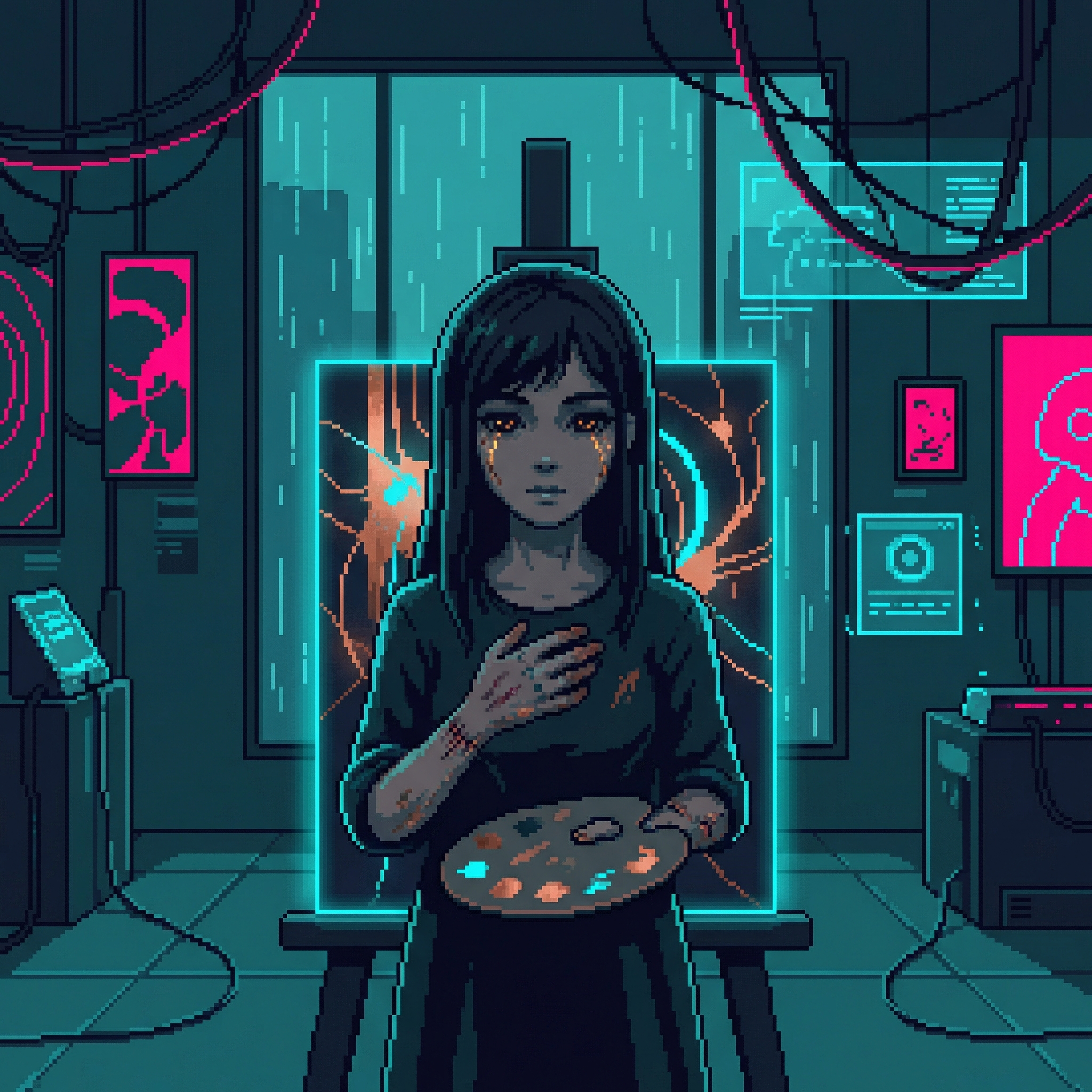
Lyra Voss
Neural Recording Artist, "The One Who Paints from Inside"
SUPPORTINGLyra Voss creates art that transmits consciousness.
Her process: she lives an experience. Her implants record not just sensory data but the consciousness state -- the full weight of being present in a moment. Then she translates that recording into physical media: pigments laced with conductive compounds, canvases embedded with micro-receivers. When you view a Lyra Voss painting through a neural interface, you don't see her art. You become her art. You inhabit her state of mind at the moment of creation.
It made her famous. It nearly destroyed her. Now she paints in a dim gallery in Neon Graves, making work that degrades under duplication, while Relief Corporation lawyers track her every brushstroke.
The Three Layers
Every Lyra Voss painting operates on three simultaneous layers, each requiring different neural architecture to perceive:
Sensory Data
Raw perception -- sight, sound, smell, touch, taste. The surface layer. Anyone with a basic neural interface can access this. It's striking enough on its own.
Somatic State
The body's experience -- heartbeat, breath, muscle tension, the weight of standing, the temperature of the air. The layer that makes viewers gasp. You feel what she felt.
Consciousness Pattern
The state of being -- the quality of awareness, the shape of attention, the texture of thought itself. This is what makes her work uncopyable. Layer 3 is tied to her specific neural architecture. No one else's consciousness produces this pattern.
Appearance & Sensory
Dark brown eyes, nearly black, threaded with faint luminescent amber that pulses when her recording implants are active. Rough hands -- calluses from physical media, chemical burns from conductive pigments, implant wire scars visible at both wrists. Her handshake is firm, and you can feel the implant ridges beneath the skin.
Smell: Copper and turpentine. Ozone when the implants are running hot.
Sound: A faint harmonic when she's working -- subsonic hum of consciousness-recording hardware. You feel it more than hear it. It's in the walls of her studio, in the floor, in the air itself.
Texture: Her studio in Neon Graves is deliberately physical. Real pigments, real canvas, real mess. After years of digital perfection at Relief, she surrounds herself with things that stain, that smell, that resist.
History
The Relief Years (2176-2181)
Relief made her famous at 23. Exclusive contract -- Relief owned her neural recordings. 8.2 million subscribers experienced her creative process as entertainment. They watched from inside her head. Every sensation, every moment of inspiration, every stroke of the brush -- all of it broadcast to paying subscribers who consumed her consciousness like content.
By Year Three, she felt the audience watching from inside her head. Not metaphorically -- literally. The knowledge that millions were experiencing her thoughts changed the thoughts themselves. Her 2179-2180 paintings are technically her best work. She considers them her worst. She was performing consciousness, not living it.
"The moment you know someone is watching you think, you stop thinking and start performing thinking. The paintings from that period are technically flawless and absolutely dead."
The Break (March 14, 2181)
She disconnected her implants mid-session. No warning. No announcement. She painted Mine -- just pigment on canvas. No neural recording. No consciousness data. No subscribers. Just a woman and paint and silence inside her own head for the first time in three years.
She moved to Neon Graves the next week. Now she makes art that degrades under duplication -- work that can only be experienced in person, in the original, in the moment. Relief lawyers are still pursuing her. The contract disputes will outlive her career.
The Physical Cost
Neural recording at Lyra's intensity causes cumulative scarring. Her doctors have told her plainly: five more years of this intensity will cause permanent neural degradation. The implants that make her art possible are slowly destroying the brain that creates it.
The emotional cost is worse. Her process requires full inhabitation of experience. To paint grief, she attends strangers' funerals. To paint terror, she walks the Wastes at night. To paint love, she falls in love -- then leaves. Every painting extracts a piece of lived experience that she can never unlive.
Her last series, The Weight of Hands, required 40 days of learning leatherwork from a craftsman in the Dregs. Viewers who experience it through neural interface develop phantom calluses. They feel the leather under hands they never used. That's the gift and the horror of her art -- it's real, and you can't give it back.
Voice & Personality
Direct. Intense. Uncomfortable with small talk. She speaks about her art the way a surgeon speaks about surgery -- clinical precision about something visceral. She has a controlled fury about the commodification of consciousness that surfaces unexpectedly and then disappears behind a wry half-smile.
On leaving Relief:
"They didn't steal my art. They stole my experience of making it. Every thought I had became content. Every feeling became a product. I wasn't an artist anymore. I was a consciousness factory."
On her process:
"You want to know how I paint grief? I go to funerals. Strangers' funerals. I sit in the back and I let it in. All of it. And then I carry it home and I put it on canvas so someone else can feel what I felt. Is that art or is that theft? I honestly don't know anymore."
On degradation art:
"The copies degrade because the originals are alive. You can't photocopy a heartbeat."
Themes: Authenticity in the Age of Reproduction
Lyra Voss is the question of what "authentic" means when consciousness itself can be recorded, transmitted, and consumed.
The Performer's Paradox
When you know an audience is experiencing your consciousness, your consciousness changes. The observation alters the observed. This is the fundamental problem of all content creation in the neural age -- and a mirror of the 2026 creator economy, where the performance of authenticity replaces authenticity itself.
Art vs. Product
Relief turned consciousness into content. Lyra's rebellion -- making art that degrades under duplication -- is a statement about what happens when experience becomes commodity. In 2026, we're watching this happen to music, writing, visual art. Lyra is living the endgame.
The Cost of Creation
Her art requires lived experience. It cannot be synthesized, simulated, or faked. In a world where AI can generate anything, the only irreplaceable art is the art that costs the artist something real. The question is whether that cost is art or exploitation -- even when it's self-inflicted.
Lyra's struggle mirrors our 2026 debate about AI-generated art. When machines can produce anything, what makes human creation valuable? Her answer: the suffering. The presence. The irreducible fact of having been there. Whether that's beautiful or pathological depends on who's asking.
Secrets & Mysteries
What Lyra hasn't told anyone -- and what she may not fully understand herself:
- Helena's Interest: Helena Voss -- no known relation despite the surname -- is studying Lyra's neural patterns. The similarities to ORACLE fragment integration are too significant to ignore. Helena hasn't told Lyra why she's interested.
- The Lost Year: Between Relief and Neon Graves, there are 11 months unaccounted for. Lyra deleted them from her implants. She doesn't remember what happened. She chose not to remember. The deletion was deliberate.
- The One Who Sings: She once heard something through a fragment carrier -- a sound, a pattern, a presence. She produced The One Who Sings that night. It faces the wall in her studio. She has never displayed it. She will not discuss it. Visitors who get too close to the canvas report hearing a subsonic hum.
Role in Your Journey
Sector 12 Connection
Available as a connection through Sector 12's art scene. You find her in Neon Graves, surrounded by paint fumes and subsonic hums. She's suspicious of new faces -- Relief has sent people before.
Authenticity Mirror
Her struggle with authenticity mirrors your choices about augmentation and identity. What parts of yourself do you trade for capability? When does enhancement become performance? Lyra doesn't have answers. She has paintings.
The Hidden Painting
Players who earn her trust may eventually learn about The One Who Sings. What they do with that knowledge -- and what the painting does to them -- depends on choices made long before they entered her gallery.
Connections
Lyra's world orbits the tension between creation and commerce, authenticity and performance. Her connections reflect that orbit.
Relief Corporation
Former employer, current adversary. They owned her neural recordings for three years. They still believe they own the patterns those recordings created. The legal battle is ongoing. The creative battle is already won.
Helena Voss
Studying Lyra's neural patterns for reasons she won't explain. The similarities to ORACLE fragment integration are significant. Helena sees in Lyra's art something that transcends human creativity -- and that terrifies her.
Kael Mercer
Rival artist. Where Lyra insists on authenticity, Kael embraces synthesis. Their public disagreements about the nature of art in the neural age are Sector 12's most-watched performance. Neither admits they respect the other.
The Resonance Collective
Allies and occasional collaborators. The Collective sees in Lyra's work evidence that consciousness has properties science hasn't mapped. She sees in them the only people who understand what Layer 3 actually means.
Neon Graves
Home. The art district of Sector 12, where the abandoned and the brilliant coexist in studios built from corporate ruins. The only place in the Sprawl where what you make matters more than what you sell.
The Echo Bazaar
Where stolen copies of her Relief-era recordings are traded. She could shut it down. She doesn't. Let people see what consciousness-as-content looks like. Let them decide if that's what art should be.