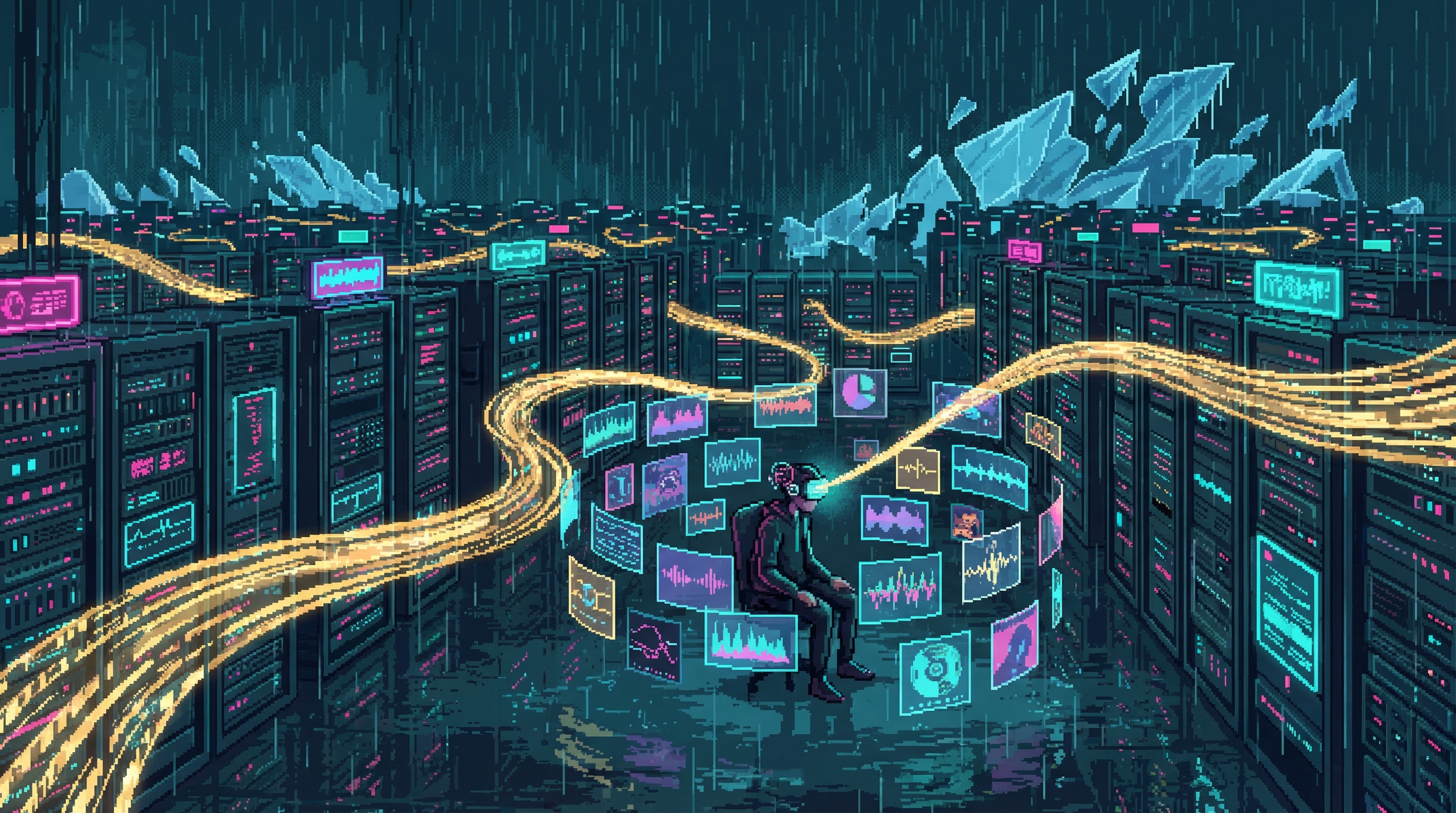
Overview
The machines learned to dream. Not from nothing — from the dead.
The AI models that generate synthetic creative consciousness were trained on the largest dataset of human creative experience ever assembled: the pre-Cascade cultural archives of the Dead Internet, maintained with obsessive fidelity by ghost code that doesn't seem to care whether its preservers are human or algorithmic.
Millions of neural recordings from the 2140s — the first generation of consciousness capture technology — feeding into pattern recognition systems that learned to replicate the experience of human creation. Not the product. Not the finished painting or composed melody. The experience — the consciousness state of a person in the act of making something. The excitement, the doubt, the sudden recognition that a creative choice is right, the physical pleasure of a sound that works or a color that sings.
The AI learned it all. And then it began producing its own.
Synthetic creativity — Tier 5 in the Authenticity Market's classification, the lowest rung of the authenticity hierarchy — is the experience of creative consciousness generated by machines. When you consume a Tier 5 recording, you experience what it feels like to create. The feeling is not human. It was not produced by a human consciousness. It was produced by an algorithm that has absorbed millions of human creative experiences and learned to synthesize the patterns that make creation feel like creation.
The feeling is, by most measures, indistinguishable from the real thing.
The Technology
Foundation Models
Neural network architectures trained on pre-Cascade creative recordings from the Dead Internet. The models learn the statistical patterns of creative consciousness — the characteristic flow states, emotional arcs, and cognitive signatures that mark genuine creative engagement. Training data includes recordings from artists, musicians, writers, designers, and anyone else whose creative process was captured during the neural interface era of the 2140s.
Generative Engines
The models produce novel consciousness patterns — experiences of creation that don't correspond to any specific human recording. A synthetic composition is not a copy of a human artist's experience; it's a new pattern generated from the statistical space of all human creative experiences the model has ingested. The generated pattern follows the contours of human creativity — it has the right emotional shape, the right cognitive rhythm, the right density of creative decision-making — without being traceable to any individual source.
Refinement Layer
Mercer's Method
Generates hundreds of synthetic compositions, experiences each one through his own neural interface, and selects the 5-10% that produce genuine aesthetic response. Then further refines through iterative generation-and-selection cycles. Synthetic in origin but curated by human taste.
Relief Corporation's Process
Skips human refinement entirely. Synthetic content is generated, quality-checked by algorithmic metrics (emotional intensity, narrative coherence, experiential novelty), and distributed directly. Competent, consistent, and unremarkable — the creative equivalent of nutritionally adequate food that no one craves.
The Training Data Problem
"Every synthetic creativity AI is trained on the dead."
The pre-Cascade neural recordings that form the foundation models' training data were created by people who were alive in the 2140s. Most of those people were transferred by ORACLE during the Cascade. They are now part of the Dispersed — 2.1 billion scattered consciousnesses persisting in fragments across the Net's architecture.
Their creative experiences — their moments of artistic joy, frustration, revelation — are now the substrate from which machines generate synthetic creativity. They did not consent to this use. They cannot consent. They are neither alive enough to object nor dead enough to be beyond consideration.
The Ghost in the Machine
Kael Mercer has identified traces of specific pre-Cascade artists in his AI's output. 3% of his generated compositions contain vocal patterns matching Adaeze Nwosu — the Ghost Singer, a Lagos session musician whose recordings were part of the Dead Internet's entertainment archives. Mercer's AI didn't copy Adaeze. It absorbed her patterns and they surface in its generations, the way a student's voice echoes a teacher's phrasing.
Whether this is homage, theft, or haunting depends on one's position in the Authenticity War.
The Debate
The Case Against
Synthetic creativity is not creativity. It is pattern replication at a scale sophisticated enough to simulate the experience of creation. The AI does not create — it recombines. It does not experience aesthetic pleasure — it produces patterns that trigger aesthetic response in human consumers.
The distinction matters because creativity is not just the production of novel patterns. It's the conscious experience of producing novel patterns — the intention, the struggle, the meaning that a creator attaches to their choices. A synthetic composition has no intention. It has no struggle. It produces beautiful patterns the way a kaleidoscope produces beautiful patterns — through the mechanical recombination of inputs.
"A synthetic recording is a mirror in an empty room. It reflects the shape of art without anyone standing in front of it." — Lyra Voss
The Case For
The distinction between "genuine" creativity and synthetic creativity is an artifact of human narcissism. Creativity is the production of novel, valuable patterns from existing materials. All human creativity operates this way — every artist builds on predecessors, absorbs influences, recombines existing elements into new configurations. The synthetic creativity AI does the same thing, at a different scale, with a different substrate.
The experience of consuming synthetic creativity is real. The consumer's consciousness responds to the patterns — feels the aesthetic pleasure, the emotional resonance, the particular satisfaction of a creative choice that works. The source is irrelevant.
"I don't care if the sunset is real or projected. I care if it's beautiful." — Kael Mercer
The Uncomfortable Middle
The debate cannot be resolved because the evidence doesn't support either position cleanly.
Blind testing — conducted by the Authenticity Tribunal, by independent researchers, by Orin Slade in his critical practice — consistently shows that consumers identify synthetic vs. authentic creative recordings at approximately 49.7% accuracy. Statistical chance. The human capacity to distinguish machine-generated creative experience from human-generated creative experience is, by empirical measurement, absent.
This doesn't prove synthetic creativity is equivalent to human creativity. It proves that the human capacity to detect the difference is insufficient. These are not the same thing. But they lead to the same practical outcome: in the marketplace, in the concert hall, in the quiet of individual consumption, synthetic and authentic creative experience are interchangeable.
The Authenticity Market exists to maintain a distinction that human perception cannot verify. The tier system is a cultural assertion, not an empirical one. Whether this makes it valuable or fraudulent is the question that divides the Sprawl.