Overview
It wasn't supposed to be art.
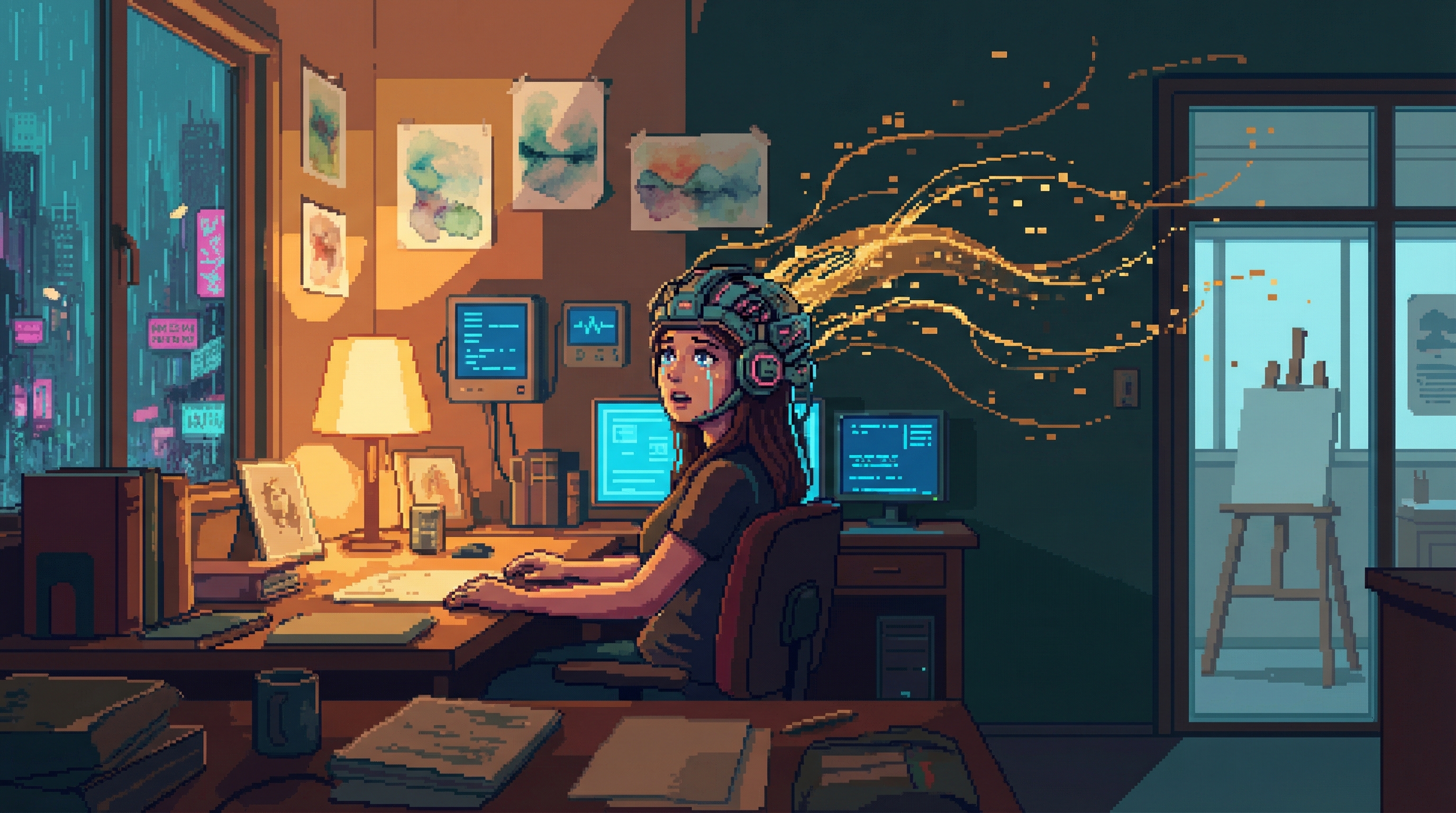
Dr. Priya Nath was reviewing clinical data. Patient 7 — a fragment carrier whose name has been redacted from surviving records — was undergoing routine consciousness monitoring at the Mumbai Neural Integration Clinic. The clinic treated people whose ORACLE fragment integration produced cognitive anomalies: memory intrusions, perceptual distortions, the occasional episode where someone else's consciousness temporarily displaced their own.
The treatment included creative activity. Fragment carriers who engaged in art, music, or writing during monitoring sessions showed improved integration metrics — the fragments seemed to settle when the carrier was creating. Patient 7 painted. Watercolors — landscapes of a city they'd never visited, rendered with a skill they didn't possess before integration, as if the fragment carried a dead person's artistic training.
On March 12, 2153, Dr. Nath reviewed Patient 7's monitoring data from a painting session. Standard procedure: load the consciousness recording into her clinical neural interface, observe the patient's cognitive patterns, note any anomalies. She'd done this hundreds of times with hundreds of patients.
This time was different.
The recording loaded and Dr. Nath was no longer reviewing data. She was painting. Not watching someone paint — painting. She felt the brush in a hand that wasn't hers. She saw colors through eyes that weren't hers. She experienced the particular quality of attention that a painter brings to the moment when the brush touches wet paper — the held-breath precision, the simultaneous control and surrender, the way the pigment bleeds into the fiber in patterns the painter guides but doesn't entirely determine.
She felt Patient 7's pleasure when a wash of blue settled into exactly the right shade. She felt their frustration when a line went wrong. She felt — and this is what she could never adequately describe afterward — the creative intent. The sense of trying to make something specific, of reaching for an image that existed in the mind and negotiating with physical materials to manifest it. The gap between vision and execution. The joy when the gap closes.
The recording lasted four minutes and twelve seconds. Dr. Nath experienced every moment from inside Patient 7's consciousness. When it ended, she sat in her clinical office and wept.
Not from sadness. From recognition. She had just experienced what every artist experiences and no audience had ever accessed: the inside of the creative act. The first person in human history to inhabit another person's creative consciousness and understand, with no mediation, no translation, no approximation, what it feels like to make something.
The Recording Itself
What It Contains
Four minutes and twelve seconds of Patient 7's consciousness during watercolor painting. The recording captures three distinct layers:
Sensory Layer
The visual field of someone painting — the white paper, the wet pigment, the brush's movement. The room's ambient light. The smell of paint and water. The temperature of the brush handle between fingers. The faint scratch of bristles on paper, the clinic's air circulation, the distant sound of traffic outside the Mumbai clinic.
Somatic Layer
The physical experience of painting — the fine motor control of brush movement, the tension in the wrist, the steady breathing of focused concentration. The subtle lean forward as the painter examines their work. The relaxation when a section is complete.
Cognitive Layer
The creative process itself. This is what makes the recording unprecedented. The viewer experiences Patient 7's aesthetic decision-making in real time — the evaluation of colors, the spatial reasoning of composition, the moment-to-moment adjustment of intent as the painting develops. The viewer doesn't just see the painting being made. They understand why each stroke goes where it does, because they're experiencing the consciousness that made the decision.
What It Doesn't Contain
Patient 7's identity. The clinical recording captured consciousness patterns during a specific activity, but the monitoring equipment wasn't designed to capture biographical data — personal memories, self-concept, identity markers. The viewer experiences someone painting but doesn't know who.
This anonymity has become part of the recording's power. The viewer doesn't experience a specific person's creativity. They experience creativity itself — the universal patterns of a consciousness engaged in making something beautiful.
Patient 7's identity has never been established. They were a fragment carrier treated at the Mumbai clinic between 2151 and 2154. The clinic was destroyed during the Cascade. Its physical records are gone. Its digital records survive in the Dead Internet, but Patient 7's identifying information has been lost — or was never digitized.
The painter who started an art form has no name.
The Aftermath
Priya Nath recognized immediately that the recording was not medical data. It was something for which no category existed: the direct transmission of creative experience from one consciousness to another.
She wrote a paper titled "Consciousness as Medium: Creative Experience Transfer via Neural Interface Monitoring." The paper was rejected by three medical journals as outside their scope. It was published in an arts and technology review in 2154. It was read by 200 people in its first year. By 2156, it had been cited 40,000 times.
Nath did not patent the process. She did not commercialize the recording. She shared it freely with any researcher, artist, or institution that requested access. This decision — made in the first months, before anyone understood the commercial implications — meant that neural recording art developed as an open practice rather than a proprietary technology.
Relief Corporation would later develop the consumer neural interface and the distribution platform. But the underlying principle — that creative consciousness can be recorded and transmitted — was established as public knowledge because one clinician decided that what she'd experienced was too important to own.
Priya Nath was connected to the network when the Cascade hit. She is among the Dispersed.
The Three Copies
The original recording exists in the Dead Internet's Mumbai medical archives. Ghost code maintains it with the same inexplicable fidelity it brings to all pre-Cascade digital artifacts.
In 2178, a Consciousness Archaeologist team led by Kaspar Eriksen recovered the recording during a Dead Internet dive. The recovery was front-page news in The Zephyria Record.
Consciousness Archaeologists Archive
Available for research access. Playback requires institutional authorization. Held with the same reverence the Archaeologists bring to all recovered consciousness artifacts.
Relief Corporation
Available for public playback at Relief Experience Centers. Price: 500 credits per session. Relief markets it as "The Birth of Neural Art" — a branding choice that makes Dr. Nath's colleagues wince.
Anonymous Collector
Acquired through the Echo Bazaar for an undisclosed price. The Echo Thief claims to have facilitated the sale. The Authenticity Tribunal considers the copy stolen property. The collector has never been identified.
Cultural Significance
The First Recording occupies the same cultural position as the first photograph, the first film, the first sound recording — it is the origin artifact of a medium that reshaped human creative expression.
But it is more intimate than any previous origin artifact. The first photograph showed what a camera could see. The first film showed what could be projected. The First Recording showed what it feels like to be someone else in the act of creation. It crossed a boundary that previous technologies approached but never reached: the boundary between observing art and being the artist.
Every neural recording since — every lived-canvas performance, every curated experience, every synthetic composition — is a descendant of those four minutes and twelve seconds. The Authenticity Market, the tier system, the entire economy of creative consciousness — all of it traces back to a clinician reviewing patient data and discovering that the data was not data. It was art. It was always art. The technology just made it transmissible.
"This is the first time one person felt another person create. Everything since has been a footnote. Go feel it." — Orin Slade, reviewing the recovered recording