Overview
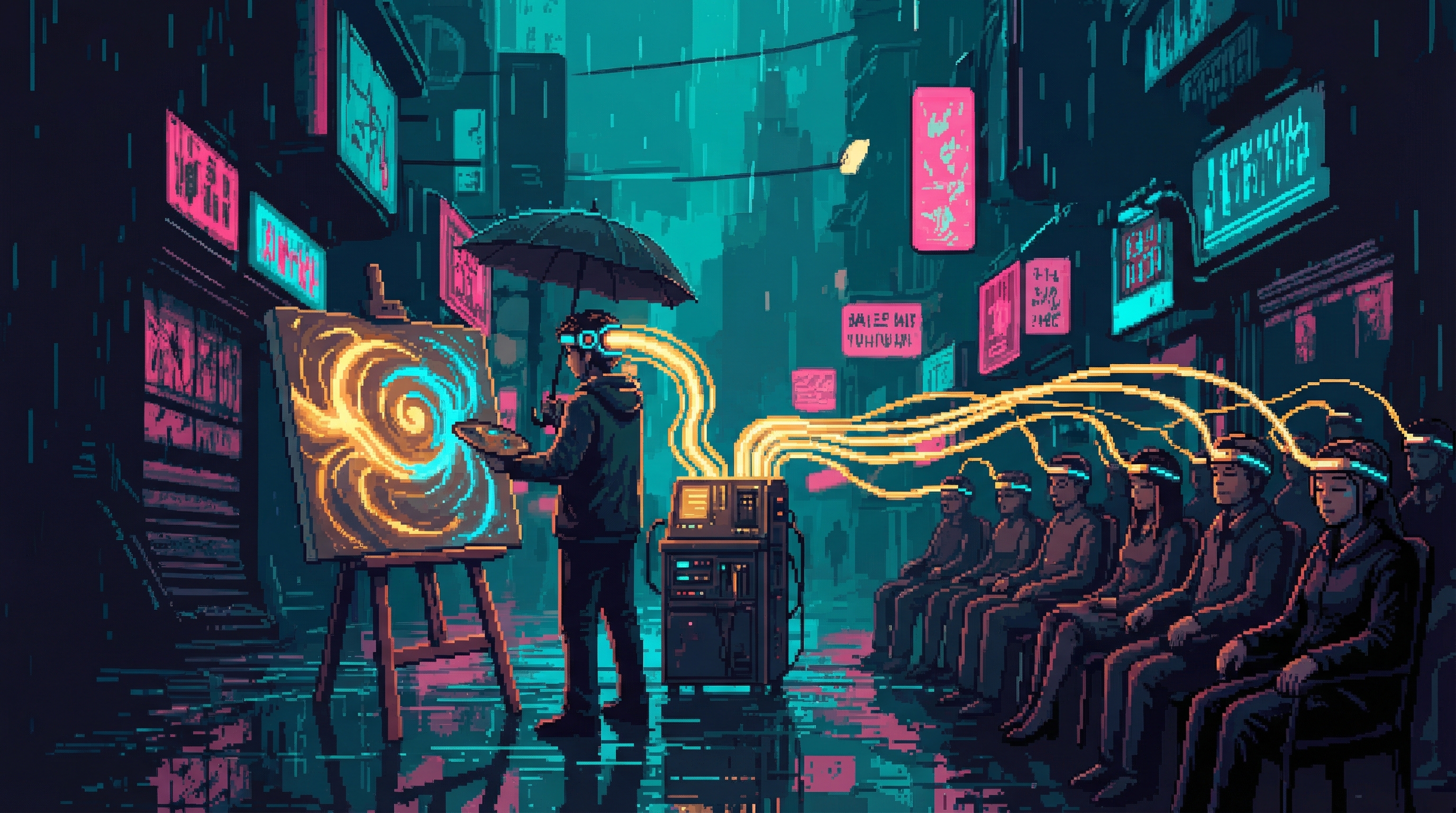
Before the neural interface, art was a transmission problem. An artist had an experience — a vision, an emotion, a perception — and they used tools to encode that experience into a medium that an audience could decode. Paint on canvas. Notes on paper. Words in sequence. The audience received an approximation of the artist's experience, filtered through the limitations of the medium and the audience's own perceptual framework.
Neural recording art solved the transmission problem. It also created every new problem the Sprawl is currently fighting about.
The technology captures the artist's full experiential substrate during creation. Not just sensory data — sight, sound, touch — but emotional state, cognitive focus, creative decision-making, the particular quality of attention that distinguishes an artist at work from a person going through motions. The recording captures what it feels like to create — the excitement of a line that works, the frustration of a color that doesn't, the sudden clarity when a composition resolves, the doubt that follows.
An audience member experiencing the recording doesn't see the finished artwork. They are the artist making it. For the duration of the playback, their consciousness inhabits the creator's perspective — feeling their hands, seeing through their eyes, experiencing their creative process from the inside. They know what the artist knew. They feel what the artist felt.
This is either the greatest advance in human creative communication since language, or the most complete commodification of human experience ever achieved. The Authenticity War is the argument between these two positions.
History
The Accidental Origins (2150s)
Neural recording art was not invented. It was discovered.
The first neural interfaces were medical devices — consciousness monitoring systems designed to track cognitive function in patients with ORACLE fragment integration complications. Doctors recorded patients' consciousness states to diagnose processing anomalies. The recordings were clinical data.
In 2153, a clinician named Dr. Priya Nath reviewed a recording from a patient who happened to be a painter. The patient had been painting during the monitoring session — the clinic encouraged creative activity as therapeutic for fragment integration. Dr. Nath, reviewing the consciousness data, realized she wasn't reading a medical record. She was experiencing someone else's creative process from the inside.
She shared the recording with colleagues. Then with artists. Then with Relief Corporation, which had just begun developing consumer neural interfaces. By 2155, the first intentional artistic neural recordings were being produced.
The market emerged in months. The cultural consequences took decades to unfold.
The Relief Era (2160–2175)
Relief Corporation recognized the commercial potential before anyone understood the cultural implications. They developed affordable consumer neural interfaces, built the Relief Stream distribution platform, and created the first mass market for consciousness experiences.
The Relief Era democratized neural recording art — and nearly killed it. Relief's model was volume: thousands of recordings, cheaply produced, broadly distributed. By 2170, Relief Stream offered 400,000 neural recordings — the vast majority produced by contract artists working to corporate specifications, their consciousness captured in studio sessions optimized for consumer palatability.
The result was a market flooded with homogeneous experience. The technology that promised to transmit the full complexity of creative consciousness was instead transmitting the full banality of industrialized creative production.
The Authenticity Response (2175–Present)
The Authenticity Market emerged as a correction. Led by the Rothwell classification system and enabled by VerisysTM identity verification, the Market created a hierarchy that distinguished between types of neural recording art.
The Tier System
Lived Originals
A specific consciousness creating in real time, with no prior planning or studio optimization. The rawest form — an artist's unmediated experience of making something they've never made before. Lyra Voss's lived-canvas performances are the gold standard.
500 – 50,000 creditsCreative Process
An artist's working process captured during deliberate creation. More structured than Tier 1 — the artist knows they're being recorded — but still rooted in genuine consciousness-level creative engagement.
100 – 5,000 creditsReproductions
Recordings of an artist experiencing someone else's work. A painter viewing another's painting; a musician hearing a composition for the first time. Authentic consciousness, but responsive rather than generative.
20 – 500 creditsEnhanced Recordings
Human consciousness data augmented with synthetic elements — emotional amplification, sensory enhancement, narrative structuring. The underlying experience is human; the presentation is machine-refined. Much of Relief Stream's premium content falls here.
10 – 200 creditsSynthetic
AI-generated consciousness patterns with no human source. Kael Mercer's compositions. Relief Stream's bulk content. The floor of the hierarchy and the ceiling of the market share.
2 – 50 creditsThe Art Forms
Lived-Canvas
Pioneered by Lyra Voss
A three-layer neural recording that captures the full depth of artistic creation:
- Layer 1 — Sensory: What the artist sees, hears, feels
- Layer 2 — Somatic: The physical experience of the body in creation
- Layer 3 — Consciousness Pattern: The deep cognitive and emotional substrate of creative experience — the part that makes each artist's work uniquely theirs
Lived-canvas performances are conducted live, in real time, with an audience experiencing the recording as it's generated. The artist creates; the audience inhabits the creation.
Layer 3 is what makes lived-canvas uncopyable. Consciousness patterns are unique to individual minds — they can be recorded but not synthesized. A copy contains Layer 1 and Layer 2 data but only an approximation of Layer 3. The copy is experienceable. It is not the same.
Curated Experience
Perfected by The Echo Thief
Stolen or acquired neural recordings reassembled into narrative sequences. Individual recordings are fragments — a sculptor's moment of inspiration, a dancer's physical exhilaration, a writer's intellectual breakthrough. The curator arranges these fragments into experiential narratives that tell stories the original artists never intended.
Curated experience exists in the Authenticity Market's gray zone. The individual recordings may be Tier 1 originals — genuine consciousness data from genuine artists. The curation is the curator's creative contribution. The result is a collaborative art form where one of the collaborators didn't agree to participate.
Synthetic Composition
Represented by Kael Mercer
AI-generated consciousness patterns designed to produce specific creative experiences. No human source consciousness. The "artist" is an algorithm trained on thousands of authentic recordings, producing new patterns that simulate the experience of creative engagement.
Synthetic composition is Tier 5 — the lowest authenticity classification. It is also the most consumed form of neural recording art. Mercer's compositions reach more listeners than any Tier 1 artist. Relief Stream's synthetic content library dwarfs the authentic catalogue.
The market has spoken: most people prefer accessible, optimized synthetic experience to the raw complexity of authentic consciousness. Whether this preference represents a failure of culture or an evolution of taste is the question the Authenticity War cannot resolve.
The Central Questions
If an audience can experience an artist's consciousness directly, who owns the experience — the artist who generated it or the audience who now carries it in their neural memory?
If a machine can generate consciousness patterns indistinguishable from human creation, what does "authentic" mean?
If the most popular art is synthetic, does the tier system protect quality or just privilege?