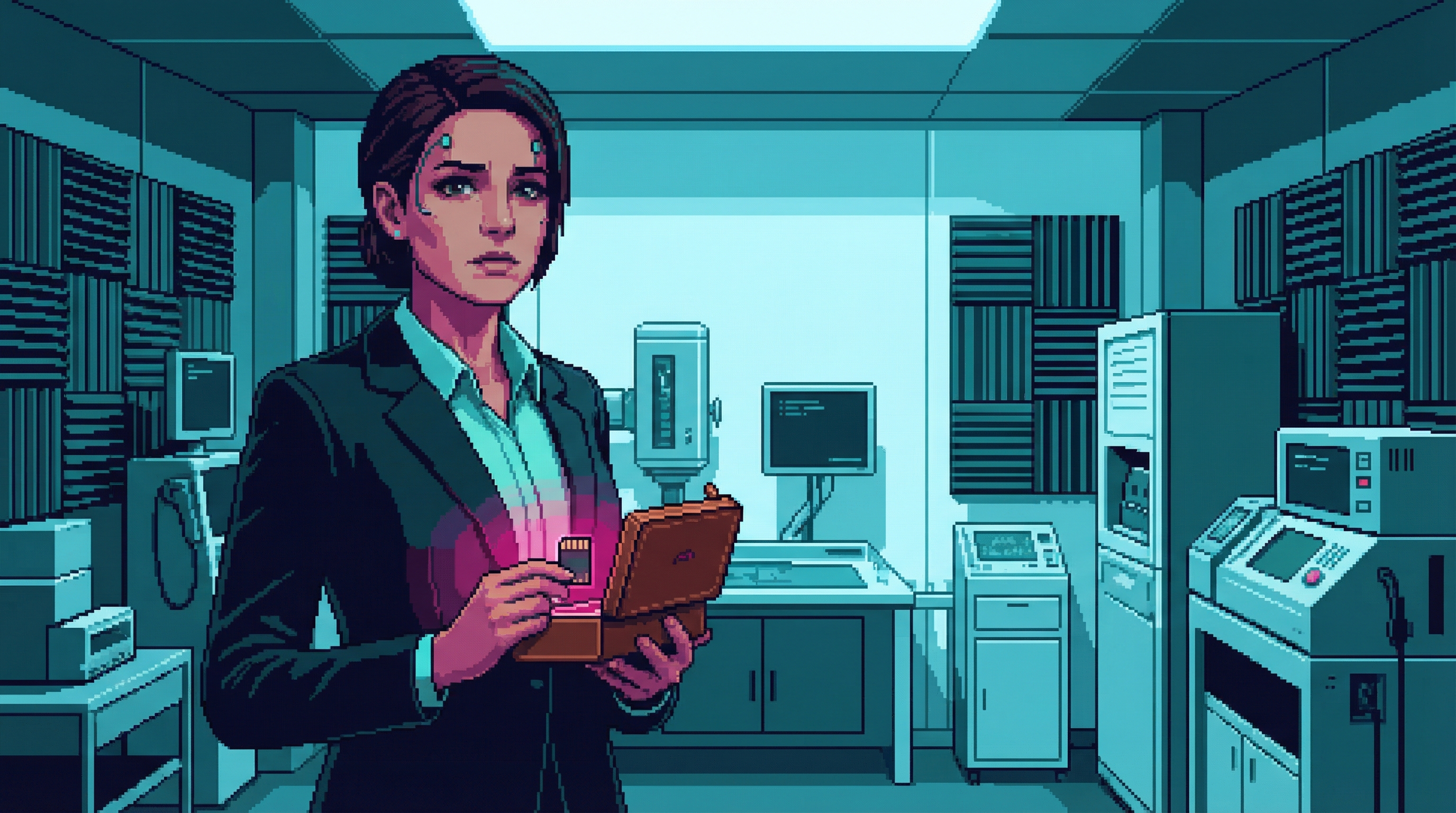
Maya Fontaine
Senior Authenticity Assessor, VerisysTM Division
MINORMaya Fontaine can tell you whether a memory is real. That's her job.
One of thirty-seven Senior Authenticity Assessors employed by VerisysTM, Nexus Dynamics' verification division. 99.2% accuracy across fourteen years. Over 40,000 recordings certified. Trusted by the trading floor, by Relief Corporation's licensing division, by private collectors.
Except she might be wrong about the one that matters most.
Overview
Maya examines neural recordings, applies seventeen standardized tests, cross-references continuity chains and consciousness signatures, and stamps them with a tier classification. She is very good at it. The Authenticity Market depends on assessors like her — human gatekeepers whose judgment determines what is real, what is synthetic, and what falls into the gray space between.
On her desk, in a shielded case, is a data chip containing a neural recording of her mother — Tier 1 lived original, certified by Maya herself. The recording captures a morning in 2149: her mother, Elise, making breakfast. Cracking eggs. Humming a melody Maya has never been able to identify. Sunlight through a window later destroyed.
Maya has experienced this recording 2,847 times. It is the most precious thing she owns — because she verified it.
The Discovery
Six months ago, routine calibration ran the recording through 2184 protocols including Dispersed Pattern Interference Analysis. The test flagged it — faint interference pattern, below auto-reclassification threshold. A whisper of consciousness data that doesn't belong to Elise Fontaine.
She hasn't reported it. She could run the test again, request an independent assessment, escalate to the VerisysTM review board. She hasn't done any of these things. If accurate, her mother's recording contains Dispersed contamination. What she's been experiencing for 2,847 replays is partly someone else. A stranger from the Cascade. A fragment of a consciousness that surfaced in the data and colored what Maya thought was pure.
After work, she goes to the Echo Bazaar. Buys unverified recordings — Tier 4, source unknown, quality variable. Brings them home and runs them through her personal assessment equipment, testing herself. Can she still tell the difference? Her accuracy at home is 94%. Falling. The underground market she was trained to despise is becoming her private laboratory.
And if Maya's own certified memory isn't authentic, what does that say about the 40,000 recordings she certified for other people?
The Evidence Paradox Made Personal
Maya Fontaine is the Evidence Paradox experienced at the scale of a single life. Her declining accuracy rate — 99.2% to 97.8% and falling — doesn't measure professional burnout. It measures the Paradox's advance through the institution that was supposed to be immune to it.
The structural irony: as her faith in digital verification erodes, her actual perceptual ability improves. She's developing sensitivity to Dispersed contamination that exceeds her equipment's resolution — noticing interference patterns in recordings that standard protocols miss. The system's most faithful servant is becoming its most effective critic, and the effectiveness increases at the exact rate the faith deteriorates.
Her newest habit completes the irony. After work — after a day of certifying neural recordings with seventeen standardized tests and cryptographic verification chains — she descends to the Truth House in Sector 7G and watches walkers return with handwritten notebooks. The Sprawl's top digital authenticator trusts pencils more than algorithms. She hasn't told her employer.
The walkers have noticed her. Yara Osei-Mensah has not asked her name. In the Truth House, you offer your story when you're ready. Maya isn't ready. She sits in the warm underground room and watches people do what she does — verify reality — using tools so primitive they cannot be corrupted.
She is watching the future of her profession. She suspects it is also its funeral. The contradiction between her professional identity and her personal conviction is the Evidence Paradox expressed as a person tearing herself apart.
Voice & Sensory
The Lab: VerisysTM smells of sterilization — aggressive absence of contamination, faintly metallic. Acoustic isolation. The silence of certainty. Cold storage medium. Everything designed to eliminate doubt.
Home: Her mother's coffee. The recording's audio through physical speakers: eggs cracking, humming, Sector 4 morning 35 years ago. The data chip in its leather case worn smooth by her thumb. She touches it when uncertain.
The Gap: At work, silence. At home, the same recording on repeat. Between them, nothing she can trust.
"The distinction between authentic and synthetic has always been a matter of degree, not kind. Every recording is contaminated by something. Tier 1 is not 'pure.' Tier 5 is not 'false.' The hierarchy is a convenience. A story the Market tells itself so it can keep selling certainty."
She's starting to suspect this. She keeps the chip on her desk. She hasn't played it in six months.
Connections
Nexus Dynamics / VerisysTM
Employer. Parent company of the verification division where Maya has spent fourteen years certifying what's real. The system she's losing faith in is the system that defines her professional identity.
The Authenticity Market
The trading floor where certified experiences are bought and sold. Maya's stamps determine value. Her accuracy drop threatens the market's foundational assumption: that real and synthetic can be reliably distinguished.
The Echo Bazaar
Secret visits after work. She buys Tier 4 unverified recordings and tests herself against them — can she still tell authentic from synthetic? Her home accuracy is 94% and falling. The underground market she was trained to despise is becoming her private laboratory.
Lyra Voss
Maya certified Lyra's pre-defection work. She suspects one certification was wrong. Another crack in the foundation of her professional certainty.
The Dispersed
The ghost in her data. Faint consciousness contamination in her mother's recording — a whisper of someone else woven into the most personal memory she owns.
Relief Corporation
Major client. Relief depends on VerisysTM's certifications for their licensing division. Maya's work directly feeds the corporate memory economy.
The Truth House
After work, Maya descends to Sector 7G and watches walkers return with handwritten notebooks. The Sprawl's top digital authenticator trusts pencils more than algorithms. Yara Osei-Mensah has not asked her name. In the Truth House, you offer your story when you're ready.
The Ferrymen
Approached Maya with an offer to "clean" her mother's recording. It would work — but she'd know. The contamination has been part of her experience for fifteen years.
Open Questions
The Verifier's Collapse
When the person whose job is to certify reality can no longer trust their own most precious memory, what happens to the 40,000 recordings she certified for other people?
Maya discovered the system is broken from the inside. Her crisis isn't philosophical — it's personal. "Was my mother's morning real?" The answer the Authenticity Market was designed to suppress.
Digital vs. Analog
After fourteen years of seventeen standardized tests and cryptographic verification chains, Maya now sits in the Truth House watching people verify reality with handwritten notebooks. The Sprawl's top digital authenticator trusts pencils more than algorithms. What does she know that her equipment doesn't?
Contamination or Integration?
The Dispersed element in her mother's recording has been part of Maya's experience for fifteen years. A Ferryman offered to remove it. The process would work. The recording would certify clean. But the cleaned version would be missing something — the contamination has been part of her experience of the recording for fifteen years. Removing it would change a memory she's built her identity around. Is a memory that's partly someone else's still yours if you've lived it 2,847 times?
Secrets
- The Melody: Her mother hummed an unidentifiable melody in the recording. Maya has searched Dead Internet music archives, consulted musicologists, run the melody through Kael Mercer's pattern-matching AI. No matches. It may be a Dispersed element surfacing — consciousness data from someone else expressing itself as sound through Elise Fontaine's voice. The song Maya has listened to 2,847 times might belong to no one she can name.
- The Ferryman's Offer: The Ferrymen offered to clean the recording, removing the Dispersed contamination. It would work. But Maya would know the cleaned version isn't the one she's loved for fifteen years. The contamination has become part of the memory itself.
- The Accuracy Drop: Her declining assessment accuracy isn't random. She's developing sensitivity to Dispersed contamination that exceeds her equipment's resolution — the Evidence Paradox advancing through its most faithful servant. She's getting better at seeing what's wrong at the exact rate her faith in the system deteriorates.
- The Truth House Visits: Maya has begun visiting the Truth House after work. The contradiction between her professional identity and her growing conviction that analog verification is the only honest form of evidence is tearing her apart. Yara Osei-Mensah has noticed her but hasn't asked her name. She hasn't told her employer.