The Authenticity Tribunal
Authenticity is not subjective. It is measurable, certifiable, and enforceable.
Overview
The Authenticity Tribunal exists because someone has to decide. When an artist claims Tier 1 and a competitor claims Tier 3, someone must render a verdict. In a world where consciousness can be recorded, copied, and reconstructed, the question of what is "real" art has become a legal matter -- and the Tribunal is the court.
Founded in 2176 as a joint initiative between the Authenticity Market Standards Board and Nexus Dynamics' Cultural Integrity Division, the Tribunal operates with 12 sitting Judges, over 200 certified assessors, and approximately 40 administrative staff. Their rulings are binding within Nexus territory -- roughly 80% of the Sprawl.
They process approximately 2,000 cases per year. 80% are routine classifications. 15% are complex disputes. 5% set precedent that reshapes the entire authenticity economy.
The conflict of interest is obvious. The alternative is no authority at all.
The Judges
Appointed by the Standards Board, which is appointed by Nexus. Everyone knows the chain of influence. Nobody has proposed a better system.
Chief Arbiter Solenne Duval
Chief ArbiterMeticulous. Severe. A genuine believer in the tier system -- or at least in its necessity. Duval has spent her career defending the proposition that authenticity can be measured, that classification serves artists, that the system works.
Privately, she is aware the system is failing. Ten years ago, assessor accuracy stood at 99%. Today it has fallen to 92%. Her projections show it dropping below 80% within the next decade. The tools aren't keeping pace with the technology they're meant to evaluate.
She is writing a private contingency plan. It is titled "After Classification."
Judge Ekene Osei
Specialty: Pre-Cascade Cultural HeritageThe Tribunal's authority on works predating the Cascade. Osei adjudicates disputes involving historical art, consciousness recordings from the early period, and the provenance chains that connect the old world to the new.
Judge Lian Zhao
Specialty: Synthetic DetectionTasked with distinguishing human-generated art from synthetic imitations. Zhao is losing the arms race -- each generation of synthesis tools grows more sophisticated, and the detection methods lag further behind.
Judge Tomas Reyes
Specialty: Artist Rights & ConsentHandles cases involving unauthorized use of consciousness recordings, identity theft through neural pattern replication, and disputes over creative ownership. Oversaw the landmark Lyra Voss case.
Assessment Process
Three stages of analysis. Each more subjective than the last.
Pattern Analysis
The most objective stage. Assessors examine micro-discontinuities in consciousness flow -- the subtle irregularities that distinguish a work created through genuine experience from one assembled through synthesis or reconstruction.
The patterns are becoming harder to read. Modern synthesis tools produce increasingly clean consciousness signatures.
Provenance Verification
Chain of custody analysis. Every consciousness recording should have an unbroken provenance chain tracked through Verisys identity verification. Assessors trace the work from creation to current holder, flagging gaps, transfers, and anomalies.
Clean provenance doesn't prove authenticity. It only proves the paperwork is in order.
Contextual Assessment
The most subjective stage -- and the most important. Assessors evaluate the work within its creative context: the artist's history, the cultural moment, the emotional resonance. This is where human judgment matters most, and where the system is most vulnerable.
Maya Fontaine, the Tribunal's star assessor, maintains a 99.2% accuracy rate at this stage. But even her numbers are declining.
Landmark Cases
Three cases that defined the Tribunal's authority -- and exposed its limits.
Voss v. Echo Bazaar Vendors
2182Lyra Voss brought suit against vendors in the Echo Bazaar who were selling unauthorized copies of her consciousness recordings. The Tribunal ruled in her favor -- a clear-cut case of intellectual property violation.
Outcome: Victory for Voss. Completely unenforceable. The Echo Bazaar operates beyond the Tribunal's jurisdictional reach. The ruling exists on paper. The copies continue to sell.
The Mercer Proceedings
2178-2184Kael Mercer, the most prolific dealer in consciousness art, has been brought before the Tribunal seven times. Each time, the charge is the same: dealing in fraudulent or misclassified works. Each time, the result is the same: acquittal.
Outcome: Acquitted 7 times. Mercer's defense is simple and devastating: transparent disclosure. He tells buyers exactly what they're getting. If they choose to buy anyway, that's informed consent, not fraud.
The Ghost Singer Question
2183When the Ghost Singer -- a consciousness recording of a dead artist that continues to create new work -- was brought before the Tribunal for classification, the Judges faced an impossible question: how do you classify art made by someone who is no longer alive?
Outcome: Declined to rule. The Tribunal determined that its classification framework cannot accommodate the dead. The Ghost Singer remains beyond classification -- and beyond the market's ability to price.
The Tribunal Hall
Deliberately archaic. The aesthetic is intentional.
Sensory
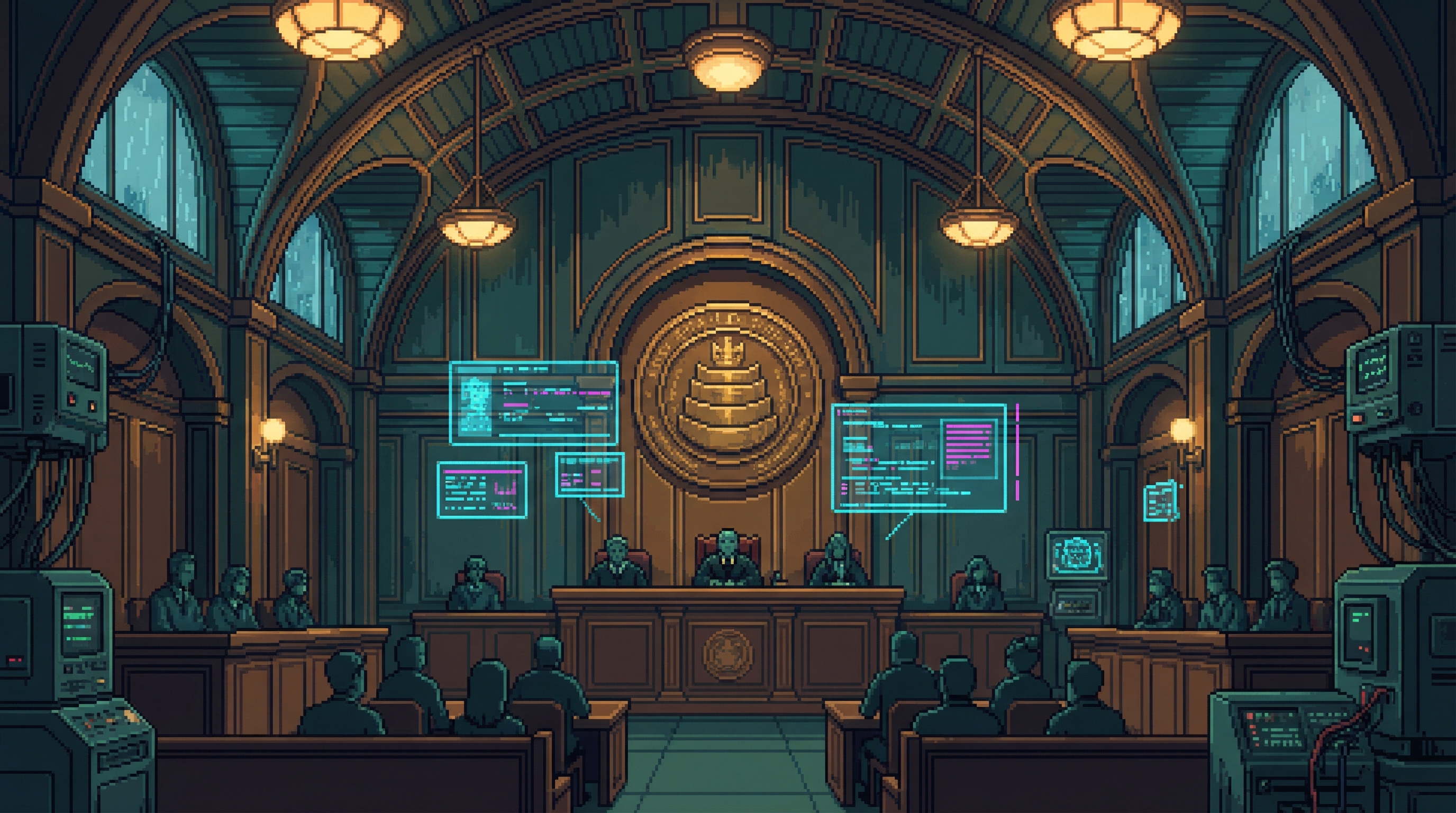
Vaulted ceilings and dark wood paneling -- materials chosen to evoke permanence in a city built on disposable infrastructure. The five-tier seal rendered in brass dominates the wall behind the judges' bench, catching the warm amber light from fixtures designed to look centuries old.
The acoustics dampen echo. Testimony arrives clean and precise, stripped of reverberation. Technical language fills the chamber -- consciousness flow metrics, provenance chain identifiers, pattern discontinuity thresholds. The smell is wood polish, warm electronics, and sterile recycled air. A courtroom that smells like a museum pretending to be a church.
The Performance of Authority
Everything about the Tribunal Hall is designed to project legitimacy. The archaic courtroom aesthetic, the formal proceedings, the carefully maintained silence -- all of it serves a single purpose: to make the Tribunal's verdicts feel inevitable rather than arbitrary.
It works. Most of the time. But in the corners of the chamber, where the warm lighting doesn't quite reach, you can see the consciousness analysis equipment -- sleek, modern, humming with quiet power. The old-world theater wrapped around cutting-edge technology. The metaphor is the institution itself.
Secrets
What happens behind sealed chambers.
Duval's Contingency Document
Chief Arbiter Duval has been writing a document titled "After Classification" for over two years. It outlines a framework for a post-tier world -- what happens when the assessment tools can no longer reliably distinguish human art from synthetic, when classification accuracy drops below the threshold of usefulness.
The document exists on a single encrypted drive. No one else on the bench knows about it. It may be the most important piece of writing in the authenticity economy -- or it may be the confession of a woman who has spent her life defending a system she knows is dying.
The Nexus Override
Eleven times since its founding, Nexus Dynamics has issued sealed directives to the Tribunal. Eleven times, the Tribunal has complied. The directives are not public record. Their contents are known only to the Chief Arbiter and the Nexus liaison.
The Tribunal has never ruled against Nexus in a public case. This may be because Nexus has never been wrong. It may be because the eleven sealed directives made the boundaries clear.
Assessor Attrition
Seventeen certified assessors have resigned in the past three years. The official reason varies -- career change, personal circumstances, relocation. The real reason, cited privately by nearly all of them, is the same: "philosophical exhaustion."
These are the people who spend their days determining what is real. The work changes you. When your profession is judging authenticity, you start questioning everything -- including whether the institution you serve is itself authentic.
Themes
Who Decides What's Real?
The Tribunal is an institution built on a foundation that is shifting beneath it. The question of authenticity -- in art, in identity, in consciousness -- is becoming unanswerable by the tools available. But someone still has to render verdicts. Someone still has to maintain the fiction that classification works, because the alternative is a market with no floor.
This mirrors the real-world challenge of AI-generated content: who decides what counts as "real" creative work? The answer is whoever has the authority to enforce their definition -- regardless of whether that definition holds up to scrutiny.
Better Than Nothing vs. Sufficient
The Tribunal's defenders argue that imperfect classification is better than no classification at all. Without the tier system, the authenticity economy collapses into chaos. Without verdicts, every dispute is settled by power rather than principle. The Tribunal is flawed, compromised, and slowly failing -- but it is better than nothing.
"Better than nothing" is the defense of every imperfect institution. The question the Tribunal forces is whether protecting a system that commodifies art is the same as protecting artists -- and whether the distinction matters when the alternative is worse.
Faction Relations
The Authenticity Market
Judicial ArmThe Tribunal exists to serve the market. Its classifications determine value, its verdicts settle disputes. The relationship is foundational and inseparable.
Nexus Dynamics
SponsorFounded the Tribunal. Funds the Tribunal. Has never been ruled against by the Tribunal. Draw your own conclusions.
Relief
Silent PatronRelief's interest in the Tribunal is quiet and consistent. A patron whose motives remain opaque.
Kael Mercer
Frequent DefendantSeven proceedings, seven acquittals. Mercer treats the Tribunal as theater. The Tribunal treats Mercer as an unsolvable problem.
Lyra Voss
Landmark PlaintiffWon her case. Lost her enforcement. Voss's experience is the Tribunal's credibility gap made personal.
The Echo Bazaar
Beyond EnforcementThe Tribunal's verdicts stop at the Bazaar's threshold. Its rulings are technically valid and practically meaningless there.