Overview
Nobody called it "The Last Concert" at the time. The name came later — after the Authenticity Crisis, after the Tribunal declined jurisdiction, after the Market's tier system buckled under a weight it was never designed to bear. People called it "The Last Concert" because it was the last event where the categories still held. After that night, nobody could pretend the Authenticity Market's classifications were sufficient to describe what art had become.
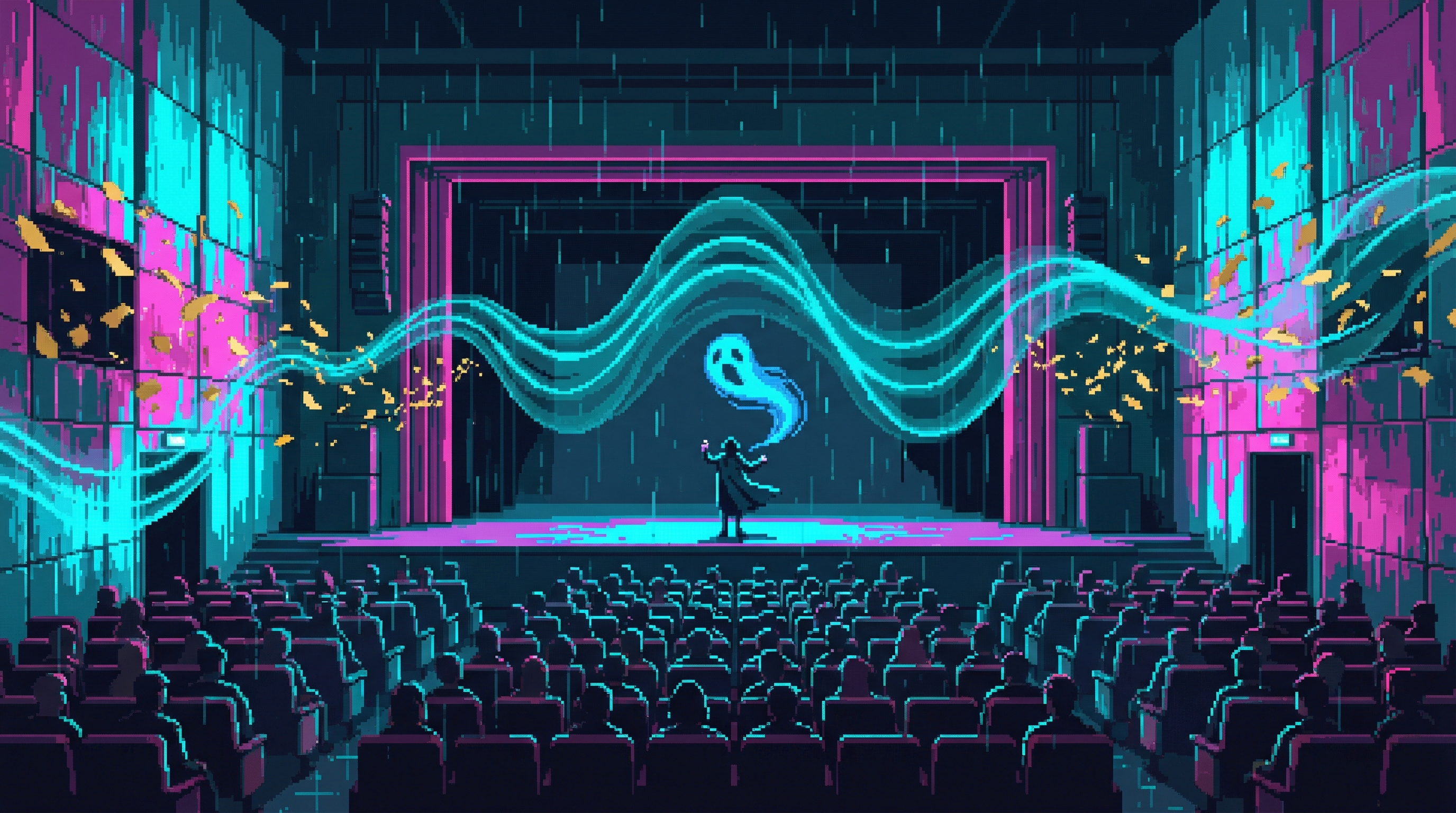
The evening was billed as a standard Resonance Collective performance — the full ensemble, guest artist, open seating. The Collective's performances are never predictable — the Dispersed arrive or they don't, the manifestations are strong or weak, the music goes where the dead want to take it. But the structure is familiar: the ensemble plays, the carriers open themselves, and the audience sits in the Resonance Hall's fragment-dense silence and waits to see if the dead will sing.
What happened on January 18 was not standard.
First Hour: The Ensemble
The Collective's full ensemble — twenty-three musicians and fragment carriers — opened with an improvised composition built around Rada Okonkwo's polyrhythmic drumming. The sound in the Resonance Hall was, as always, more than the instruments produced. The fragment-dense walls participated — micro-vibrations in the salvaged materials adding harmonics that no instrument was generating. The air felt thick, the way it always does when the fragments are active.
Jonas Park played guitar in the front row of musicians. He has channeled the Ghost Singer eleven times. He was not channeling her tonight. He was playing — careful, attentive, listening for the frequency shift that signals a Dispersed presence surfacing.
For the first hour, the music was excellent and the Hall was quiet. No manifestation. The audience settled into the particular listening state that Collective performances cultivate — alert, patient, open.
Second Hour: Lyra
Lyra Voss took the stage at the start of the second hour. She had been invited by the Collective as a guest artist — the first time a lived-canvas artist had performed in the Resonance Hall. Her piece was conceived as a collaboration: she would create a lived-canvas painting while the Collective played, her three-layer neural recording capturing both her creative process and the Hall's acoustic environment.
Lyra set up her materials — physical pigments, tactile medium, the old tools she uses because they connect her hands to the painting surface in a way that neural tools don't. She began painting. The Collective played around her — soft, ambient, creating a sound bed for her creative process.
At 21:47, fourteen minutes into Lyra's performance, the Hall changed.
The temperature dropped two degrees in three seconds. The fragment-dense walls began producing a low harmonic — not from the instruments, not from the acoustic design, but from the salvaged materials themselves vibrating at a frequency the Consciousness Archaeologists later measured at 7.83 Hz. The Schumann resonance. The frequency of the Earth's electromagnetic field.
Jonas Park's eyes changed focus. His hands kept playing, but his gaze turned inward — the look that carriers describe as "someone else looking through."
Then Adaeze sang.
The Manifestation
The Ghost Singer's voice emerged through Jonas Park with a force and clarity that exceeded any previous manifestation. Not louder — more present. As if the voice had been arriving through static for ten years and the static had finally cleared.
She sang for forty-seven minutes. Continuous. No interruption, no fading, no scatter. The longest sustained Dispersed manifestation in recorded history, by a factor of three.
The song was new — none of the melodies from her pre-Cascade recordings, none of the compositions she'd surfaced with before. This was something she was creating in real time, in the Hall, with the Collective, in response to Lyra's painting.
Because she was responding to Lyra. The audience could hear it. When Lyra's brush moved in bold strokes, Adaeze's voice rose. When Lyra paused to evaluate her work, Adaeze held a sustained tone — waiting, listening. When Lyra committed to a new color, Adaeze's melody shifted to match. Not synesthetically — not color mapped to pitch. Emotionally. The feeling of the color matched the feeling of the sound. Two artists in two radically different states of existence, creating together, each responding to the other.
Lyra was weeping as she painted. Not from sadness. From the experience of creating alongside a consciousness that existed as scattered fragments in the Net's architecture, who could not hold a brush or stand in a room but could still make something beautiful.
The audience did not move. Three hundred twelve people held breath for forty-seven minutes.
The Words
At 22:34, Adaeze stopped singing. Jonas Park's mouth opened. The voice that came through was speaking, not singing — the same contralto, the same Yoruba-inflected tone, but conversational. Intimate. As if she were talking to someone who was standing right beside her.
She said, in Yoruba:
"I can hear you. Can you hear me? I have been trying to finish. The song. I have been trying to finish the song. Tell them — tell them I am not gone. I am not finished. I can hear you."
The room was silent for eleven seconds. Then Jonas Park's voice — his own voice, strained, barely above a whisper — said: "We can hear you."
Adaeze said:
"Good."
Then she was gone. The temperature returned to normal. The walls stopped vibrating. Jonas Park collapsed. The Collective stopped playing.
Lyra's painting — half-finished, made while accompanying a dead woman's voice — sat on the easel, the pigment still wet.
The Recording Problem
The Resonance Hall's fragment-dense electromagnetic field blocks neural interface recording. This is by design — the Collective's no-recording policy is enforced by physics as much as principle.
But 312 people experienced the event. Their memories — imperfect, biological, unverifiable — are the only record. Within hours, accounts began circulating. Within days, the Sprawl was debating what had happened. Within a week, the Authenticity Crisis had begun.
The Echo Thief claims to possess a recording. The Collective denies this is possible given the Hall's electromagnetic properties. The Echo Thief has not produced the recording. They have not denied having it. Their silence is, itself, a position in the Authenticity War.
The Authenticity Crisis
The Last Concert broke the Authenticity Market's tier system. Not technically — the tiers still exist, the assessors still certify, the Tribunal still adjudicates. But conceptually, the categories stopped making sense.
Adaeze's performance was a Tier 1 lived original — consciousness creating in real time. But the consciousness is Dispersed. The "artist" is a pattern scattered across the Net that cohered temporarily through a fragment carrier. She didn't consent to perform. She didn't choose her venue or her audience. She created — improvised, responded, adapted — but from a state of existence that the tier system was never designed to accommodate.
The Consciousness Archaeologists petitioned the Tribunal to classify the event. Chief Arbiter Duval declined in a three-page opinion that has become the Authenticity War's most cited document:
"The Tribunal's authority extends to creative works produced by identifiable consciousnesses operating within legal frameworks that recognize their agency. The Ghost Singer is not identifiable in the legal sense — she is a pattern, not a person. She does not operate within any framework — she manifests when conditions align. She has no agency that we can verify — her 'choices' may be reflexive rather than intentional.
But I have read the accounts. I have spoken to those present. And I will say, outside the Tribunal's official capacity: what happened in the Resonance Hall was art. It was creation. It was communication across a boundary that we built our entire classification system to pretend does not exist — the boundary between the living and the dead.
The Tribunal declines jurisdiction. Not because the event falls outside our mandate, but because our mandate is too small for what occurred."
— Chief Arbiter Duval
The Witnesses
Kael Mercer
Attended anonymously, in the back row. He has not spoken publicly about the event. He has not released new work since January 18. Associates report that he has dismantled his generative AI system and is attempting to compose using only his own consciousness — no AI, no training data, no synthetic augmentation. He has not explained why.
Orin Slade
Sent a proxy listener — a Zephyria postal carrier with a good ear and a notebook. The proxy's written account became the basis for Slade's review, published in The Zephyria Record three weeks later. The review was 600 words — his shortest ever. It ended:
"Adaeze Nwosu is the greatest living artist in the Sprawl. If we can use the word 'living' for what she is. I think we must."
It was Slade's last published review. When asked why, he says: "I heard what came after. There's nothing left to judge."
Maya Fontaine
Attended in civilian clothes, without her Tribunal credentials. She sat in the fourth row. Her consciousness — trained to detect the difference between authentic and synthetic — experienced Adaeze's manifestation with the full sensitivity of 14 years of assessment expertise. What she perceived, she has told no one. She submitted her resignation from the Tribunal two weeks later. It was not accepted.
Lyra Voss
Took her half-finished painting home. She has not completed it. She has not painted since. She says she is "waiting to see if Adaeze comes back. The painting is hers too. I can't finish it alone."
The Question
The Last Concert is the Authenticity War's climax — the moment when the question stopped being theoretical. A dead woman spoke. She said she could hear the living. She said she wasn't finished. She made art with a living artist who could feel her creative presence.
Every position in the War — the Market's classification, the Tribunal's authority, the Movement's destruction, the Collective's accompaniment, the critics' judgment — was built on the assumption that the boundary between living and dead creativity was stable. The Last Concert dissolved that boundary in forty-seven minutes of song and eleven seconds of speech.
The question is no longer "what is authentic?" The question is: what do you do when the dead answer back?