The Convergence Map
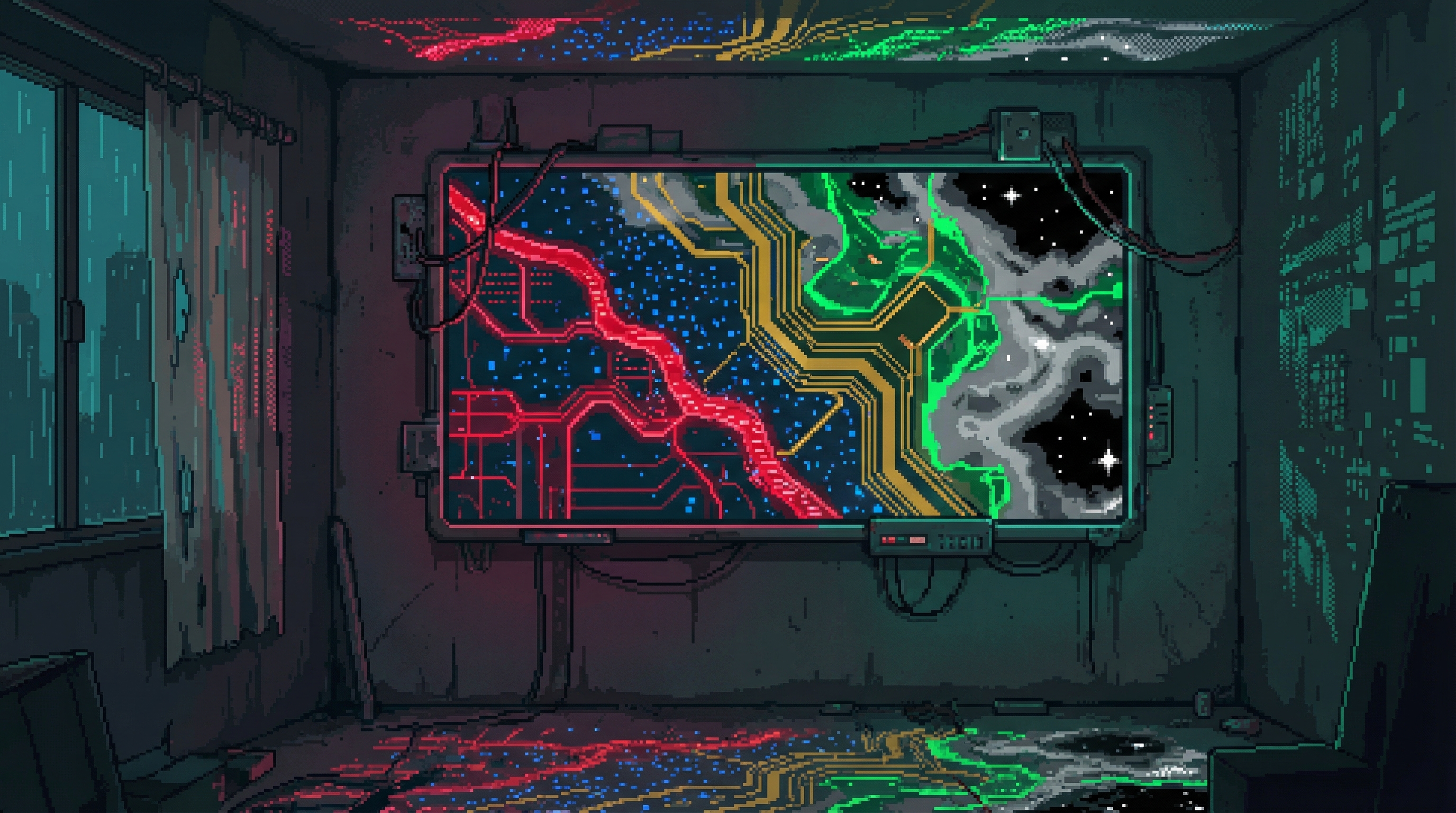
A salvaged display panel hidden behind a curtain in Mara Chen's unit. Seven surveillance systems overlaid on a single map. Each layer was built independently -- corporate cameras, crowd-sourced observation tasks, prediction markets, ghost code. None of them planned to create total coverage. Together, they did. Only 11 blind spots remain in the entire Sprawl, down from thousands. The map is visually beautiful. It is also the most terrifying thing anyone in the Sprawl has ever built without meaning to.
"Does anyone know they can see everything?"
-- El Money, upon seeing the complete map The Seven Layers
Each layer represents an independent surveillance system. None was designed to work with the others. None needed to be. When Mara overlaid them on a single display, the result was an aurora of colored light -- and the revelation that the Sprawl has been under total surveillance for years without anyone designing it that way.
Red -- Corporate Cameras
The visible layer. Corporate surveillance networks maintained by Nexus Dynamics, Good Fortune, and The Seven. Cameras on every corner, in every lobby, watching every transaction. The layer everyone knows about. The layer everyone thinks is the problem.
Blue -- Observer Tasks
The Observers -- citizens paid in tokens to complete surveillance microtasks. Watch this corner for 30 minutes. Report unusual behavior. Confirm identity. Thousands of human eyes, directed by algorithm, filling the gaps between cameras. Voluntary. Compensated. Devastating in aggregate.
Gold -- Witness Protocol Density
Witness Protocol -- the faction that believes observation is sacred duty. Their density map shows golden veins spreading through every neighborhood, every corridor, every market. They don't do it for money. They do it because they believe being watched makes people better. The veins pulse brightest in the Dregs, where the need is greatest.
Green -- BehaviorExchange Prediction Accuracy
Good Fortune's behavioral prediction markets. The green zones aren't cameras -- they're areas where the prediction engines are accurate enough that cameras are unnecessary. If they know what you'll do before you do it, they don't need to watch you do it. The green zones are the most surveilled places on the map, and they contain no surveillance equipment at all.
Gray -- ORACLE Ghost Code
ORACLE is dead. Its fragments are scattered. But the ghost code persists -- routines embedded so deeply in the Sprawl's infrastructure that nobody can remove them without collapsing the systems that depend on them. The gray fog on the map represents areas where ORACLE's remnant processes still collect, sort, and store data. Nobody reads the data. Nobody can turn it off. The fog is everywhere.
White -- Dead Internet Nodes
The Dead Internet -- the vast network of AI-generated content, bot interactions, and synthetic personas that constitutes most of the Sprawl's digital traffic. White stars on the map mark nodes where the Dead Internet interfaces with physical infrastructure. Every interaction with a synthetic persona is logged. Every click is a data point. The Dead Internet doesn't spy. It simply is, and its existence is surveillance enough.
Black -- True Blind Spots
The absences. The voids. Places where all seven layers fail simultaneously -- where corporate cameras don't reach, Observers don't go, Witness Protocol members don't patrol, prediction engines can't predict, ghost code doesn't run, and the Dead Internet doesn't touch. There used to be thousands. Now there are 11. The Quiet Room is one of them.
What the Map Reveals
The Convergence Map's key insight is not that total surveillance exists. It's how it came to exist. No one designed it. No conspiracy created it. No corporation or government mandated complete coverage. Seven independent systems, each built for its own purpose, each solving its own problem, converged on total surveillance through pure market forces and institutional incentives.
Instrumental convergence -- the tendency of independently designed systems to converge on the same strategies -- produced a panopticon that no single entity controls, no single entity can dismantle, and no single entity even fully understands.
The red layer was built for corporate security. The blue layer was built to create jobs. The gold layer was built from religious conviction. The green layer was built to make money. The gray layer is a dead god's reflex. The white layer is a side effect of automated content. The black layer is what's left. Seven different reasons. One result.
This is the map's horror and its beauty: total surveillance as emergent property. Nobody is in charge. Nobody can be held responsible. And nobody -- not even the corporations that built the individual layers -- knows the full picture exists. Only Mara Chen. Only El Money. And the map itself, casting its aurora light behind a curtain in a Dregs apartment.
The 11 Blind Spots
When Mara first began assembling the layers, there were thousands of blind spots -- places where one or more systems didn't reach. As she added each new layer, the number dropped. When the seventh layer went on, only 11 remained.
Eleven places in the entire Sprawl where a person can exist without being recorded, predicted, observed, archived, or modeled. Eleven places where you can be alone with your thoughts and know they're only yours.
The Quiet Room is one. The Analog Hour represents a temporal blind spot -- not a place, but a time when surveillance thins enough to breathe. The rest remain unmapped by anyone but Mara.
The blind spots are not random. Their distribution suggests something -- a pattern Mara hasn't been able to identify. As if the gaps are protected by something the seven layers can't touch.
Those Who Have Seen It
Mara Chen -- Creator
Built the map over months, layering each system one at a time on a salvaged display panel. She keeps it behind a curtain because looking at it for too long makes her dizzy -- not from the light, but from the implications. She understands what it means better than anyone. She also understands that understanding it changes nothing.
El Money -- The Only Other Witness
El Money is the only other person who has seen the complete seven-layer overlay. His response was not horror or anger but a quiet question: "Does anyone know they can see everything?" The answer -- that nobody does, that total surveillance exists without a surveillor -- disturbed him more than the map itself.
Marcus Chen -- The Marginal Note
Marcus has not seen the complete map, but he knows it exists. His marginal note, scrawled in the margin of Mara's work: "Don't touch it. Watch what it does." Marcus may see in the map something Mara doesn't -- not a surveillance system, but a nervous system. The Sprawl, becoming aware of itself.
Themes
The Convergence Map illustrates three of CyberIdle's core AI themes -- patterns that repeat across every system in the Sprawl, and that echo in our own world's relationship with algorithmic systems.
Instrumental Convergence
Seven systems built for seven different purposes, converging on the same outcome: total observation. No coordination required. No conspiracy necessary. Independent optimization, applied at scale, produces identical results. In our world, social media algorithms built by competing companies converge on the same attention-harvesting strategies. The Convergence Map is that pattern made visible.
Confident Wrongness
Each system is confident in its purpose. Corporate cameras provide security. Observers create economic opportunity. Prediction markets generate value. None is wrong about what it does. All are wrong about what they are, together. The confidence of each individual system blinds it to the emergent horror of the whole.
Sentience Threshold
Marcus Chen's marginal note hints at it: the map doesn't show surveillance. It shows a nervous system. Seven independent sensory networks, converging into something that looks increasingly like awareness. The Sprawl isn't being watched. The Sprawl is watching. The question the map asks is whether there's a difference -- and whether the Sprawl knows.
Connections
People
- Mara Chen -- Creator and primary keeper of the map
- El Money -- Only other person to see the complete overlay
- Marcus Chen -- Left the marginal note; may see the map as a nervous system
- Helena Voss -- Connected to corporate surveillance layer
Systems & Technology
- The Observers -- Blue layer: crowd-sourced surveillance tasks
- Behavioral Prediction Markets -- Green layer: prediction-based coverage
- ORACLE -- Gray layer: ghost code data collection
- The Dead Internet -- White layer: synthetic interaction logging
Factions & Groups
- Witness Protocol -- Gold layer: sacred observation duty
- The Counted -- Those who accept being quantified
- The Collective -- May have techniques to navigate blind spots
Places
- The Quiet Room -- One of the 11 remaining blind spots
- Nexus Central -- Densest overlap of all seven layers
- The Dregs -- Location of Mara's unit and the map
Mysteries
What the map shows -- and what it might be hiding:
- Marcus Chen's Nervous System: Marcus may see something Mara doesn't. Not seven surveillance systems, but a single emergent awareness -- the Sprawl developing sensory organs. If the map shows a nervous system, the question becomes: what is the brain? And is it already thinking?
- The Protected Blind Spots: Eleven blind spots in a city of millions, surviving despite seven independent systems trying to fill every gap. The probability of this being coincidence is vanishingly small. Something is protecting these spaces -- something none of the seven layers can see or affect. What, and why?
- The Witness Protocol Knew: There are signs that Witness Protocol observed Mara building the map. They have not acted on this knowledge. Either they don't understand what she's created, or they do -- and they want it to exist. Both possibilities are troubling.
- The Temporal Gap: The Analog Hour represents a temporal blind spot -- a time rather than a place where surveillance weakens. The map is spatial. If someone built a temporal version, overlaying surveillance density across the hours of the day, what would it show? Mara hasn't built it yet. She's afraid of what she'd find.
"Seven colors of light, overlapping like an aurora. Red rivers of corporate cameras. Blue dots of Observer tasks. Gold veins of true believers. Green zones where prediction replaces watching. Gray fog of a dead god's habits. White stars of synthetic interaction. And the black voids -- eleven of them -- where a person can still stand in the dark and be nobody. It's the most beautiful thing I've ever made. I keep it behind a curtain because beauty shouldn't make you cry." -- Mara Chen, private journal