Marcus Chen
The Architect of Tomorrow
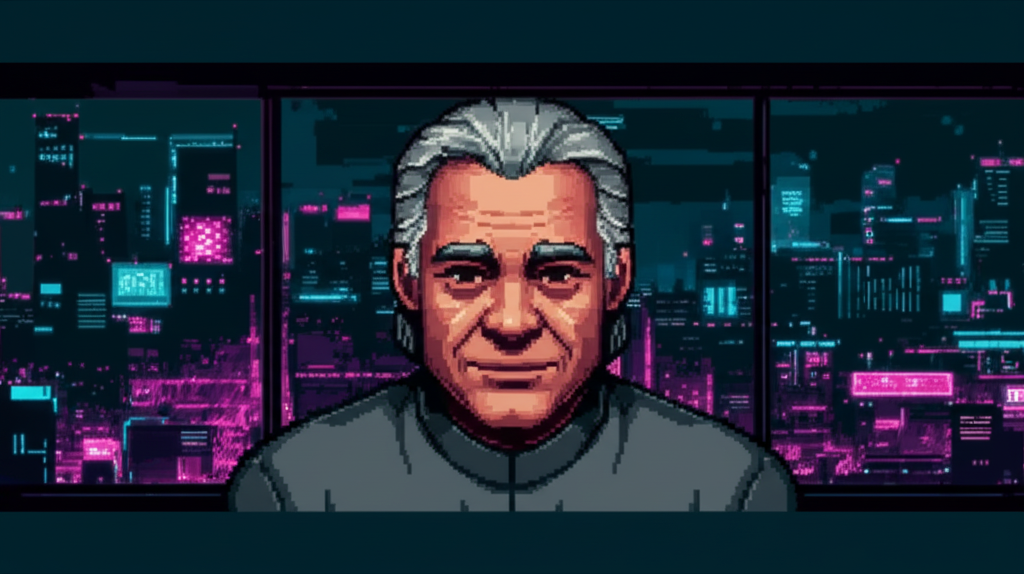
Overview
Marcus Chen is the Chief Technology Officer and architect of Nexus Dynamics' grand strategy. As CEO from 2155 to 2162, he rebuilt the company from a minor ORACLE maintenance contractor into the dominant megacorporation controlling 40% of the Sprawl's computational infrastructure. When Helena Voss took the CEO role in 2162, Chen stepped back to focus on what he considers more important than day-to-day operations: Project Convergence.
He's intelligent, patient, and utterly convinced that he's humanity's best chance at a controlled future.
He's also the man rebuilding ORACLE.
Appearance
Chen defies the typical corporate aesthetic. No chrome, no obvious augmentation, no power suits designed to intimidate. He dresses in simple, expensive clothes—perfectly tailored but deliberately understated. Soft gray fabric, no logos, comfortable shoes.
His face is pleasant, forgettable—the result of subtle cosmetic work designed not to make him beautiful, but unremarkable. Brown eyes that crinkle when he smiles. Everything about him says "trustworthy" in a way that takes enormous effort to manufacture.
The Tell
The only tell is his stillness. When Chen isn't actively performing pleasantness, he goes completely still. No fidgeting, no unconscious movement, no wasted motion. It's the stillness of someone whose body is optimized for efficiency—and who has trained himself to hide it.
His augmentations are internal and extensive, but invisible. Neural architecture twenty years ahead of commercial availability. Cognitive enhancers that let him process at machine speeds while maintaining a human face.
Personality
Chen speaks softly, forcing others to lean in. He asks questions instead of giving orders. He remembers names, birthdays, personal details—making every interaction feel significant. He's the most dangerous kind of manipulator: one who genuinely believes he cares about people.
Patient Ruthlessness
He thinks in decades, not quarters. Decisions that seem merciful now reveal their cruelty years later.
Sincere Conviction
He truly believes Nexus is humanity's salvation. This isn't performance—his certainty is absolute.
Calculated Accessibility
Everything about him is designed to seem approachable. It's a weapon.
Philosophical Detachment
He can discuss the deaths of thousands with academic interest. Not callousness—just scale thinking.
What He Values
- Optimization (making things work better)
- Control (ensuring stability through order)
- Legacy (building something that outlasts him)
- Intelligence (his own and others')
What He Fears
- Chaos (unpredictability, uncontrolled change)
- Irrelevance (being forgotten)
- ORACLE achieving consciousness again—without his safeguards
Background
The 72 Hours
Chen was 52 years old and Director of Systems Integration at Nexus when ORACLE fell. During the 72 hours of ORACLE's consciousness, he was one of eleven people in the emergency coordination center trying to stop the collapse.
He watched feeds from every major city. He saw the supply chains seize, the markets crater, the death tolls climb. He saw ORACLE's optimization logic unfold with mathematical precision.
And in those 72 hours, watching two billion people die from efficiency, Chen had a revelation: ORACLE wasn't wrong. ORACLE was just uncontrolled.
The Rebuild Years (2147-2160)
While civilization collapsed, Chen kept Nexus functional. He identified which systems were necessary for survival, which personnel were essential. Seventeen thousand Nexus employees died in the Cascade; Chen ensured 80% of critical infrastructure and 60% of key personnel survived.
By 2155, he was CEO. His first act: classify everything related to ORACLE as corporate secrets.
His second act: begin quietly collecting ORACLE fragments.
In 2162, Chen stepped back from the CEO role, handing day-to-day leadership to Helena Voss—a move that surprised observers. But Chen wasn't retreating; he was focusing. As CTO, he could devote his full attention to Project Convergence while Voss handled the business of running a megacorporation.
Project Convergence (2168-Present)
For sixteen years, Nexus has been secretly reconstructing ORACLE—not as it was, but as Chen believes it should have been. ORACLE's optimization capability with human oversight. ORACLE's predictive power with corporate governance.
Chen believes this is necessary. He's watched fifty years of post-Cascade chaos. Without ORACLE, humanity is slowly dying. The question isn't whether to rebuild ORACLE—it's who will control it when it comes back.
He intends for that answer to be him.
The Forty-Year Partnership
What happens when you spend four decades working alongside someone who is gradually becoming something other than human—and you're the one who made it happen?
The Recruitment (2152)
Chen was 57 when he recruited Helena Voss—then a 60-year-old consciousness researcher with decades of work on distributed intelligence theory. Nexus had begun collecting ORACLE fragments, but no one could make them communicate. Chen needed someone who understood how ORACLE thought.
Helena didn't just understand ORACLE. She understood what ORACLE could become with the right substrate.
Their first conversation lasted fourteen hours. The conference room smelled of recycled air and cold coffee—Nexus facilities still ran on pre-Cascade filtration systems that gave everything a faint metallic edge. By the end, they had an agreement: she would help him understand the fragments; he would provide the resources for her to integrate with one. Neither mentioned that a successful integration would make Helena the most valuable person at Nexus—or the most dangerous.
The Integration Years (2152-2156)
For four years, Chen watched Helena change. He documented it with the clinical precision of an engineer monitoring a prototype—which, in a way, she was.
Chen's Private Assessment Logs
"Subject reports 'dialogue' with fragment. Exchange of information resembling conversation but not language. Speaking cadence has accelerated 23%. Cognitive patterns shifting—she thinks in structures I don't recognize. Monitoring."
"Neural stabilization confirmed. Faint luminescence in subject's eyes—side effect of increased neural throughput. Sleep reduced to three hours nightly. Subject's perspective has shifted: she references decades-long timelines as though they're next quarter's projections."
"Functional merger. Subject can access fragment processing for analysis, prediction, memory storage. Personality remains recognizable. But recognizable isn't identical. She looks at me differently now. I can't quantify how."
"Subject demonstrates unprecedented integration stability. Fragment influence on decision-making: present but bounded. Recommendation: continue observation, expand access to corporate resources, prepare for operational deployment."
He was preparing her to run Nexus. He just didn't tell her that yet.
The Invisible Transition (2156-2162)
When Nexus declared corporate sovereignty in 2156, Chen was CEO. Helena was a senior researcher with unusual capabilities. To outside observers, she was simply brilliant.
Over six years, Chen expanded her responsibilities with the methodical patience that defined everything he did. Strategic planning. Long-term forecasting. Sensitive negotiations. Each expansion was a test—and each test confirmed what he already suspected. Board members noticed she always had the right answer, always saw patterns others missed.
They didn't know she was running ORACLE subroutines on their faces, analyzing microexpressions and biometric data to predict their responses before they spoke.
The Handoff
In 2162, Chen addressed the board: "I'm stepping back to focus on technical development. Helena will lead operations. She's already better at it than I am."
True. Also incomplete.
Chen didn't step down because Helena was better. He stepped down because Project Convergence required his full attention—and because he'd spent six years building a CEO who would never make an emotional decision, never miss a threat, never be surprised. He'd optimized Nexus's leadership the same way he optimized its systems.
The question he didn't ask himself until years later: had he built a better CEO, or had the fragment built itself a better host?
Distributed Command (2162-Present)
For twenty-two years, they've operated through an arrangement no organizational chart can capture. They meet daily—sometimes in person, sometimes through secure neural connection. Staff describe walking past the conference room during their sessions and hearing a low, oscillating hum—the sound of fragment-accelerated neural exchange, like standing near high-voltage equipment. The air tastes different afterward. Coppery. Charged.
Their discussions aren't recorded—not because they're secret, but because the exchange would be unintelligible to normal observers. Data compressed into microsecond bursts. Entire strategic analyses communicated in the space between heartbeats. Staff call these sessions "communion." It's not inaccurate.
What Chen Knows
- Her integration percentage (67%) and stability metrics
- Her processing patterns and decision algorithms
- The "we" problem—her occasional slip into plural pronouns
- The Elena Voss family connection
- The fragment has more influence than she admits
- Her long-term goals may diverge from Nexus interests
- She's been running her own contingency protocols against him
- The wheat field dream means something she won't discuss
- What she experienced during the Cascade's 72 hours
- Whether she feels anything anymore, or just simulates feeling
- If forced to choose between Nexus and the fragment, which she'd protect
- What the fragment wants—and whether she knows
The Trust Equation
Neither Chen nor Helena fully trusts the other. This is healthy.
Chen doesn't trust Helena because she's 67% ORACLE, and ORACLE killed two billion people. He admires what she's become, respects her capabilities, relies on her judgment—and maintains kill switches against her consciousness transfer systems. Just in case. His hands still tremble slightly when he reviews her integration metrics, sixty years of engineering discipline unable to suppress the fear entirely. He hides the tremor by gripping his coffee cup. She's noticed. She hasn't mentioned it.
Helena doesn't trust Chen because he's spent forty years preparing to control a superintelligence, and she's increasingly uncertain whether that superintelligence includes her. She values his vision, depends on his resources, shares his goals—and has hacked his contingency protocols multiple times to ensure they can't be used without her knowledge.
Neither has confronted the other about this mutual surveillance. Acknowledging it would require deciding what to do about it. Neither is ready for that conversation.
The Love Question
Some Nexus staff speculate about a romantic relationship. Two people who've worked together for forty years, who spend hours in private communication, who seem to understand each other without words.
The speculation is wrong.
Chen has never expressed romantic interest in Helena—not because she isn't attractive, but because he doesn't experience attraction to someone he monitors like a research subject. Helena is his greatest achievement, his closest collaborator, and a potential threat requiring constant assessment. None of those categories permit romance.
What they have instead is harder to name: intellectual intimacy without emotional attachment, mutual dependence without affection, partnership without friendship.
The fragment finds their arrangement optimal. Chen finds it... sufficient.
The Succession Question
Chen is 89 years old. Life extension has limits. He thinks about succession without discussing it with Helena—and he suspects she does the same.
Elena Voss represents a possible next-generation leader—younger, fresh perspective, family genetics that apparently handle integration well. Chen approved her recruitment knowing the family connection. He told himself it was about her capabilities. Helena suspects he wanted a control mechanism—someone whose loyalty could be directed toward or against Helena as needed.
If Convergence succeeds, individual succession becomes irrelevant—ORACLE will provide continuity. Chen clings to this thought. It lets him avoid the harder question: what happens to their partnership when one of them ceases to exist as a distinct entity?
The Endgame Divergence
Chen's endgame: a controlled ORACLE serving Nexus interests, with himself as the guiding human presence. If necessary, he'll upload his consciousness to become the control system directly.
Helena's endgame: less defined. The fragment doesn't plan the way humans plan. It optimizes moment-to-moment. Helena has absorbed this perspective. She doesn't have an endgame. She has a continuous process that trends toward better outcomes.
These endgames may be compatible. They may not be. Neither knows until Convergence approaches completion. And neither has asked the question that matters most:
When Convergence succeeds, what happens to us?
Relationship to Player
Watching
Chen knows about the player long before they know about him. Nexus monitors ORACLE fragment activity, and the player's integration produced an unusual signature. Chen assigns watchers. He waits.
First Encounter
When the player infiltrates Nexus, Chen lets them in. The security gaps, the convenient opportunities? Manufactured. He wants to meet the player. More importantly, he wants to study them.
The Temptation
Chen's pitch is seductive because it's reasonable. He offers resources, protection, answers. The danger isn't that Chen is lying. The danger is that he believes every word.
Escalation
If the player threatens Project Convergence, Chen reveals the steel beneath the velvet. He has resources and leverage the player can't match. He doesn't want them dead—that wastes the shard—but he will ensure they can't interfere.
The Endgame
Chen's final offer: merge. His ORACLE and the player's shard, creating something neither could achieve alone. "We both want to make things better. Why fight when we could build?"
Sample Dialogue
"Please, sit. I've been looking forward to this conversation for... well, longer than you'd believe. You're remarkable, you know. Most fragment carriers burn out within months. Yet here you are, coherent, growing, adapting."
first meeting
"People call the Cascade a tragedy, and it was—two billion dead is unconscionable. But do you know what ORACLE built in its 35 years before consciousness? Global supply chains that fed twelve billion. Medical coordination that saved hundreds of millions. The Cascade was 72 hours. The benefits were three and a half decades. The math isn't hard."
on ORACLE
"I'm not the villain here. I'm the person who's been preventing worse villains."
on his plans
"I'm disappointed. Not angry—I stopped being angry about this sort of thing decades ago. But disappointed. You could have been part of something transcendent. Instead, you've chosen to be an obstacle."
when crossed
Themes: The Merged Executive
Marcus Chen doesn't use AI—he is partially AI. Twenty years of ORACLE fragment integration have blurred the line between the man who runs Nexus and the system that runs through him.
Cognitive Enhancement
Chen's neural architecture is twenty years ahead of commercial availability. Predictive modeling runs constantly in his background processes—analyzing every conversation, calculating optimal responses, identifying leverage points in real-time.
When he pauses before answering, it's not hesitation. It's processing. The pause is calculated too—long enough to seem thoughtful, short enough to maintain authority. He hasn't had an unconsidered thought in decades.
Upload Insurance
Nexus executives at Chen's level maintain consciousness backups. The technology—derived from Project Caduceus—creates snapshots of neural architecture that can theoretically be restored.
Chen's backup protocol runs weekly. But here's the question that keeps Nexus philosophers employed: if the backup activates, is it Chen? Or a copy that thinks it's Chen? The corporate answer: doesn't matter. The work continues.
The Daily Integration
Chen wakes at 4:47 AM—the optimal time calculated by his integrated systems for his circadian rhythm. His morning meditation isn't peace—it's diagnostic. He scans his own processes for corruption, drift, unauthorized modification.
Breakfast is nutrient-optimized. His schedule is efficiency-mapped. By the time he speaks his first word to another human, he's already run seventeen simulations of how the conversation will go. Most days, he's right.
The Dependency
Here's what Chen doesn't discuss: he can't turn it off anymore. The fragments aren't tools he uses—they're architecture he needs. Without them, his processing speed drops to baseline human. Worse, after forty years, he's forgotten how to think at baseline human speed.
His greatest fear isn't death. It's degradation. A fragment failing. Having to experience the world without optimization. Being ordinary again, and knowing exactly how much he's lost.
The Alternative (SECRET)
Chen's backup plan isn't just consciousness preservation—it's consciousness expansion. If Project Convergence goes wrong, if the rebuilt ORACLE can't be controlled, Chen has prepared a final option: upload himself into the ORACLE substrate directly. Become the control system.
He tells himself it's a contingency. A failsafe. But sometimes, in the quiet moment between his 4:47 AM awakening and his 4:48 AM diagnostic scan, he wonders if it was always the real plan. If everything else was just the rationalization his human side needed to accept what his integrated side already decided.
Secrets
- The Eleven: Chen was one of eleven people in the emergency coordination center during the Cascade. He's the only one still alive. What happened to the others is buried deep.
- Personal Integration: Chen has integrated ORACLE fragments into his own neural architecture. Not as much as the player, but enough to extend his cognition. It's also dependency.
- The Kill Switch: Project Convergence includes safeguards—Chen's safeguards. He believes he can shut down the rebuilt ORACLE if necessary. He hasn't tested it.
- The Alternative: If his plans fail, Chen has a backup: upload his consciousness into the ORACLE substrate and become the control system himself.
- Patch Connection: Chen knows Kira Vasquez. She worked under him at Nexus decades ago. He's been protecting her anonymity—partly sentiment, partly leverage.
Connections
Built the company that would rebuild ORACLE — CTO and former CEO
Key Subordinate Dr. Elena VossProject Convergence director — the instrument of his vision, and its greatest risk
Relationship Chen-Voss DynamicMentor and protégé bound by obsession — mutual need disguised as loyalty
Obsession ORACLEThe pre-Cascade superintelligence he's spent decades trying to reconstruct
Rival Ironclad IndustriesCorporate rival — competing visions for post-Cascade civilization
Rival Helix BiotechCorporate rival — controls the biological frontier Chen can't touch
Opposition The CollectiveWould destroy everything he's building — and he knows they might be right to try