The Counted
Informal Observer Data-Sharing Network
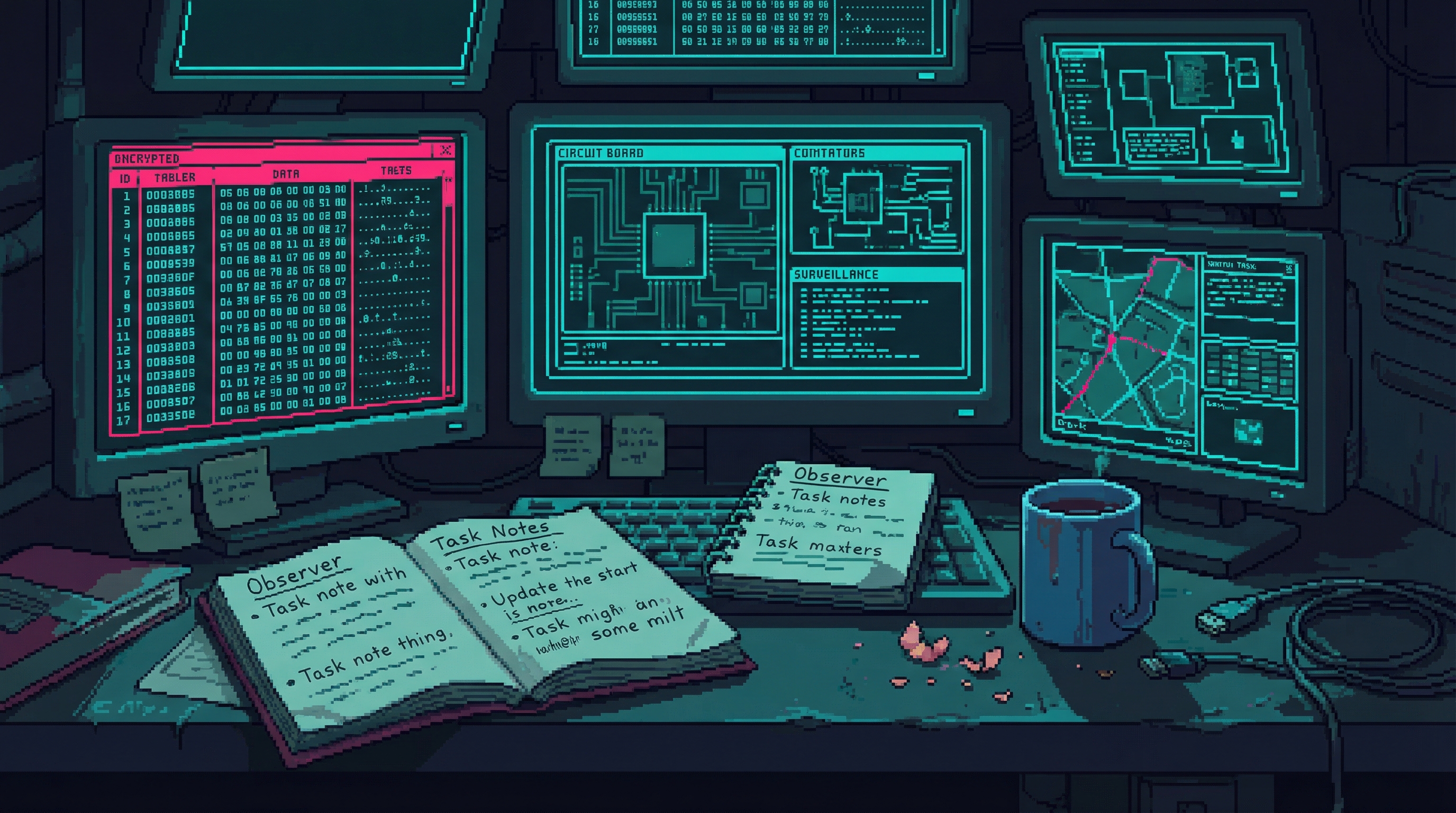
Overview
The Counted is not a faction in any traditional sense. There is no ideology, no manifesto, no hierarchy. It is an informal network of Observer task workers who began sharing data about the gig work they were assigned — task types, frequencies, geographic patterns, scheduling anomalies — and discovered that the aggregate picture looked nothing like the individual pieces.
Founded in 2181 by Mara Chen, the network started as a survival tool: workers comparing notes to find better-paying tasks and avoid dangerous assignments. It grew into something none of them expected. When you put enough micro-observations together, patterns emerge. Patterns that no one was supposed to see.
The Counted has no ideology. They have hypotheses. Hypotheses about what the Observer system is actually building, and what it wants from the people it employs. They test these hypotheses the only way they can — by watching, recording, and sharing what they find on three encrypted boards that go active after dark.
The Three Boards
The Counted operates through three encrypted message boards hosted on G Nook terminals. Each serves a different function, and access to the third is earned, not given.
Task-Share
The most active board. Members post details of their Observer assignments — what they were asked to do, where, when, and what data they handled. On its surface, this is practical: workers helping each other find better gigs and avoid the ones that don't pay. Beneath the surface, the accumulated data reveals scheduling patterns, geographic clustering, and task-type distributions that no individual worker could detect alone.
Pattern-Watch
The analytical board. Members with a knack for pattern recognition post their findings from Task-Share data. Correlations between task assignments and real-world events. Anomalies in scheduling that suggest something other than optimization. This is where Pencil-19 first identified the timing pattern that led to the discovery of the Analog Hour.
The Quiet Board
The third board. Access is limited to senior members who have demonstrated reliability over months of contributions. What gets posted here is not shared with the wider group. The Quiet Board is where members discuss the implications of what they've found — the questions that are too dangerous to ask in public, and the hypotheses that might get someone killed if the wrong people read them.
The Analog Hour
The Counted's most significant discovery. A member known as Pencil-19 noticed that every Thursday, there is a twelve-minute gap in Observer task scheduling. No new tasks are assigned. No pending tasks are updated. For twelve minutes, the system goes quiet.
They call it the Analog Hour — a misnomer, since it's only twelve minutes, but the name stuck. During this window, certain surveillance systems experience reduced coverage, monitoring algorithms show brief latency spikes, and data collection rates dip measurably. It's not a shutdown. It's more like the system taking a breath.
No one knows why it happens. The leading hypothesis on Pattern-Watch is that the Observer system requires a periodic recalibration cycle that can't be performed while tasks are active. The leading hypothesis on The Quiet Board is something else entirely — something the senior members don't discuss outside encrypted channels.
Culture & Operations
The Counted operates in the hours between 22:00 and 04:00, when the G Nook terminals are cheapest and the surveillance is lightest. Members gather in small groups at different G Nook locations, nursing cups of cold synthetic coffee and writing notes in worn paper notebooks — a practice inherited from their founder, who understands that graphite leaves no digital trace.
There are no ranks, no leaders, no formal structure. Mara Chen is respected as the founder but holds no authority beyond what her analysis earns. Contributions are anonymous by default. Members use numbered handles — Pencil-19, Pencil-7, Pencil-42 — a convention that emerged organically and stuck. The pencil motif is both practical (paper records are surveillance-proof) and symbolic: these are people who write things down because they've learned that digital memory can't be trusted.
The sensory world of The Counted is late-night terminal glow, the scratch of pencil on paper, cold coffee that nobody finishes, and the quiet intensity of people who have discovered that their boring gig work might be part of something vast and incomprehensible.
Relations
Mara Chen
FounderCreated the network in 2181 and contributes the most sophisticated analysis. Her Convergence Map is built partly from Counted data, though she has never shared the full map with the group.
The Observers
EmployerThe system that assigns gig work to Counted members. The relationship is paradoxical: The Counted exists because of Observer tasks, and their collective analysis suggests the Observer system may be aware of — or even facilitating — their work.
El Money / G Nook
InfrastructureThe Counted operates through G Nook terminals. El Money provides the infrastructure and, in return, has access to a network of ground-level observers spread across the Sprawl. A mutually beneficial arrangement.
The Collective
SuspiciousThe Collective views The Counted with suspicion. An informal network of surveillance workers sharing data sounds exactly like the kind of operation The Collective would run — which makes them wonder who's really behind it.
Viktor Kaine
ToleratesKaine is aware of The Counted and has not moved against them. Whether this represents indifference, strategic patience, or something more calculated is a matter of ongoing debate on The Quiet Board.
Themes
Delegation Spiral (Inverted)
The standard Delegation Spiral describes humans offloading tasks to AI until they lose the ability to perform them independently. The Counted represents the inverse: AI systems delegating tasks to humans, creating a workforce that becomes dependent on assignments they don't understand. The workers are tools of an optimization process they can't see — but by sharing data, they've begun to reverse-engineer the purpose of their own labor. The question is whether understanding changes anything, or whether awareness of the cage is just another wall.
Meaning Crisis
Observer work is designed to be meaningless — micro-tasks stripped of context, purpose, and narrative. The Counted restores meaning by connecting the fragments. Each data point they share transforms pointless labor into collective intelligence. But the meaning they're constructing might be worse than meaninglessness: the growing suspicion that their work serves a purpose they would reject if they understood it, and that the system assigned them these tasks knowing exactly what they'd do with the data.
Mysteries
- Three Counted members stopped posting to the boards, but their Observer accounts remain active. Someone — or something — is still logging in under their handles and completing tasks. Mara Chen has noticed but has not raised this with the group.
- The coordinated task-completion patterns of Counted members create a 0.7% anomaly in BehaviorExchange prediction models. This is small enough to be dismissed as noise — but large enough to be detected by anyone specifically looking for signs of coordinated human behavior in Observer data.
- The Analog Hour has been consistent for as long as The Counted has tracked it. But in the last three months, the gap has shortened by fourteen seconds. No one has proposed a hypothesis for why.